Benjamin Netanyahu
Netanyahu’s Future Hangs In The Balance In A Decisive Election For The Entire Middle East

“The most important in the country.” “Crucial for the future of the Middle East.” “A historic crossroads.” Israel is holding elections this Tuesday — the first since the Hamas-led attacks of October 2023 — which have been described in many ways because they are decisive. Prime Minister Benjamin Netanyahu is staking his future — both political and personal — on the vote, after, against all odds, completing a four-year term leading the most right-wing coalition in the country’s history.
Since 2022 a lot has happened in Israel: protests against the judicial reform proposed by Netanyahu, the brutal devastation of Gaza, runaway settlement of the West Bank, clashes with Lebanon and Syria and, above all, tensions with Iran… All of which will weigh from the moment the polls open at 7.00 a.m. local time until they close at 10.00 p.m. The last permitted polls, published Friday, indicate that Yashar, the center-right party of former Israel Defense Forces (IDF) chief of staff Gadi Eisenkot, will receive the most votes and that the Jewish opposition bloc it belongs to will have a slight lead over Netanyahu’s coalition. But even so it will need the sidelined Arab parties, which represent Palestinians with Israeli citizenship, to build a majority.
The mood in Israel is that the public wants an end to the Netanyahu era and that, although the prime minister is a political animal not to be underestimated, this time the numbers will probably not add up in his favor.
Polls estimate that his party, Likud, will win about 21 seats, compared with the 32 it won four years ago. Adding the support of religious and ultra-nationalist parties, it could reach about 50 of the Knesset’s 120 seats, still far short of the 61 needed for a majority.
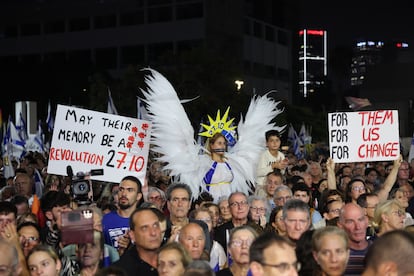
His refusal to create an independent commission to investigate what happened on October 7, 2023, and the security failures committed, his clear interest in evading justice — which seeks to put him on trial for corruption — and the limited results in the many conflicts the country is involved in, such as Gaza or Iran, all risk costing him at the ballot box. “We need change now,” protestors chanted in the streets of Tel Aviv last Saturday, where several thousand people gathered to call for the end of the Netanyahu era.
Yossi Mekelberg, professor of international relations at Regent’s University London and an associate analyst for the Middle East and North Africa program at the British think-tank Chatham House, urges “not to underestimate how important these elections are.” Mekelberg says the last elections of similar significance, “although not to this level,” were those in 1992, won by Labour’s Yitzhak Rabin, which led to the signing of the Oslo Accords. He adds that on October 27 the stakes include whether Israel “ends up becoming a pariah state” in the eyes of the world.


Lengthy negotiations
The prime minister heads to the polls facing criticism from much of the world and an arrest warrant from the International Criminal Court for alleged war crimes, but with the backing of Donald Trump. “When you go to the Polls please remember that Bibi [Netanyahu] has been an outstanding Warrior Prime Minister!” the U.S. president said on Sunday, before suggesting that together they would launch another war against Iran: “We have to finish the job that we started!”
Netanyahu faces a heterogeneous bloc of Jewish opposition parties that represent half the country and range from traditional right to socialist left. Aware of the moment’s importance, they have put aside their differences to try to defeat the prime minister. Together they could add up to about 56 seats.
The two Arab lists (which represent Palestinians with Israeli citizenship, one-fifth of the national population) are expected to be the kingmakers the opposition will need if the arithmetic does not go their way, after the opposition largely refused during the campaign to make deals with them. Together they could win 15 seats, thanks to unprecedented mobilization by their voters, who feel discriminated against and treated as second-class citizens in Israel, especially since the 2023 attacks.
In Israel’s electoral system — which consists of a single constituency where voters almost always back their own parties — a handful of votes can change the landscape, due to the 3.25% electoral threshold. This is the percentage of votes a party needs to win seats. If a party falls short of this threshold, it is excluded from the Knesset and all its ballots are discarded. If it exceeds it, it enters parliament directly with four representatives. In 2022, for example, the pacifist Meretz party fell about 4,000 votes short of reaching this threshold. Had it succeeded, it would have shifted the balance of power in the Knesset.
It is very likely that Israel will not have a new government or a new prime minister by Tuesday night and that arduous negotiations and calculations will be needed to form a majority. “And even if Eisenkot manages to do it in the coming weeks and ends the Netanyahu era, there is a deeper question. Will Israeli policies change?” asks Yehuda Shaul, co-founder of the think-tank Ofek (horizon in Hebrew). “For that we will need commitment and international pressure more than ever, so the balance and decisions tilt to the right side.”
The Palestinian issue has been largely absent from Israel’s election campaign and no candidate has, for example, presented a plan for Gaza’s future. The Strip has been devastated by three years of bombardment that has left some 75,000 Palestinians dead, according to UN figures.
Stoking fears
Iran, however, has been present up to the 11th hour. On the eve of the elections, Channel 12 reported an “unprecedented” and very tense confrontation between the prime minister and the IDF chief of staff, Eyal Zamir, that took place Sunday at an air base. The reason: a military operation approved by the government that could have triggered a war with Iran.

Zamir interpreted that Netanyahu was guided more by the political gain a new war would bring him before the elections than by a real threat and demanded a legal authorization signed by government representatives to proceed, according to Channel 12. With Netanyahu issuing daily threats, the danger was that a Tehran on high alert would interpret the action as an offensive move. One of the right-wing opposition candidates — his former defense and foreign minister, Avigdor Lieberman, who is not exactly a moderate — filed a lawsuit against Netanyahu on Monday for treason and accused him of having “lost his way.”
Dozens of combat aircraft from the Israeli Air Force crossed Syrian and Iraqi airspace on October 19 to reach the border with Iran, Israeli and U.S. sources told Axios. Israel presented it as a deterrence exercise, but U.S. sources had the impression they were waiting for the Iranians to open fire, thereby creating a justification for an offensive.
The other last-minute controversy in the campaign was an image created with artificial intelligence simulating a nuclear bomb falling on Tel Aviv. Netanyahu posted it on his social media, citing a far-right activist who warned of the risk of a “second Holocaust.” The message to voters was clear: this is what Iran will do if you don’t re-elect me this Tuesday.
Eisenkot replied: “Netanyahu, you’re hysterical. As in every election campaign, he resorts to the same method of lies and intimidation tactics. This time, threatening Israeli citizens with mass destruction.”
Indeed, the prime minister tends to press the button of lies and Israeli fears at the last minute, but his latest moves mostly make him appear nervous because the race looks so tight. Even more so when — as the opposition recalled after the image circulated — just a year ago (after the first Israeli strike on Iran) Netanyahu boasted of damage to Tehran’s nuclear program that would last “generations.” In September, during a speech to a half-empty UN General Assembly, he claimed to have “destroyed” Iran’s nuclear weapons capability. Six months earlier he had said Tehran was no longer a “threat to Israel’s existence.”
Sign up for our weekly newsletter to get more English-language news coverage from EL PAÍS USA Edition