Connect with us

%

New Costa Del Sol Homes Are Selling Before Builders Even Break Ground

Published

on

new-costa-del-sol-homes-are-selling-before-builders-even-break-ground

Reserved before the first brick. Credit: Pavel Lysenko / Shutterstock

Buyers searching in Marbella, Estepona, Mijas Costa and Fuengirola are finding some developments already 30 to 50 per cent reserved before construction starts. British purchasers remain among the strongest overseas buyers, while limited land and slow new supply are forcing decisions long before anyone receives the keys.

Buyers are committing to Costa del Sol homes still only on paper

It is becoming increasingly more common for Costa del Sol buyers to make decisions based on floor plans, computer-generated images and views across an empty plot. The finished home could remain months or years away, yet a deposit may be needed to secure the right floor, orientation or terrace.

Savills says some well-positioned new developments are selling between 30 and 50 per cent of their homes before construction has even started, and many more have a significant share reserved well before completion. The figures apply specifically to newly built apartments and houses. They do not describe the entire Costa del Sol property market, which also includes a much larger stock of existing and resale homes.

Why demand remains strong despite rising prices

José Félix Pérez-Peña, executive director of Savills Andalucía, said demand remains considerably higher than the number of new homes available, particularly in the upper-middle and prime segments. He said the Costa del Sol was no longer solely a holiday destination, but had developed into one of southern Europe’s main international residential markets.

Savills attributes that change partly to permanent residents, remote workers and international buyers seeking “quality of life, connectivity and a dynamic economic environment”.

That demand has continued despite a steep rise in new-build prices. The average newly built apartment on the Costa del Sol reached €5,725 per square metre in 2025, an annual increase of 23 per cent. The average total price passed €1 million for the first time, while newly built detached properties averaged €2.97 million. These are averages for the new-build market and are heavily influenced by the growing number of luxury and prime developments.

Marbella, Estepona, Mijas Costa and Fuengirola are leading the market

The strongest activity is concentrated in four of the coast’s best-known property destinations.

Estepona accounts for 28 per cent of the Costa del Sol’s initial new-build supply, according to Savills. Mijas Costa represents 18 per cent and Fuengirola 16 per cent. Meanwhile, Marbella remains the market’s principal driver of value. Newly built luxury apartments there average close to €2.5 million and more than €8,000 per square metre, around 41 per cent above the wider Costa del Sol average.

International buyers now account for more than half of new-build demand in Marbella, Mijas Costa and Fuengirola. Savills lists British, Dutch, Swedish and German purchasers among the most active, particularly in the upper-middle and prime markets.

Britons also remained the largest single nationality among foreign homebuyers across Spain during 2025, accounting for nearly 8 per cent of purchases made by overseas nationals, according to the College of Property Registrars. Those national figures cover both new and previously owned homes.

Why builders are struggling to match buyer demand

Savills recorded approximately 12,265 new-build homes sold on the Costa del Sol during 2025, compared with an available stock of just 5,328 units. The consultancy says the imbalance is structural rather than temporary. A shortage of land ready for development, lengthy administrative procedures and rising construction costs are limiting how quickly builders can add homes in the areas facing the strongest demand.

In some locations, the problem is not that no construction is taking place. It’s that the number of new homes reaching the market remains relatively low compared with the number of buyers looking for them. That allows successful developments to enter the sales process early, sometimes before excavation or building work has begun. 

How reserving early can leave buyers exposed for longer

Buying from plans gives purchasers access to homes that may never even reach the completed-property market. It can also mean committing substantial sums without being able to inspect the finished apartment, building or communal areas. Payments are commonly made at several stages, beginning with a reservation and followed by further instalments during construction. British buyers paying from sterling income may also face exchange-rate changes between the reservation date and completion.

The pressure to secure a property quickly should not replace checks on the developer, plot, planning position, building licence, completion date and contractual specifications. Andalucía’s consumer service says anyone selling a home that is planned or under construction must provide prospective buyers with an abbreviated information document, known in Spanish as the Documento Informativo Abreviado.

Advance payments made after the building licence is obtained must be protected by a bank guarantee or surety insurance. The Banco de España says that protection should cover all money paid in advance, including taxes and legal interest. An independent lawyer can also check ownership of the land, any registered debts or restrictions, payment guarantees and what the contract allows if construction is delayed.

Limited supply could keep the pressure on early buyers

Savills expects new-build prices to record accumulated growth of between 13 and 16 per cent during 2026 and 2027. Its forecast does not guarantee that every development or municipality will rise at the same rate. However, the consultancy expects limited land, planning delays and construction costs to continue restricting new supply in the coast’s most sought-after locations.

%

Start Of Improvements On Costa Del Sol Commuter Train Line

Published

on

start-of-improvements-on-costa-del-sol-commuter-train-line

Plaza Mayor train station. Credit: Renfe

Renfe has set aside €1,200,000 to work on improving five stations on the C1 Cercanías line from Malaga, including Plaza Mayor, Victoria Kent, Malaga Centro Alameda, Torreblanca and Montemar Alto. The projects are planned to deliver stations with better comfort, accessibility, safety and functionality for the over 28,500 daily passengers who use the 104 services on the line.

Upgrades progress at five Costa del Sol stations

Works already started at Plaza Mayor on July 6. Victoria Kent station activity is planned to begin in mid-July; Malaga Centro Alameda improvements follow later in July. Torreblanca and Montemar Alto will see works start progressively through the month. All sites stay operational during construction.

Focus on accessibility at Victoria Kent and Alameda stations

Victoria Kent is to receive attention to accessibility, lighting and safety in the concourse and on the platforms. There will be long-awaited works to replace damaged lights and glass, add better grip on paths, renew handrails with double grips and fit anti-slip strips on steps. Malaga Centro Alameda sees renewal of finishes; LED lighting, signage improvements, damp control and anti-slip stair features are also included in the plans.

Additional C1 route improvements underway or planned

Plans will eventually extend to other stations on the C1 route. Five halts are adapted for 100-metre trains, including Los Boliches, Carvajal, El Pinillo, Plaza Mayor and Centro Alameda. Benalmadena station platforms extend to 200 metres. Duplication of the track between the airport and Campamento Benitez is hoped to be better reliability. Other studies cover duplications in Torremolinos to El Pinillo and Benalmadena to Campo de Golf sections.

Capacity increase targets 60 per cent and 15-minute intervals

Ministry of Transport plans seek to raise C1 capacity by 60 per cent and cut train intervals from 20 to 15 minutes. Signalling and control system renewals are going ahead, and it is hoped that more than 14 million users will benefit from Malaga Cercanias improvements.

Alora double track restoration to increase capacity

Double track working returns in the Alora area from July 17 after repairs to February storm damage. One track reopened in April. Remaining tasks are to complete electrification, safety and drainage elements.

Continue Reading

%

Five Villages Evacuated As Fresh Wildfires Push Aragón To Breaking Point

Published

on

five-villages-evacuated-as-fresh-wildfires-push-aragon-to-breaking-point

Evacuation orders were issued for Orés, Asín, Luesia, Malpica de Arba. Photo credit: Antonio Galvez Lopez/Shutterstock

Hundreds of people have fled their homes, thousands of hectares have gone up in smoke and firefighters are now battling three major blazes as Spain’s relentless wildfire season shows no sign of easing. For the families forced to leave everything behind, it began with the smell of smoke. Within hours, roads were closing, emergency alerts were sounding on mobile phones and entire villages were being evacuated as flames raced across the countryside in Aragón.

What started as a wildfire near the Zaragoza municipality of Orés has rapidly become one of Spain’s most serious fire emergencies of the summer. More than 4,500 hectares have already been destroyed, five villages have been evacuated and the fire has reached the urban area of Asín, damaging homes and forcing residents to flee.  And just as emergency crews poured every available resource into containing the inferno, two more wildfires broke out in the Aragonese Pyrenees, stretching firefighters across multiple fronts during one of the most dangerous periods of the year. 

A race against the flames

Wildfires are nothing new in Spain, but the speed at which this emergency has unfolded has shocked even experienced firefighters. The Orés blaze spread rapidly through the Cinco Villas region, driven by soaring temperatures, strong winds and exceptionally dry conditions. Authorities activated Level 2 of Aragón’s Civil Protection Plan, calling in the Military Emergency Unit (UME) along with reinforcement crews from neighbouring regions as the scale of the fire became clear. 

For residents, there was little time to think, evacuation orders were issued for Orés, Asín, Luesia, Malpica de Arba and nearby residential facilities, including care homes, as emergency services focused on getting people to safety before the fire advanced further. While firefighters battled walls of flame, families watched from a distance, uncertain whether they would have homes to return to.

Three fires, one enormous challenge

As if the situation in Zaragoza province were not difficult enough, two new wildfires broke out in the Pyrenees, including fires in the Peña Montañesa and Castanesa areas of Huesca province. Although those fires are separate incidents, together they have placed enormous pressure on Aragón’s emergency services, forcing crews to divide personnel, aircraft and equipment across three active fronts. 

Hundreds of firefighters, supported by helicopters, fixed-wing aircraft, drones and specialist military units, are working around the clock in an effort to stop the flames spreading further. But with high temperatures, low humidity and shifting winds continuing to fuel the fires, officials have warned that bringing the situation under control could take days rather than hours. 

Spain’s wildfire season is becoming increasingly unforgiving

The images emerging from Aragón are becoming an all-too-familiar sight across Spain, columns of thick smoke rising above forests. Fire crews working through the night. Villages emptied in a matter of hours as residents leave with little more than the essentials they can carry.

Each summer seems to bring another devastating wildfire, but this year’s season has been particularly relentless, with fires breaking out in several parts of the country during prolonged periods of extreme heat, for many communities, the fear is no longer simply that a wildfire might start, it is whether there will be enough time to escape if it does.

Firefighters face an impossible task

Spain has some of Europe’s most experienced wildfire crews, backed by sophisticated aircraft and highly trained emergency teams. Yet even they acknowledge there are limits when fires are driven by extreme weather. Once flames gain momentum in dry vegetation, every change in the wind can alter the direction of the fire within minutes, creating dangerous and unpredictable conditions for firefighters and residents alike. 

Protecting lives becomes the priority, homes, farmland and woodland can often only be defended where conditions allow. That is why evacuation orders are sometimes issued long before flames reach a village.

A summer that is far from over

For now, all eyes remain on Aragón, firefighters continue to work tirelessly to contain the Orés wildfire while monitoring the two new blazes in the Pyrenees, hoping that changing weather conditions will finally offer some relief.  But beyond Aragón, the latest emergency is another stark reminder that Spain’s wildfire season is far from over.

Every day of extreme heat, every gust of dry wind and every new ignition has the potential to become the next major emergency. For the hundreds of residents forced to abandon their homes this week, that reality has already arrived. And as another difficult summer unfolds, many more communities across Spain will be hoping they are not next.

Continue Reading

%

Morrisons Gibraltar Warns Of Supply Gaps

Published

on

morrisons-gibraltar-warns-of-supply-gaps

Morrisons in Gibraltar. Credit: MGC FB

Morrisons staff in Gibraltar have alerted their regular shoppers to possible short-term gaps in certain British products after the new treaty with the European Union came into force. The supermarket chain has explained that fresh customs and sanitary rules now affect how goods arrive from the United Kingdom.

Director Eva Wallace explains supply chain friction

Store director Eva Wallace signed a statement on the company’s social channels that outlines the practical effects of the deal and how there may be a shortage in stock of items previously loved by residents in Spain who crossed the border specifically to snap up their favourites.

She says that around 20,000 product lines have undergone full checks recently to confirm they meet European Union standards on labelling and documentation. Despite this preparation, the chain accepts that the treaty does actually create unavoidable extra steps in the supply route from Britain.
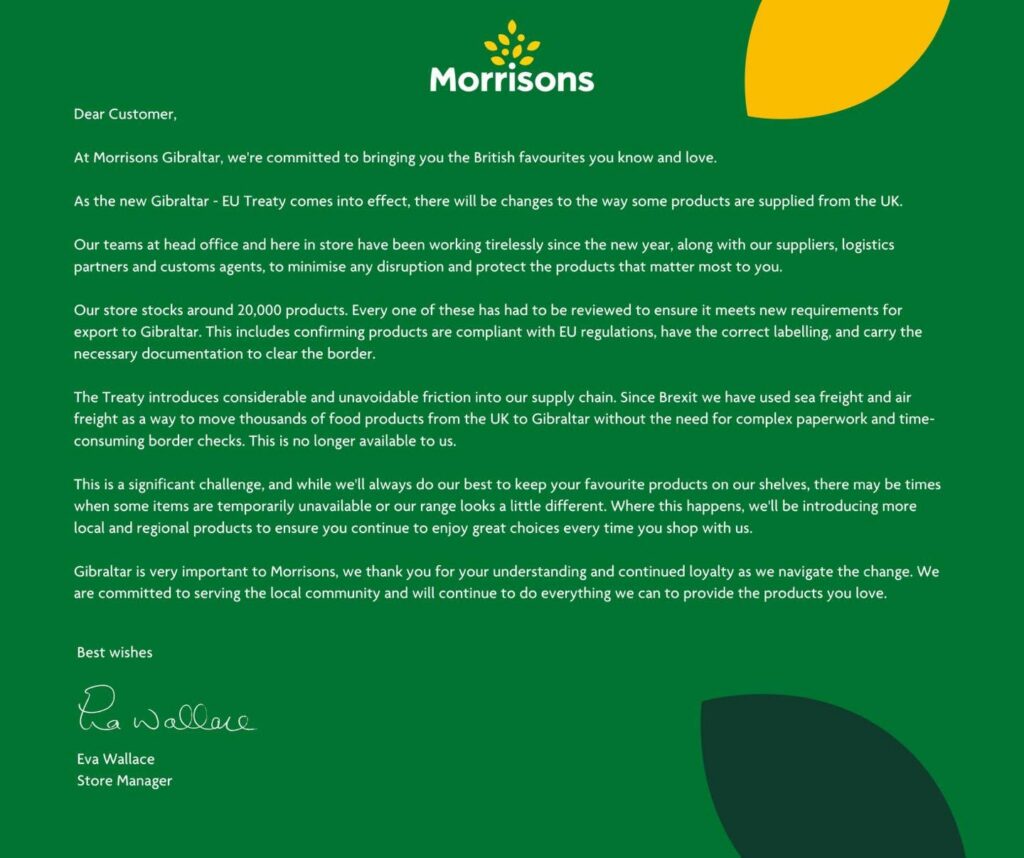
Statement from Morrisons.
Credit: MGC FB

Previous direct routes no longer there

Morrisons has continued to bring stock from the United Kingdom by sea and air after Brexit without facing heavy border checks. That simpler arrangement had lasted well under recent rules. As a result of the changes, the popular UK supermarket accepts that some familiar British items could disappear from shelves for a period or that the range on offer may change over the coming weeks. Such will be the tightened security checks in Gibraltar that smaller UK product shops already established in the Costa del Sol might have laxer checks, according to what those suppliers have suggested in private to this news outlet.

Spanish products fill gaps

To keep choice wide for shoppers, Morrisons has increased its range of local and regional products. The company has also found alternative suppliers and opened new logistics paths, including routes through Ireland. These steps hope to maintain stock levels while the business adjusts fully to the updated system and scrutiny.

Many British products remain available

The supermarket reassures customers that it will keep the majority of its current British lines. It has protected every reference whose export remains allowed and holds enough existing stock to prevent immediate shortages. The management adds that it has not yet listed specific items at risk because it expects several to continue arriving as normal.

Email opens for customer queries

The company says that changes to the range will not affect every product. It expects the situation to ease from 2027 once a new, updated trade deal between the United Kingdom and the European Union takes effect and reduces export difficulties from Britain.

Shoppers can expect updates through the store’s usual social channels as more details become clear in the coming weeks.

Continue Reading

Trending

Copyright © 2017 Spanish Property & News