Australia
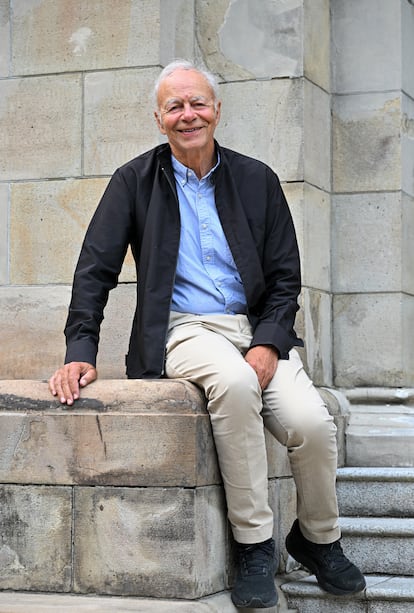
Peter Singer, Philosopher: ‘People Still Think The Animals We Eat Live Out In The Fields, Outdoors’

If, while carving up a piece of chicken, you ever find yourself wondering what sort of life the creature you are about to consume might have led, that question has a source: Peter Singer. More than half a century ago, the Australian philosopher opened the door to our moral consideration of animals with Animal Liberation (1975). Since then, Singer has never stopped drawing attention to the atrocities inflicted on millions of animals and has helped provide the theoretical foundations of the animal rights movement.
Yet the numbers keep growing: some 70 billion land animals are born and die each year in industrial farming. Singer is also troubled by other issues: the climate emergency we so brazenly ignore, as he explored in One World: The Ethics of Globalization (2003) and Ethics in the Real World (2018); and the poverty in which a large share of the world’s population lives, the subject of The Life You Can Save (2009). Those concerns ultimately led him to found an organization that certifies companies that donate part of their profits to effective causes.
In short, Singer is a leading voice in ethics who describes himself as a consequentialist: he believes actions should be judged by their consequences. He does not dream of utopias or propose revolutions. Instead, he starts from the world as it is and offers proposals that improve lives.
Now he returns to his signature subject, animal rights, with a new book, Consider the Turkey, which makes it difficult to look at a tray of roast turkey in quite the same way. The Australian thinker, who spent many Thanksgiving holidays while teaching at Princeton University in the United States, describes how these animals are bred through the insertion of semen into the vagina, a process that causes pain and that he calls “rape”; how they are packed into enclosed spaces; and how they are subjected to mutilations without anesthesia.
He answers the video call from Singapore, where, he says, he has been trying to persuade a group of millionaires to donate their money to worthy causes. He is speaking from a nondescript hotel room, the kind, judging by his packed travel schedule, with which he must be thoroughly familiar. It could be anywhere. Singer speaks kindly, with a certain detachment. It is 9 p.m. in the sprawling Asian city-state.
Question. I doubt anyone who reads your book can go back to eating turkey with a clear conscience. What did you set out to achieve with this book?
Answer. Every Thanksgiving, most American families sit down at the table and place a dead animal at the center. I am not only concerned about turkeys; I am worried about the vast majority of animals we kill for food in most countries, especially affluent ones. They never get to go outside in the fields, never get to walk in the sun, and don’t live in a social group that suits their nature. We treat them like machines for converting low-priced grain into flesh, eggs, or milk. Maybe I could stimulate some of the families to discuss what they’re doing. The number of animals raised and killed for food continues to rise, which to me is a moral atrocity, and I want more people to be aware of it.
Q. Was it a Thanksgiving dinner that first upset you?
A. You can’t avoid being aware of that tradition, especially because they still keep this ridiculous ritual in which the president pardons one or two turkeys, as if they had done something wrong.
Q. With Animal Liberation, you opened our eyes to the cruelty behind our food. Do you think a world of more than eight billion people is one of the causes of the problem?
A. No, I don’t think so. If we want to feed a growing population, planting grain and soy to feed animals is not the right way to do it; it is a waste of food. If we feed ourselves from cows that graze on grass, well, we can’t live on grass, so it does add to the human food supply. But if we confine animals indoors and to feed them we have to grow grain and soy — which then need to be transported to be eaten — we will never get more than a third of what we put in, although it depends on the species. We waste two-thirds of the food value that we feed to animals in factory farms.
Q. How would you describe the state of concern for animal welfare in 2026?
A. It’s hard to gauge. I see more awareness, but it does not seem to be having a major impact. People still imagine animals as being outdoors in the fields, though it depends on the country. In Singapore, where I’m speaking from, I don’t think there is much awareness, nor in Seoul or China, which produces more pork through factory farming than any other country. There’s a long way to go.
Q. You may be one of the reasons Kentucky Fried Chicken launched its vegan option. However, many vegans say they still eat meat. What’s going on?
A. I think social conformism plays a large role. We like being with friends, and we don’t want to have to tell them, “hey, what you’re doing is wrong.” Although people would prefer to socialize with others who don’t eat meat, they still maintain ties with their social circle — we all do. We need to reach a critical mass of people who do not eat meat. Like with smoking. When I was young, everyone smoked at parties. Advertising about its negative effects gradually changed the perception completely. Now smokers are seen as the odd ones out; they have to step outside buildings to smoke… I think something similar is possible with meat, but we haven’t reached that tipping point yet.
Q. But what do you make of the confusion within part of the vegan movement? The dropout rate is high; some who call themselves vegan admit to eating cheese…
A. I don’t think purity is what matters. It’s not like being religious and observing halal or kosher rules. What we ought to be trying to do is to reduce the demand for animal products that leads to factory farming. If someone is vegan 90% of the time, and 10% of the time eats some animal product, they’ve made a 90% difference. I am not critical of people who are mostly vegan even if they don’t always succeed. I think they are doing their part to reduce meat consumption, and that is what’s important. If you want to be completely pure, fine. But what we must do is reduce meat consumption as much as possible; that way we’ll get somewhere.
Q. Animal-welfare-friendly food is more expensive, and many people can’t afford it. The same goes for meat substitutes. What should we do about this?
A. Plant-based protein is not more expensive than animal protein. But animals raised with higher welfare standards are more costly. That is why factory farming has developed: to lower prices. And that is a problem. I certainly don’t want people who have less money to be less well nourished. I would like them to learn to make protein from lentils, beans… Historically, protein was obtained from these plant products; meat was a luxury. Now we can buy meat, so we are consuming less of the plant proteins we used to. I would urge people to mostly eat plants and, if someone wants some meat, that it is not factory farmed and that they treat it like something they only eat on occasions.

Q. Let’s talk about your concern with global poverty. You encourage people to donate whatever they can to help the world’s poorest. We have seen the devastation caused by the withdrawal of U.S. aid. Don’t you think a tax on great wealth would be more effective than individual altruism, which is clearly nowhere near sufficient today?
A. That would be fantastic, but I do what I can; I am a practical person. We don’t even have a global government —how could we raise taxes on millionaires? I think Trump made a disastrous decision. If one of the richest countries in the world can withdraw all its development aid, I don’t see how we could raise taxes on the wealthiest. But I can urge more people and more companies to donate what they can. I founded Profit for Good, which urges companies to donate at least 10% of corporate profits to good causes. And companies benefit by showing the public they have good values. It’s a win–win situation.
Q. Some time ago you proposed a Darwinian left. What does that consist of?
A. Saying something is Darwinian means accepting Darwin’s ideas, particularly his theory of evolution. For years the left rejected it. Marx posited that if we changed the economic basis of society, we would also change human nature; he did not believe in a biologically evolved human nature. This suggests that communal ownership of the means of production would lead people to distribute themselves according to ability, etc. But if we look at the Soviet Union, we know well that this did not happen. There was still inequality of power and wealth, and overall incomes were not high. Why? Because, generation after generation, people think of themselves and their own children before everyone else. The left must take our human nature into account when implementing policies. It will only succeed once it accepts that Darwin was right and leaves behind many of its utopian ideas.
Q. Given the reversals we are seeing across much of the world, what kind of left gives you hope?
A. Social-democratic parties that focus on social welfare. Those that defend a strong safety net for the vulnerable within a capitalist society. I don’t believe in a socialism based on public ownership. It never worked, and China became more prosperous when Xi Jinping left that stage behind. I think there are many lessons to draw from that. We can have a strong social-welfare network, with strong community ties and responsibility for the weaker. Left-wing parties are much better than right-wing ones, but if they forget the idea that they can magically transform society, they will be more effective.
Q. You do not support fully open borders for immigration. Why?
A. I am not in favor of completely open borders; no — when we do that we lose out. If left-wing parties adopt this policy, they do not stay in power. The result will not only be closed borders; it will have worse effects: total failure to act on climate change, a real and major threat. And the right will go further: start crazy wars, as we have seen in Iran. Open borders have enormous political consequences. Unfortunately, there are elements in our nature that allow politicians to stir up hostility toward people who enter the country and have different traits or religions. It’s easy for far-right politicians to tap into that sentiment. The left would do much more for them, but when the working class votes for Trump, they are not voting in their own interests. That is why I think the left has to be more strategic. It must do what is necessary to curb the far right. And if that implies placing limits on immigration — and I do not mean closing borders completely — there will be some chance of coming to power and stopping it.
Q. You may previously have favored open borders because they allow more people to lead better lives.
A. That is so. But seeing how the right manipulates the issue… I saw it in Australia: people arriving by small boats from Indonesia seeking asylum. Initially I supported them. They were people in great need that Australia could help; we could accept more immigrants. But the right began to stir up hostility and to grow. I saw the Labor Party, which is not perfect but is infinitely better, start to lose elections. They became more pragmatic, and today they are back in government.
Q. What do you make of the increasingly common claim that the West we knew is dead?
A. I would not say it is dead. Trump is not going to be around forever, although we do not know who will replace him. His popularity is low for now, and it looks like that in the midterm elections, the Democrats will control at least the House of Representatives. We do not know what will happen in 2028. NATO is not doing well at the moment, but there is still hope it can recover, that the U.S. can have more sensible leadership and that American voters will wake up to the mistake they have made. It will revive under a future president who appreciates the value of the alliance. Let us hope that happens.
Q. You lost three of your grandparents in Auschwitz. What do you think of the role of Israel and specifically of Benjamin Netanyahu in the Middle East?
A. He is the worst prime minister Israel has had since its founding in 1948. The early governments, which also did reprehensible things, at least showed respect for others. Palestinians were badly treated, but not to the same scale or with the same ruthlessness. Civilian casualties are terrible. This is an extremely selfish government that places Israeli lives above Palestinian ones.
Q. I don’t know if you’re in touch with people who live there. Can they see that their behavior is causing alarm and terror throughout the rest of the world?
A. Many Israelis are opposed to this, but not enough of them. And I think there is much concern about antisemitism around the world, even in Australia, where months ago there was a massacre. People blame antisemitism, but it is clear that it is a reaction to what Netanyahu’s government is doing. It is the actions of this government that truly inspire crazy people to commit these terrible things. It is not a coincidence. There is a cause-and-effect relationship.
Q. Before we finish, let me satisfy a curiosity. You took up surfing after the age of 50. Do you still surf?
A. Yes, a couple of months ago I was surfing on beaches near Melbourne. I don’t pretend to be a really good surfer; I probably started too late for that, but it is certainly something I still enjoy.
Sign up for our weekly newsletter to get more English-language news coverage from EL PAÍS USA Edition