Connect with us

%

Ryanair Boss Offers ‘maths For Dummies’ To Spain’s Transport Minister After Calling Him A ‘failure’

Published

on

ryanair-boss-offers-‘maths-for-dummies’-to-spain’s-transport-minister-after-calling-him-a-‘failure’

O’Leary called the minister “a dummy” who needs to learn to add, subtract and “maybe read”. Credit: Ryanair / YouTube

Calling a government minister a ‘failure’ on camera isn’t exactly how most airlines usually try to keep their routes open. But Ryanair’s Michael O’Leary has done exactly that this week, and Spain’s transport minister hit back just as hard.

‘Fracasado’: O’Leary’s video brands Puente a failure

Michael O’Leary, chief executive of the Ryanair Group, posted a video on Wednesday August 26 accusing Spain’s Transport Minister Óscar Puente of getting his facts wrong about the airline’s shrinking presence at the country’s regional airports. In it, O’Leary said Ryanair is flying 648 aircraft this summer, 29 more than a year earlier, and expects to carry 216 million passengers in 2026, eight million more than the 208 million it carried in 2025. However, none of that extra growth, he said, is reaching regional Spain, where he accused Puente of presiding over high aviation taxes and uneconomic airport fees at empty airports. He pointed to Slovakia, Ireland, Sweden and regional Italy scrapping aviation taxes this year, and dismissed Puente’s claim that Spain already has among the lowest in Europe as false. 

He finished by saying he would send Puente a copy of “Basic Math for Dummies”, calling the minister “a dummy” who needs to learn to add, subtract and “maybe read”.

Puente hits back: ‘I know how to add perfectly’ 

Puente rejected the insult and turned O’Leary’s own figures back on him. He said the cuts stem from delayed deliveries of Boeing’s 737 MAX-8200 aircraft, which he said have “conditioned” Ryanair’s scheduling, since airlines plan routes six to 18 months ahead through the International Air Transport Association (IATA). He said Spanish airport fees are low enough that a Ryanair figure took home a €100 million bonus last year, according to reporting cited in his reply, and insisted he “knows how to add perfectly”.

Puente closed by telling O’Leary that if he dislikes Spain’s rules, he can fly elsewhere, echoing a line Ryanair’s own Spanish social media account once posted at customers in July 2025: “Dislike our rules? Walk to your destination.” 

Could the real cost be bases and routes disappearing across regional Spain?

Behind the insults sits a genuine dispute over money. AENA raised its 2026 airport charge by 6.62 per cent, taking the average fee to around €11.03 per passenger, and Ryanair blames that rise for the cuts it is now making. The airline has already closed bases at Santiago de Compostela, Valladolid, Jerez de la Frontera, Tenerife Norte and Vigo as part of its winter 2025-26 schedule, and a further 36 direct routes are being cancelled from regional and Canary Islands airports this year

Airports on the Peninsula are losing roughly 41 per cent of Ryanair’s seats, about 600,000 in total, while the Canary Islands lose closer to 10 per cent, or 400,000 seats. That capacity is being redirected to Morocco, Italy, Croatia and Albania, while Madrid, Barcelona, Palma and Málaga are all gaining flights instead. Ryanair has previously said it could reverse the cuts if fees at regional airports come down.

It’s not the first time O’Leary has picked a fight with a Spanish minister 

This is not the first Spanish minister O’Leary has had dealings with. In February 2025, Ryanair ran an advertising campaign dressing then-Consumer Rights Minister Pablo Bustinduy as a clown and branding him a “mad communist” over the fines the government had imposed on low-cost airlines for charging extra for cabin baggage. Bustinduy said at the time he was “not offended”.

O’Leary isn’t scared to put on the gloves well beyond Spain too. He has clashed publicly with Wetherspoons boss Tim Martin over airport drinking limits, dismissed Ireland’s own parliament as “full of teachers”, and once challenged Elon Musk to an arm wrestle to settle a row over Starlink.

The Ryanair boss clearly knows how and when to stand up for his company, even if the medium is a little unorthodox for a CEO. For now, the routes are the tally that matters. While the war of words plays out online, five Spanish airports have already lost their Ryanair base, and Puente’s ministry has yet to signal any change to the fees behind it.

%

Ceuta Crisis Reaches Mainland Spain As Rallies Are Called Across The Country

Published

on

ceuta-crisis-reaches-mainland-spain-as-rallies-are-called-across-the-country

Demonstrators wave Spanish flags outside Madrid’s Moroccan embassy on August 2, an earlier show of support for Ceuta. Credit: David Raw / Shutterstock

Ceuta’s regional day usually passes with a quiet medal ceremony and general celebration throughout the city, but this year it is drawing rallies to town halls and city squares in more than 30 places across Spain. The gatherings directly follow the migration crisis that disrupted the city at the end of July. 

Local councils asked to support Ceuta from 8pm on September 2

The Spanish Federation of Municipalities and Provinces (FEMP), which represents town halls and provincial councils nationwide, has called for gatherings outside town halls at 8pm on Wednesday September 2, Ceuta’s regional day. The invitation covers all 8,132 Spanish municipalities, though FEMP has confirmed only that several councils have agreed to take part rather than claiming universal participation.

FEMP President María José García-Pelayo said Ceuta was “in intensive care” and needed the government to act “in a proportionate way”, describing the aftermath of the crisis as the most difficult moment in the city’s recent history.

García-Pelayo has also given up her seat on the EU’s Committee of the Regions so that Ceuta’s president, Juan Vivas, can represent the city directly in Brussels, and FEMP’s next governing board meeting, on September 29, will be held in Ceuta itself.

Fuengirola and Torremolinos on the Costa del Sol are among the councils that have already confirmed events.

A separate citizen movement has spread to far more than 30 cities

Alongside the official FEMP call, a decentralised citizen campaign called Por Ceuta has organised its own concentrations for the same evening, under messages including “Toda España por Ceuta” (All of Spain for Ceuta) and “Ceuta no está sola. España está con Ceuta” (Ceuta is not alone. Spain is with Ceuta).

🇪🇸 TODA ESPAÑA POR CEUTA 🇪🇸

El próximo 2 de septiembre, Día de Ceuta, nos manifestamos en toda España.

🗓️ 2 de septiembre
🕗 20:00 h
📍 Frente a los ayuntamientos de toda España

Por Ceuta. Por nuestras fronteras. Por España.

Que se escuche en cada rincón del país: CEUTA NO… pic.twitter.com/BDRmQGQKcP

— Muy.Mona/🇪🇸💚 (@Capitana_espana) August 19, 2026

Unlike the FEMP appeal, this strand carries no formal municipal backing. It began on social media and has since spread all over Spain, including cities like Madrid, Barcelona, Valencia, Sevilla, Málaga, Zaragoza and Bilbao, according to organisers’ own published lists. 

The overlap between the two calls means turnout in some places could combine both official and grassroot participants. An expected attendance figure has not yet been published.

“Ceuta is not for sale, Ceuta defends itself”

In Ceuta itself, the Neighbourhood Associations Federation (FPAV) has called a separate march under the slogan “Ceuta no se vende, Ceuta se defiende” (Ceuta is not for sale, Ceuta defends itself).

The march sets off at 7pm from the Patio de Armas at the Murallas Reales, the city’s fortified walls, and follows a route through the old town before ending outside the Government Delegation. Organisers have asked participants to leave political and ideological banners at home and to bring Spanish or Ceuta flags instead.

A month on, the government sets up a single command

The gatherings come a month after the crisis at the border that dominated headlines through late July and into August, as Spain shifts from emergency response to a longer-term plan for the city.

On Wednesday, the Spanish government announced a new single command structure for the crisis, led by Territorial Policy Minister Ángel Víctor Torres and including Vivas, the government’s Ceuta delegate and national security officials, alongside an expanded socioeconomic plan for the city worth more than €180 million.

Whether the show of support on September 2 changes anything about that response is, for now, the open question hanging over what should have been the regular annual celebration day for the city.

Continue Reading

%

‘It Could Kill Them’: Experts Warn Beachgoers Against Pushing Stranded Dolphins Into Sea

Published

on

‘it-could-kill-them’:-experts-warn-beachgoers-against-pushing-stranded-dolphins-into-sea

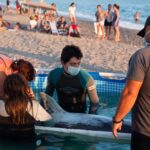
A stranded cetacean has not simply ended up on the sand because it took a wrong turn. Photo credit: Alexander Sánchez

A group of well-meaning beachgoers recently helped a stranded dolphin back into the sea on Spain’s Costa Tropical, however several marine biologist are warning that what looks like a rescue can actually put the animal’s life at greater risk. Dolphins are extremely sensitive animals, and the stress of being surrounded, handled and moved by people can itself have serious consequences. 

A dolphin that reaches the beach is often already sick, injured, exhausted or otherwise compromised, meaning simply getting it back into the water does not necessarily save it. The warning comes after bathers on Castell de Ferro beach in Granada helped a striped dolphin return to the sea after it washed ashore on August 19. The people who intervened were trying to help. Alexander Sánchez, a marine biologist for Pelagics Conservation, based in Almerimar, says members of the public should not attempt to reintroduce stranded cetaceans themselves.

Why pushing a stranded dolphin back can be dangerous

Talking to Euro Weekly News Sánchez explains that it is unusual for a striped dolphin to come so close to shore and that the species normally travels in groups. From the footage of the Castell de Ferro incident, he says it was quite possible that the dolphin had some sort of underlying problem.

That is the crucial point for anyone who finds a dolphin on the beach. A stranded cetacean has not simply ended up on the sand because it took a wrong turn. The reason for the stranding needs to be established before anyone decides whether the animal can safely return to the water.

They are already struggling 

Sánchez says that in the majority of the cases, a stranded dolphin is either old, sick or injured. Returning it to the sea without veterinary assessment can mean that it simply becomes stranded again somewhere else, continues to suffer or drowns.

Dolphins are also highly sensitive to stress. Being surrounded by crowds, touched repeatedly, dragged across the sand or forced back into the water can place an already compromised animal under enormous physiological strain. In severe cases, that stress can contribute to its death.

Andalucía’s own marine environment service specifically warns that a live stranded cetacean should be reported to 112, with members of the public then following the instructions given by the veterinary team. The regional authority says that releasing an animal without a prior health assessment can result in its death.

A dolphin on the beach needs help, not a push

The risks are not theoretical, In July 2025, a common dolphin stranded at Roquetas de Mar in Almería up to three times. When specialists from the local stranding network assessed the adult male, it had head injuries and signs of respiratory failure. The veterinary team ultimately decided that euthanasia was the most humane option because the animal was already agonising.

Another case in Mijas, Málaga, in May this year ended with a stranded dolphin dying shortly after reaching the beach. Marine conservation teams again advised the public not to handle the animal or attempt to return it to the sea, explaining that stranded dolphins can be injured, disorientated or severely weakened.

There are occasions when a stranded dolphin can be returned to the sea, but that decision only belongs to trained professionals after the animal has been assessed. In La Línea de la Concepción, for example, specialists examined a stranded striped dolphin in 2023 and determined that its condition was apparently good. Its swimming and buoyancy were assessed before it was eventually released.

What beachgoers should do

If a dolphin or another cetacean is found stranded on a Spanish beach, the correct response is straightforward: call 112 and wait for instructions. People should not attempt to drag the animal into the water, push it offshore or surround it in an effort to help. Apart from potentially worsening its condition, unnecessary handling can interfere with the assessment needed to determine why it stranded in the first place.

Andalucía’s official guidance also points out that intervention by untrained members of the public can put people at risk. The bathers at Castell de Ferro were clearly trying to do the right thing. But for marine mammals, the most compassionate response is not always the most obvious one. If a dolphin is stranded, leave the rescue to the people trained to decide whether it can be saved. Call 112, keep your distance and follow the instructions given by the emergency team.

Continue Reading

%

UK Prepares Emergency Campaign Urging Households To Keep Food And Water At Home

Published

on

uk-prepares-emergency-campaign-urging-households-to-keep-food-and-water-at-home

The campaign will encourage households to take simple steps to prepare for risks. Photo credit: David Pereiras/Shutterstock

In recent hours major UK news outlets including The Guardian and The Independent have reported that ministers are preparing to launch a public campaign encouraging households to keep basic emergency supplies, including bottled water and tinned food, at home.

The reports are likely to draw the attention of British residents in Spain who have family, property or other close ties in the UK. However, there is no need to panic, yet. There is currently no warning of an immediate emergency and no instruction to panic buy. The government’s message is about helping households cope for a few days if essential services are disrupted.

The government has confirmed a campaign is coming

The reports follow an official Cabinet Office announcement published on July 14, confirming that a national resilience campaign will launch later this year. It will encourage the public to take simple steps to prepare for risks including severe weather, flooding, cyber attacks and other incidents. Ministers say that better-prepared households can help emergency services concentrate on people who are most vulnerable during a crisis.

The Cabinet Office has also said that government crisis plans are being updated as part of its Home Defence Programme. That work covers a range of possible threats, but it is not a prediction that an attack or national disaster is about to happen.

Food and water advice is already available

The guidance asks households to consider what they would need if a power cut, water outage, flooding or another emergency lasted for several days. Suggested supplies include bottled water, food that does not need cooking, a manual tin opener, a torch, candles, spare batteries, a phone power bank, a battery or wind-up radio and basic first aid supplies. 

It also recommends allowing for at least 2.5 to 3 litres of drinking water per person each day. People should also make sure they have enough regular medication to last several days. Importantly, the advice is not to rush out and buy everything at once and definitely no need to panic-buy toilet paper. Households are encouraged to build up their supplies little by little but when possible.

A quick check worth making from Spain

If you have an older parent or vulnerable relative in UK, it may be worth checking that they have their medication, a torch, enough food and water for a short disruption, and important telephone numbers written somewhere other than on their mobile phone. It is also worth asking whether they know a neighbour who could check on them if phone networks or transport were affected. Having someone nearby who can make contact could be particularly useful for people who live alone or have mobility problems.

Families separated between the UK and Spain may also want to agree on a simple contact plan. People who are older, disabled or medically dependent may be eligible for extra support through their supplier’s Priority Services Register. This allows energy, gas and water providers to identify customers who may need additional assistance during an interruption. Anyone with a second home in Britain should also make sure a trusted neighbour, friend or property manager has up-to-date contact details and knows how to reach the owner if there is a problem at the property.

Prepare calmly, not fearfully

The government has confirmed that the national resilience campaign is coming, but its detailed launch material has not yet been published. The recent reports indicate that advice about keeping basic supplies at home is likely to form part of it.

For Britons living in Spain, there is no reason to panic or start stockpiling food and water. What is advised however is that we check on relatives in the UK, make sure they could manage for a few days if essential services were interrupted, and agree how you would stay in contact if normal communications were affected.

Continue Reading

Trending

Copyright © 2017 Spanish Property & News