Christopher Nolan
Soccer, As Portrayed In ‘The Odyssey’: A Women’s Sport Played With The Hands


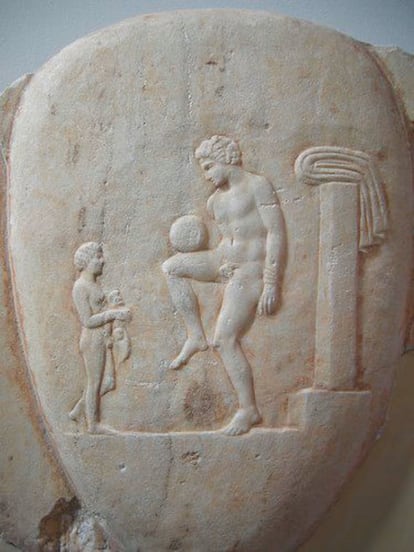
In Book VI of the Odyssey (which has been in the public eye this year thanks to Christopher Nolan’s film), there is an episode that could be considered the origin of soccer and rugby: some girls are tossing a ball with their hands on the seashore. The ball lands next to a body lying there, battered from a shipwreck: Odysseus, asleep, discovered by Nausicaa and her maids. In a way, this is the rudimentary origin of what we know today as soccer. “Although those early games were also played with the feet, the ball was, above all, passed by hand. The rag ball would spin over the opponent’s head until it reached the end line,” recounts Alessandro Bertolino, a professor, writer, and archaeologist specializing in antiquity and Christianity, and a tutor at the Pontifical Roman Academy of Archaeology.
It took several centuries for this still-unrefined form of soccer to be revitalized. Specifically, it wasn’t until Rome’s conquest of Greece, in the 2nd century B.C. A radical and revolutionary shift. “A sort of modernization took place with Harpastum, which actually means strappo or porto via (theft and the act of initiating something). This gives us an idea of the new game,” adds Bertolino.
Unlike the naive rhetoric of the Odyssey, in Rome it evolved into an exclusively male activity, practiced, moreover, by Roman legionaries. It quickly spread throughout Europe. According to Bertolino, ancient sources describe a historic match between Rome and various peoples of Britannia, a former province of the Empire that encompassed present-day England and Wales. It took place in 264 A.D. and ended 1-0 in favor of the home side. “It is the first soccer match we know of with a definitive result,” Bertolino notes.
There was no turning back. The tradition never ceased. Harpastum, in a way, would evolve into Calcio storico fiorentino, played in the noble Piazza Santa Croce in Florence. Today, it is the theater that safeguards the art of war. Because yes, the CSF is a fierce battle without weapons. A tradition that admits no morality and whose first seed was sown on the seashore, on the island of the Phaeacians (Echeria). The mythical place where the goddess Athena appeared in a dream to Princess Nausicaa, daughter of King Alcinous. Yes, when she reminded her of her approaching wedding and that her bridal gown must be washed and purified. After the sacred rite, those revelatory young maidens emerged, passing the ball to one another without goals, without limits, without scoring, without much purpose, and without direction. Only a wayward shot ended with the ball in the sea. Then, a liberating cry from all of them to awaken the soul of Odysseus, the indomitable, tenacious, and graceful Achaean hero. An exhausted castaway, hidden among reeds and seaweed washed up by the water. Those were time immemorial when athletic sports and wrestling were practiced. There was poetry, and it was as vast as a cathedral.
Perhaps the first (non-)match is considered one of the most important lyrical episodes in ancient literature. Nausicaa represents the unfulfilled, the longing for something never experienced, the melancholy for an Odysseus who, upon seeing these teenage girls playing with a ball, chose to return to Ithaca, where Penelope and his son Telemachus awaited him.
It is no stretch to say that in that Homeric Greece, soccer was born as an art form. An epiphany that strives to preserve purity in the absence of compromise with hypocrisy or the system… That is why it seems necessary to rediscover the Odyssey and its landscapes. And also those protagonists who lived while people were experimenting with what would later become soccer. Indeed, today they are all asking for another turn. Every one of them. The Cyclops, Circe, or Menelaus, king of Sparta, husband of Helen, and younger brother of Agamemnon… All of them imbued this initiatory journey with an aura of magical and ethereal geography, albeit one roughly centered on the Mediterranean. The first dribble against the sea’s sap. A fantasy that should reclaim its innocence and its music, like the rhapsodies and the requiem.
Sign up for our weekly newsletter to get more English-language news coverage from EL PAÍS USA Edition