CBS
Stephen Colbert’s Late-Night Successor Trades Trump Satire For Harmless Jokes

“I got three beautiful kids.” Applause from the audience. “The point is, I have four kids altogether, but three of them are beautiful. When that fourth one sneaks up on you… Aaaah! Don’t do that to daddy, I thought an orangutan broke into the house.” Laughter and more applause.
The comedian Bill Dwyer is speaking on Comics Unleashed, the show that since May has occupied CBS’s coveted late-night slot. It replaced veteran host Stephen Colbert, who from 2015 had mocked politicians of every stripe in the United States, until he ran afoul of Donald Trump. The Republican demanded his head, and CBS handed it over, in what the network described as “a financial decision against a challenging backdrop in late night.”
Now, instead of interviews with major public figures (Paul McCartney appeared on the show’s final episode) and sharp commentary on the day’s events, Americans are getting a daily dose of harmless jokes that offend no one. The punchlines are about how owners of small dogs can’t be trusted, or the absurdity of excessive airport security measures. Family-friendly humor in a decidedly non-family-friendly time slot: 11:35 p.m. on the East Coast.
The decision to replace The Late Show with Comics Unleashed may look like a simple programming change. In reality, it reflects far deeper currents in U.S. society, politics and economics. The pressures exerted by the Trump administration, undeniable as they are, have arrived at a particularly vulnerable moment for late-night television.
A toxic mix of young viewers’ declining interest in traditional television, political polarization and the omnipresence of smartphones has made it increasingly difficult to gather an entire family in the living room to watch the same program. The result is shrinking audiences, declining revenues and rising costs. Colbert’s demise is a symptom of the broader decline of political satire on U.S. television.
“The pressure from this administration is enormous. Large corporations have a great deal to lose if they refuse its demands,” says Dannagal G. Young, a communications professor at the University of Delaware, speaking by video call. “Political satire is still very much alive, but it is moving away from television and onto other platforms, particularly social media.”

Comics Unleashed is hardly new. CBS’s quick fix for replacing Colbert was to move into that slot a program that had already been around for two decades and cost a fraction of what traditional late-night shows typically do.
Its creator is Byron Allen, a comedian turned media mogul who, at 65, has built a communications and entertainment empire. As he has explained in various interviews, he offered CBS a solution to a business that was becoming increasingly difficult to sustain: he would pay the network $15 million to air Comics Unleashed in exchange for keeping most of the advertising time and selling it himself. It was the same business model that had helped make him wealthy.
The new show has triggered a sharp ratings decline. In its first weeks, CBS’s audience in the time slot fell by roughly 60%. The paradox is that, despite those figures, the arrangement may still be working financially for the network.
Less audience, more money
“CBS has won big-time because they have zero production costs and now they are saving $55 million a year,” he told the Los Angeles Times.
When he accepted the deal, Allen said he regretted the cancellation of The Late Show. “I love Stephen Colbert. I’m a big fan,” Allen said. But once the network had made its decision, he saw no reason not to move ahead with his plans. “This isn’t show business, this is business show,” he said.
The Trump administration has made little effort to conceal its desire to influence television programming and sideline hosts it dislikes. That was evident in the case of Jimmy Kimmel after remarks he made about the killing of conservative activist Charlie Kirk. Brendan Carr, chairman of the Federal Communications Commission and a close Trump ally, was unusually blunt. “We can do this the easy way or the hard way,” he said on a podcast.
A few days later, ABC announced that it was canceling Kimmel’s show, but reversed course after a wave of backlash. “Our government cannot be allowed to control what we do and do not say on television,” the comedian said in his first show after the controversy.

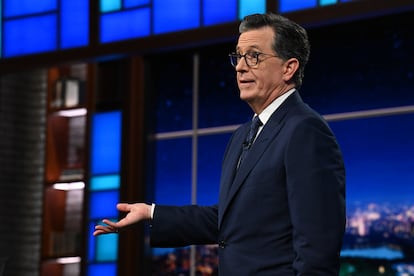
Colbert was not so lucky. He dared to criticize the $16 million settlement that Paramount, CBS’s parent company, agreed to pay Trump in exchange for dropping a lawsuit over what he claimed was an unfairly edited interview with Kamala Harris, the Democratic candidate in the 2024 election. The lawsuit was widely seen as unlikely to succeed, but Paramount was reluctant to antagonize the administration while seeking approval for its merger with Skydance. On air, Colbert remarked that the “technical name” for the agreement was “a big fat bribe.” Days later, CBS announced that the show would end. Its final episode aired on May 21.
“All of these changes stem from an administration characterized by the concentration of power in the executive branch, the silencing of dissenting voices and a disregard for satire, a form of expression protected by the Constitution,” says Professor Young, who is also the author of Wrong: How Media, Politics, and Identity Drive Our Appetite for Misinformation.
David Letterman, the legendary host of The Late Show from 1993 until he handed the reins to Colbert in 2015, expressed what many believe about both the cancellation of the program and its replacement by Comics Unleashed. Of the cancellation, he called it “pure cowardice.” As for the new show, he said: “They don’t want to spend any money, so they’re going to make money. They charge Byron Allen some reasonable price. He sells all the advertising for his Comics Unleashed and it’ll be, I think, 90 minutes or two hours of comics talking about funny stuff.”
Hours before Colbert’s final show was taped at Manhattan’s Ed Sullivan Theater on May 21, a line of fans stretched for several blocks. Many had traveled from other cities to pay a final tribute to their idol. And they seemed to agree on one thing: it was a bad day for both U.S. television and the United States.
Sign up for our weekly newsletter to get more English-language news coverage from EL PAÍS USA Edition