%
Swiss Precision Meets Andalucian Soul: Lorenz Nenning, The Man Redefining Luxury Real Estate
Published
2 weeks agoon
Lorenz Nenning. Credit: LN
From the moment Lorenz Nenning first set foot in Marbella as a wide-eyed child in 1980, something profound took hold of him. The golden light spilling across the Mediterranean, the dramatic embrace of the Sierra Blanca, and the effortless elegance of life where mountains meet sea awakened a passion that has never faded. Today, that same passion burns brighter than ever.
As the driving force behind Citadelle Consulting & Co., Nenning has transformed his childhood love for Marbella into a sophisticated cross-border enterprise that combines Swiss precision with Andalusian soul. For him, Marbella is far more than a market, it is a way of life, a source of daily inspiration, and the place he still describes, with quiet intensity, as “the most beautiful corner of Europe.”
Euro Weekly News sat down with Lorenz Nenning to discover more about this deep-seated love for this part of the Costa del Sol that has driven his career.
You’ve known Marbella and the Costa del Sol since 1980, when you were just a child visiting with your parents. What was it, do you think, that first prompted this lifelong passion for this region, and how has it evolved into building a cross-border business between Switzerland and Spain?
The light, the landscape, the effortless elegance of life
“My first memories of Marbella are from around 1980, when my parents brought me here as a child. The light, the landscape, the effortless elegance of life between the mountains and the sea — it made an impression that never really left. Growing up in Switzerland, where precision and structure are part of the culture, I always carried that contrast with me: the Swiss discipline on one side, the Andalucian warmth and beauty on the other.
Over time, what began as a personal affinity became a professional conviction. Switzerland and the Costa del Sol are not as different as they might seem. Both attract discerning international families who value quality of life, privacy, and long-term security. My cross-border structure between Switzerland and Spain was a natural evolution: I bring the financial rigour, banking expertise, and structured investment philosophy of my Swiss background and apply it to one of Europe’s most compelling real estate markets. For high-net-worth individuals, that combination is genuinely rare.”
Nature, particularly the landscape of the Marbella surrounds, appears an integral part of the designs you deal with. Was this part of the original allure of your relationship with southern Spain? And would you say it has created an instinct in you for matching client to property?

Credit: CC&Co
The physical drama of the Andalucia coastline
“Absolutely. What first captivated me about this region was not just the lifestyle. It was the physical drama of the place. The way the Sierra Blanca frames the coastline, the pine forests descending toward the sea, the microclimate that makes this corner of Andalucia unlike anywhere else in Europe. These are not backdrops; they are the architecture. Any project that ignores that relationship between built space and natural landscape is, in my view, already failing its client.
That sensibility does translate into an instinct for matching people to places. Over the years I have come to understand that a client drawn to La Zagaleta is not the same person as a client who wants to be in the hills above Estepona, even if their budgets are identical. The landscape speaks to something deeply personal: a vision of how they want to live, what they want to see when they wake up. My job is to understand that before they have fully articulated it themselves.”
Unlike traditional real estate agents, you describe your role as a “creator and developer of bespoke properties.” Can you walk us through how you help the most demanding clients design and realise truly unique homes tailored to their individual lifestyles and needs?
Synergy of investment and home
“The distinction matters enormously to me, and it is one I learned early on. When I started in private banking at Wegelin & Co. roughly 25 years ago, the minimum to open an account was five million Swiss francs, so every client was, by definition, a high-net-worth individual. What struck me, however, was a paradox: these were extraordinarily intelligent, financially sophisticated people, yet almost none of them had ever applied that same rigour to how they actually lived. They had optimised their portfolios to the last basis point, but they were living in homes that were, essentially, compromises.
The moment a client first experiences a property that has been genuinely created around their life, their routines, their family, the way they like to start a morning or end an evening, the reaction is always the same. They cannot believe how many years they spent settling for less. That moment of realisation, that happiness and gratitude, is something I find more personally rewarding than delivering an outstanding investment return. And I have delivered both.
Each residence is a response to its setting and its owner
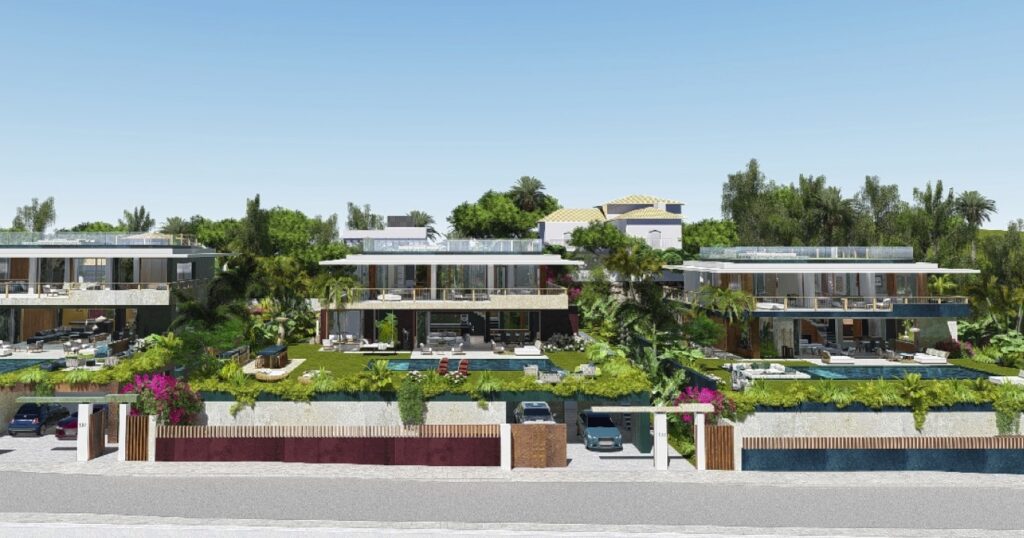
That is the philosophy behind everything we do. A traditional agent presents what exists. I begin with the client, who they are, how their family lives, what their daily rituals are, what privacy means to them, how they entertain. Only once I understand their world do I think about property. In practice, this means guiding a client through the entire journey: from identifying the right plot, through architectural concept and planning, to construction and interior realisation. Our La Paloma 10 project is a good example, with ten villas where each residence is a distinct response to its setting and its owner, not a repeated formula.”
Credit: CC & Co
Your background in private banking clearly informs your investment philosophy. What makes a real estate project on the Costa del Sol not only profitable but also the safest bet for high-net-worth investors?
“My years in private banking taught me that the best investments combine genuine scarcity with structural demand, and the Costa del Sol has both. You cannot replicate the climate, the infrastructure, the international community, or the proximity to major European capitals. What has changed is the sophistication of the buyers: today’s HNWI investor is not simply acquiring a beautiful property, they are structuring a multi-jurisdictional asset with real fiscal and succession implications.
“For a high-net-worth family, the real estate itself is only part of the equation”
That is where my background genuinely differentiates what we offer. I help investors understand the full picture: tax efficiency, holding structures, exit strategy, currency considerations for non-euro investors, and the interplay between residency options, lump-sum tax solutions in Switzerland, and Spanish fiscal frameworks. For a high-net-worth family, the real estate itself is only part of the equation. The most secure investment is one where the legal, tax, and financial architecture is as well-constructed as the property itself.”
You’ve successfully delivered everything from soft refurbishments to building luxury projects from scratch. Could you share an example of a recent project that best illustrates your service and the kind of client it was created for?
“Our current portfolio says it best: active projects in La Paloma in Manilva, Almenara Golf in Sotogrande, La Zagaleta in Benahavis, Madrid, and Brazil. Some are one-of-a-kind architectural statements; others are structured purely as investments, but even those deliver something exceptional, because our standards never change.
La Paloma is a good illustration of the opportunity that still exists on the Costa del Sol when you know where to look. While attention concentrates on the Golden Mile and peak Marbella, Manilva is a consolidated, well-connected location where prices have been rising strongly and where, in our view, the growth trajectory over the next five years will outperform more saturated prime markets. In La Paloma we are currently building villas from €1.4 million upwards (La Paloma 10), while our other projects in the area exceed €5 million but remain significantly below €10 million. This shows that, even with a more accessible budget, you can still acquire a truly unique and prime villa — provided you search well and find the right partner. Delivering a genuine “wow” property at this price point nowadays requires real skill and market knowledge.
The syndicated, vertically integrated model
The investment side operates through what I call a syndicated, vertically integrated model. We source off-market opportunities at below-market value, then bring our full in-house capability to bear: design and technical architects, construction specialists, international tax experts, and marketing professionals. Our investor clients own the asset directly, not units in a fund, not a financial product with layers of fees and distance from the underlying. They own real property, in exceptional locations, with our team maximising every dimension of value. We always have skin in the game ourselves, which tells you more about our conviction in these projects than any brochure could.
Brazil deserves a separate mention, because it genuinely excites me. The macroeconomic and geopolitical case is compelling: strong foreign capital inflows, a currency that gives European and dollar-based investors a structural entry advantage, and coastal markets where international demand is growing faster than supply can respond. Our projects there are exclusively frontline beach. And in Brazil, that means something very specific. There is a finite amount of first-line oceanfront land in the country’s finest locations, and almost none of it is being developed to European luxury standards. I lived through what Marbella looked like in the late 1970s, the potential was visible but unrealised, the land was accessible, and those who moved early made exceptional long-term returns. Brazil’s finest beachfront locations feel exactly like that moment. We are at the right place, at the right time, with the right product.”
With your expertise in lump-sum tax solutions, family office services, and premium real estate, what advice would you give to international investors and families considering the Costa del Sol in 2026 as their next home, forever home, or investment destination in today’s changing market?
The window of opportunity in this market is real
“The window of opportunity in this market is real but not indefinite. Prime land in the most sought-after areas, La Zagaleta, Sotogrande, the Golden Mile, is increasingly constrained, and the calibre of international demand shows no sign of softening. For families considering this as a forever home: do not wait for perfect timing, because the right property in the right location is always rare, and this coastline continues to attract a calibre of international buyer that sustains values through every cycle.
For investors, 2026 presents a compelling entry point, with strong yields, robust capital appreciation in the luxury segment, and a fiscal environment that, properly navigated, is highly favourable. My advice in both cases is the same: work with people who understand both worlds — the market on the ground, and the financial and tax architecture that protects and multiplies your capital. That intersection is exactly where we operate. We are not agents. We are investors, project managers, and creators, and we only take on projects we believe in enough to back with our own capital.”
Mr. Nenning, living between Spain, Switzerland and Brazil sounds like a very busy life. Do you still attend clients personally?
“What drives me is not the transaction but the outcome”
“Always! And I would not have it any other way. What drives me is not the transaction but the outcome: a family standing in a home built around their life, or an investor seeing a return that genuinely surprises them. That never gets old.
In practice, I no longer personally handle showings, as we have specialists for that. But everything that matters most, I am directly involved in: every land acquisition, the formation of every project team, and every investor relationship. We deliberately keep our investor client base small. These are not clients managed at arm’s length, they are partners, and I treat them as such.
In concrete terms: for families looking to create or acquire their dream home, we work from a minimum budget of €3 million. For investors participating in our syndicated projects, entry starts at €250,000, giving access to the same off-market opportunities, the same team, and the same premium assets that would typically require far larger tickets elsewhere. The scale differs; the care and commitment are always identical, because ultimately, what we build carries our name.”
As the interview ends, Lorenz Nenning’s voice softens with unmistakable affection when he speaks of Marbella. For him, this is not simply a place of business, it is the landscape that first stole his heart more than four decades ago and has guided every decision since. Whether he is sourcing a hidden plot in the hills above Benahavis, designing a villa that perfectly frames the sunset over the sea, or simply walking the golden coastline at dawn, his passion remains as fresh and fervent as it was in 1980. In Marbella, Lorenz Nenning has found his true home, and through his work, he continues to help others discover theirs.
You may like
-
Ryanair Flight Leaves 150 Passengers Behind
-
Spain’s Transport Strike Delayed In Last-Minute Move For Pope Leo’s Visit
-
Barbón Acusa A Santos Cerdán De Haber Intentado “desestabilizar” Al PSOE De Asturias
-
Hacienda Crea Una Plataforma Para Evitar Que Los Deudores Cobren Ayudas Públicas Sin Saldar Sus Pagos
-
David Sánchez Niega Haber Hecho Valer Su Apellido: “No Tengo Capacidad De Influir En Nada”
-
Marjane Satrapi: Directa, Cortante, Transparente, Desbordante, Genial
Passengers faced heavy congestion at Toulouse Airport, where long border control queues were blamed for travellers missing a Ryanair flight to London. Credit : BalkansCat, Shutterstock
Most travellers believe there is one simple rule when flying: arrive at the airport early and you’ll be fine. For around 150 Ryanair passengers at Toulouse Airport last week, that wasn’t the case.
Despite checking in, clearing security and making their way through the terminal, they never made it onto their flight to London Stansted. The aircraft took off without them after long queues at border control left hundreds of passengers stuck waiting while boarding was already underway.
The incident has sparked fresh concerns about growing delays at some European airports following the introduction of the EU’s new Entry/Exit System (EES). With the summer holiday season now beginning, many travellers are wondering whether arriving two hours before departure will still be enough.
According to passengers who were there, the problem was not a delayed flight or a last minute gate change. It was simply the sheer number of people trying to get through border checks at the same time.
For anyone planning a summer trip between the UK and Europe, the story serves as a reminder that the biggest obstacle may no longer be airport security. It could be what happens afterwards.
How 150 passengers ended up missing the same Ryanair flight
The flight involved was Ryanair service FR282 from Toulouse to London Stansted on 30 May.
Passengers described scenes of confusion near border control as hundreds of travellers attempted to reach departure gates for several flights scheduled around the same time.
One traveller told The Connexion that the area was packed with people and that there appeared to be no clearly organised queue system. Instead, passengers were trying to move forward through a crowd that she estimated included several hundred people.
Her description painted a picture many frequent travellers will recognise. Everyone could see the departure time approaching, yet nobody seemed to be moving fast enough to make progress.
She said there were between 400 and 500 people gathered in the area and described the situation as chaotic.
By the time many passengers finally reached the gate, boarding had already closed.
According to reports from passengers on board the aircraft, the pilot later announced that approximately 150 travellers had failed to make the flight because they were still stuck in the border control queue.
For those left behind, it was a frustrating end to a journey that had started exactly as planned.
Why border queues are becoming a bigger problem for travellers
The timing of the incident is significant.
European airports are currently adapting to the gradual introduction of the Entry/Exit System, commonly known as EES.
The new system is designed to modernise border management by collecting biometric information from non EU travellers entering the Schengen Area. Depending on the circumstances, this can include fingerprints and facial image registration.
The objective is to improve border security and create a more accurate record of entries and exits.
However, aviation industry groups have repeatedly warned that the transition period could create longer waiting times at some airports.
British travellers are among those most likely to notice the changes because they now pass through border procedures that differ from those in place before Brexit.
During quieter periods the impact may be limited.During school holidays, bank holiday weekends and peak summer travel days, even small delays can quickly build into much larger queues.
That appears to be what happened in Toulouse.
Ryanair has disputed claims that passengers were deliberately left behind.
In a statement, the airline said the issue resulted from border control staff shortages at Toulouse Airport. The carrier added that all passengers who reached the gate before boarding closed travelled without any issues.
What travellers can learn from the Toulouse incident
Nobody enjoys arriving at an airport hours before departure. Most travellers aim to leave enough time without spending half the day sitting near the gate.
The difficulty is that airport processing times are becoming harder to predict.
A passenger who flew through the same airport last month may have a completely different experience this month depending on staffing levels, passenger numbers and border procedures.
Travel experts continue to advise passengers to allow extra time when travelling internationally, particularly on routes involving passport checks.
For UK travellers heading to destinations within the Schengen Area, the first months of EES implementation may be less predictable than many people are used to.
The Toulouse incident does not mean every airport will experience the same problems.
It does, however, highlight how quickly delays can build once large numbers of passengers reach border control at the same time.
For the 150 travellers who watched their Ryanair flight leave without them, arriving at the airport was not the challenge.Getting through the final queue turned out to be the real problem.
Q&A section
Which flight was affected?
The incident involved Ryanair flight FR282 from Toulouse Airport to London Stansted on 30 May.
How many passengers missed the flight?
According to reports from passengers on board, around 150 travellers were unable to reach the gate before boarding closed.
Why were passengers delayed?
Travellers reported lengthy queues at border control, while Ryanair said border control staff shortages contributed to the delays.
What is the EU Entry/Exit System (EES)?
The EES is a new border management system that records biometric information from non EU travellers entering the Schengen Area.
Will all airports experience similar delays?
Not necessarily. Waiting times will vary depending on passenger numbers, staffing levels and how quickly airports adapt to the new procedures.
Should travellers arrive earlier at the airport this summer?
Many travel experts recommend allowing extra time for international flights, particularly when travelling between the UK and Schengen countries during busy holiday periods.
%
Spain’s Transport Strike Delayed In Last-Minute Move For Pope Leo’s Visit
Published
9 hours agoon
June 4, 2026By
Molly Grace
Transport operators and local authorities will now be watching closely. Photo credit: TIMUR BATYRSHIN/Shutterstock
The Spanish trade union UGT has postponed the start of an indefinite strike involving truck and bus drivers until June 22, delaying industrial action that had originally been scheduled to begin on 8 June. The decision was announced by the union’s Road Transport, Urban Transport and Logistics sector, which said it wanted to avoid disrupting travel during the visit of Pope Leo XIV in these coming weeks (this may come as a miracle to many)!
UGT described the move as a responsible measure aimed at preventing additional transport difficulties during a period when large numbers of people are expected to travel. The strike will affect drivers working in Spain’s road transport sector, including both passenger transport and freight services. Despite the delay, the union has confirmed that the dispute remains active and that industrial action will begin on the new date if no agreement is reached beforehand. The disagreement centres on working conditions and demands for improvements for professional drivers, particularly older workers approaching retirement.
What does the postponement mean
For residents, businesses and visitors across Spain, the postponement means transport services are expected to operate normally during the Pope’s visit and the busy early summer travel period. Areas with significant tourist activity, including Malaga, Barcelona, Benidorm and Torrevieja would likely have felt the impact of a nationwide transport strike. Bus services are particularly important in many coastal towns where large numbers of residents and tourists rely on public transport to travel between resorts, airports and city centres.
Freight transport is also critical for local businesses. A prolonged strike could affect deliveries to supermarkets, shops and hospitality businesses, especially in popular tourist destinations preparing for the summer season. By delaying the action until later in June, the union has reduced the immediate risk of travel disruption at a time when many religious events, holidays and summer journeys are expected to increase demand on Spain’s transport network.
Transport operators and local authorities will now be watching closely to see whether negotiations can resolve hopefully before the new strike date arrives.
Advice for passengers and businesses
Although no immediate disruption is expected, residents and travellers should remain aware of developments.
If you are planning to travel to and around Spain during the second half of June you should remember to do the following:
- Check regularly with your bus or coach operator before travelling.
- Monitor updates from transport companies and local authorities.
- Allow extra flexibility in travel plans after June 22.
- Consider alternative transport options such as BlaBla car, taxi service or trains especially if travelling longer distances.
For businesses that depend on road freight should:
- Review delivery schedules for late June.
- Contact suppliers about contingency plans.
- Monitor announcements from transport associations and unions.
At present, no additional action is required for journeys taking place before the planned date.
What has changed compared with the original plan?
The key difference is the timing rather than the nature of the dispute itself.
Under the original plan, the indefinite strike was due to begin on June 8, creating the possibility of disruption during the Pope’s visit to Spain and at the start of the summer travel season. Following UGT’s decision, the strike has been postponed until later in the month This means the expected increase in travel linked to the Pope’s visit will not coincide with industrial action, reducing the risk of transport problems for residents, pilgrims and tourists. It also gives unions and employers an additional two weeks to continue negotiations and potentially reach an agreement.
However, the underlying dispute remains unresolved. The union has not cancelled the strike and continues to press for improvements to working conditions and retirement arrangements for professional drivers. If talks fail, both freight and passenger transport services could still face disruption from June 22 onwards. For travellers and businesses, the postponement provides short-term certainty but does not remove the possibility of disruption later in the month. Anyone with travel plans or deliveries scheduled after the new set date should continue to monitor developments closely.
Questions regarding the strike
Does this affect existing bus and coach services if im travelling?
Yes, only if you are travelling from June 22 onwards
Should I stock up on food if the strike affects deliveries?
While a prolonged freight strike could eventually affect deliveries of fresh produce, dairy products and other short-shelf-life goods, supermarkets across Spain generally have contingency plans and existing stock levels designed to manage short-term disruption.
What happens if negotiations succeed before June 22?
If unions and employers reach an agreement, the planned strike could be cancelled or suspended. Further announcements would be made before the scheduled start date.
Attention turns to negotiations
Passengers, transport companies and businesses across Spain will now be looking towards the next key date. Further updates are expected as negotiations continue, and transport operators may issue contingency plans if an agreement remains out of reach.
For now, the immediate threat of disruption has been removed, but the possibility of a nationwide truck and bus drivers’ strike later this month remains firmly on the table.
Spain is keeping its crown firmly placed on its head as the ultimate overseas destination for British holidaymakers in 2026. Fresh research reveals that UK travellers are more often than not choosing Spanish resorts over major Mediterranean rivals like Greece, Portugal, Italy, and Turkey. Britons choosing a holiday place a much higher premium on safety, value for money, reliable flight connections, and the comfort of familiar holiday experiences. Spain meets this demand head-on with record-breaking visitor numbers, expanded flight paths, and more holiday options than ever before.
Why Spain is dominating UK travel lists over Italy and Greece in 2026
New data from YouGov confirms that Spain remains the absolute top consideration for British travellers booking flights in 2026. The survey shows that 49.8% of British consumers planning an overseas holiday are eyeing up Spain, comfortably ahead of Italy (45.8%), Greece (41.4%), and Portugal (39.2%).
Spain’s popularity grew by 4.2 percentage points compared to last year, an impressive rise for a country that already dominates a large part of the market. Industry insiders link this boost to travel uncertainty in other parts of the world, growing safety worries, and a clear preference for destinations that guarantee a predictable, hassle-free holiday. Spain entered 2026 from a hugely successful 2025, having welcomed roughly 96.8 million international visitors over the course of the year.
Why Spain is benefiting from Middle East uncertainty
This years pattern shows brits moving back towards travelling to established European destinations. The ABTA notes that ongoing instability in parts of the Middle East has caused many families who may have been considering travelling further to rethink their plans.
Rather than taking unnecessary risks with unfamiliar or volatile destinations, travellers want locations with dependable tourism infrastructure and predictable travel links. Spain is the clear front runner here. Its vast network of airports, short flight times, and decades-long history of welcoming British tourists provides exactly the kind of reassurance anxious holidaymakers are looking for.
UK outpaces major European nations in early 2026 surge
The true scale of Britain’s love affair with Spain has been made clearer in the latest travel data. According to recent figures from Travel And Tour World, the UK has completely outpaced other major European nations, including France, Germany, Italy, the Netherlands, Belgium, and Portugal, to become the undisputed number one driver of Spanish tourism momentum.
Spain is also experiencing higher international arrival numbers, but it is the British market that is making the difference in figures. Industry insiders note that this boom is due to bigger spending and high-value visitor growth. While other Europeans are hesitating, British holidaymakers are injecting a massive wave of revenue into local economies just ahead of the summer rush.
Spain is no longer competing on price alone
Alternative destinations such as Morocco, Tunisia, and Egypt often tempt travellers with cheaper headline prices, however Spain wins on reliability. Industry data indicates that British tourists are much more focused on long-term overall value than just finding the cheapest deal.
When weighing up their options, holidaymakers are looking at the big picture: short direct flights with choice, reliable healthcare access, clear consumer holiday protection, and high-quality local infrastructure. For the majority of UK travellers, Spain achieves the best overall balance, even if it means paying slightly more for complete peace of mind.
More and more are looking beyond traditional resorts
The increasing trend of experience-led travel has also had an effect on the numbers. Classic sun, sea and sand holidays still pull in the big numbers, but an increasing amount of tourists want to discover Spain’s cultural cities, authentic food scenes, book sports experience holidays and go further afield on outdoor adventure trails.
Cities like Seville, Valencia, and Bilbao are enjoying a massive influx of visitors wanting to taste world-class gastronomy and learn local heritage. This shift is fantastic news for the country, as it helps spread tourist revenue far beyond the traditional coastal hotspots.
Local tourism businesses are also benefiting from a longer holiday season. More Britons are opting to visit during the spring and autumn months rather than cramming all their trips into July and August. For local hotels, restaurants, and bars, this means a much more stable, welcome flow of income throughout the entire year.
Spain holidays 2026, the answers to your most common travel questions
Is Spain still the most popular destination for British tourists?
Absolutely. Spain easily holds its own as the number one overseas holiday destination for UK travellers, bringing in more British visitors year after year than any other country on earth.
Is Middle East instability affecting holiday bookings?
Yes. Industry data confirms that a growing number of holidaymakers are switching their plans in favour of safe, established European destinations, with Spain acting as the main “refuge destination.”
Is Spain becoming too expensive?
While local prices and taxes have risen, Spain stays highly competitive. This is down to its massive choice of holiday rentals, an abundance of low-cost flight routes, and aggressive pricing from major package holiday operators.
The future of the 2026 travel season, what lies ahead for visitors
Tourism analysts fully expect Spain to dominate the European travel market for the rest of 2026. Local debates around overtourism and rising rental costs continue to hit the headlines, but current booking trends prove that British holidaymakers care most about certainty, convenience, and a stress-free experience when picking a destination.
Spain looks set to keep its competitive edge by delivering the exact mix that people are looking for when heading on holiday, which other destinations struggle to match.
Ryanair Flight Leaves 150 Passengers Behind
Spain’s Transport Strike Delayed In Last-Minute Move For Pope Leo’s Visit
Max Verstappen F1 future hangs in the balance as three teams block 2027 rule changes
Insurance company Mapfre decides to pay out €14 million compensation for 2025 blackout
In The Final Stretch Of Colombia’s Presidential Campaign, Undecided Voters Are In High Demand
Inside The Most LUXURIOUS Apartment Building In Spain!
Tags
Trending
-
blackout April 20254 weeks ago
Insurance company Mapfre decides to pay out €14 million compensation for 2025 blackout
-
Abelardo de la Espriella2 weeks ago
In The Final Stretch Of Colombia’s Presidential Campaign, Undecided Voters Are In High Demand
-
New Developments4 weeks agoInside The Most LUXURIOUS Apartment Building In Spain!
-
Costa Blanca South4 weeks ago
Alicante police chief to retire after 17 years of service
-
New Developments4 weeks ago🌅 Stunning Penthouse With Panoramic Sea & Mountain Views Benalmádena
-
aemet2 weeks ago
Spain heatwave 2026: When the next extreme temperatures could hit and which areas may suffer most
-
New Developments3 weeks agoHow To Get A Tourist Rental Licence In Andalusia (Spain) – Step-By-Step Guide 2025
-
News from Spain4 weeks ago
Ouigo celebrates five years in Spain with 5,000 tickets at just €5