Abelardo de la Espriella
The Ette Ennaka, The Indigenous People Fighting To Reclaim Their Place In Colombia’s Sierra Nevada

It is nighttime, and Luis, a kraanti (traditional leader), lights a cigarette while sitting in a chair outside his concrete house in the Nara Kajmanta Indigenous reserve, in the department of Magdalena in northern Colombia. In the dim light, he prays for his people, the Ette Ennaka, formerly known as the Chimila, an Indigenous group that was nearly wiped out by violence and is now struggling to reclaim its ancestral territory. He strokes his beard as the Gaira River roars outside and rain lashes the slopes of the Sierra Nevada.
On October 1, 2026, he attended, together with reserve governor Luis Sánchez, the presentation of a bill by the left-wing Historic Pact movement that would turn into law a presidential decree protecting the Línea Negra (Black Line), the spiritual territory of the peoples who inhabit this mountain range spanning some 573,000 hectares. They regard it as “the heart of the world.”
The two men greeted fellow Indigenous leaders and exchanged coca leaves at the event, held in the city of Santa Marta. But the smiles faded when the bill introduced by Senator Patricia Caicedo referred only to four Indigenous peoples of the Sierra Nevada: the Kogui, Wiwa, Kankuamo, and Arhuaco, though she did mention the Chimila in remarks.
“They do not take into account that we are part of the Sierra Nevada de Santa Marta,” lamented Sánchez. Echoing that sentiment, Luis said his people should not be “used for the benefit of others” and warned that he would not allow that to happen.
Asked about the criticism, Senator Caicedo said that “the specific reference to the four peoples is not intended to exclude other existing communities, or those seeking greater recognition of their rights,” but rather to “strengthen the path already laid out through the legal and documentary foundations that exist today.”

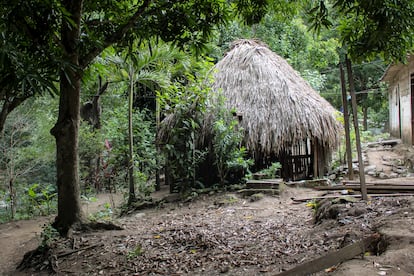
The Ette Ennaka live with a peculiar paradox. After spending decades hiding in order to survive, they have gradually regrouped in recent years and, without actively seeking it, have found themselves in a prominent position in the dispute over the future of the Línea Negra.
Conceived in the 1970s, the Línea Negra is a territory defined by sacred sites that, among other things, requires consultation with the Indigenous peoples of the Sierra Nevada before projects that could affect them are undertaken. The measure was formalized in 2018, during the government of Juan Manuel Santos, in the context of the peace agreement signed with the FARC guerrillas. But a legal challenge backed by mining and oil industry associations led the Council of State, one of Colombia’s highest courts, to strike down the decree in February 2026.
The lawsuit argued, among other things, that not all of the Indigenous peoples concerned had been consulted. The court agreed, ruling that the Wayuu, Chimila and Taganga communities should also have been included. When then-president Gustavo Petro signed a new decree in May, the Ette Ennaka saw an opportunity to reclaim rights that had been taken from them.
During the era of the Spanish conquest, explains sociologist César Rozo, director of the Teje Teje association, the Ette Ennaka were a collection of semi-nomadic groups that formed a nation spread across four departments on Colombia’s Caribbean coast: Magdalena, Cesar, Atlántico and La Guajira. They inhabited the plains and foothills of the Sierra Nevada, home to their principal deity, Yaao.
According to their elders, they fought the invaders to the death while other peoples retreated into the higher reaches of the mountains, forcing them to migrate to remote and inhospitable areas. Colonial records eventually declared them extinct. “But one thing is to cease being visible to those who wrote that history from the outside and quite another for the people to have ceased to exist,” explains anthropologist Caterina Villa De Liguori.

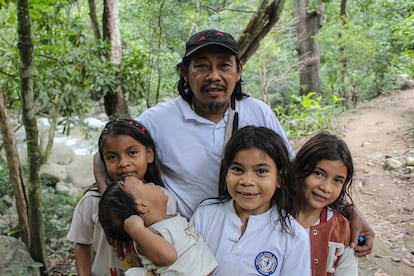
In the 1950s, violence by settler loggers scattered the survivors. Yet they managed to preserve their language, ette taara, as well as their origin stories, spiritual knowledge and ancestral practices, including the use of medicinal plants and the weaving of cotton bags. In 1990, a year before Colombia’s Constitution expanded protections for minority groups, they were granted land in the municipality of San Ángel, in the department of Magdalena. But the armed conflict eventually reached them too, bringing killings, displacement, forced recruitment and even bans on speaking their language.
Even so, “our grandparents did say these words: ‘We are not going to return to the Sierra Nevada again, but you, the new generations, will return to walk it’,” Sánchez recounts. Today, the Ette Ennaka — meaning “new people” — whose official population stood at 1,346 in 2017, estimate that they number around 4,000. They are spread across four reserves, including two in the Sierra Nevada, as well as a dozen settlements. “We changed the arrow for the word, because today we are no longer here to speak of war, but to unite, unify and speak of harmony and peace,” says the kraanti.
Reaching Nara Kajmanta requires travelling along an unpaved road that winds through small farms and roadside resting spots. The handful of houses in the reserve are no longer enough for a rapidly growing population living on mountainous land with limited farmland and patches of forest. One area is set aside as a burial ground.
On October 17, a dozen local authorities met in the maloka — the traditional communal house — to discuss their next steps and define the demands they would present in upcoming talks with other Indigenous authorities about the Línea Negra. Inside the cabin, with its earthen floor, they smoked cigars, their spirals of smoke filling the room.
“The Indigenous house does not belong to only four peoples. We want unity, but one that respects the teachings and traditions of each people,” the kraanti said before listing the community’s demands: the expansion of territory that had been ordered by a land judge but has yet to be guaranteed by the authorities; stronger food security; improvements in health care and education to reinforce their ethno-education project, through which they teach their language; and official recognition that there are seven Indigenous peoples in the Sierra Nevada, not just four.
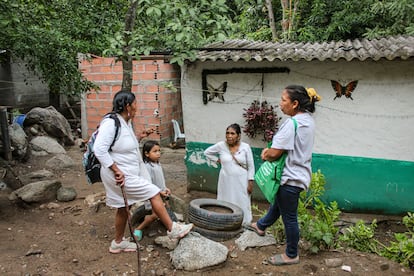
Above all, they want to be consulted on projects that affect their reserves and to secure the backing of other Indigenous peoples for recognition of the “Línea Blanca” (White Line), a proposal they have mapped out with the support of Teje Teje. Following the model of the Línea Negra, the map identifies their sacred sites, but the initiative has yet to receive official recognition. In some areas, the two territories overlap.
What is at stake is the recovery of at least part of what was lost. Before the Spanish conquest, the greater Chimila nation occupied more than 10,810 square miles. Today, according to Rozo, the Ette Ennaka have just 9,840 acres, or about 15 square miles, for some 500 families. Nearly half of that land is preserved in its natural state for environmental protection, leaving far less territory than Colombian guidelines recommend for sustaining family agriculture in the region.
The struggle, however, is far from straightforward. The four Indigenous peoples traditionally associated with the Sierra Nevada argue that the Línea Negra is rooted in their own worldview and spiritual mandates, which do not necessarily coincide with those of other Indigenous groups, although that does not negate the latter’s rights in the region. Speaking by phone, Kogui representative Juangil Garavito said he would not personally oppose the creation of a Línea Blanca, provided it is used “to defend the territory” and not for mining or hydrocarbon activities.
Meanwhile, the arrival of right-wing President Abelardo de la Espriella in August 2026 does not bode well for Indigenous communities. In his first months in office, he has pledged to turn mining and energy into engines of economic growth. During the transition from the previous administration, members of his team also indicated that he would seek to repeal the Indigenous Territorial Entities, a constitutional framework that allows Indigenous governments to administer their territories with a degree of autonomy. Although the mechanism was established in the Colombian Constitution decades ago, the first eight such entities were formally created only under the administration of Gustavo Petro. The presidency was contacted for comment but did not respond.
“How do we protect the Sierra Nevada with mining? That is, how do I keep you alive if I give you cyanide?” asked Arhuaco leader and adviser to Senator Caicedo, Saúl Mendiola.
For the kraanti, however, the current moment may also represent an opportunity. It could, he says, be “the moment of the Ette Ennaka.”
Sign up for our weekly newsletter to get more English-language news coverage from EL PAÍS USA Edition