America
The Longest-Living Fisherman Of Robinson Crusoe Island: ‘They’ll Have To Take Me Out Of My Boat In A Coffin’

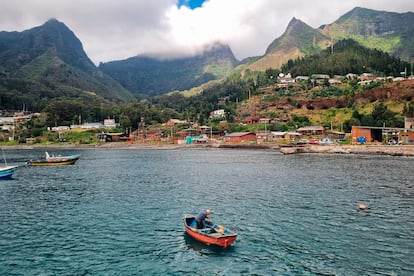
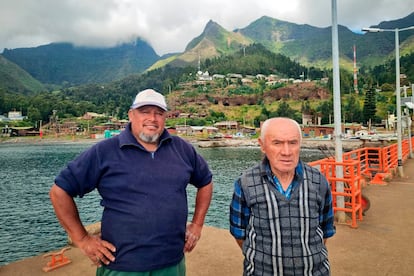
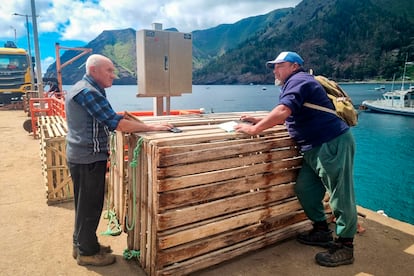
Under an intense sun and strong winds, Wilson González Celedón, 83, and his nephew Alberto Vergara Recabarren, 57, stand on the dock of Robinson Crusoe Island and push out the Lunajo II, the eight-meter (26-ft) boat in which they go out every morning in search of lobsters. They have worked together for more than two decades now, and both have a unique history within the Juan Fernández archipelago. This is one of the most isolated populated areas in Chile: it is located almost 700 kilometers (435 miles) from the mainland, and requires 36 hours of arduous navigation from the Valparaíso region to get here.
González is the longest-living fisherman in the archipelago. Vergara, meanwhile, was the first archipelago resident found alive—though in extremely serious condition—during the early hours of February 27, 2010, when a tsunami devastated part of the island region. “I am considered the first survivor,” he says as he introduces himself with a smile, although his memories are as distressing as they are devastating.
González was born on the island Más a Tierra, which in 1966 was renamed Robinson Crusoe by the Chilean state, in tribute to the 1719 novel of the same name by Daniel Defoe, inspired by the story of Alexander Selkirk, a Scottish sailor who lived there as a castaway between 1704 and 1709. He started working at 11 years old, when he started going fishing with his older brother, and by 13 he was a boat captain. “I didn’t waste my time,” says Wilson. He says he can’t imagine his life any other way than on a boat. “It’s just that I’m fascinated by the sea,” he points out.
He remembers that he only tried once to be a grocery store vendor, but it lasted barely a week. “I was more bored than a dog in a boat; there was nothing to do,” he recalls. This feeling is understandable given his experience, since he also spent 23 seasons fishing for lobsters in the Desventuradas Islands, located about 700 km (434 miles) from the archipelago, off Caldera, in the Atacama region, northern Chile: it took him two and a half nights to get there and he brought drinking water in galvanized jars.
Vergara, meanwhile, began his fishing career when he was about to turn 19. It was González who went to pick him up in Valparaíso, where he was living with his parents. His nephew grew up on the mainland, but spent almost every summer in Juan Fernández since his entire maternal family is from there: his mother Luz, who died in 2004; his grandparents, his cousins, his uncles Wilson and Luisa. “Since I was a child, I wanted to live here, but as a child I couldn’t make my own decisions. That’s why, as soon as I could, I came,” Alberto says.

He remembers perfectly the day in 1989 when his uncle Wilson said to him: “Do you want to go work in the Desventurada Islands?” That’s how his career at sea began, and they boarded the ship Carlos Darwin together. “It was the first time I was away from my house for so long, because the season lasts nine months,” Alberto says. He spent three lobster seasons in northern Chile: 1989, 1990, and 1991.
Like his uncle, Alberto has a passion for being a fisherman. “I’m no good for anything else. I used to work on a truck in Valparaíso, but the abusive way people get treated, especially when they’re new, was too much to take. Besides, teamwork didn’t exist.” González is the one who taught him lobster fishing and acted, his nephew admits, like a teacher. Together they spend up to 15 hours a day on the high seas. “We get along well,” says González, although both admit that, in almost 25 years, they’ve had a few brushes in the solitude of sailing. “That will always happen, because not everything can be rosy. Sometimes he has one opinion and I have another,” says Vergara. “It’s just like a marriage,” his uncle adds with a laugh.
In all the years they’ve been together, Alberto has left Lunajo about three times — the name comes from González’s children being named Luisa, Nadia, and Jonathan — to try his luck on other boats on the island. He did it “to cool off a bit,” but admits that as soon as he stepped on the first new boat, he felt uncomfortable. “You start to notice flaws that aren’t on the boat you worked on so many years. You’re nervous, bouncy, and honestly, you just don’t get used to it,” he says while his uncle watches him closely. “I’ve worked with several fishermen [there are 288 in the Juan Fernández archipelago] and not all are the same,” Vergara continues. And he explains that his uncle Wilson’s generation “teaches the good practices of old fishermen and the stories they tell are very different from those told now.”
González takes the opportunity to explain the routine of those old fishermen: “The first thing we do in the morning is have breakfast, but inside the boat. Then we prepare the bait [for the lobsters]. In the middle of his story, there’s something Wilson wants to highlight: “As I was saying, I’m fascinated by the sea. But I’m very respectful of the sea, because there are people who make reckless mistakes and that only leaves behind sadness.”
Since 2015, the lobster fishery in the archipelago—on the islands of Robinson Crusoe, Santa Clara, and Alejandro Selkirk—has had international certification from the Marine Stewardship Council, an eco-label that guarantees it is a sustainable fishery.
Nearly a farewell
On the night of February 26, 2010, the yellow house owned by Wilson González and his wife Luisa, located halfway up Robinson Crusoe Island, was the meeting place for a family barbecue and, of course, they also fried some fish. Alberto was one of the diners and he went home to his own house, located a few meters further down, facing the coast, shortly before midnight. The next day, as always, and very early in the morning, he would go out with his uncle to fish for lobsters. “I didn’t want him to leave, because we were having a good time,” González recalls.
At 3:34 a.m. on February 27, a devastating 8.8 earthquake occurred on the mainland, causing a tsunami in the regions of El Maule and Biobío, but also in Juan Fernández, without its 1,150 inhabitants ever being alerted by national authorities. González managed to receive a call from a sister-in-law from Valparaíso: “She said we should be very careful, because there was an earthquake. And no one knew here.”
Alberto remembers that that night, when he got home, he turned on the TV for a while to watch the Viña del Mar International Song Festival. “Suddenly I saw a stain, something black coming,” he still says with some fear in his voice. “I heard some screams, but who would have imagined what happened next.”

What happened was devastating. “Water entered my house, I broke my head against a beam, and the water carried me in about 100 or 200 meters (328 to 656 ft). It was dark, I couldn’t see anything, the only thing I could make out from afar were the school’s cypresses [the school was destroyed by the tsunami]. I started pinching myself, to see if it was a dream, while floating holding onto two sticks. The water was full of gasoline and oil. Then another wave caught me, and it threw me far away, another 200 meters beyond the pier.”
The waters only reached the door of González’s family’s home, located further up the hill. Desperate, Wilson remembers running down to check on his nephew, but when he arrived, he saw the house had disappeared. A harrowing search on the island began, while Alberto, after spending more than an hour in a sea full of debris, couldn’t take it anymore: “I had already given myself up. I told God: ‘I don’t want any more. If you’re going to send another wave, let it come with a stick and blow my head off at once.’”
The tsunami caused the death of 10 people in Juan Fernández, while six remain missing to this day. Alberto was the first resident to be found alive after the waves threw him onto the shore. That’s how he was found on the sand by a group of fishermen: “Is anyone there?” they called out. “Here,” Alberto replied and then fainted. He was taken in a van to the Juan Fernández health center, where his uncle finally found him. He was completely bloodied, his body swollen with salt, and had a broken leg. “He didn’t look very good, but he was alive. I was overjoyed,” González recalls.
Alberto spent five months hospitalized in two hospitals in Valparaíso, and upon his return to the island in July 2010, he was cared for by Wilson. “My uncle is like a second father, I’ve always told him,” he says. It was a difficult time in which he struggled to sleep because if he closed his eyes he could see himself underwater with the rubble hitting him. His kidneys were poisoned with salt, and the swelling in his body was such that he couldn’t fit in a wheelchair.
Despite those nightmares, Alberto just wanted to go out fishing again. A new boat was waiting for him, built after the tsunami, the Lunajo ll. “We came back in October 2010. At first it was hard for me, because of the images playing over in my mind. But the return was also exciting,” he recalls. “I couldn’t work at anything else,” he reiterates, standing on the dock. His uncle Wilson agrees, and after seven decades as a fisherman, he assures: “They’ll have to take me out of my boat in a coffin.”
Sign up for our weekly newsletter to get more English-language news coverage from EL PAÍS USA Edition