America
The Open Wounds Of Guatemala’s Civil War: 68 Victims Of Genocide Identified

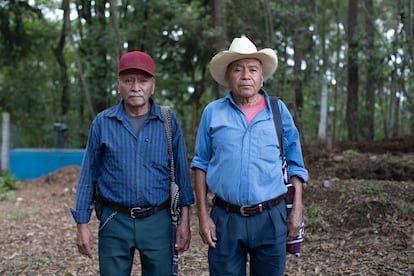
Simeón Atz Tzutuj, a 76-year-old farmer, lost his three daughters and his pregnant wife in an attack by the Guatemalan Army in Chimaltenango, a Kaqchikel Maya community located 41 miles west of the capital.
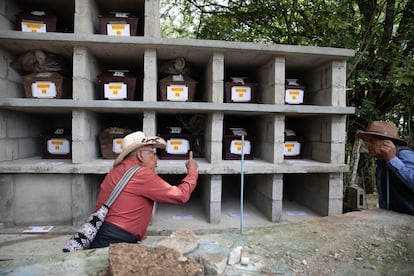
“The soldier arrived at my house and my wife came out. ‘Stand up, María, daughter of a great whore!’ he shouted. It was in 1982. I saw him from a distance. She came out of the house. They shot her here,” he says, pointing to his forehead.
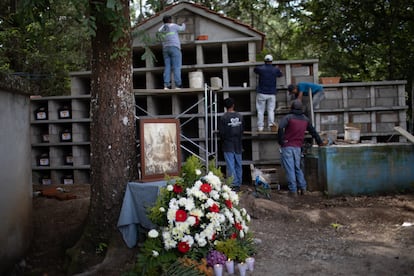
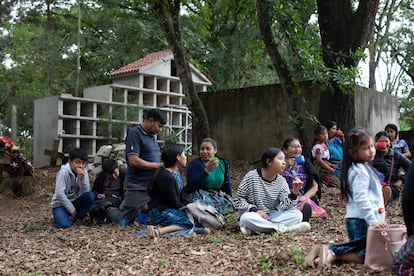
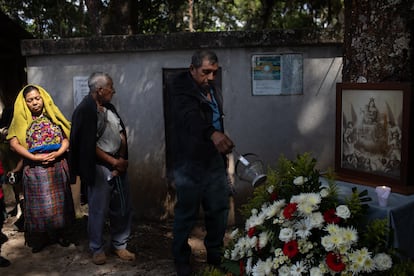
Atz Tzutuj is one of the relatives who attended the burial ceremony at the general cemetery of Pacoj, in San Martín Jilotepeque, where on Monday the remains of 68 victims of Guatemala’s internal armed conflict — killed between 1981 and 1982 in the region — were laid to rest.
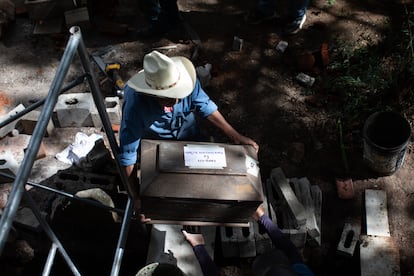
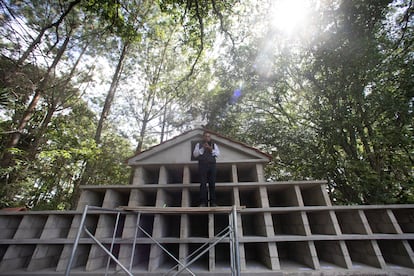
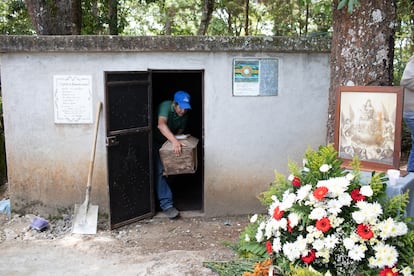
The Association for Justice and Reconciliation (AJR) and the Center for Forensic Analysis and Applied Sciences (CAFCA) organized the burial 44 years after the massacre. The remains of the victims, most of them men, had been kept in small wooden coffins, while others were stored in transparent plastic bags, stacked inside a small vault. They had remained there for 20 years until the two organizations, frustrated by the state’s failure to fulfill its promises, sought international assistance and, with support from relatives, managed to build individual burial niches.
“We rebuilt the damaged coffins and replaced those beyond repair. We have grouped family members together. They are now catalogued, and each person will have an individual plaque, along with a general memorial listing all the victims,” says José Silvio Tay, an adviser to the AJR board.
This is the second burial ceremony held in Chimaltenango, following the one organized in 2018, when the remains of 172 people were recovered from the military outpost in San Juan Comalapa, now transformed into the Landscapes of Memory Memorial. Tay says that the municipalities of San Martín Jilotepeque, Poaquil and Comalapa, all in Chimaltenango, accounted for the largest number of deaths at the site during Guatemala’s 36-year civil war (1960–1996).

What is known in Guatemala as the internal armed conflict left a deep scar on the country’s history. The darkest chapter of the war came in the 1980s, when the Guatemalan state implemented a brutal “scorched earth” strategy in the country’s western regions. This counterinsurgency policy bore down relentlessly on civilians and systematically targeted Indigenous Maya communities.
The signing of the Peace Accords in December 1996 brought an end to the hostilities, but it also opened a complex and still unfinished process of memory, justice and reparations. According to the Historical Clarification Commission (CEH), the war left more than 200,000 people dead or disappeared. The commission attributed more than 90% of human rights violations to state and paramilitary forces and described the massacres carried out in Maya territories as acts of genocide.
The San Martín massacre
On February 12, 1982, the army, under the command of then-president Fernando Romeo Lucas García, entered San Martín Jilotepeque and executed dozens of men, women and children. García was overthrown the following month by coup leader General Efraín Ríos Montt.
“It happened on a Friday. My brothers,who were still very young, tried to defend themselves. Some wrapped themselves in jackets. Others hid under the bed, but the army had no mercy and killed them. Only my mother survived. She was the one who gave us all the information,” says Cleto Martín Yool, a 65-year-old farmer.
That February day, several members of the Martín Yool family, along with other residents of the community, were dragged from their homes and executed together. Their mother survived by pretending to be dead as she lay on the ground. Cleto escaped the massacre because he was working in the sugar-cane harvests in the south of the country. When he returned home that weekend, he learned that his brothers and uncles had been killed.
He, too, came to the cemetery on Monday to accompany the reburial of 11 relatives. “I feel happy that finally we can light a candle and pray for each of our relatives separately; that will be an advantage,” says Martín Yool. “This was my late father’s struggle for reparation and it was never fulfilled until AJR took it upon itself to make it happen.”
Despite national and international investigations and complaints over human rights abuses, Lucas García was never brought to trial. His brother, Manuel Benedicto Lucas García, who served as army chief of staff between 1981 and 1982, was arrested in 2016 on charges of enforced disappearances and crimes against humanity. In 2018, he was sentenced to 58 years in prison in the Molina Theissen case. In 2024, proceedings began against him in the Ixil genocide trial, but the case never reached a verdict. Ríos Montt, who died in 2018, was convicted of genocide. During his rule, from March 1982 to August 1983, massacres left thousands of Maya Ixil people dead.
The burial ceremony began at 9 a.m. in the cemetery, attended by relatives and human rights organizations. It opened with a religious service, followed by the opening of the vault where the remains had been stored. The coffins were then passed hand to hand and carried one by one to the newly built niches. The process was expected to continue for at least another day. The AJR plans to hold an official handover ceremony for the niches on July 15, and will invite the entire community to take part.
Byron García, a consultant with the Center for Forensic Analysis and Applied Sciences (CAFCA), said the community spent years demanding a dignified resting place for its dead. Between 1998 and 2020, several exhumations were carried out, but many of the remains were placed in cardboard boxes that gradually deteriorated. During the tenure of former attorney general Consuelo Porras, numerous cases seeking to prosecute military officers accused of crimes against humanity during the internal armed conflict were suspended.
The community continues to demand that these cases be fully investigated. Although they face a long road ahead because many witnesses have already died, the community hopes that victims’ relatives can unite to present a more comprehensive case file to the Human Rights Attorney’s General Office.
“San Martín Jilotepeque was a town where cooperatives were developing at the time, working on soil restoration and water management, and this coincided with the years of the armed conflict,” Tay explains. “They [the military] thought these were defensive trenches and that people were organizing to become guerrillas. Although it is true that many young people from this town did join the guerrilla movement.”
Teodoro Atz Tzutuj, 70, Simeón’s brother, has never forgotten the horror his family endured. “I was cutting a pine tree, trimming its branches, and I heard the gunfire. I thought they were fireworks, but it was not the season for that. I came up to look for my family and they had killed my brother’s wife and two of my children,” he says.
Today, he says he feels a measure of peace knowing that his relatives can finally rest in a dignified burial niche — a place where he can visit them.
Sign up for our weekly newsletter to get more English-language news coverage from EL PAÍS USA Edition