Barcelona
The Photographic Universe Of Valérie Belin: Beauty Between Reality And Fiction

Valérie Belin, 62, maintains that, “throughout history, beauty has functioned as a Holy Grail.” That is, as an ideal that’s eternally pursued. It fascinates because it’s an enigma that no one has been able to fully decipher.
For the French photographer, who was born in Boulogne-Billancourt, an inner suburb of Paris, beauty is a social and illusory construct: “Synonymous with power,” she notes, “but, at the same time, with danger.” This is what happens with unattainable promises. From this starting point, a significant part of her work reflects a vain quest — one that is embodied in people who aspire to this ideal, as well as in objects that reproduce and stage it in the same way.
Recognized as one of the most outstanding photographers of her generation, Valérie Belin has developed a body of work that reveals the complex process of how identity and perception are constructed via images and stereotypes. The boundary between reality and fiction is blurred in her photography.

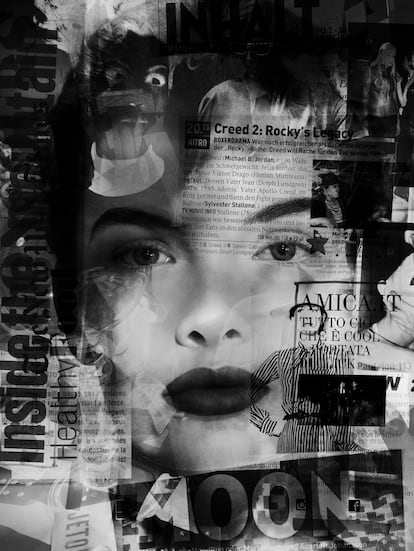
Belin’s large-format photographic series feature human figures, mirrors, masks, mannequins, shop windows and still lifes. These carefully-constructed images highlight the omnipresence of simulation in contemporary society, where the boundaries between beings, objects and images are blurred. Nothing is stable and nothing is what it seems in her work.
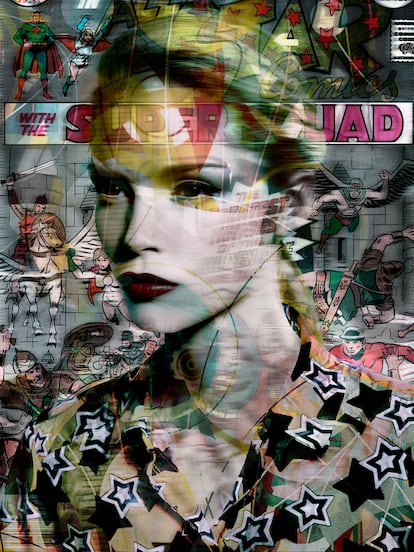
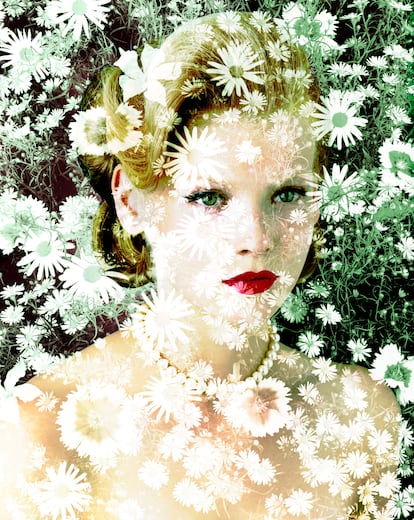
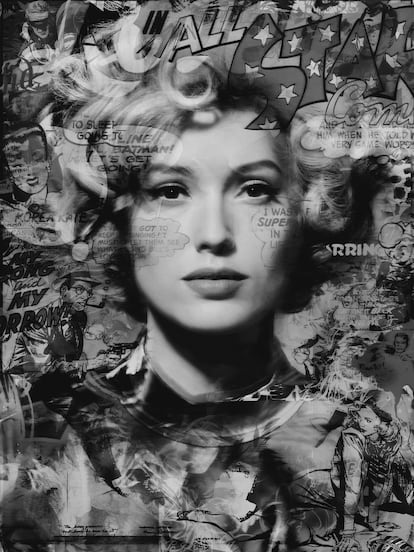
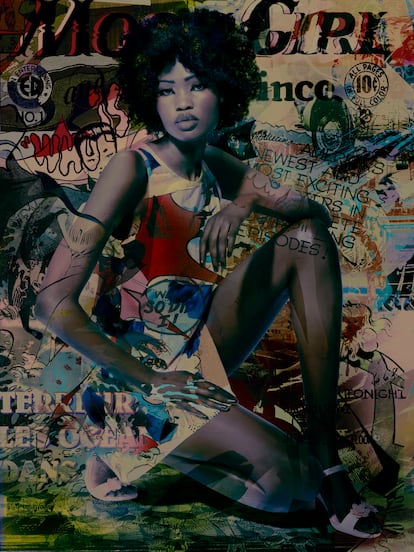
The Picasso Museum in Barcelona is dedicating an exhibition of 32 pieces to the photographer, representing her most emblematic series. Among them, three stand out: Venice II (1997), which multiplies the image to the point of almost erasing it through the use of mirrors; Black-Eyed Susan (2010), in which she merges female faces and flowers, blurring the boundary between subject and ornament; and Cover Girls (2026), where she combines close-ups of models in the studio with superimposed cutouts, to show how identity is shaped by multiple media influences. The exhibition invites us to imagine photography as a flexible medium, linked to artifice, interpretation and transformation.
Belin came to photography in the mid-1980s, while studying Fine Arts. Unlike the more introspective experience of painting, photography allowed for — and also demanded — an active connection with the outside world. “I’m very observant. I’m more about observation than about the act of creating something on a canvas,” the artist states.

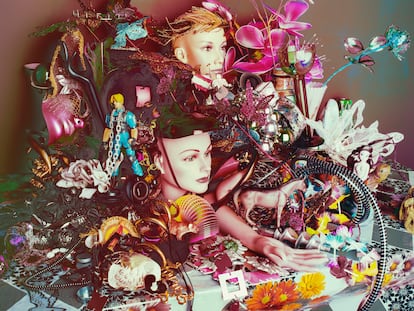
Her work departs from naturalism, occupying a space that’s both painterly and abstract. It draws on diverse influences, such as minimalism, pop art and the Baroque. In this context, exaggeration becomes a central element of her work: “[Since I created] my earliest pieces, I’ve photographed subjects and objects that are out of the ordinary, seeking a form of extreme beauty, often linked to excess,” Belin emphasizes.
She works intuitively, always leaving a gap between the initial idea and the final result. Her images are presented as fictions, in which post-production constitutes an experimental phase that takes up half of the creative process. “The objective of my photographs isn’t to show a soul, but rather its existence,” she clarifies. “That’s why, in my work, everything tends to stay on the surface, whether it’s the surface of objects or human beings. They’re phenomena or typologies. I work on that surface as a kind of canvas, on which I’m going to create a character [whose] gaze, posture, or expression reveals attitudes of alienation, narcissism, or psychological confinement.”

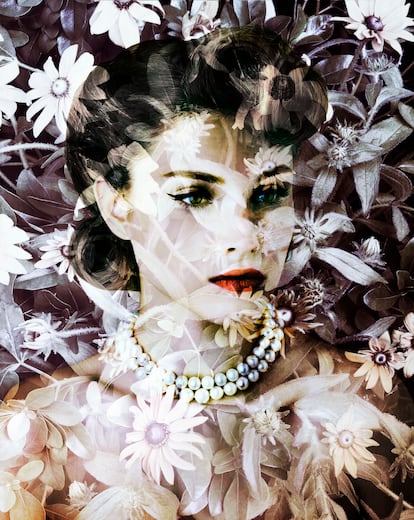
Similarly, she explores the tension between presence and objectification: “My images are of beautiful young women, but there’s always something jarring in them. You can sense that this woman is half-alive, in an intermediate state between existing and not existing; between being an image and being someone who resists this.” In her view, women remain vulnerable to stereotypes: “For a long time, the patriarchal system has made seduction a woman’s only weapon. There’s been progress — there are movements fighting against it — but it remains deeply ingrained in the collective unconscious.”
Her series share a common thread: the continuous reference to the fragility of life and a certain disorder that permeates our existence. Belin reminds us that everything we see, be it an object or a human being, is at once, an enigma, a reflection and a constantly-transforming canvas, where appearance becomes the very substance of meaning.


Sign up for our weekly newsletter to get more English-language news coverage from EL PAÍS USA Edition