
Delcy Rodríguez
Trump And Delcy Rodríguez’s Joint Hunt In The Gold Mines Of Venezuela








Those were turbulent times. It was November 2024 and Nicolás Maduro was holed up inside Miraflores Palace, the Venezuelan presidential residence. When any foreign leader hinted to him that it might be time to leave power, he answered with a single word: “Never.” The police and intelligence services under his command detained thousands of people who had taken to the streets to protest the electoral fraud that Chavismo had perpetrated in plain view of the world. Protesters had pulled down bronze statues of Hugo Chávez across the country. Prisons were overflowing. The nation was on the brink of rebellion or a bloodbath — or both.
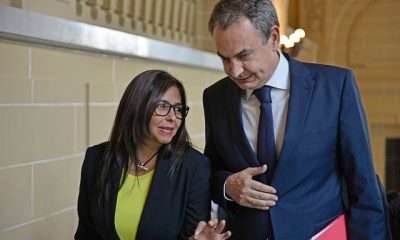
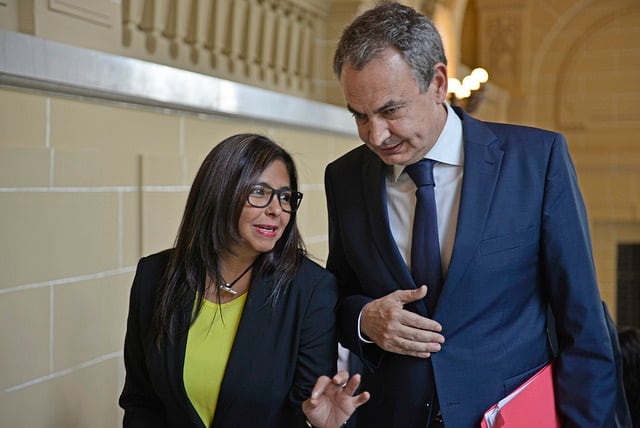
One day in that month of November, Maduro received in his office a tall, slim man who watched what he ate and went running several times a week. It was José Luis Rodríguez Zapatero, a former prime minister of Spain (2004-2011), and he was in the company of the Rodríguez (no relation) siblings, Jorge and Delcy, two people whom Maduro trusted wholly. At that meeting, previously unknown until now, Zapatero presented what came to be known as Plan Z, a proposal for Venezuela that takes on particular relevance now that the former Spanish socialist leader’s ties to the South American country are under scrutiny by a Spanish court that has charged him with alleged influence peddling.
The former Spanish leader had nothing down in writing at that meeting with Maduro, instead presenting his proposal verbally, witnesses to the meeting said. The main idea was to get Venezuela out of the deep institutional crisis it was experiencing, and Zapatero was proposing a constitutional reform to shorten the presidential term from six to four years, and to create the position of prime minister, a person who would be responsible for day-to-day governance. The president’s role — Maduro’s role — would be limited to that of head of state, a largely ceremonial function similar to that of some European countries. The proposal also included an amnesty law. There were not many more details; they were more like general guidelines that ultimately aimed at the same goal: removing Maduro from power. Chávez’s successor appeared to listen attentively; he nodded, then brought the meeting to a close without much ceremony. It was not unusual that, after meeting with him, interlocutors were unclear about what Maduro really thought. The fact is the Venezuelan president did not respond with anything concrete. Nor did he accept other proposals made to him at that time from Colombia, Brazil or the United States, offering him golden retirements in Cuba, Russia and Qatar. Nothing convinced him. Ultimately he did not leave the presidential palace willingly but by force, when a U.S. military unit attacked Caracas at dawn and took him away, dressed in a gray Nike tracksuit, to a prison in Brooklyn. U.S. President Donald Trump and State Secretary Marco Rubio watched the entire operation live on a screen.
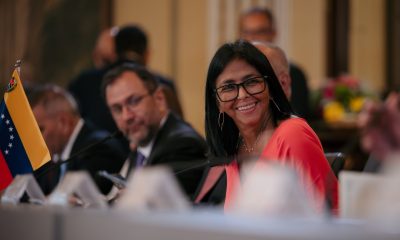
Plan Z was one of the former Spanish leader’s last attempts to achieve political change in Venezuela, a matter that had become a personal obsession for him, friends and close associates confirm. Since he began mediating between the Venezuelan government and the opposition in 2015, he has traveled to Caracas more than 50 times. According to EL PAÍS’ calculations, he went there 15 times in 2016, plus one trip to Washington to discuss Venezuelan matters. In 2017 he made 14 more visits to Caracas, and another nine to the Dominican Republic, where a negotiation table he led was established. Practically his entire agenda was consumed by this work. The following year he was in Venezuela six times, and also visited Rome and Bogotá on related missions. In subsequent years his trips dropped to a little more than two a year. The Venezuelan opposition’s hard-line wing, which later became the majority within the dissidence, began to distrust him because of his closeness to Chavismo — especially to Delcy Rodríguez, who is now the interim president of Venezuela following Maduro’s capture.
Zapatero’s political intervention in Venezuela has been surrounded by controversy all these years, but that has not moved him an inch from his position, much to the despair of many, including people in his close circle who urged him to distance himself. “You’re going to get burned,” someone close warned him. It has now been officially revealed that the Spanish courts are probing the former leader’s business activities in Venezuela. The Audiencia Nacional, Spain’s central criminal court, is investigating Zapatero for several alleged crimes that include money laundering, an unprecedented situation for someone who has held his office in Spain. Investigators place him at the apex of an influence-peddling network with Chinese and Venezuelan companies whom he allegedly he charged illegal commissions through Análisis Relevante, a consultancy registered in the name of Julio Martínez Martínez, a personal friend with whom Zapatero often went running.
Zapatero’s mediation has been conducted on the edge of an abyss. He has never wanted to jeopardize his relationship with Chavismo and has always been very careful with his words, even in the most dramatic moments. He did not comment on the 2024 electoral fraud, nor has he ever openly criticized the repression or the detention of opponents. He has avoided calling Maduro a dictator despite the fact that the latter is extremely unpopular, especially in his country, where he faced broad rejection in the polls. Privately, Zapatero tells those who regularly listen to him that such statements would endanger his own role as a facilitator, and bury all the work he has already done. He sees no point in blowing up the bridges of dialogue with one of the parties. Zapatero is one of the few interlocutors whom Chavista leaders feel has not abandoned them during this past decade in which Venezuela has sometimes been isolated, its economy shattered, and subject to sanctions by the United States and Europe for its authoritarian and repressive drift. “He has done so much good in his efforts to bring people together and act as a good intermediary. I don’t understand the determination to destroy him,” says someone close to Delcy Rodríguez.
Diplomacy with Chavismo is a kind of tightrope walk. One misspoken word, one offhand comment or one insinuation can be fatal. Ambassadors and high-level representatives have been blocked overnight on WhatsApp and Telegram over a single indiscretion. Not Zapatero. In Miraflores they have never stopped taking his phone calls. He has been photographed with Maduro and with Jorge and Delcy Rodríguez. Maduro posted online a relaxed-sounding phone conversation between the two in which he thanked him for his work and Zapatero responded kindly. That cordiality with Chavismo — one of the regimes that has most often confronted politicians around the world and has dominated attention like Cuba once did — is riskier than a base jump in terms of public image. Accustomed to dealing with verbal attacks from the political right in Spain, Zapatero believed he could also withstand criticism from Venezuela and from parts of the international community. His main concern? “The political prisoners. He has spent an ocean of time devoted to that. Freeing people has been one of the driving forces of his life these years,” summarizes someone very close to him.
In the circles close to María Corina Machado, the opposition leader, Zapatero is portrayed as the devil. They view him as a false friend who has actually helped to cement Chavismo in power. Zapatero advocated for dialogue tables and holding elections — processes that the hard-line opposition considered tainted, since the ruling party always played with an advantage by disqualifying or imprisoning its most popular rivals. And, as the election of July 28, 2024 showed, Maduro had no intention of leaving power. Zapatero’s optimism clashed with Venezuela’s harsh reality, according to those who reject his role in the country. He waded into murky waters.
He did so, curiously, at the request of the Mesa de la Unidad Democrática (MUD), a broad opposition coalition in Venezuela that had invited him as an electoral observer in 2015. In those days, Zapatero was pictured shaking Maduro’s hand, but in a press conference he defended himself by saying he was there to talk to everyone. One of the opponents who brought him to Venezuela says that another former Spanish prime minister, Felipe González (1982-1996) was also on their list of potential international observers, but they thought González would clash strongly with Chavismo. Zapatero, it was thought, would handle it with a softer touch.
In those 2015 parliamentary elections, according to this newspaper’s reconstruction of events, Zapatero played an important role in the public release of the voting results. The opposition swept the vote and delivered Chavismo its first defeat since 1999, since the rise of Hugo Chávez. Confusion among Maduro and his allies was total. It was the regional counting boards that proclaimed the winners, but Tibisay Lucena, the president of the National Electoral Council (CNE) — a die-hard Chavista — held the power to annul those proclamations. For hours, Chavismo kept an agonizing silence. According to three sources, Zapatero remained in touch with Lucena — who died in 2023 — and with the Chavista leadership in order to get them to acknowledge their defeat. In the end, they did.
That fell like a bombshell on Chavismo: they were not as beloved as they had believed. The legacy left behind by Chávez, who had died two years earlier, was not enough. Political polarization intensified. To prepare for the next elections, the presidential ones, Chavismo and the opposition had to be seated together in Santo Domingo. Zapatero served as mediator alongside the president of the Dominican Republic at the time, Danilo Medina, and other accompanying countries such as Mexico and Chile. It was three months of tug-of-war, and it was very exhausting. The opposition included people politically close to the left as well as those on the far right — a patchwork whose glue was the need to restore institutional order in the country.
Several participants in those talks recall a dispute between Zapatero and Jorge Rodríguez, then the head of Maduro’s delegation. That morning, Rodríguez had accepted the observation of the European Union, one of the basic points of the agreement, but that same afternoon he rejected it. This surprised Zapatero, who rebuked him for withdrawing a pledged commitment. It was a tense moment. Likewise, the former PM did everything possible to secure a signature, even if the conditions were not the most balanced. The opposition could not present any of the candidates it wanted — all of them had been disqualified — and the only one still standing was Henry Ramos Allup. Zapatero, according to multiple sources consulted by this newspaper, believed this was the best attainable outcome; Chavismo, which had the final say, would not give more ground.
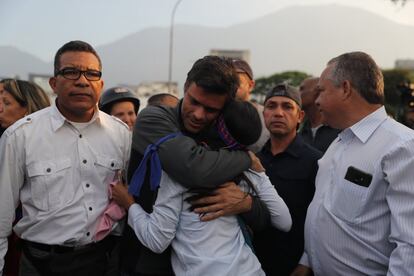
Zapatero tried by every means possible. He even visited the prominent opposition leader Leopoldo López at his Caracas home, where he was under house arrest after spending three years in Ramo Verde prison. Zapatero had visited him there three times and played a decisive role in his release. At a dinner at Leopoldo’s home he was unable to persuade him. However, he came close. Delegations traveled to Santo Domingo to finalize the agreement, but at the last moment the opposition backed away. “It was a devastating blow for Zapatero, a terrible disappointment,” says a witness who saw the president receive the news in a restaurant while he was having lunch.
The opposition had reasons to walk away from the table. They did not believe in Ramos Allup’s leadership and distrusted Chavismo’s ultimate intentions. They sensed they had no reason to leave without a prior negotiation. At that point a debate emerged that has lasted to this day: whether it was advisable to participate in the elections. The hard-line wing, later led by Machado, opposed doing so without sufficient guarantees. Losing to Chavismo, they argued, would legitimize Maduro and his allies before the world and give them credibility. Meanwhile, Zapatero and other opponents who remained committed to participation — such as Timoteo Zambrano, Eudoro González and Stalin González — argued it was better to take aprt and keep the Venezuelan electoral structure standing before the entire institutional framework collapsed and Chavismo took the final step to become a closed dictatorship.
That tension between factions has been constant and has soured to suffocating extremes. Machado sought to change the regime with the support of the United States, which by deposing Maduro on January 3, ironically, has left Delcy Rodríguez in power, so that Zapatero’s influence in Miraflores is even greater than before. That section of the opposition has been claiming for years that the Spaniard used his proximity to the Venezuelan government for his own affairs. They claimed his main interest was not democracy. They hinted that he owned a gold mine in Venezuela given to him by Maduro — an unverified claim published in the media that many Venezuelans accept as true without proof. Without the attention to detail and nuance required in any complex matter, Zapatero’s story in Venezuela becomes inextricably linked to Chavismo.
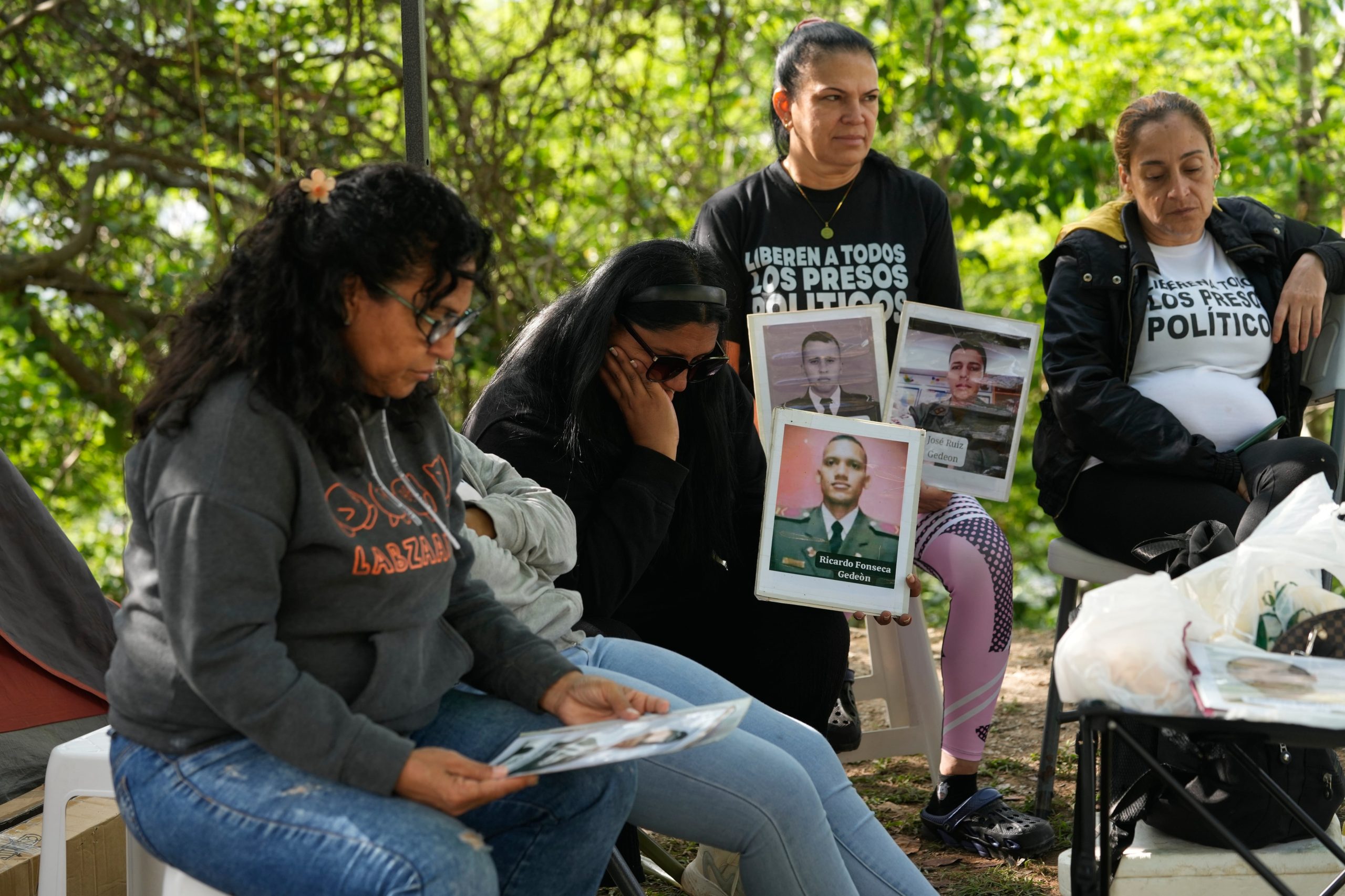
He has accepted paying that price, those who know him say. He is never seen to waver, not even when his wife, Sonsoles Espinosa, has pointed things out to him. A significant number of his friends are now Venezuelan. Zapatero responds to almost every message sent to him by relatives of political prisoners, many of them from María Corina Machado’s circle. He meets them in a room at the Santo Mauro hotel in Madrid; he notes what they need and informs the government at the first opportunity. His critics have sought to downplay that work, but with a list in hand there are hundreds of people who have been freed through his mediation.
That is the case of Ricardo Albacete, the 73-year-old businessman who during the 2024 campaign built the Corina-Mobile, a convertible vehicle that transported the candidate. “I told Zapatero: ‘Look, I’m a libertarian, somewhere between Milei and Bukele‚’” Albacete says in a Madrid café. Machado slept two nights at his house during her tour of the country. The Sebin, the Venezuelan secret service, detained him shortly afterward and he spent six months in prison. His family contacted Zapatero and he set the machinery in motion. According to sources with access to the negotiation, Diosdado Cabello, the Chavista regime’s number two official, refused to release him, so senior government officials and other allies of Zapatero had to mediate. Albacete was released in December 2025, at Christmas. “I adore María Corina, there is no one of her caliber, she is a stateswoman. A Nobel Prize winner. A woman for the history books. Above all, I want her to be president. But that does not stop me from thanking Zapatero and thinking he is a great guy. When I arrived here I gave him the names of two of my workers who were also imprisoned. Poor fellows, they had nothing to do with it. They were freed almost immediately,” Albacete adds.
Zapatero’s phone number is prized among the Venezuelan community. People write to him with all kinds of problems, from businessmen stripped of their assets to people entangled in Kafkaesque bureaucratic processes. Among the most prominent prisoners he has helped free in recent times there is the human rights defender Rocío San Miguel, General Miguel Rodríguez Torres, the candidate Enrique Márquez, and two young Spaniards accused of being spies for the intelligence agency CNI. Sometimes Zapatero has been accompanied in these efforts by Julio Martínez, a friend and businessman whose role in the influence-peddling case is being investigated in Spain. Martínez brought paperwork, assisted families, and on occasion visited prisoners in their cells. Spanish investigators have found notes of his travels with Zapatero in his notebook. On one page, in his own handwriting, it says: “Plan Z.”
Zapatero has not cracked in these two weeks and has secluded himself at home to prepare his legal defense. He denies the charges, and insists all payments he has received are legal. Despite all the problems, he has not stopped operating in Venezuela. In recent days he facilitated the return to Caracas of Rocío San Miguel and of Lester Toledo, an opponent close to Machado and until very recently a primary target of Chavista-controlled justice system. Both passed through the security controls at Maiquetía airport, the country’s largest, and walked out into the street without trouble. Zapatero himself was scheduled to make that same trip on May 19 in the mid-afternoon. However, early that morning he learned of his indictment for influence peddling and money laundering, and of the search of his office and his daughters’ company. He canceled the flight and read the indictment. He hopes, those close to him say, to clear everything up and soon prove his innocence. He still does not spend a minute without thinking about Venezuela, they say.
Sign up for our weekly newsletter to get more English-language news coverage from EL PAÍS USA Edition


Los Hogares Españoles Se Han Ahorrado 10 Euros Al Mes Durante La Guerra Gracias Al Auge De Las Renovables

Brasil Acusa De Homicidio Y Encarcela A Los Operarios Que Lanzaron A Una Mujer Sin Sujeción Desde Un Puente

Tobacco Prices Change Again In Spain

Europe Enters The ‘era Of Deportations’

Peru’s Roberto Sánchez And Keiko Fujimori Urge Caution As Vote Count Continues In Very Tight Presidential Election

Max Verstappen F1 future hangs in the balance as three teams block 2027 rule changes


-
 Africa2 weeks ago
Europe Enters The ‘era Of Deportations’
-
 Alberto Fujimori1 week ago
Peru’s Roberto Sánchez And Keiko Fujimori Urge Caution As Vote Count Continues In Very Tight Presidential Election
-
 Uncategorized2 weeks ago
Max Verstappen F1 future hangs in the balance as three teams block 2027 rule changes
-
 Barcelona2 weeks ago
Spain, A Country Of 50 Million People With Infrastructure For 40 Million: ‘The Cracks Are Starting To Show’
-
David Beckham2 weeks ago
A Journey Through The Ages Of Soccer In The United States
-
Costa del Sol2 weeks ago
Marbella Fair 2026 San Bernabe festival dates, concerts, and exciting upgrades
-
british holidaymakers2 weeks ago
Why more British tourists are choosing Spain over other holiday destinations in 2026
-
Latest2 weeks ago
Today In Spain: A Roundup Of The Latest News On Friday