Donald Trump
Ukraine, At An Impasse: Besieged By Putin And Abandoned By Trump

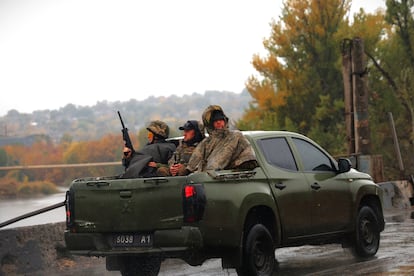
Dawn breaks under rainfall in Kramatorsk, a Ukrainian stronghold under Russian threat on the eastern front. What makes it harder for drones to fly becomes an opportunity for Russian infantry to try to gain ground. These are, in any case, small skirmishes. EL PAÍS reports this from a military command post in Kramatorsk based on images captured by drones on October 15. The front line shows hardly any change and the war is stuck in a complex tangle as the fifth anniversary of the full-scale invasion approaches. Kyiv has also recently suffered serious setbacks: at home, with attacks across around 20 of its regions, and internationally, the blow represented by the United States’ overt alignment with Russia.
Beyond the Kremlin’s imperial posturing, decisions in boardrooms and on international markets are also pushing Ukraine further away from a just and lasting peace — the kind frequently discussed in diplomatic forums and meetings. President Volodymyr Zelenskiy has accused his allies of not doing enough, especially after several ballistic missile attacks on his country last week about which Kyiv was not warned, as often happens. Behind this is published reporting that the United States could stop sharing intelligence with Kyiv. Added to that was a partial outage of Starlink, Elon Musk’s company, whose terminals are essential to the Ukrainian military, in what Zelenskiy called a “planned operation.”

Zelenskiy does not hide the fact that he feels betrayed by U.S. President Donald Trump at a time when relations between them have again soured. The U.S. and Russian leaders recently signed an agreement to release hundreds of thousands of barrels of diesel despite sanctions on Moscow. Beyond his outrage, Zelenskiy cannot openly confront Washington despite Trump’s repeated slights — whether because of the latter’s closeness to Vladimir Putin or because of the way the Republican belittles him and Ukraine. On October 17, responding to journalists via WhatsApp, he said he expected new meetings with U.S. negotiators to try again for an energy truce. But he is clear that Putin “wants our destruction. Surrender is not enough for him.”
Zelenskiy, in any case, is trying to keep his composure. After the U.S. president’s announcement of an “energy ceasefire” on October 11 — which never really existed because Moscow rejected it — Kyiv resumed strikes on Russian refineries. That further irritated Trump in a kind of vicious circle. “We Ukrainians have dignity,” Zelenskiy said on October 16 in Brussels. In a jab at the Republican magnate, he praised Europeans as “real leaders” who have stood by Ukraine “from the very beginning of this war.”
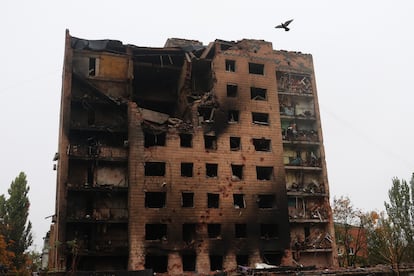
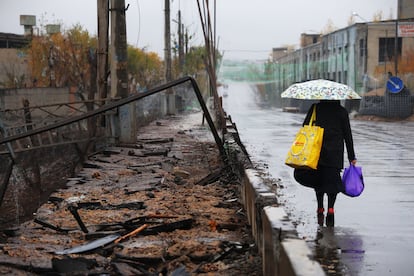
Meanwhile, ordinary citizens are bearing the brunt. Life in the country’s major cities, such as Kyiv, the capital, and Kharkiv, the second-largest city, remains disrupted by constant attacks that local air defenses fail to repel. Cuts to basic services are commonplace and nothing suggests conditions will improve.
Moscow’s main objective now is to shut off water, electricity, and gas as a new winter approaches. The attempt to ensure that attacks would spare energy infrastructure was nothing more than a mirage that few believed in when, as on previous occasions, Trump’s empty diplomatic gestures came to nothing at the first sign of trouble.
Bad weather, good weather
From a bunker in Kramatorsk filled with screens where Ukrainian troops watch the battle unfold in real time, orders are issued to those on the ground. Sitting in a chair like those used for long hours of gaming and wearing a tracksuit, Roman, a 42-year-old deputy battalion commander, admits his country is having a hard time.
He enlisted shortly after Moscow launched a military operation in 2014 to occupy part of Ukraine’s Donbas region, a precursor to the blow of the full-scale invasion of February 2022. Adverse weather hampers drones, he explains, but “helps Russian infantry to advance on land. This weather is ultimately worse because the Russians have more personnel and resources than we do and we cannot push them back. They move slowly, but they move,” he says.
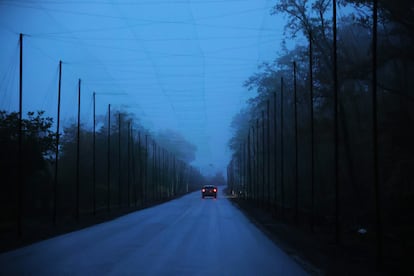
In four months it will be five years since the Kremlin launched its invasion. A trip through different regions of eastern and southern Ukraine is a reality check that helps explain the pessimism and fatigue among the population, although each person views the conflict through their own lens. The number of bombed gas stations keeps growing, as do the miles of roads and streets covered with netting to try to blunt the impact of Russian drones. There are stretches in Kherson, in the south, where there is evidence of Russian airstrikes almost every 50 meters — some with the wreckage of a vehicle nearby — that underline the measure’s limited usefulness and how they barely stop the smallest devices.
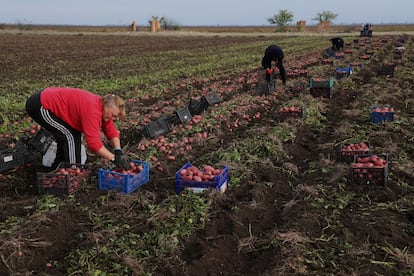
Not far from there, in the village of Sahaidachne, Natalia leads a crew of half a dozen women busy harvesting potatoes. The 42-year-old spent seven months under Russian occupation in Zmiivka on the banks of the Dnipro River. She recalls that there they had everything needed for a decent life — working the land and even with young people still in the town. In November 2022, after Ukrainian forces expelled the occupiers from the area, she ended up settled in this new village. “We don’t have money to move again,” she says resignedly, despite a recent incident when a drone landed next to the house where she now lives with her husband. She believes Moscow should return all occupied territory to Kyiv.
A little farther north, in Nyva Trudova, a small village in the Dnipropetrovsk region, three workers from an agricultural and livestock company share dinner. The oldest, Oleksi, 60, does not hide his hostility toward Zelenskiy, whom he considers “corrupt,” like those around him. He thinks Ukraine will not recover the roughly 20% of the country that Russia still occupies. For that reason, he believes a peace deal should be signed now and that Moscow should keep that territory, because otherwise, he says, it will continue to gain more ground.
Against the noise from Washington, Kyiv’s allies — especially in the European Union — have been unable to impose sanctions on Moscow that would prevent the military aggression from reaching its current extent. Zelenskiy conducts frequent rounds of talks and constant foreign visits, such as last week’s trips to London and Brussels, but Kyiv still lacks the weaponry and financing required to stop Moscow’s offensive, particularly its ballistic missiles and jet-powered drones. All this is unfolding amid an expanding hybrid war deployed by the Kremlin, whose tentacles increasingly reach across Europe.
In the underground command center in Kramatorsk, Roman puffs on an electronic cigarette as he recounts that during nighttime operations Russians camouflage themselves with special clothing so they are not detected from the air as heat sources. In the background, despite the rain, artillery thunders and air-raid sirens go off in the streets. On one of the televisions, the soldier shows footage captured that very morning by the camera of one of those unmanned aerial vehicles as it drops its bomb on an invading soldier trying to advance his position in the area. Minutes later, another device — this one classified as a surveillance drone — confirms the death. But it’s just one.
These unmanned systems have become the main protagonists of the armament revolution this conflict represents for both sides. Some are small, flying only a few thousand meters and carrying a kilo of explosives, while others have ranges and speeds that are difficult to counter. New drones — increasingly sophisticated alongside ballistic missiles and aerial bombs — allow Moscow to extend the front line and keep all of Ukraine permanently on edge. At the same time, surprising advances in Ukrainian industry, despite having less funding and resources, allow Kyiv to strike targets over 2,000 kilometers (1,240 miles) inside enemy territory.
Underground, Roman, despite the small trickle of Russian uniforms visible from the drones, knows there are thousands still trying to advance and take Kramatorsk, increasingly destroyed and deserted. This city is the largest under Kyiv’s authority in Donetsk region, of which Russia occupies about 70%. Putin will not renounce it. For that reason, Roman and the others fear that, as with Bakhmut and other nearby towns, Kramatorsk could end up falling.
Meanwhile, Natalia continues working in her potato field. She says her dog is unfazed by Ukrainian drones but hides when they are Russian. That gives this woman peace of mind and confidence. She says she has an official certificate of internal displacement but has not received from the government the money due to her after losing her home. She opens her phone and shows it, destroyed. “Why do we deserve this war?” she asks.
Sign up for our weekly newsletterto get more English-language news coverage from EL PAÍS USA Edition