Foreign demand
What Germany’s Car Crisis Could Mean For The Spanish Property Market
Germany’s car industry is in trouble. That matters for Spain because Germans are not just holidaymakers here — they are one of the most important foreign buyer groups in the Spanish second-home market.
The crisis unfolding in the German car industry is no longer just a boardroom problem in Wolfsburg, Stuttgart, or Munich. It could soon become a property-market problem in Mallorca, Tenerife, and other Spanish destinations that depend heavily on German buyers.
Volkswagen is reportedly weighing deeper job cuts (100,000) and possible German plant closures (4) as part of a dramatic restructuring, whilst the wider industry is struggling with weak demand, high costs, Chinese EV competition, and the painful transition away from combustion engines. Reuters recently reported that VW’s existing job-cutting plans may not be enough, with much bigger reductions under consideration.
The German automotive sector is not just another industry. It is one of the pillars of the German economy, employing hundreds of thousands of people directly and supporting many more through suppliers, logistics, engineering, finance, dealerships, and local services. Germany’s own car-industry lobby, the VDA, warns that the sector faces the potential loss of a further 125,000 jobs by 2035 if Germany and the EU fail to improve competitiveness.
Why this matters for Spain
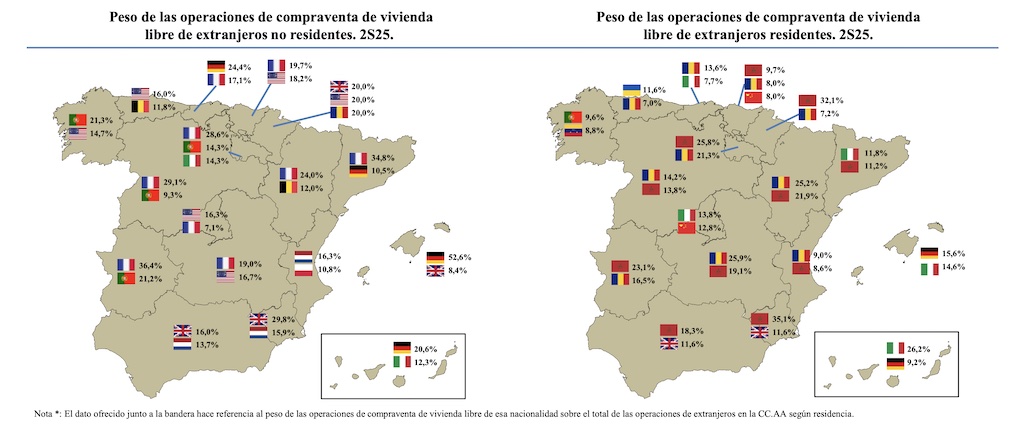
German buyers have long been one of the most important sources of foreign demand for Spanish property. According to notary figures (illustrated in the map above), they dominate the second-home market in the Balearics, where they account for more than half of foreign second-home purchases, and are also the leading group in the Canary Islands. They are number two in Catalonia and Cantabria.
For Spain as a whole, Germans have usually been the second-biggest foreign buyer group behind the British. They briefly took first place in 2021, but since the end of 2025 have slipped into third place behind the Dutch.
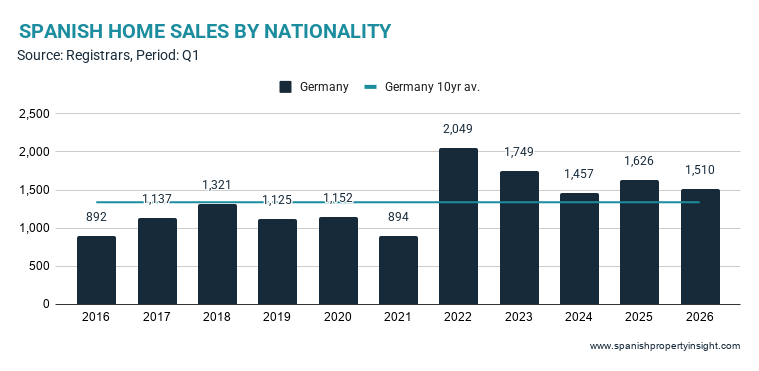
Registrar data already show German acquisitions of Spanish property declining year-on-year for three consecutive quarters. That does not yet amount to a slump: German demand remains well above pre-pandemic levels. But the direction of travel is no longer encouraging.
Could early retirement soften the blow?
There is one possible twist. A wave of restructuring in Germany might push some older workers into early retirement, and Spain could look attractive to those with decent pensions, savings, and a desire to make their money go further in the sun.
That may support some demand, especially from wealthier households. But it is unlikely to offset the broader damage if Germany’s industrial crisis deepens. Rising uncertainty tends to make people delay big discretionary purchases, and a second home abroad is about as discretionary as it gets.
The most exposed markets
The Balearics and the Canaries are the most exposed because German buyers play such an outsized role there. Mallorca in particular has spent decades building a market around German demand, from modest apartments to luxury villas. If German confidence and spending power take a serious hit, these markets will feel it first.
Catalonia could also be affected, though German demand there is less dominant and the region has other problems of its own, not least investor-hostile policies and high transaction costs.
The bottom line
A German car-industry crisis will not crash the Spanish property market on its own. Foreign demand is diversified, and British, Dutch, French, Belgian, Nordic, and domestic buyers all matter.
But if Germany’s industrial troubles turn into a wider economic malaise, Spanish second-home markets with heavy German exposure should expect weaker demand, longer selling times, and more price sensitivity. The Germans are not disappearing from Spain. But they may arrive with less confidence, tighter budgets, and a stronger instinct to wait and see.