Housing politics
Which Election Result Would Do The Least Harm To Spain’s Housing Market?

Author: 
Posted on

Spain votes this Sunday in a general election called by Socialist Prime Minister Pedro Sánchez after Congress rejected his housing decrees. I look at what the parties propose and ask which election result is most likely to ease the housing crisis.
How I judge the promises
My view is that political intervention in housing tends to backfire. Government has a clear job to do. It should plan neighbourhoods well, enforce basic building standards, fund social housing for those who need it and invest in public transport. For the rest of the market, from modest flats to luxury homes, the priority should be to make building easier where people want to live. Simpler rules, predictable planning decisions and fewer delays would cut costs and give private investors a reason to build.
The same principle applies to renting. Rent caps can benefit sitting tenants, but they also make it less attractive to let a property or spend money maintaining it. The people who pay for that are those still looking for a home, especially those on lower incomes. Spain also needs legitimate temporary lets for students, people on work assignments and those who travel for medical treatment. Blaming landlords, foreign buyers and investment funds may win votes, but deterring their capital leaves a gap the government is in little position to fill. That’s my test for the parties’ promises. Will they make it easier to build, maintain and let more homes?
Eight years of promises
After eight years of socialist Sánchez-led leftwing government, Spain still builds too few homes where demand is strongest. The Bank of Spain identifies constraints on supply as a principal factor in the shortage. Since the 2023 Housing Act opened the door to local rent caps, affordability has continued to deteriorate. In the second quarter of 2026, house prices rose 12.2% year on year. In the third quarter, Idealista had 10% fewer long-term rental listings than a year earlier. And in the first nine months, registered sales of price-regulated homes fell 10%, compared with 3.2% for market-rate homes. Those sales include existing homes, so completions are the figure to watch when ministers promise new ones.
The least bad
- Popular Party (PP). The clear first choice on housing. Repealing the Housing Act, removing rent caps, freeing up land and speeding up planning would give builders and landlords more reason to invest. A million homes is a campaign promise. The planning reforms are what matter.
- Vox and Junts. Vox would repeal the Housing Act too, but its plans to tax non-EU buyers more heavily and give Spaniards priority for subsidised housing count against it. Junts deserves credit for protecting small landlords and backing new construction, though it also wants to bar certain funds from buying rental homes.
Bad
- The Socialists PSOE would double down on rent intervention. Coalición Canaria wants to restrict foreign purchases and holiday lets. The Basque nationalist PNV has sensible proposals on planning and renovation, but its support for extending existing tenancies by decree makes me wary. SALF (The Party is Over Party) has some attractive ideas on purchase taxes and rent guarantees, alongside a promise to make first homes 35% cheaper by law.
Terrible
- Frente Amplio, Podemos, ERC, EH Bildu and Compromís. The details vary, from Podemos’s proposed 40% rent cut by law to ERC’s higher taxes on second homes and Compromís’s proposed ban on purchases by non-residents in high-pressure areas. Across these programmes, tighter controls, higher taxes or expropriation would, in my view, deter the investment Spain needs to ease the shortage.
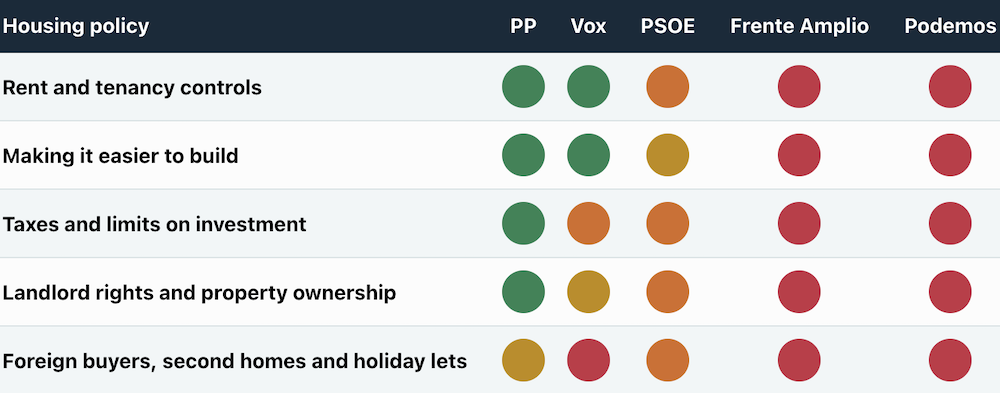
How housing-friendly are the parties’ programmes?
More market-friendly Mixed or unclear Unfavourable Strongly unfavourable
| Housing policy | PP | Vox | PSOE | Frente Amplio | Podemos |
|---|---|---|---|---|---|
| Rent and tenancy controls | |||||
| Making it easier to build | |||||
| Taxes and limits on investment | |||||
| Landlord rights and property ownership | |||||
| Foreign buyers, second homes and holiday lets |
What the next government could mean for housing
The polls put a PP majority on its own well out of reach. The likeliest route to a PP government is with Vox, either in coalition or with its support in Congress. That’s the least bad outcome for housing in my view, though Vox’s proposed tax penalties for non-EU buyers would be bad news for the second-home market.
A PSOE-led government relying again on parties to its left would, I expect, bring tighter rent controls and more restrictions on owners and investors. After eight years of Sánchez-led government, it’s hard to see how more of the same would make homes easier to find or afford.
Even if the PP and Vox can agree to repeal the 2023 Housing Act and make it easier to build, it takes years to turn a planning reform into homes people can move into. That’s what’s riding on Sunday’s vote for the housing market. The next government can start to ease the shortage, or spend another term making it harder to fix.