Connect with us

%

Foreign Population Boom In Spain

Published

on

foreign-population-boom-in-spain

The number of immigrants living across the European Union has reached a historic high, with 64.2 million foreign-born residents recorded in 2025. The figure, published in a new report by the Centre for Research and Analysis on Migration at RFBerlin, marks an increase of around 2.1 million in just one year.

Drawing on data from Eurostat and the UNHCR, the report highlights how migration has steadily reshaped Europe over the past decade. Back in 2010, the total stood closer to 40 million, underlining the scale of change.

Germany remains the bloc’s largest host country, with close to 18 million foreign-born residents. But it is Spain that is now drawing attention for the speed of its recent growth.

Spain’s surge in foreign-born residents

According to the same report, Spain has experienced one of the fastest increases in foreign-born population in the EU, adding roughly 700,000 people in a short period.

That brings the total number of foreign-born residents in Spain to around 9.5 million: a figure that reflects people born outside the country, including many who may now hold Spanish nationality.

This distinction matters. Official headlines often refer to “foreign population” as those without Spanish citizenship, which produces a slightly lower figure, closer to nine million. But when measured by place of birth, the true scale of Spain’s international community is significantly higher.

A visible shift in daily life

For foreign residents already living in Spain, these figures simply confirm what is visible on the ground.

From Barcelona to the Balearics and along the Costa del Sol, international communities are no longer niche, they are part of the mainstream. Schools, workplaces and neighbourhoods are increasingly multilingual, reflecting a country that is becoming more diverse by the year.

Whether it’s remote workers from across Europe, Latin American families settling long-term, or retirees seeking a better quality of life, Spain continues to attract people for a mix of economic opportunity and lifestyle appeal.

Growth driven by necessity

This surge is not just about desirability, it is also about demographic reality.

Spain, like much of Europe, faces an ageing population and low birth rates. As a result, population growth is now heavily dependent on arrivals from abroad. The RFBerlin report notes that the majority of migrants are of working age, making them vital to the labour market and broader economy.

In practical terms, this means foreign residents are playing an increasingly central role in sustaining public services, filling workforce gaps and supporting long-term economic stability.

Pressure points and growing pains

But rapid population growth brings challenges too.

In some of Spain’s most sought-after regions, rising demand is putting pressure on housing, infrastructure and local services. Rental markets remain tight, prices continue to climb, and concerns around overdevelopment and tourism saturation are becoming more pronounced.

For foreign residents, this creates a complex picture: Spain remains one of Europe’s most attractive places to live, yet the very popularity driving that appeal is also contributing to strains in certain areas.

A long-term shift, not a short-term trend

What is clear from the data is that this is not a temporary spike.

Migration across the EU has been rising steadily for more than a decade, and Spain’s recent surge forms part of that broader, long-term pattern. The country is not just experiencing growth, it is undergoing a structural demographic shift.

What it means for foreign residents

For those who have made Spain their home, the takeaway is simple: this is no longer a fringe experience.

The foreign-born population is now a fundamental part of Spain’s identity: shaping its economy, culture and future direction. The “expat” label is becoming less distinct as international residents form an ever larger share of everyday life.

So whether you arrived recently or have been here for decades, the numbers tell a bigger story.

This isn’t just about statistics… it’s about how Spain is evolving, and where you fit within it.

%

Spain’s 018 Accident Helpline Is Now Live. Here’s What Happens When You Call

Published

on

spain’s-018-accident-helpline-is-now-live.-here’s-what-happens-when-you-call

Being involved in a road collision abroad can be more difficult than at home. Photo credit: vladimir subbotin/Shutterstock

Starting today, April 23, the 018 road accident helpline is active in Spain as a national support service for people affected by road traffic accidents. Operated by the Dirección General de Tráfico (DGT), it provides assistance across the country to anyone involved in or impacted by a road incident.

Unlike emergency services number 112, 018 is not designed for reporting an accident as it happens. It is intended for use afterwards, when immediate danger has passed and people may need help understanding what to do next. The service is available 365 days a year, from 08:00 am to 09:00 pm, giving callers access to support throughout the day, including weekends and public holidays.

What happens when you call 018

When you dial 018, you are connected to a trained support operator rather than emergency responders. The call is handled by staff who guide the caller through the situation step by step. The conversation usually begins with basic details about the accident. This may include when and where it happened, whether emergency services were involved, and whether medical attention has already been received. 

From there, the focus shifts to the caller’s current needs. This can include emotional support if the person is distressed, disoriented or dealing with shock after the incident. The final part of the call is practical guidance. Call handlers explain what typically needs to be done after a road accident in Spain, such as how to obtain reports, what steps may be required with insurance providers, and where to seek follow-up support.

The service is also designed to be accessible to international users, with assistance available in up to 50 languages, helping non-Spanish speakers communicate their situation and understand the guidance provided. The aim is to help the caller leave the conversation with a clearer understanding of what to do next.

Who the service is for

The 018 helpline is available to anyone affected by a road traffic accident in Spain, regardless of nationality or residency status.

This includes:

  • Residents living in Spain, including foreign nationals 
  • Tourists involved in road traffic accidents 
  • Family members of injured or deceased individuals 
  • Witnesses directly affected by a serious incident 

For expats and tourists, the service can be particularly helpful when dealing with unfamiliar procedures or language barriers after an accident.

The helpline is available nationwide and can be accessed from anywhere in Spain.

What kind of help you can expect

The support offered through 018 covers several types of assistance that are commonly needed after a road accident. Callers may receive psychological support if they are dealing with shock, anxiety or emotional distress following the incident.

They may also be given basic legal orientation, helping them understand general next steps after a collision, including documentation and reporting processes.

In addition, the service can provide information on accessing medical care and rehabilitation services, as well as guidance on relevant public support options. In more serious situations, such as major injury or bereavement, family members can also be supported and directed towards appropriate services.

For foreign residents and visitors, this can help reduce uncertainty when dealing with processes they may not be familiar with.

A support service, not an emergency line

The 018 number is not an emergency service. It does not replace 112, which remains the number for urgent medical assistance, police response or fire services. If an accident is happening or there is immediate danger, 112 should always be called first.

018 is intended for use after the emergency has been resolved, when people need help understanding and managing what comes next. It is also not a substitute for formal legal advice, insurance handling or medical diagnosis. Instead, it provides general guidance and helps direct people towards the appropriate services.

People can contact the service in several ways:

  • Telephone: 018
  • WhatsApp: 645 713 823
  • Email: victimastrafico@dgt.es
  • Online contact options through official DGT channels

This range of contact methods may help travellers who do not have immediate access to a local phone line but can use mobile data or messaging apps.

Part of the accident aftermath support process

The introduction of 018 provides a single national contact point for people dealing with the aftermath of road traffic accidents in Spain. For many people, especially those unfamiliar with the system, the period after an accident can involve uncertainty around documentation, medical follow-up and administrative steps.

This service brings those queries into one place, offering structured support at a time when individuals may be under stress. In simple terms, the distinction is clear: 112 is for emergencies, while 018 is for guidance once the immediate situation has passed.

Continue Reading

%

British Woman Honoured 42 Years Later For Life-Saving Bridge

Published

on

british-woman-honoured-42-years-later-for-life-saving-bridge

The Benavista community safe due to one woman’s determination. Credit: EWN

Heroes often come in the form of people who simply refuse to look the other way. Stella Bosworth returned to Estepona on Thursday, April 23, to receive a silver plaque in honour of her unwavering determination in 1984. That year, she witnessed the lethal nature of the coastal road, the A340, now the A-7, and delivered a stern ultimatum to her boss: build a bridge or lose a manager.

Stella told her boss, developer Alan James, in no uncertain terms, “I’m going to have to resign, because I don’t want any more people being killed on that road. We’ve got to build a bridge.” Her stance provoked a movement that transformed safety on what was then one of Europe’s most dangerous stretches of tarmac. Alan James, founder of The Experience Group, took the extraordinary step of privately funding the crossing after official channels failed to act.
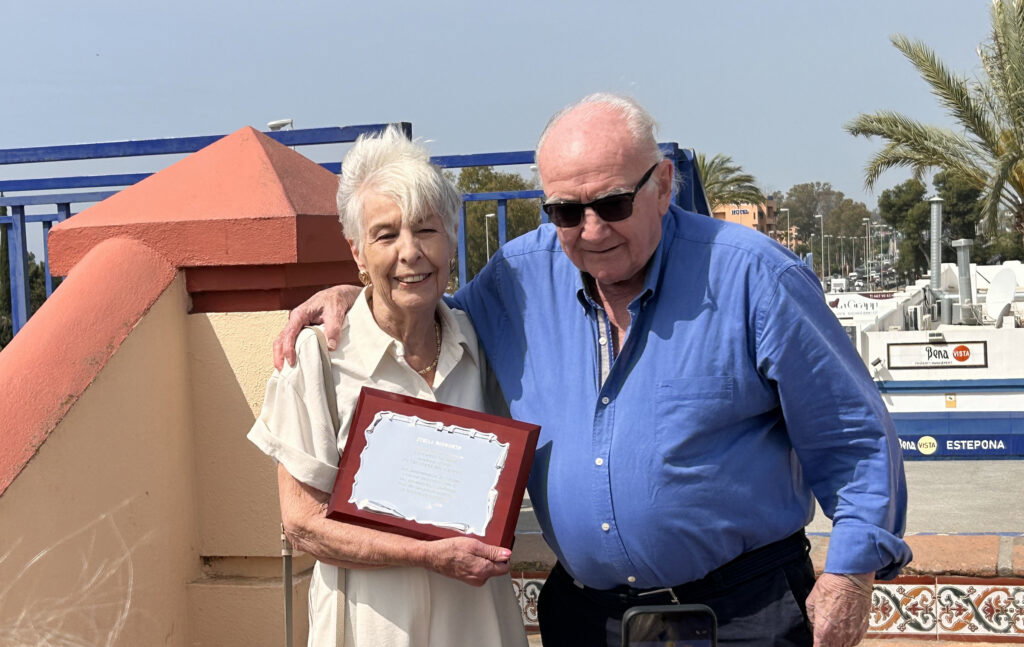
Alan James thanks Stella Bosworth.
Credit: EWN

Private funding for public safety

Alan recalled the frustration of the era during the presentation at the Benavista footbridge. “I went to Estepona town hall, but nothing. I went to the Malaga town hall, but nothing,” he explained. He decided the community could not wait any longer for bureaucrats to move, as the delays were impacting essential services and safety in the area. “We decided that it had to be done, so we paid for it and built the bridge. So, it was the determination from this lady, when she was still a slip of a lass, that saved hundreds of lives.”

Dangers are still there on the A-7

Danger remains a constant on the A-7, as evidenced by a three-car pile-up that occurred just 30 metres away, only five minutes before the ceremony started. This accident served as a grim reminder of why Bosworth’s intervention was so vital. Without her tenacity, Alan believes a footbridge “probably wouldn’t have even been thought of for another 10 years”. Scores of similar crossings now line the coast, yet this original structure remains a symbol of individual initiative and life-saving determination.

Council confirms long-awaited upgrades

Estepona councillors attended the ceremony to officially announce that extended works have been approved. Funding for ramp access is now budgeted, making sure that people with disabilities, the elderly, and parents with prams will be able to access the crossing safely. Stella Bosworth and Alan James remain an inspiration, proving that taking the first step can create a lasting, life-saving legacy for the community.


Continue Reading

%

Fire At La Ermita Industrial Estate

Published

on

fire-at-la-ermita-industrial-estate

Emergency services quickly and efficiently brought under control a major fire that broke out on Thursday, April 23 in the morning at a candle warehouse in the La Ermita industrial estate in Marbella. 

The incident began shortly before 10am, according to local reports, and produced a large column of black smoke that was visible from several parts of the town. The smoke prompted a rapid response from emergency services.

Firefighters from Marbella and surrounding areas were deployed to the scene, supported by Local Police, National Police, and medical personnel. More than 20 firefighters and multiple fire engines were involved in the operation at the warehouse on Calle Hierro. 

The cause of the fire is yet to be determined

Three people were reported injured. Emergency services treated them at the scene. Thankfully, the injuries were described as minor and included one of the people suffering smoke inhalation and the other two injured members with minor burns. 

The unfortunate fire affected a large warehouse used for the storage and production of candles. The building contained highly flammable materials associated with candle manufacturing and storage.

Police quickly established a wide security perimeter around the industrial estate to allow emergency crews to work at speed. Access to parts of the area was restricted while firefighting operations were carried out. Power interruptions were reported in nearby areas during the incident, according to local sources.

By early afternoon, emergency services thankfully reported that the fire had been brought under control. Firefighters remained at the scene to continue to extinguish remaining hot spots and secure the affected structure.

No fatalities were reported from the scene

The warehouse has sustained significant damage as a result of the fire. Nearby buildings were monitored by emergency services during the response.

The cause of the fire has not yet been confirmed by authorities and crews continue to work to determine the start of the incident. No fatalities were reported from the incident. 

Continue Reading
Advertisement
Advertisement

Spanish Real Estate Agents

Tags

Trending

Copyright © 2017 Spanish Property & News