Connect with us

Latest

Spanish Citizenship Concessions ‘treble’ Under Sánchez, Data Shows

Published

on

Though the headline figures show a trebling under the current Socialist government, in reality the data is more nuanced and the Sánchez government’s high rate of citizenship concessions isn’t out of keeping with recent history.

The number of people gaining Spanish citizenship per year has trebled under Socialist Prime Minister Pedro Sánchez, new figures have revealed.

The full data, however, hides nuances about the granting of Spanish nationality over time and reveals that although record-breaking, the rate at which Spanish nationality is given out under this current Socialist (PSOE) government is not an historical anomaly. 

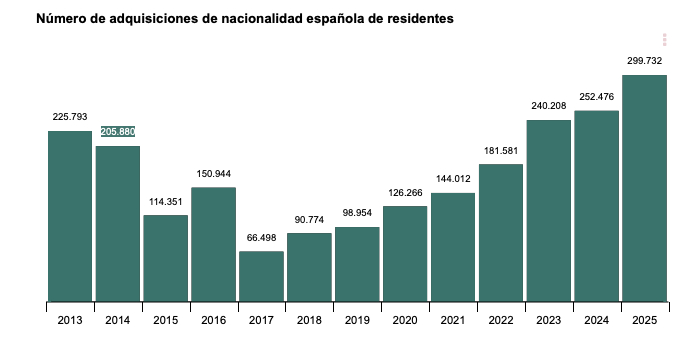
According to a report by Spain’s national stats body, INE, during 2025, a total of 299,732 foreign nationals residing in Spain acquired Spanish nationality.

This figure represents an increase of 18.7 percent year-on-year and is “the highest on record”, the body states.

The figures provided by the INE relate to the most common route to obtaining nationality, which is available to those who can already prove a minimum period of residence in Spain – usually 10 years for most foreigners.

READ ALSO: Spain grants citizenship to 300,000 foreigners in one year

You have the right to apply for Spanish citizenship generally if you have 10 years of continuous legal residency in Spain or five years if you’re a refugee.  

Those from Spanish or Portuguese-speaking Latin American countries, Andorra, Equatorial Guinea, the Philippines or Portugal, however, will only have to wait two years.

The breakdown of the INE nationality data shows that most common countries of origin for foreigners becoming Spanish by residency were Morocco (42,114), Colombia (37,712) and Venezuela (36,271).

Catalonia (70,933) and Madrid (69,566) were the regions with the highest number of residents acquiring Spanish nationality in this way.

Where the data has really grabbed attention in the Spanish media, however, is in the increase over the medium to long-term.

If we look at the year Sánchez came into power, 2018, and compare the number of citizenship concessions with the most recent data, 2025, we see a more than trebling of nationalities awarded annually.

In 2018 some 90,774 nationalities by residency were awarded, compared to almost 300,000 (299,732) in 2025.

However, some important nuance is needed here.

Though it’s true that concessions have trebled between 2018 and 2025, that doesn’t necessarily mean that the Sánchez government — portrayed by its opponents as radical leftists trying to socially engineer the census for electoral gain — is responsible for the change, or, indeed, that such high figures are historically incongruent with governments that came before it.

If we go further back in the data set, we see that annual concessions of 200,000 per year or more is not unusual. 

In fact, in 2013 (225,793) and 2014 (205,880), Spain handed out more citizenships than that — under a centre-right Popular Party government fronted by former Prime Minister Mariano Rajoy.

As the graph shows, from 2017 (66,498) to 2019 (98,954) there was a severe drop off in the number of foreign residents granted Spanish citizenship. 
Spanish naitonalitry graph

Photo: INE.

Furthermore, though reports in the PP-sympathetic Spanish press have framed the news as a direct tripling “under Sánchez”, while a politically convenient interpretation this is not analytically correct.

Not only are hundreds of thousands of new Spaniards a year nothing new and in keeping with previous rates, it’s important to note that INE statistics record the year in which nationality was acquired, not necessarily when the application was made.

This could mean, for example, that some of the thousands of foreigners who became legally Spanish under the Sánchez government actually applied and were approved under the Rajoy government.

Or, equally, that some of the more 200,000 who gained citizenship in the early years of the Rajoy government actually applied under the previous Socialist administration.

Similarly, annual totals can be affected by administrative speed, bureaucratic backlogs, changes in the law affecting eligibility, and events, such as the figures for 2020 and 2021 suggest.

Similarly, citizenship via long-term residency isn’t the only way to get Spanish nationality. 

Under the Sánchez government, new routes have been opened to those eligible to become Spanish nationals but who reside abroad.

This is an option provided for under the Historical Memory Law, among various other ways.

In total, taking both procedures into account – those for residents and those for non-residents – the total number of new Spanish nationals recognised by the Sánchez government is estimated to amount to 1.8 million between 2018 and 2025.

READ ALSO: How to avoid 8 common mistakes when applying for Spanish citizenship 

Continue Reading
Click to comment

Leave a Reply

Your email address will not be published.

Latest

‘Unique Event’: Solar Eclipse Fever Fills Empty Spain

Published

on

By

As a child, Enrique Bordallo would gaze in awe at the starry night sky in rural Spain. Next month’s solar eclipse has now made his passion a popular obsession.

“We’re absolutely buzzing,” Bordallo, president of the Burgos Astronomy Association, told AFP before explaining the workings of the celestial spectacle to dozens of excited locals in the northern village of Belorado.

“We’re eager for this to happen now, to experience it, for the weather to be right, for everything to work,” he said.

The total solar eclipse on August 12 — the first in Spain since 1905 — will only last around 90 seconds.

But the global attention and tourism could bring long-term benefits to often overlooked areas known as “empty Spain”.

The “band of totality” where the eclipse will be fully visible is due to plunge into darkness swathes of rural regions suffering population decline, including Castile and Leon in the north.

“Castile and Leon isn’t always in the news, and unfortunately the foreigners (tourists) stay more on the coast,” said Belen Molinuevo Puras, a 51-year-old anthropologist who has family roots in Belorado.

“We’re really excited that it (the eclipse) is in this area,” she told AFP in a pitch-black field in the village, where the astronomy association was running a night-time star observation session.

READ ALSO: How Spain is gearing up for August’s total solar eclipse

Stars align

As the world’s second most-visited country after France, Spain is already a tourism powerhouse.

But the government aims to diversify away from seasonally dependent beach holidays and places under strain from overtourism such as Barcelona.

After August 12, another two eclipses are due in 2027 and 2028, and rural areas are set to reap economic benefits, according to a May report commissioned by travel platform Airbnb.

The three eclipses are “an unprecedented opportunity to help rebalance tourist flows in Spain”, the report said.

In the city of Burgos, a modest provincial capital that will offer excellent vantage points when the Moon covers the Sun, eclipse hunters have hoovered up accommodation options.

The United States, South America, Japan and other Asian countries have driven international eclipse tourism in Burgos, vice mayor Andrea Ballesteros told AFP outside the city’s landmark 13th-century cathedral.

The hope is that foreign visitors “take away a good impression of our city, and later that can have a ripple effect”, said Ballesteros, who heads the municipal entity responsible for coordinating activities around the event.

Burgos works to “attract external tourism, not just in the summer months”, while the eclipse “will be a boost for tourism and culture” and “a major economic boost”, she added.

Chinese guests are the largest group at Lucia Molina’s hotel in Burgos, which is fully booked for August 12 and where reservations started up to 18 months in advance.

“Practically all rooms have sold out for very high prices, not only here, but in all hotels in Burgos,” the receptionist said.

The rare spare rooms were going for up to 1,200 euros ($1,370) a night, Molina added.

‘Unique event’

Around 500,000 visitors are predicted to flock to Castile and Leon for the eclipse, including some 40,000 in Burgos — more than one-fifth of the city’s population.

But the prospect of thousands of visitors traipsing through fields and sweltering for hours in the summer heat has raised security, health and logistical concerns.

Droves of day-trippers from the rest of Spain and caravans from neighbouring France are expected to amplify the anarchy on the roads.

Ballesteros conceded the “challenge” was bound to cause disruption but emphasised months of preparation between different levels of government and the emergency services, including the creation of specific observation points to manage the crowds.

As for potential health hazards, Marta Serrano, who works at an optical store in Burgos, insisted on the importance of wearing specially designed glasses to watch the eclipse.

“This is like going to the beach on a cloudy day. You say, ‘today I won’t put on cream because I won’t burn,'” Serrano said.

“Then at night you realise that you did because the rays keep getting through. This will be the same,” she said, warning of the risks for eyesight.

Demand for the glasses is now “very large” after “people were not too worried” initially, Serrano said.

Back in Belorado, astronomer Bordallo cannot wait to see decades of work culminating in his home region under the world’s gaze.

“It’s a unique event, it’s a wonder, it’s a free show within anyone’s reach. And it will astonish them and delight them,” he enthused.

Continue Reading

Argentina

El Lado B Del Mundial

Published

on

el-lado-b-del-mundial

Esto, querido lector, es una correspondencia entre dos de las grandes plumas de las letras hispánicas. Martín Caparrós y Juan Villoro, amigos y fanáticos futboleros, iniciaron una conversación –íntima y pública al mismo tiempo– con la excusa de la celebración del Mundial de Qatar, en 2022. Ahora, cuatro años más tarde, retoman esa misma seríe, titulada ‘Un mundial de ida y vuelta’, para seguir con idéntica pasión el día a día de este otro Mundial que acogen EEUU, México y Canadá.

Seguir leyendo

Continue Reading

Deportes

Suiza Es Más Efectiva En Los Penales Y Colombia Lamenta Su Oportunidad Perdida

Published

on

suiza-es-mas-efectiva-en-los-penales-y-colombia-lamenta-su-oportunidad-perdida

Colombia atravesó todas las fronteras, las de México, Estados Unidos y Canadá, pero quedó eliminado en una instancia demasiado inicial para las expectativas que su buen Mundial había despertado: en los octavos de final. La única selección que jugó en los tres países anfitriones de la Copa del Mundo 2026 perdió 4-3 por penales contra Suiza en el mediodía de Vancouver, tras el empate 0-0 en los 120 minutos, y sufrió un golpe que no significa un fracaso pero que sí huele a una oportunidad perdida. Colombia se despidió en la ambivalencia: invicta, aunque sin haber dado el salto de calidad para el que parecía preparado.

Seguir leyendo

Continue Reading

Trending

Copyright © 2017 Spanish Property & News