Connect with us

%

Almuñecar Gets Tough On Illegal Jet Ski Use With Drone Surveillance

Published

on

almunecar-gets-tough-on-illegal-jet-ski-use-with-drone-surveillance

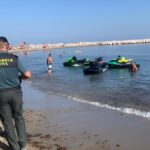
Jet Skiers stopped by police in Almuñecar. Credit: GC

Police in Almuñecar have intensified monitoring of jet ski operations along the Mediterranean coast to address repeated violations in swimming zones. Drone patrols commenced recently over affected areas.

Daily drone patrols target problem behaviours

Drones equipped for aerial observation are now flying above designated swimming sections. Any jet ski detection leads to automatic recording of photographs, video footage and precise GPS locations. Council teams and local police officers are examining this material and passing details to the harbour master for formal proceedings and fines where appropriate.

Operations will cover the period from 1pm until 7pm daily. Weekend coverage applies until July 15 before full daily service extends through 31 August.

Real-time assistance and evidence gathering

Footage will identify unauthorised mooring, high-speed travel through channels, hazardous manoeuvres and swimming line crossings. This system supports enforcement while also enabling immediate alerts to lifeguard stations during swimmer emergencies.

Priority coverage centres on Velilla Beach in Almuñecar and La Herradura. The equipment range extends roughly one kilometre, permitting observation across much of the local coastline.

Clearer boundaries reduce accident risks

Extra buoys now delineate swimming and navigation areas at 200 metres from the shoreline. Signposted access channels guide boats safely and minimise potential conflicts during high summer visitor numbers. Such measures contribute to accident prevention and greater order on the water.

Focus on protected coastal areas

Regional coordination has now been put in the spotlight around Maro-Cerro Gordo. This special and very delicate protection zone includes a nautical mile allocated for anchoring and experiences substantial recreational boating throughout summer.

Established requirements for jet ski users

Difficulties with jet ski activity have continued for years, often linked to limited experience among leisure users and inconsistent adherence to existing standards. Operators must observe several core conditions.

Distance from the shore requires at least 300 metres under the new rules. Full nautical mile separation applies near nature reserves. Entry and exit occur solely through waterways marked with buoys. A minimum spacing of 50 metres between jet skis and other boats is compulsory. Speed stays below three knots, or 5.6 kilometres per hour, inside marked zones. Swimming boundaries must never be crossed.

Approved life jackets form part of compulsory equipment. The minimum rider age is still 18 years old, with 16-year-olds permitted under written parental or guardian approval. Maximum capacity per jet ski totals two people and no more. Any minor requires adult supervision. Remaining seated throughout journeys receives a strong recommendation.

These combined actions promote safer conditions for beachgoers and water users during peak season.

%

Priced Out Of Home: Why Working People Are Now Living In Caravans In Spain

Published

on

priced-out-of-home:-why-working-people-are-now-living-in-caravans-in-spain

More people are living in caravans across Spain. Photo credit: Sonia Bonet/Shutterstock

For many people, living by the sea sounds like the dream. For around 100 people on Málaga’s Sacaba beach, it has become the only way they can keep a roof over their heads. Now they fear they could lose even that. Finding somewhere to live has become one of the biggest worries for people across Spain. Rents continue to climb, buying a home feels out of reach for many, and affordable housing has become increasingly difficult to find. 

In cities such as Málaga, where demand has surged in recent years, many residents say they are being priced out of the very places where they work. That reality is now playing out in full view on the edge of one of the Costa del Sol’s busiest beaches. Around a hundred people remain living in caravans, camper vans and motorhomes at Sacaba despite an expected eviction that, for now, has yet to happen. For those living there, every passing day brings more uncertainty. They know they could be asked to leave at any moment, but many insist they have nowhere else to go.

“They’ll come when our guard is down”

Residents woke this week expecting the Policía local and municipal tow trucks after Málaga City Council announced plans to clear the site, instead, the morning passed quietly. that has done little to reassure the people living there. Many believe the operation has simply been delayed and fear the authorities will return once the attention surrounding the case fades. One resident summed up the mood, saying they believed officials would “throw us out when our guard is down.”

For families, pensioners and workers living at Sacaba, that uncertainty has become part of everyday life. Some have packed belongings ready to leave at short notice, while others simply wait, unsure whether tomorrow will bring another normal day or the loss of the only home they have.

This is no longer just about caravans

It would be easy to dismiss Sacaba as another dispute over illegal parking, that would miss the bigger picture. Many of the people living there are not tourists extending a holiday or travellers choosing an alternative lifestyle. They are workers, couples and families who say they have been pushed there by a housing market they can no longer afford.

Some hold down full-time jobs in Málaga. Others have lived in the city for years. Despite working, they say paying market rents has become impossible. The camper van or caravan was never meant to be permanent,It became the only realistic option.

A problem being repeated across Spain

Housing organisations have warned for years that rising rents and a shortage of affordable homes are forcing more people into increasingly precarious living situations. What was once considered unusual is becoming more common. Across Spain, more people are living in caravans, converted vans or temporary accommodation because they cannot secure a conventional rental.

Others move between campsites or informal settlements while trying to save enough money to return to permanent housing. Málaga has become one of the cities most affected by rising housing costs. Demand has grown rapidly, fuelled by population growth, tourism and international buyers, while the supply of affordable homes has struggled to keep pace. For many local workers, the result has been simple. They earn enough to work in the city, but not enough to live in it.

Residents want a solution, not a confrontation

Those living at Sacaba insist they are not refusing to cooperate, their message has remained consistent. They are asking for somewhere else to go. Residents have proposed creating an association, registering formally and opening discussions with Málaga City Council in the hope of finding an alternative location rather than simply being removed.

Housing campaign group Un Techo por Derecho, which has been supporting residents, argues that clearing the site without providing another option will not solve the housing problem. It will simply move it elsewhere.

The council has already taken action

Although the expected eviction has not yet taken place, Málaga City Council has already restricted access to the area. Fencing has been installed and new caravans have been prevented from entering, signalling that officials still intend to recover the land. Exactly when any removal operation might happen remains unclear. That uncertainty has left residents constantly watching for police vehicles or council contractors arriving at the entrance.

What happens next?

Nobody knows how long the current situation will continue, the council has not confirmed when any eviction could take place, while residents remain convinced it is only a matter of time. Whatever happens over the coming days, Sacaba has become more than a local dispute over caravans parked near the beach.

It has become another symbol of Spain’s housing crisis, for years, caravans parked beside the sea have been associated with holidays, freedom and weekends away. Today, for around 100 people on Málaga’s coastline, they represent something very different. They are kitchens, bedrooms, living rooms and, for now at least, the only homes they have left.

As the debate over housing affordability continues across Spain, Sacaba offers a stark picture of what happens when wages fail to keep up with the cost of somewhere to live. For the people waking up there each morning, the conversation about housing is no longer political or theoretical. It is about whether they will still have somewhere to sleep tomorrow.

Continue Reading

%

Ryanair Passengers From Spain Left Nearly 300km From Destination After Fuel Emergency

Published

on

ryanair-passengers-from-spain-left-nearly-300km-from-destination-after-fuel-emergency

Ryanair passengers from Seville were diverted to Brest after disruption at Nantes. Credit: Niels Baars / Unsplash

Passengers flying from Seville to Nantes landed in Brest instead after a runway incident involving an Air Nostrum aircraft disrupted arrivals in western France. The Ryanair crew declared a fuel emergency before landing safely, leaving travellers facing an unexpected diversion far from their planned destination.

Seville passengers landed in Brest after Nantes runway disruption

A Ryanair flight from Seville to Nantes was diverted to Brest on Monday, July 6, after an earlier incident involving an Air Nostrum aircraft reportedly left the runway at Nantes Atlantique Airport unavailable for incoming flights.

Flight FR5448, operated by a Boeing 737-800, had been due to land in Nantes after departing from southern Spain. Aviation tracking reports said the aircraft carried out a missed approach at Nantes, entered holding, then diverted to Brest Bretagne Airport.

The flight landed safely in Brest shortly after 8pm local time, according to aviation reports. The aircraft was identified by flight-tracking sources as EI-EBK.

For passengers, the disruption meant arriving at a different airport around 290 kilometres by road from Nantes, depending on the route. For those with hotel bookings, onward trains, car hire or people waiting at arrivals, the incident turned a routine Spain-to-France flight into a much more stressful evening.

Air Nostrum incident reportedly blocked the Nantes runway

The disruption at Nantes was linked to Air Nostrum flight IB1222, an Iberia Regional service from Nantes to Madrid. Aviation Safety Network and Airlive both reported that the Air Nostrum CRJ-1000 suffered a tyre burst and engine-related problem shortly after take-off before returning to Nantes. Airlive reported that debris was later found on the runway and that flight operations were temporarily suspended while inspections were carried out.

Air Nostrum is a Spanish regional airline that operates flights under the Iberia Regional brand. According to the company, it operates more than 200 daily flights to or from 60 airports in nine countries across Europe and North Africa.

At the time of writing, the most detailed public accounts of the Nantes sequence came from aviation tracking and incident-monitoring sources rather than a full official investigation report. However, the core sequence reported by aviation sources is that the Air Nostrum incident affected runway availability, forcing other aircraft, including the Ryanair flight from Seville, to abandon planned landings.

How a fuel emergency gave the Ryanair flight priority to land

The phrase “fuel emergency” can sound very dramatic, but in aviation it has a specific operational meaning. It doesn’t automatically mean an aircraft is about to run out of fuel or burst into flames. It means the crew has calculated that priority handling is needed because the aircraft’s fuel situation no longer allows for further delay in the normal way.

SKYbrary, the aviation safety knowledge base, explains that a fuel emergency is an explicit statement that priority handling by air traffic control is required and expected. Final reserve fuel is protected fuel intended to keep an aircraft airborne for a further period under defined conditions. For jet aircraft, aviation guidance commonly refers to 30 minutes of fuel at holding speed in standard conditions.

In this case, the missed approach at Nantes, the period of holding and the diversion to Brest all added time to a flight that had originally been planned to land in Nantes. Declaring an emergency allowed the crew to receive priority for the landing at Brest.

The important passenger point is that the Ryanair aircraft landed safely. A fuel emergency is serious, but it is also part of the safety system designed to make sure aircraft are not left waiting when margins are reduced.

How these diversions can leave travellers with extra costs and uncertainty

Although the aircraft landed safely, passengers were still left in the practical position of being at the wrong airport. Brest is not a simple terminal change from Nantes, and onward transport late in the day can be difficult, especially for families, tourists or residents returning home.

Under European Union air passenger rights guidance, when passengers are accepted on a flight to an alternative airport, the airline is generally responsible for transport costs between that alternative airport and the original destination airport, or another nearby destination agreed with the passenger.

Compensation is a bit less straight-forward. EU rules allow claims in some cases when passengers arrive at their final destination three hours or more late, but airlines can avoid compensation if they prove the disruption was caused by extraordinary circumstances. A runway closure caused by another aircraft incident may fall into that category, depending on the facts. Passengers affected by the diversion would still be sensible to keep boarding passes, airline messages, receipts and evidence of when they eventually reached Nantes.

The next clarification is likely to come from the operators or aviation authorities on the exact sequence of the Air Nostrum incident, the length of the runway closure and how passengers on the diverted Ryanair flight were eventually taken on to their planned destination.

Continue Reading

%

Iron Maiden Mania: How Rock Imperium Festival Just Put Cartagena On The Global Rock Music Map

Published

on

iron-maiden-mania:-how-rock-imperium-festival-just-put-cartagena-on-the-global-rock-music-map

Cartagena’s historic rock festival drew 50,000 fans, boosting the economy. Photo Credit: Cartagena City Hall

The fifth edition of the Rock Imperium Festival in Cartagena has experienced resounding success, with more than 50,000 attendees brought together from 40 countries, and marking a historic feat in the Costa Calida municipality. The music festival, dedicated to the spirit of rock, saw more than 15 million generated in economic impact, and has re-established the city as one of the premier locations for major events not only in Murcia, but in the whole of Spain.

Iron Maiden leads a historic lineup: Legendary English rock band makes waves in Cartagena

One of the major highlights of the event was the Iron Maiden concert, which drew an incredible 20,000 attendees in the Cuesta del Batel from some 40 countries and consolidated the festival as one of the biggest of the summer for the Region of Murcia. The legendary British heavy metal band made history in the city, as their concert created one of the most crowded musical events held to date in Cartagena.

A taste of cartagena with the Rock Imperium Tapas Route

Attendees also enjoyed the delicious The Rock Imperium Tapas Route, which also contributed to the success of the event. This was a gastronomic offering in which some twenty establishments in the historic centre participated, offering low-cost tapas and drinks to festivalgoers.

Looking ahead to the 2027 edition

A major success story for the municipality and for Murcia, the music festival has already announced some of the bands that will play during its 2027 edition in July. The next edition, to be specific, will be held on July 2, 3 and 4, 2027.

In addition, the first names on the lineup have already been announced, including Helloween, with their 40th anniversary tour; Children of Bodom, Mayhem, Venom, and Swedish vocalist Erik Grönwall, of which several will be performing exclusively in Spain.

With record attendance, a significant economic impact and a growing international presence, Rock Imperium continues to solidify Cartagena as one of Europe’s leading destinations for major music festivals.

Continue Reading

Trending

Copyright © 2017 Spanish Property & News