Connect with us

Donald Trump

Nine Hours In Front Of A Computer: An 11-Year-Old Waits His Turn In A Mass Hearing For Migrant Minors


Published

on

nine-hours-in-front-of-a-computer:-an-11-year-old-waits-his-turn-in-a-mass-hearing-for-migrant-minors

José waited nine hours in front of a computer for his virtual hearing before an immigration judge. He is 11 years old, and there were 25 children on the screen alongside him. He was the youngest at the mass preliminary hearing, one of the tools the Donald Trump administration has been using since May 2026, according to attorneys and advocacy groups, to speed up the deportation process for a larger number of migrants at the same time. In this case, children.

José and his father arrived at the home of an activist at 7:30 a.m. on a day in July, where she helped them log into the federal court system from somewhere on the U.S. East Coast. She is recounting the story anonymously, using a pseudonym for the boy and withholding their location for fear of jeopardizing the immigration cases of the entire family. An immigration attorney involved in José’s case verified her account.

“At 2:00 p.m. he was telling me, ‘Oh ma’am, we’ve already been here six and a half hours.’ He joked about it; he didn’t complain. He acted like a real champ,” the activist says in a video call. By order of the judge, José had to remain visible on screen throughout the hearing, like the other children, some of whom were unaccompanied minors attending from government shelters.

In José’s case, the activist fetched him food and, at one point, after seeing him rest his head on the table from exhaustion, brought him a pillow so he could rest. On the screen, another child had already fallen asleep with his head resting on his right hand.

The group was divided between those who had legal representation, about half the children, and those who did not, and their cases were reviewed in that order. José’s hearing was the second-to-last of the day. It began at 4 p.m. and lasted 15 minutes.

The judge asked whether he had a lawyer. He said no. Who was accompanying him? He said his father. The judge explained the process he would face, provided instructions, and granted him a few more days to obtain legal representation and evidence to support his asylum claim.

“He’s a minor. He didn’t even understand what any of that was about,” the activist says.

Since late May, the National Immigrant Justice Center has observed preliminary hearings, the first stage of immigration proceedings, in courts in Chicago and Indianapolis where between 30 and as many as 100 people were scheduled at the same time, many of them without legal counsel. In some cases, attorneys witnessed judges handing migrants forms that, if completed, could accelerate or alter the course of their deportation proceedings.

In the case of children who have just left a shelter — like José — or who are in federal custody, activists warn that the consequences for those without a lawyer could be even worse.

“The consequences are devastating”

José and his 15-year-old sister arrived with their mother at the U.S. southern border in May 2025. They wanted to reunite with their father, who had migrated to the United States years earlier. But on arrival, they were detained and the mother was deported immediately. The children were taken to a shelter run by the Office of Refugee Resettlement (ORR), hundreds of miles from their father. The activist clearly remembers the siblings’ conversation in the car when she picked them up at the airport with their father after he regained custody.

“From the back seat, the girl said, ‘Oh dad, can you believe we’d already been there a year [in the shelter]?’ And the boy turned to her and corrected her: ‘Sorry, sis, 364 days.’ Somebody had been counting the days,” the activist recalls.

Until then, their father had only been able to speak with them briefly each day, and separately. The children were housed in different sections of the shelter based on gender.

The siblings were finally reunited with their father thanks to the legal assistance of pro bono attorneys from one of nearly 100 organizations that had received federal funding for years to represent migrant children. Those lawyers filed a habeas corpus petition that secured their release.

But on July 31, the government cut funding to those pro bono organizations after they refused to share data on the migrant children they represented in exchange for keeping their contracts. Thousands of minors, from infants to teenagers, are now at risk of losing that legal assistance in their immigration cases.

At a September 1 press conference, some of those organizations shared additional cases to illustrate the impact. A one-year-old child appeared without a lawyer at an immigration hearing in Arizona on August 18, where a judge instructed him to file an asylum application. In another court in Los Angeles on August 6, an unrepresented child requested voluntary departure, but a pro bono attorney who had spent years representing migrant children happened to be in the courtroom. She intervened and secured permission for the child to continue with their case.

“Five days later, a child in Texas wasn’t so lucky. There was no attorney in the room, and he gave up his immigration claims without truly understanding what he was accepting,” said Bilal Askaryar, communications director at the Acacia Center for Justice, the nonprofit organization that for years received government funding for the representation of minors and distributed it to partner organizations. “In just four weeks, the consequences have been devastating.”

In Chicago, Laura Smith, executive director of the Children’s Legal Center, said at the same press conference that seven of the children her organization represented between July and August, including kidnapping victims, children who witnessed the murder of their parents in their home countries, and children abandoned by their families, were deported without due process. She said the cases demonstrated the government’s intention to accelerate the deportation of migrant children as well.

“These are children who fled to the U.S. seeking protection from horrors no child should endure,” she said. “They are seven children with pending or approved applications under the law. What does this mean? That this administration is taking steps to return these children to their abusers, to traffickers, and to a country where they have no adult caregiver […] These policies endanger the safety of minors and violate the laws meant to protect them.”

Since the expiration of the ORR’s contract with Acacia, it is unclear how the federal government is ensuring legal representation for children in immigration court. EL PAÍS asked the agency about the issue but received no response. As of August 31, 2026, ORR had 1,882 children in its custody, according to data published on its website.

Among the nearly 100 organizations that lost federal funding, some have closed their juvenile defense programs; others continue to represent children who were already clients but are not accepting new cases.

That is precisely what is happening with José. The pro bono attorney who filed his habeas corpus petition referred him to another organization in July, but it has been unable to take on his case because of budget constraints.

A network of volunteers

It is not the first time the activist telling José’s story has helped a migrant family. After the 2024 presidential election, she and a group of about 14 volunteers began educating members of their communities about their rights, how to stay safe, and organizing free workshops where attorneys could advise families.

The workload grew as arrests intensified, hearing dates were moved forward for dozens of migrants, and families were separated or deported. “It’s like a tsunami of bad news hitting them from every direction. It’s a tsunami of cruelty aimed at people who have done everything right,” she says.

The group also drives families to Immigration and Customs Enforcement (ICE) check-ins and accompanies them to appointments, helps them recover cars left behind on the street after a family member is arrested, retrieves belongings from apartments, and records enforcement operations on video. “If I were in their shoes, I’d want someone to hold my hand.”

That summer morning, the activist helped José’s father log into the virtual hearing and stayed with them patiently throughout the nine-hour wait. As the day went on, the boy’s father kept his boss updated on the progress of the hearing. He lost a full day of work.

After learning José’s story, the activist says she stopped thinking about her own needs and concerns and focused instead on providing him with a safe and welcoming environment. “The government is already doing everything it can to make following the law a miserable process.”

When the hearing finally ended, shortly before 5 p.m., the activist drove them home: “You simply do everything physically within your reach to make a child’s day better.”

Sign up for our weekly newsletter to get more English-language news coverage from EL PAÍS USA Edition

Alibaba

China Reacciona A Las Alertas Por La IA Denunciando Una “agenda Oculta” Para “estrangular” Su Tecnología


Published

on

By

china-reacciona-a-las-alertas-por-la-ia-denunciando-una-“agenda-oculta”-para-“estrangular”-su-tecnologia

El llamamiento del consejero delegado de Anthropic, Dario Amodei, a pisar el freno en la carrera de la inteligencia artificial (IA) ha abierto un nuevo frente en la rivalidad entre China y Estados Unidos, a las puertas de que se celebre una nueva cumbre entre sus líderes, Xi Jinping y Donald Trump, prevista para dentro de diez días. Pekín ha recibido la propuesta de Amodei con recelo y advirtió este lunes de que presentar el avance de esta tecnología como una amenaza y alimentar la confrontación solo dificultará la elaboración de reglas globales.

Hasta ahora, el pulso tecnológico entre ambas potencias se había dirimido principalmente en torno a los chips, los centros de datos y la capacidad para construir modelos cada vez más potentes. Este fin de semana, sin embargo, la disputa se desplazó a un terreno menos tangible, pero igualmente decisivo: quién puede marcar el ritmo de ese desarrollo. Amodei aboga por que las compañías estadounidenses avancen más despacio, pero teme que China las adelante mientras ellas echan el freno. Y, para evitar que Estados Unidos pierda su ventaja, propone endurecer las restricciones que ya dificultan el progreso del gigante asiático, un planteamiento que ha suscitado un fuerte rechazo por parte del Gobierno chino.

El Ministerio de Exteriores ha expuesto este lunes la posición oficial. El portavoz Guo Jiakun, que evitó entrar en los riesgos concretos señalados por Amodei, respondió desde el lenguaje habitual de la diplomacia china y situó el debate en el terreno de la cooperación internacional. Defendió una IA “abierta, inclusiva, que beneficie a todos y orientada al bien” y advirtió de que las “narrativas de amenaza” y la “competencia malintencionada” perjudican la gobernanza global de esta tecnología. “No benefician a los intereses de ninguna de las partes”, zanjó.

Guo señaló además que China ha incorporado formalmente la IA a su marco jurídico nacional de ciberseguridad y continúa perfeccionando las normas institucionales y los códigos éticos.

China no niega que la IA plantee amenazas, pero rechaza que estas se utilicen como argumento para frenar su desarrollo. En julio, China y otros 28 países firmaron en Shanghái el acuerdo para constituir la Organización Mundial de Cooperación sobre IA. Xi reclamó entonces que la supervisión sea “más precisa y eficaz”.

La propuesta de Amodei ha dividido también a Estados Unidos. Aunque recibió el respaldo del responsable de OpenAI, Sam Altman, y del fundador de xAI, Elon Musk, el mandatario estadounidense restó importancia a la necesidad de una ralentización. Si bien Trump admitió que pueden introducirse salvaguardas, calificó de “fuerzas muy negativas” a quienes plantean escenarios que, en su opinión, no llegarán a producirse. “Estamos por delante de China en IA. Somos el país más sofisticado del mundo y, francamente, quiero que siga siendo así, porque quien gane la IA, gana”, afirmó. Este lunes, denunció en su red social, Truth Social, una “conspiración enfermiza” contra la IA y los centros de datos de la que, aseveró, China sería la única beneficiaria.

“Estrangular” el desarrollo chino

La reacción más contundente desde China llegó desde el rotativo nacionalista Global Times, que acusó a Amodei de tener una “agenda oculta” contra la segunda economía del planeta y querer “estrangular” su desarrollo. En un editorial publicado el domingo, el diario dependiente del Partido Comunista le acusó de disfrazar de “reflexión racional” sobre la seguridad un “manual de guerra fría”.

El objetivo, de acuerdo con este medio, es frenar a las firmas chinas mediante barreras tecnológicas y “monopolios regulatorios”, preservar la hegemonía estadounidense y apartar a Pekín de la elaboración de las normas mundiales. “Excluir a China y a sus empresas solo aumentará significativamente los costos de ensayo y error y los riesgos de pérdida de control en el desarrollo global de la IA”, advirtió el periódico oficialista.

En su ensayo, Amodei no reclama detener la investigación ni suspender el entrenamiento de modelos. Sugiere acompasar el aumento de sus capacidades con el desarrollo de medidas de seguridad, introducir verificadores externos en los principales laboratorios, coordinar límites entre las empresas de los países democráticos y buscar acuerdos globales con China. Pero, al mismo tiempo, advierte de que Estados Unidos no puede reducir el ritmo hasta el punto de que los proyectos chinos lo adelanten. Por eso reclama mantener fuera del alcance de China los chips más avanzados y la maquinaria necesaria para fabricarlos, perseguir su contrabando y el acceso remoto a centros de datos situados en otros países, proteger los parámetros internos de los modelos (“pesos”) y combatir la “destilación” no autorizada.

La destilación permite entrenar un modelo más pequeño y barato a partir de las respuestas generadas por otro más potente. La Agencia de Seguridad Nacional estadounidense (NSA), el FBI y la Agencia de Ciberseguridad y Seguridad de las Infraestructuras (CISA) acusaron este mes a seis empresas chinas —DeepSeek, Moonshot AI, MiniMax, Alibaba, StepFun y Zhipu AI— de extraer de manera sistemática capacidades de modelos estadounidenses mediante campañas de destilación “a escala industrial”. El Ministerio de Comercio chino rechazó las acusaciones por considerarlas infundadas, aseguró que se trata de una técnica habitual en la industria y acusó a Washington de intentar monopolizar el sector.

La disputa se intensifica después de que la distancia entre ambos países se haya reducido con rapidez. El Índice de IA 2026 de Stanford considera que la brecha de rendimiento entre los mejores modelos estadounidenses y chinos se ha estrechado considerablemente. Desde comienzos de 2025, se han alternado en los primeros puestos de Arena, una clasificación basada en comparaciones a ciegas en las que los usuarios eligen qué respuestas consideran mejores. En marzo, el modelo líder, desarrollado por Anthropic, aventajaba en esa clasificación al principal competidor chino por solo un 2,7%.

No obstante, la ventaja estadounidense sigue siendo considerable en capacidad de computación, inversión y número de modelos de primer nivel. Además, controla, junto con sus aliados, el acceso a semiconductores más avanzados. La estrategia china ha sido la de tratar de obtener más rendimiento con menos recursos para reducir su dependencia. Sus principales compañías ofrecen modelos abiertos, costes más bajos y una rápida aplicación de la IA en la economía real a través de su integración en fábricas, servicios públicos y aplicaciones de consumo.

El ministro chino de Seguridad del Estado, Chen Yixin, definió el domingo la IA como el “principal campo de batalla de la competencia tecnológica mundial” y como un nuevo terreno de la “pugna estratégica entre grandes potencias”. En un artículo publicado en la revista oficial de la Administración del Ciberespacio de China, acusó a “determinados países” de invocar la seguridad nacional para imponer controles tecnológicos, monopolizar los estándares y limitar la capacidad de innovación de otros Estados.

Al enumerar los seis grandes riesgos que, a su juicio, entraña la IA, Chen situó en primer lugar su impacto sobre la seguridad política y acusó a “fuerzas hostiles” de emplear contenidos manipulados y redes automatizadas de propaganda para librar una “guerra cognitiva” contra China. También alertó de filtraciones de datos, ciberataques contra infraestructuras esenciales y de la transformación de la guerra por la IA.

Las advertencias de Amodei y Chen parten de una misma certeza: la IA entraña riesgos que ningún país puede afrontar por sí solo. Pero ahí termina el consenso. El desencuentro coincide con los intentos de abrir un diálogo bilateral dedicado específicamente a su seguridad, el primero entre el Gobierno chino y la Administración Trump. Según fuentes citadas por Reuters, Pekín quiere convertir ese canal en uno de los principales resultados de la cumbre prevista para el 24 de septiembre, pero la Casa Blanca mantiene que la reunión no está cerrada.

Continue Reading

Donald Trump

The Ordeal Of Miami’s Migrant Mega-Hearings: ‘If I Don’t Make It, They’ll Issue A Deportation Order’

Published

on

Roxana Valladares was at Homestead Hospital, southwest of Miami, with her six-year-old son when she started packing in the middle of the night. She grabbed a blanket, a change of clothes for the boy and a folding beach chair. She packed water and snacks into a cooler and called an Uber. By 4 a.m., she was outside the immigration court in downtown Miami, hoping to secure a good spot in line and make it into her hearing shortly after noon.

To her surprise, people were already waiting. She ended up third in line for the 1 p.m. hearing. She spread the blanket on the sidewalk and laid down her son, who had been running a fever and struggling to breathe and was still feeling unwell.

“They told me that if I don’t make it [to the hearing], they’ll issue a deportation order,” says Valladares, a 29-year-old Salvadoran woman, shortly after dawn as she fans her son with a handkerchief as he sleeps amid the growing crowd gathered outside the immigration court building by the Miami River.
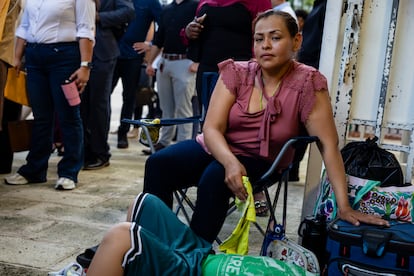
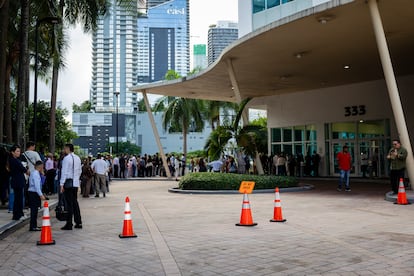
Since last month, when the courts began scheduling groups of 100 or more people at a time in so-called mega master hearings, the lines outside the building have stretched around the parking lot and underneath the Metromover station — the automated train in that area —all the way to the sidewalk on Southeast 3rd Street, nearly reaching the ramp of a neighboring hotel.

This week, the Miami immigration court restricted the use of the virtual hearing system, called Webex, and began requiring immigrants to appear in person. “It wasn’t like this before. You’d arrive, stand in a normal line, maybe wait half an hour or 40 minutes, but it never took more than an hour,” says immigration attorney Estefanía Echeverry, who had appeared in court that morning with clients. “Nowadays you can be out there for up to two hours exposed to the elements.”

Even inside the building, courtrooms hold at most about 20 people. “There are a lot of people waiting for their turn; they have to wait outside,” Echeverry adds. “People have to arrive hours in advance to make sure they can get into the courtroom. If the person doesn’t make it to court on time, they’re given a deportation order.”

Echeverry goes to immigration court three or four times a week. She explains that judges used to hear the cases of migrants with attorneys in the courtroom first, then those joining via Webex, and finally the migrants without legal representation. On some occasions, her clients have been stuck in the line outside, and she has had to tell the judge at the scheduled hearing time that they were still trying to get into the building.

The Donald Trump administration says it is trying to speed up immigration court proceedings in order to reduce a years-long backlog that now exceeds 3.1 million cases. More than 2.2 million of those cases are asylum applications that are still awaiting a decision, according to independent organizations that track court records. Miami-Dade County has the largest number of pending deportation cases in the country, according to court data compiled by TRAC, the nonpartisan research center founded at Syracuse University.

The mega hearings have created confusion among migrants, and some have received new court dates with little advance notice. Valladares, for example, had originally been scheduled to appear in September 2027, but last week she received a notice ordering her to appear last Wednesday instead.

The mother says she arrived at the U.S.-Mexico border two years ago and applied for asylum after fleeing domestic violence and fearing for her life and that of her son.
Deportation orders in absentia rise

Civil rights advocates warn that the new system increases the likelihood that people who fail to appear on time will receive removal orders. In recent months, in absentia deportation orders have surged nationwide, peaking at 56,523 in June — a 60% increase over previous months, according to an analysis by data platform bklg.org. In Miami, the number of orders rose from 1,383 in May to 2,886 in July, an increase of 108%. The average lead time between scheduling a hearing and the court date itself has fallen from about 200 days to less than two months.

The Department of Homeland Security (DHS) told EL PAÍS in response to an inquiry that “any foreign national in an irregular immigration status who has a final order of removal has been afforded all due process protections.” It added that it is “working rapidly and around the clock to transfer these individuals from detention facilities to their final destination: their countries of origin.”

The DHS referred questions about the courts to the Department of Justice (DOJ). A DOJ spokesperson said that “reducing the backlog in immigration courts remains one of this administration’s top priorities.”

Immigration courts operate under the Executive Office for Immigration Review (EOIR), an agency within the Department of Justice that reports to the attorney general. The EOIR told EL PAÍS it is making “scheduling adjustments” to speed up stalled cases.

According to DOJ, although hearings are scheduled “for large groups,” “each case is handled individually and due process is ensured.” “For an in absentia deportation order to be issued, the immigration judge must determine that the individual received proper notice and that the Department of Homeland Security has shown the person is removable,” the agency said in an email to EL PAÍS.

The move to require in-person appearances comes after months of anxiety among immigrants with cases before the courts. For much of that time, Immigration and Customs Enforcement (ICE) agents, often masked, were known to patrol courthouse hallways, waiting for people to emerge from hearings so they could be arrested. In June, a federal judge put a stop to those operations.

William Botsch, a volunteer with the American Friends Service Committee who has been observing hearings in Miami since last year, says that since officers stopped patrolling the courthouse hallways, government prosecutors have stopped asking judges to dismiss cases, except in exceptional circumstances.

Many immigrants with scheduled hearings had sought ways to appear remotely. “The opportunity to appear online was very helpful,” says Echeverry. “These situations cause a huge amount of distress and anxiety because people have to appear in court. Being online eased some of that fear that something might happen to them, because people are still very afraid of being arrested.”

Valladares spent much of the day at the courthouse, but the judge called her case a little earlier than expected. He told her that the date of her next hearing would be sent by mail.

Sign up for our weekly newsletter to get more English-language news coverage from EL PAÍS USA Edition

Continue Reading

Alejandro Betancourt

United States Stalls Spanish Investigation Into Alejandro Betancourt, Its New Oil Czar In Venezuela


Published

on

united-states-stalls-spanish-investigation-into-alejandro-betancourt,-its-new-oil-czar-in-venezuela

The hand of the United States has resurfaced in the legal proceedings facing Alejandro Betancourt. This time in Spain. The Venezuelan businessman, identified as the architect of the deal that will give Donald Trump control of a fifth of Venezuela’s oil, has been under investigation by Spain’s National Court (Audiencia Nacional) for more than a year on charges of money laundering and tax evasion. But the case has been stalled for months, and sources close to the investigation point to one party responsible: Washington.

Judge Santiago Pedraz is waiting on a response to a formal request for legal assistance sent to U.S. authorities that never arrives, and after shelving the case once already, he has issued a new warning: if there is no answer from the United States by December, he will close the case again.

Behind this story lies more than a simple delay; it’s about a figure of critical interest to the United States. Betancourt has emerged as the man behind the oil deal that Washington and Caracas signed a few weeks ago, one that will allow the United States to profit to the tune of millions of dollars from a quarter of Venezuela’s oil reserves. Trump’s inner circle is well aware of his legal cases in Venezuela, the United States, Switzerland, and Spain —the latter two still active— but has used him to achieve its goal of reviving Venezuela’s oil business following the capture of Nicolás Maduro this past January 3.

The signing of that deal put the businessman and his multiple legal cases under scrutiny, but the White House —and acting Venezuelan president Delcy Rodríguez— have not only defended him publicly, but had also been maneuvering for months to protect him legally, as U.S. media has extensively documented.

The Spanish judicial proceeding, which is investigating the origin and destination of more than 4 billion dollars allegedly diverted from PDVSA, Venezuela’s state oil company, is waiting for Washington to respond to a request to take testimony from a series of key witnesses, since they have already been convicted in the United States. Their testimony could help establish the underlying crime in Madrid, but nearly a year after that request was made, no one has responded.

The money laundering offense under investigation in Spain requires a predicate crime that establishes the illicit origin of the funds. Judicial sources explain that if the witnesses confirm corruption at the oil company, it would establish that the money that reached Spanish territory has illicit roots, and the Spanish case could move forward to examine how that money was laundered by feeding it into a legal financial system. Betancourt, known in Spain for having become the owner of the Hawkers eyewear brand, invested millions in numerous Spanish companies and even bought a castle in Toledo.

The five “essential” witnesses have already been convicted in the United States for the same PDVSA corruption scheme, known as Money Flight. They are Abraham Ortega Morales, the oil company’s former director of financial planning; Carmelo Urdaneta, a senior official in Venezuela’s oil sector; Álvaro Ledo Nass, PDVSA’s former legal advisor; Luis Fernando Vuteff, an Argentine businessman and son-in-law of opposition figure Antonio Ledezma; and Luis Carlos de León, former financial director of Electricidad de Caracas, a PDVSA subsidiary.

Sources at the Audiencia Nacional explain that there is no legal deadline by which the country must respond. So when does it usually respond? “When it’s in its interest,” notes one judge who asked to remain anonymous. Spain and the U.S. have well-oiled judicial cooperation systems backed by cooperation treaties. In fact, the Ministry of Justice keeps a Spanish liaison judge in Washington to help facilitate cooperation. Until a few weeks ago that position was held by María de las Heras, though she has just been replaced by judge Íñigo Herrero.

Prosecutorial sources who have worked in international cooperation explain that collaboration with the United States isn’t always straightforward, given the country’s size and the fact that its 50 states plus federal system operate separately. Cooperation becomes more difficult, they say, when what’s being requested is a measure that limits rights —such as a search and seizure or a wiretap— but they note that taking testimony via videoconference, as in this case, “should move quickly.”

In this impasse, Betancourt is shoring up his legal position with documents from Venezuela’s Public Ministry certifying that, despite all the schemes and suspicions in which the businessman has ended up involved, the case against him in his home country was dismissed without his involvement being proven.

EL PAÍS reached out to the U.S. Department of Justice, which did not respond; the State Department, which declined to respond officially; and the Pentagon, which merely offered the same statement issued after the announcement of the oil deal with Betancourt, reports Macarena Vidal Liy.

American help in Switzerland

The proceedings in Spain stem from an investigation opened in Switzerland nearly a decade ago. The Zurich Prosecutor’s Office had an extradition order against Betancourt from the United Kingdom, where he remained confined between his two mansions because he was barred from leaving the country. But in May, U.S. efforts to help him paid off. As The Washington Post revealed, senior Trump administration officials —then-Attorney General Pam Bondi, her deputy Todd Blanche, and Deputy Secretary of State Christopher Landau— pressured Swiss prosecutors directly seeking information and favorable treatment for their ally.

The Zurich Prosecutor’s Office declined to confirm to this newspaper whether that pressure influenced its decision, but it did confirm that it withdrew the extradition request, citing particularities of British law. Thanks to that withdrawal, the travel restrictions the U.K. had imposed on him while reviewing the extradition request were lifted, and Betancourt was able to resume flying by private jet to Venezuela and the United States to finalize the details of the historic oil deal announced by Trump nearly two weeks ago.

The case in Switzerland remains open, but another detail revealed by The Post showed that the United States has no interest in cooperating. The Prosecutor’s Office asked the U.S. Department of Justice to arrest Betancourt if he entered U.S. territory, and not only did it fail to do so, but it also shielded him as its business partner.

Meanwhile in Spain, the Anti-Corruption Prosecutor’s Office —which filed the original lawsuit in June 2025 not only against Betancourt but also against his cousin Pedro Trebbau, his partner Francisco Convit, and three other people— remains determined to prove a multimillion-dollar fraud.

According to the investigation, in 2012 the Venezuelan oil company issued a 4.35 billion loan to the private company Administrador Atlantic that was, in reality, only meant to get the money out of the country so it could eventually be laundered, allegedly, through accounts belonging to Venezuelan businessmen and former officials. Anti-Corruption investigators believe that “significant amounts of money” were invested in Spanish territory in real estate and other assets after the money was brought from Venezuela “through bribes paid to officials” totaling 42 million dollars.

This vast money-laundering network has international ramifications. Sources close to the investigation explain that between March and April of 2025 there was a meeting at Eurojust —the European Union’s agency for judicial cooperation— where officials from various countries, including Spain, shared information on how to address this complex money-laundering scheme, which sought to conceal, through overlapping companies and different countries, the enormous amount of money under investigation.

Although Judge Pedraz had shelved the case in March, the Criminal Chamber forced him to reopen it following an appeal from the Anti-Corruption Prosecutor’s Office, which considered the dismissal “premature.” Testimony was still needed from those witnesses, who can only be interrogated with Washington’s cooperation. And nothing has moved since.

Betancourt isn’t willing to lose any legal battle, and he has armed himself both inside and outside Spain. Outside the country, back in 2019, he hired Rudy Giuliani —then Donald Trump’s personal lawyer— to defend him before the U.S. Department of Justice, where he had been named an unindicted co-conspirator in the Money Flight case. In Spain, he has retained the law firm of José Antonio Choclán, one of the most sought-after criminal defense attorneys in major corruption cases. The firm has defended, among others, singer Julio Iglesias, the former lover of Spain’s emeritus king, Corinna Larsen, broker Víctor de Aldama in the Koldo case —a corruption scandal implicating the Socialist Party (PSOE)— and former Real Madrid footballer Cristiano Ronaldo.

While the United States has yet to respond to the request for legal assistance, Betancourt has submitted to the Spanish court a document from the Directorate General of International Criminal Cooperation of Venezuela’s Prosecutor’s Office, which was overhauled in February following the capture of Nicolás Maduro. Unlike the terms former Attorney General Tarek William Saab and several Chavista officials used to describe Betancourt in the past, this document now clears him of all responsibility.

The speed of Venezuelan justice contrasts sharply, in this case, with the slowness of the American one. In just six days —following a formal request from his own lawyer in Caracas on June 30— the agency’s director, Ana Osto Ascanio, signed a response detailing the investigation point by point. It reaffirms that the Venezuelan case was closed in 2023 with “res judicata” status, meaning, the Venezuelan prosecutor’s office argues, that he cannot be prosecuted in another country for the same acts, according to investigation documents reviewed by EL PAÍS.

Various sources consulted at the Audiencia Nacional point out the speed with which Delcy Rodríguez’s government —which now backs Betancourt— handed over this document, even as Venezuela has gone decades without cooperating in other major Spanish judicial cases, such as the extradition of ETA members sheltering in the country. One such case involves the Audiencia Nacional’s renewed effort to locate 14 ETA members in hopes that Maduro’s fall would open a new avenue for cooperation, a request that remains unresolved.

Judge Pedraz’s ultimatum, in any case, still stands. In a filing dated August 10, the judge stated that he cannot continue pursuing proceedings into the money laundering charge because, without establishing the predicate crime (corruption), they would be “useless.” The judge asserts that he “cannot wait indefinitely for U.S. authorities” to act on Spain’s request, calling it contradictory that they have shown “great interest and cooperation” while failing to respond. He therefore allows a “reasonable amount of time” that, in his view, “cannot extend beyond December of this year.”

The clock, once again, is running in Betancourt’s favor. And in this case, the United States doesn’t need to make major moves that later get exposed in the American press months down the line. Simply doing nothing is enough.

Continue Reading

Trending

Copyright © 2017 Spanish Property & News