Connect with us

Donald Trump

Nine Hours In Front Of A Computer: An 11-Year-Old Waits His Turn In A Mass Hearing For Migrant Minors


Published

on

nine-hours-in-front-of-a-computer:-an-11-year-old-waits-his-turn-in-a-mass-hearing-for-migrant-minors

José waited nine hours in front of a computer for his virtual hearing before an immigration judge. He is 11 years old, and there were 25 children on the screen alongside him. He was the youngest at the mass preliminary hearing, one of the tools the Donald Trump administration has been using since May 2026, according to attorneys and advocacy groups, to speed up the deportation process for a larger number of migrants at the same time. In this case, children.

José and his father arrived at the home of an activist at 7:30 a.m. on a day in July, where she helped them log into the federal court system from somewhere on the U.S. East Coast. She is recounting the story anonymously, using a pseudonym for the boy and withholding their location for fear of jeopardizing the immigration cases of the entire family. An immigration attorney involved in José’s case verified her account.

“At 2:00 p.m. he was telling me, ‘Oh ma’am, we’ve already been here six and a half hours.’ He joked about it; he didn’t complain. He acted like a real champ,” the activist says in a video call. By order of the judge, José had to remain visible on screen throughout the hearing, like the other children, some of whom were unaccompanied minors attending from government shelters.

In José’s case, the activist fetched him food and, at one point, after seeing him rest his head on the table from exhaustion, brought him a pillow so he could rest. On the screen, another child had already fallen asleep with his head resting on his right hand.

The group was divided between those who had legal representation, about half the children, and those who did not, and their cases were reviewed in that order. José’s hearing was the second-to-last of the day. It began at 4 p.m. and lasted 15 minutes.

The judge asked whether he had a lawyer. He said no. Who was accompanying him? He said his father. The judge explained the process he would face, provided instructions, and granted him a few more days to obtain legal representation and evidence to support his asylum claim.

“He’s a minor. He didn’t even understand what any of that was about,” the activist says.

Since late May, the National Immigrant Justice Center has observed preliminary hearings, the first stage of immigration proceedings, in courts in Chicago and Indianapolis where between 30 and as many as 100 people were scheduled at the same time, many of them without legal counsel. In some cases, attorneys witnessed judges handing migrants forms that, if completed, could accelerate or alter the course of their deportation proceedings.

In the case of children who have just left a shelter — like José — or who are in federal custody, activists warn that the consequences for those without a lawyer could be even worse.

“The consequences are devastating”

José and his 15-year-old sister arrived with their mother at the U.S. southern border in May 2025. They wanted to reunite with their father, who had migrated to the United States years earlier. But on arrival, they were detained and the mother was deported immediately. The children were taken to a shelter run by the Office of Refugee Resettlement (ORR), hundreds of miles from their father. The activist clearly remembers the siblings’ conversation in the car when she picked them up at the airport with their father after he regained custody.

“From the back seat, the girl said, ‘Oh dad, can you believe we’d already been there a year [in the shelter]?’ And the boy turned to her and corrected her: ‘Sorry, sis, 364 days.’ Somebody had been counting the days,” the activist recalls.

Until then, their father had only been able to speak with them briefly each day, and separately. The children were housed in different sections of the shelter based on gender.

The siblings were finally reunited with their father thanks to the legal assistance of pro bono attorneys from one of nearly 100 organizations that had received federal funding for years to represent migrant children. Those lawyers filed a habeas corpus petition that secured their release.

But on July 31, the government cut funding to those pro bono organizations after they refused to share data on the migrant children they represented in exchange for keeping their contracts. Thousands of minors, from infants to teenagers, are now at risk of losing that legal assistance in their immigration cases.

At a September 1 press conference, some of those organizations shared additional cases to illustrate the impact. A one-year-old child appeared without a lawyer at an immigration hearing in Arizona on August 18, where a judge instructed him to file an asylum application. In another court in Los Angeles on August 6, an unrepresented child requested voluntary departure, but a pro bono attorney who had spent years representing migrant children happened to be in the courtroom. She intervened and secured permission for the child to continue with their case.

“Five days later, a child in Texas wasn’t so lucky. There was no attorney in the room, and he gave up his immigration claims without truly understanding what he was accepting,” said Bilal Askaryar, communications director at the Acacia Center for Justice, the nonprofit organization that for years received government funding for the representation of minors and distributed it to partner organizations. “In just four weeks, the consequences have been devastating.”

In Chicago, Laura Smith, executive director of the Children’s Legal Center, said at the same press conference that seven of the children her organization represented between July and August, including kidnapping victims, children who witnessed the murder of their parents in their home countries, and children abandoned by their families, were deported without due process. She said the cases demonstrated the government’s intention to accelerate the deportation of migrant children as well.

“These are children who fled to the U.S. seeking protection from horrors no child should endure,” she said. “They are seven children with pending or approved applications under the law. What does this mean? That this administration is taking steps to return these children to their abusers, to traffickers, and to a country where they have no adult caregiver […] These policies endanger the safety of minors and violate the laws meant to protect them.”

Since the expiration of the ORR’s contract with Acacia, it is unclear how the federal government is ensuring legal representation for children in immigration court. EL PAÍS asked the agency about the issue but received no response. As of August 31, 2026, ORR had 1,882 children in its custody, according to data published on its website.

Among the nearly 100 organizations that lost federal funding, some have closed their juvenile defense programs; others continue to represent children who were already clients but are not accepting new cases.

That is precisely what is happening with José. The pro bono attorney who filed his habeas corpus petition referred him to another organization in July, but it has been unable to take on his case because of budget constraints.

A network of volunteers

It is not the first time the activist telling José’s story has helped a migrant family. After the 2024 presidential election, she and a group of about 14 volunteers began educating members of their communities about their rights, how to stay safe, and organizing free workshops where attorneys could advise families.

The workload grew as arrests intensified, hearing dates were moved forward for dozens of migrants, and families were separated or deported. “It’s like a tsunami of bad news hitting them from every direction. It’s a tsunami of cruelty aimed at people who have done everything right,” she says.

The group also drives families to Immigration and Customs Enforcement (ICE) check-ins and accompanies them to appointments, helps them recover cars left behind on the street after a family member is arrested, retrieves belongings from apartments, and records enforcement operations on video. “If I were in their shoes, I’d want someone to hold my hand.”

That summer morning, the activist helped José’s father log into the virtual hearing and stayed with them patiently throughout the nine-hour wait. As the day went on, the boy’s father kept his boss updated on the progress of the hearing. He lost a full day of work.

After learning José’s story, the activist says she stopped thinking about her own needs and concerns and focused instead on providing him with a safe and welcoming environment. “The government is already doing everything it can to make following the law a miserable process.”

When the hearing finally ended, shortly before 5 p.m., the activist drove them home: “You simply do everything physically within your reach to make a child’s day better.”

Sign up for our weekly newsletter to get more English-language news coverage from EL PAÍS USA Edition

Donald Trump

The Ordeal Of Miami’s Migrant Mega-Hearings: ‘If I Don’t Make It, They’ll Issue A Deportation Order’

Published

on

Roxana Valladares was at Homestead Hospital, southwest of Miami, with her six-year-old son when she started packing in the middle of the night. She grabbed a blanket, a change of clothes for the boy and a folding beach chair. She packed water and snacks into a cooler and called an Uber. By 4 a.m., she was outside the immigration court in downtown Miami, hoping to secure a good spot in line and make it into her hearing shortly after noon.

To her surprise, people were already waiting. She ended up third in line for the 1 p.m. hearing. She spread the blanket on the sidewalk and laid down her son, who had been running a fever and struggling to breathe and was still feeling unwell.

“They told me that if I don’t make it [to the hearing], they’ll issue a deportation order,” says Valladares, a 29-year-old Salvadoran woman, shortly after dawn as she fans her son with a handkerchief as he sleeps amid the growing crowd gathered outside the immigration court building by the Miami River.
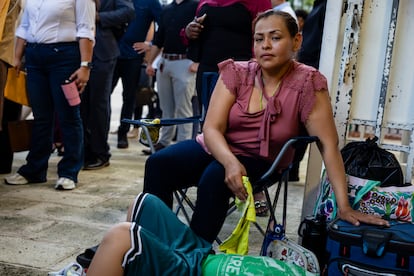
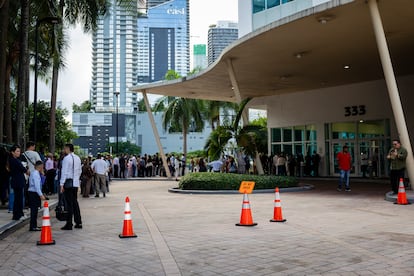
Since last month, when the courts began scheduling groups of 100 or more people at a time in so-called mega master hearings, the lines outside the building have stretched around the parking lot and underneath the Metromover station — the automated train in that area —all the way to the sidewalk on Southeast 3rd Street, nearly reaching the ramp of a neighboring hotel.

This week, the Miami immigration court restricted the use of the virtual hearing system, called Webex, and began requiring immigrants to appear in person. “It wasn’t like this before. You’d arrive, stand in a normal line, maybe wait half an hour or 40 minutes, but it never took more than an hour,” says immigration attorney Estefanía Echeverry, who had appeared in court that morning with clients. “Nowadays you can be out there for up to two hours exposed to the elements.”

Even inside the building, courtrooms hold at most about 20 people. “There are a lot of people waiting for their turn; they have to wait outside,” Echeverry adds. “People have to arrive hours in advance to make sure they can get into the courtroom. If the person doesn’t make it to court on time, they’re given a deportation order.”
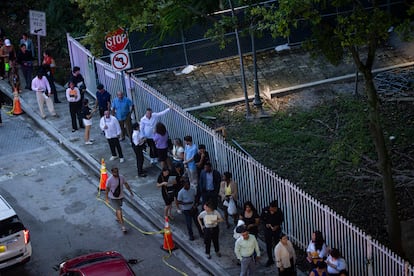
Echeverry goes to immigration court three or four times a week. She explains that judges used to hear the cases of migrants with attorneys in the courtroom first, then those joining via Webex, and finally the migrants without legal representation. On some occasions, her clients have been stuck in the line outside, and she has had to tell the judge at the scheduled hearing time that they were still trying to get into the building.

The Donald Trump administration says it is trying to speed up immigration court proceedings in order to reduce a years-long backlog that now exceeds 3.1 million cases. More than 2.2 million of those cases are asylum applications that are still awaiting a decision, according to independent organizations that track court records. Miami-Dade County has the largest number of pending deportation cases in the country, according to court data compiled by TRAC, the nonpartisan research center founded at Syracuse University.

The mega hearings have created confusion among migrants, and some have received new court dates with little advance notice. Valladares, for example, had originally been scheduled to appear in September 2027, but last week she received a notice ordering her to appear last Wednesday instead.

The mother says she arrived at the U.S.-Mexico border two years ago and applied for asylum after fleeing domestic violence and fearing for her life and that of her son.
Deportation orders in absentia rise

Civil rights advocates warn that the new system increases the likelihood that people who fail to appear on time will receive removal orders. In recent months, in absentia deportation orders have surged nationwide, peaking at 56,523 in June — a 60% increase over previous months, according to an analysis by data platform bklg.org. In Miami, the number of orders rose from 1,383 in May to 2,886 in July, an increase of 108%. The average lead time between scheduling a hearing and the court date itself has fallen from about 200 days to less than two months.

The Department of Homeland Security (DHS) told EL PAÍS in response to an inquiry that “any foreign national in an irregular immigration status who has a final order of removal has been afforded all due process protections.” It added that it is “working rapidly and around the clock to transfer these individuals from detention facilities to their final destination: their countries of origin.”

The DHS referred questions about the courts to the Department of Justice (DOJ). A DOJ spokesperson said that “reducing the backlog in immigration courts remains one of this administration’s top priorities.”

Immigration courts operate under the Executive Office for Immigration Review (EOIR), an agency within the Department of Justice that reports to the attorney general. The EOIR told EL PAÍS it is making “scheduling adjustments” to speed up stalled cases.

According to DOJ, although hearings are scheduled “for large groups,” “each case is handled individually and due process is ensured.” “For an in absentia deportation order to be issued, the immigration judge must determine that the individual received proper notice and that the Department of Homeland Security has shown the person is removable,” the agency said in an email to EL PAÍS.

The move to require in-person appearances comes after months of anxiety among immigrants with cases before the courts. For much of that time, Immigration and Customs Enforcement (ICE) agents, often masked, were known to patrol courthouse hallways, waiting for people to emerge from hearings so they could be arrested. In June, a federal judge put a stop to those operations.

William Botsch, a volunteer with the American Friends Service Committee who has been observing hearings in Miami since last year, says that since officers stopped patrolling the courthouse hallways, government prosecutors have stopped asking judges to dismiss cases, except in exceptional circumstances.

Many immigrants with scheduled hearings had sought ways to appear remotely. “The opportunity to appear online was very helpful,” says Echeverry. “These situations cause a huge amount of distress and anxiety because people have to appear in court. Being online eased some of that fear that something might happen to them, because people are still very afraid of being arrested.”

Valladares spent much of the day at the courthouse, but the judge called her case a little earlier than expected. He told her that the date of her next hearing would be sent by mail.

Sign up for our weekly newsletter to get more English-language news coverage from EL PAÍS USA Edition

Continue Reading

Alejandro Betancourt

United States Stalls Spanish Investigation Into Alejandro Betancourt, Its New Oil Czar In Venezuela

Published

on

united-states-stalls-spanish-investigation-into-alejandro-betancourt,-its-new-oil-czar-in-venezuela

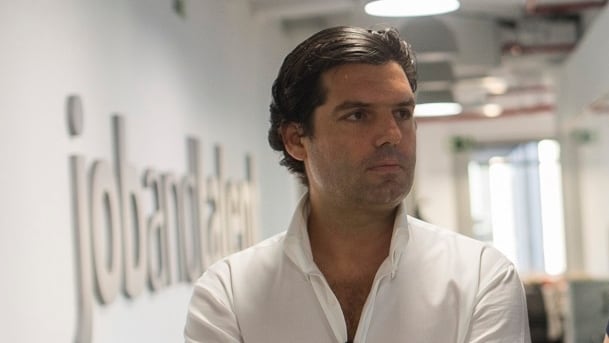
The hand of the United States has resurfaced in the legal proceedings facing Alejandro Betancourt. This time in Spain. The Venezuelan businessman, identified as the architect of the deal that will give Donald Trump control of a fifth of Venezuela’s oil, has been under investigation by Spain’s National Court (Audiencia Nacional) for more than a year on charges of money laundering and tax evasion. But the case has been stalled for months, and sources close to the investigation point to one party responsible: Washington.

Judge Santiago Pedraz is waiting on a response to a formal request for legal assistance sent to U.S. authorities that never arrives, and after shelving the case once already, he has issued a new warning: if there is no answer from the United States by December, he will close the case again.

Behind this story lies more than a simple delay; it’s about a figure of critical interest to the United States. Betancourt has emerged as the man behind the oil deal that Washington and Caracas signed a few weeks ago, one that will allow the United States to profit to the tune of millions of dollars from a quarter of Venezuela’s oil reserves. Trump’s inner circle is well aware of his legal cases in Venezuela, the United States, Switzerland, and Spain —the latter two still active— but has used him to achieve its goal of reviving Venezuela’s oil business following the capture of Nicolás Maduro this past January 3.

The signing of that deal put the businessman and his multiple legal cases under scrutiny, but the White House —and acting Venezuelan president Delcy Rodríguez— have not only defended him publicly, but had also been maneuvering for months to protect him legally, as U.S. media has extensively documented.

The Spanish judicial proceeding, which is investigating the origin and destination of more than 4 billion dollars allegedly diverted from PDVSA, Venezuela’s state oil company, is waiting for Washington to respond to a request to take testimony from a series of key witnesses, since they have already been convicted in the United States. Their testimony could help establish the underlying crime in Madrid, but nearly a year after that request was made, no one has responded.

The money laundering offense under investigation in Spain requires a predicate crime that establishes the illicit origin of the funds. Judicial sources explain that if the witnesses confirm corruption at the oil company, it would establish that the money that reached Spanish territory has illicit roots, and the Spanish case could move forward to examine how that money was laundered by feeding it into a legal financial system. Betancourt, known in Spain for having become the owner of the Hawkers eyewear brand, invested millions in numerous Spanish companies and even bought a castle in Toledo.

The five “essential” witnesses have already been convicted in the United States for the same PDVSA corruption scheme, known as Money Flight. They are Abraham Ortega Morales, the oil company’s former director of financial planning; Carmelo Urdaneta, a senior official in Venezuela’s oil sector; Álvaro Ledo Nass, PDVSA’s former legal advisor; Luis Fernando Vuteff, an Argentine businessman and son-in-law of opposition figure Antonio Ledezma; and Luis Carlos de León, former financial director of Electricidad de Caracas, a PDVSA subsidiary.

Sources at the Audiencia Nacional explain that there is no legal deadline by which the country must respond. So when does it usually respond? “When it’s in its interest,” notes one judge who asked to remain anonymous. Spain and the U.S. have well-oiled judicial cooperation systems backed by cooperation treaties. In fact, the Ministry of Justice keeps a Spanish liaison judge in Washington to help facilitate cooperation. Until a few weeks ago that position was held by María de las Heras, though she has just been replaced by judge Íñigo Herrero.

Prosecutorial sources who have worked in international cooperation explain that collaboration with the United States isn’t always straightforward, given the country’s size and the fact that its 50 states plus federal system operate separately. Cooperation becomes more difficult, they say, when what’s being requested is a measure that limits rights —such as a search and seizure or a wiretap— but they note that taking testimony via videoconference, as in this case, “should move quickly.”

In this impasse, Betancourt is shoring up his legal position with documents from Venezuela’s Public Ministry certifying that, despite all the schemes and suspicions in which the businessman has ended up involved, the case against him in his home country was dismissed without his involvement being proven.

EL PAÍS reached out to the U.S. Department of Justice, which did not respond; the State Department, which declined to respond officially; and the Pentagon, which merely offered the same statement issued after the announcement of the oil deal with Betancourt, reports Macarena Vidal Liy.

American help in Switzerland

The proceedings in Spain stem from an investigation opened in Switzerland nearly a decade ago. The Zurich Prosecutor’s Office had an extradition order against Betancourt from the United Kingdom, where he remained confined between his two mansions because he was barred from leaving the country. But in May, U.S. efforts to help him paid off. As The Washington Post revealed, senior Trump administration officials —then-Attorney General Pam Bondi, her deputy Todd Blanche, and Deputy Secretary of State Christopher Landau— pressured Swiss prosecutors directly seeking information and favorable treatment for their ally.

The Zurich Prosecutor’s Office declined to confirm to this newspaper whether that pressure influenced its decision, but it did confirm that it withdrew the extradition request, citing particularities of British law. Thanks to that withdrawal, the travel restrictions the U.K. had imposed on him while reviewing the extradition request were lifted, and Betancourt was able to resume flying by private jet to Venezuela and the United States to finalize the details of the historic oil deal announced by Trump nearly two weeks ago.

The case in Switzerland remains open, but another detail revealed by The Post showed that the United States has no interest in cooperating. The Prosecutor’s Office asked the U.S. Department of Justice to arrest Betancourt if he entered U.S. territory, and not only did it fail to do so, but it also shielded him as its business partner.

Meanwhile in Spain, the Anti-Corruption Prosecutor’s Office —which filed the original lawsuit in June 2025 not only against Betancourt but also against his cousin Pedro Trebbau, his partner Francisco Convit, and three other people— remains determined to prove a multimillion-dollar fraud.

According to the investigation, in 2012 the Venezuelan oil company issued a 4.35 billion loan to the private company Administrador Atlantic that was, in reality, only meant to get the money out of the country so it could eventually be laundered, allegedly, through accounts belonging to Venezuelan businessmen and former officials. Anti-Corruption investigators believe that “significant amounts of money” were invested in Spanish territory in real estate and other assets after the money was brought from Venezuela “through bribes paid to officials” totaling 42 million dollars.

This vast money-laundering network has international ramifications. Sources close to the investigation explain that between March and April of 2025 there was a meeting at Eurojust —the European Union’s agency for judicial cooperation— where officials from various countries, including Spain, shared information on how to address this complex money-laundering scheme, which sought to conceal, through overlapping companies and different countries, the enormous amount of money under investigation.

Although Judge Pedraz had shelved the case in March, the Criminal Chamber forced him to reopen it following an appeal from the Anti-Corruption Prosecutor’s Office, which considered the dismissal “premature.” Testimony was still needed from those witnesses, who can only be interrogated with Washington’s cooperation. And nothing has moved since.

Betancourt isn’t willing to lose any legal battle, and he has armed himself both inside and outside Spain. Outside the country, back in 2019, he hired Rudy Giuliani —then Donald Trump’s personal lawyer— to defend him before the U.S. Department of Justice, where he had been named an unindicted co-conspirator in the Money Flight case. In Spain, he has retained the law firm of José Antonio Choclán, one of the most sought-after criminal defense attorneys in major corruption cases. The firm has defended, among others, singer Julio Iglesias, the former lover of Spain’s emeritus king, Corinna Larsen, broker Víctor de Aldama in the Koldo case —a corruption scandal implicating the Socialist Party (PSOE)— and former Real Madrid footballer Cristiano Ronaldo.

While the United States has yet to respond to the request for legal assistance, Betancourt has submitted to the Spanish court a document from the Directorate General of International Criminal Cooperation of Venezuela’s Prosecutor’s Office, which was overhauled in February following the capture of Nicolás Maduro. Unlike the terms former Attorney General Tarek William Saab and several Chavista officials used to describe Betancourt in the past, this document now clears him of all responsibility.

The speed of Venezuelan justice contrasts sharply, in this case, with the slowness of the American one. In just six days —following a formal request from his own lawyer in Caracas on June 30— the agency’s director, Ana Osto Ascanio, signed a response detailing the investigation point by point. It reaffirms that the Venezuelan case was closed in 2023 with “res judicata” status, meaning, the Venezuelan prosecutor’s office argues, that he cannot be prosecuted in another country for the same acts, according to investigation documents reviewed by EL PAÍS.

Various sources consulted at the Audiencia Nacional point out the speed with which Delcy Rodríguez’s government —which now backs Betancourt— handed over this document, even as Venezuela has gone decades without cooperating in other major Spanish judicial cases, such as the extradition of ETA members sheltering in the country. One such case involves the Audiencia Nacional’s renewed effort to locate 14 ETA members in hopes that Maduro’s fall would open a new avenue for cooperation, a request that remains unresolved.

Judge Pedraz’s ultimatum, in any case, still stands. In a filing dated August 10, the judge stated that he cannot continue pursuing proceedings into the money laundering charge because, without establishing the predicate crime (corruption), they would be “useless.” The judge asserts that he “cannot wait indefinitely for U.S. authorities” to act on Spain’s request, calling it contradictory that they have shown “great interest and cooperation” while failing to respond. He therefore allows a “reasonable amount of time” that, in his view, “cannot extend beyond December of this year.”

The clock, once again, is running in Betancourt’s favor. And in this case, the United States doesn’t need to make major moves that later get exposed in the American press months down the line. Simply doing nothing is enough.

Continue Reading

Argentina

The Falklands: The Open Wound That Unites Argentines

Published

on

the-falklands:-the-open-wound-that-unites-argentines

The Argentine collective joy after winning the Qatar World Cup in 2022 was played out to a soundtrack that began like this: “In Argentina I was born, land of Diego and Lionel, of the lads from the Falklands I will never forget.” Four years later — in the attempt to win a fourth star in the tournament held in the U.S., Mexico and Canada — Messi, Maradona and the islands shared verses again in a new Argentine soccer anthem: “For the Falklands, for Diego, for Leo’s last one, Argentina, I want to see you two-time champion.”

In Argentina, soccer and nationhood go hand-in-hand. There is no greater or more popular nationalist cause here than regaining the islands that have been a British Overseas Territory since 1833. The Falklands, which are known in Argentina as Las Malvinas, awaken a mix of pride, pain, and belonging, but they also create a consensus that turns them into a readily available political resource to shift attention when reality becomes uncomfortable, as Javier Milei has just done.

Why do the Falklands occupy a central place in the Argentine imagination? Some researchers say you must go back to Argentina’s founding narrative and its thwarted destiny — the story that nostalgically recalls that the country was once powerful and prosperous and then ceased to be.

“When Argentina emancipated itself from Spain, the Falklands were part of it and then they were stolen from us, and that ties into Argentina’s trauma — to what it could be and is not,” says political scientist Mariana Altieri, author of the book Malvinas y Gibraltar, conflictos atrincherados (The Falklands and Gibraltar: Long-Standing Conflicts). She recalls that from the start of the British occupation successive governments and major literary figures such as José Hernández, author of Martín Fierro, demanded Argentine sovereignty over the islands. “Those rights never expire,” Hernández wrote in 1869.
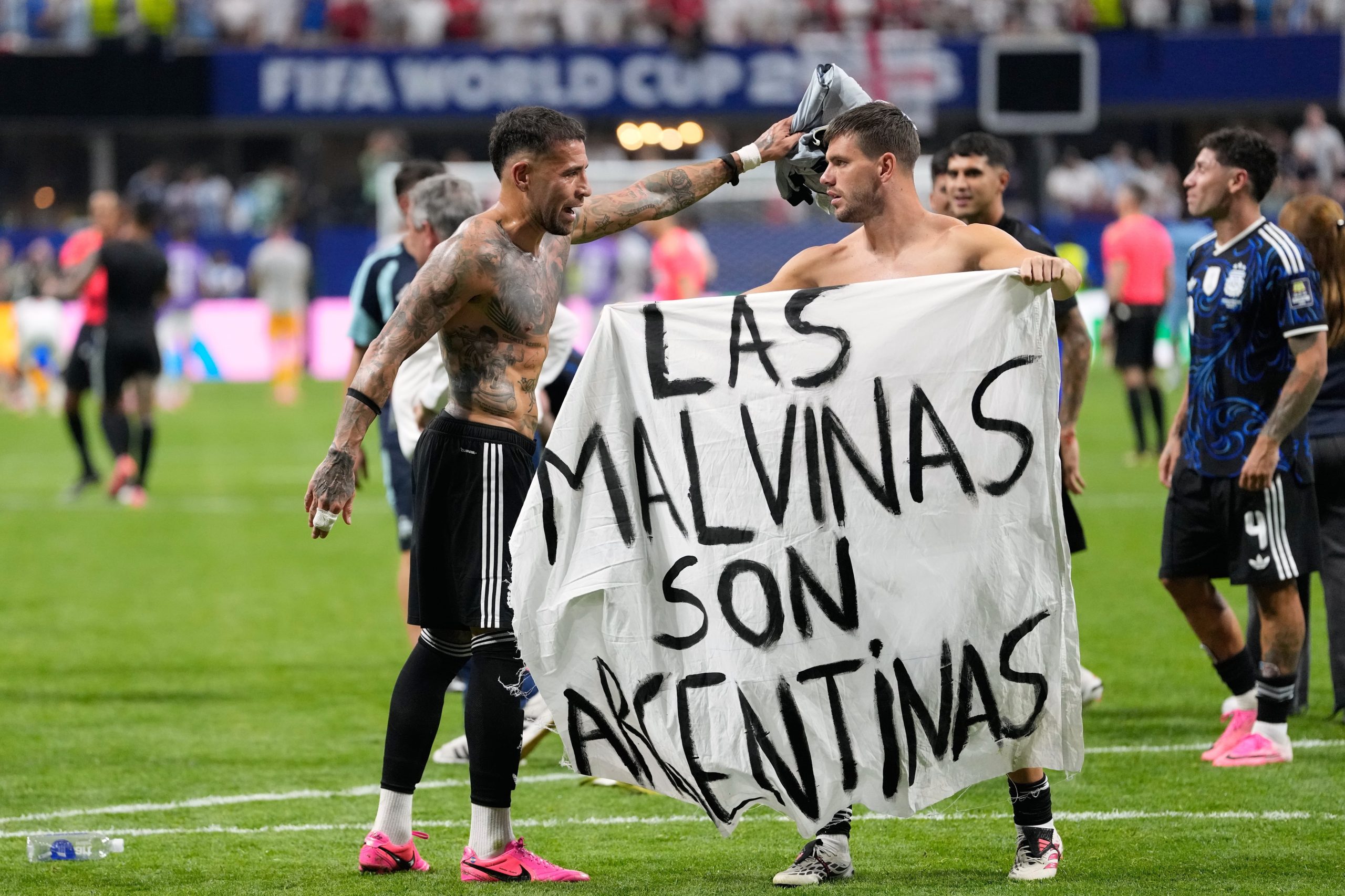
“The farther the idea of recovering them recedes, the more the logic of revenge grows,” Altieri continues, noting that soccer has been one of the arenas where that revenge has been possible symbolically. The most remembered instance came in 1986, only four years after the Falklands War, when Diego Armando Maradona scored one goal with his hand and another after dribbling past five English players and the goalkeeper in what was dubbed “the goal of the century.” The latest meeting, in 2026, in the World Cup semifinal, featured his heir, Lionel Messi, as captain of the Albiceleste in a comeback 2-1 victory. The euphoria that greeted the second goal in front of every television in Argentina increased at the end of the match, when some players unfurled a homemade flag on the pitch that read “Las Malvinas son argentinas” (The Falklands are Argentine). No one cared about the expected FIFA sanction.

Anthropologist Rosana Guber, one of the country’s leading specialists on the Falklands War, says it was “obvious” there would be some political claim during the match. “The players were a channel. The protagonist was a guy at the hotel who grabbed a sheet and painted the slogan on it. He was nobody. Or he was everyone. Because what he did was shout that we beat the British, that we have rights over the islands and that we must be recognized,” Guber says.

A professor and senior researcher at the National Scientific and Technical Research Council (CONICET), Guber believes that the feeling the Falklands provoke in Argentines can be understood if they are seen as a symbol. “A symbol like the flag, the national anthem, or the cross. And symbols have different meanings, not just one. They speak to people who can hold very different positions on everything. That was the point Milei appealed to the other day, saying: ‘On this we are all together.’ Just like in 1982,” she notes.

Of all its multiple meanings, Guber highlights three: the outstanding sovereignty issue that Great Britain refuses to negotiate with any Argentine government; the popular cause that claims the Falklands from soccer stands, parades, demonstrations and any other setting; and the 1982 war, to which the dictatorship sent thousands of conscripts aged 19 and 20 and which caused the deaths of 649 Argentine combatants and 255 British servicemen.

An omnipresent emblem

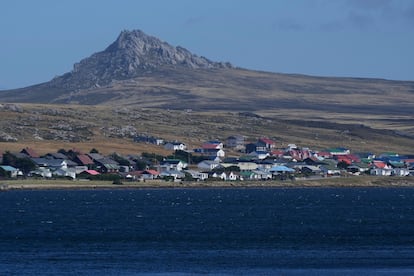
Historian Esteban Rodríguez lives in Río Grande, the city closest to the Falklands. It is less than 600 kilometers (370 miles) away, compared with the nearly 12,800 kilometers (7,950 miles) separating the islands from the British coast. The province that includes Río Grande, Argentina’s southernmost, is called Tierra del Fuego, Antarctica, and the South Atlantic Islands, and the outline of the islands appears on every Fuegian student uniform, on all of the local soccer clubs’ kits and on numerous murals and plaques. The provincial anthem is the March of the Malvinas. Children learn it from the moment they enter school: “Behind their misty quilt / We shall not forget them / The Argentine Falklands / Claims the wind and roars the sea.”

It is easy to understand why, Rodríguez says, because the Falklands are an inseparable part of Argentine identity, especially in the south. “We feel the Falklands as a loss and it is a loss that has been seared into us because we are reminded of it all the time,” the historian says. That feeling deepened after defeat in the war declared by the dictator Leopoldo Fortunato Galtieri.
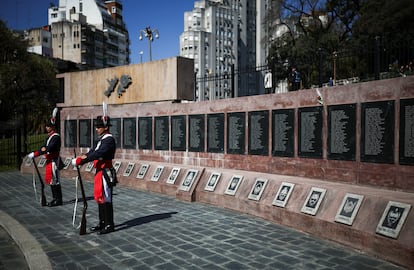
Río Grande was the main city in the conflict. Super Étendard jets took off from there to bomb British ships. After the defeat, every April 1, on the eve of the day the war began, a vigil is held to pay tribute to the fallen and keep the memory alive. The tribute continued despite the de-Falklandization policies imposed in the 1980s and 1990s, when veterans maintained the cause against the tide. Today, despite low temperatures and the nearly constant icy wind, “the vigil can bring together up to 20,000 people,” Rodríguez says.

Unknown islands

Journalist Nicolás Cassese has just published the novel Puerto Stanley, 1982 and has traveled to the Falklands three times as a reporter for the newspaper La Nación. He believes many Argentines know little about the islands beyond the dispossession in 1833 and the war a century and a half later: “The latest resurgence of Argentine nationalism rests on the triple M — Messi, Maradona and the Malvinas — but we have an enormous amount of information on the first two and almost nothing about the Falklands,” Cassese says.

As an example, he recalls that when he published the novel some friends asked about the title because they did not know what Puerto Stanley referred to and some even associated it with a well-known brand of thermoses. They were unaware that it is the name the British use for the largest town in the archipelago, Port Stanley, known on Argentine maps as Puerto Argentino. Although he was accused on social media of being a traitor, he explains that the town was founded in 1845, when the British already controlled the islands, and that Argentines themselves used that name for decades. Also little known are the strong cultural and commercial ties that once existed between the Falklands, Tierra del Fuego, and the far south of Chile. “The first sheep brought to Santa Cruz at the end of the 19th century came from the Falklands,” he says by way of example.

Milei Trump

Knowledge about the islands is rarely firsthand. Fewer than 1% of Argentines have visited the Falklands. The journey is very expensive, requires staying at least a week and accepting that your passport will be stamped. Yet they are an indispensable part of the historical construction of national identity. “In the 19th century, Argentina was a new country with many immigrants who spoke different languages, and education was crucial to creating a common identity. The Falklands were part of that narrative,” Cassese says. Others, like Guber, believe the school’s role was lesser than often claimed, even minimal.

Experts speak of the Falklands as a symbol, a place of mourning and an open wound. But the islands are also one of the few points of unity in a society split in two. That unity has made them politically useful on numerous occasions. Milei took advantage of a remark by Donald Trump that hinted the United States might revisit its historic neutrality in the sovereignty dispute over the islands to defend, on national television, the statement “the Falklands are Argentine.” In his speech, which ended with “viva la patria” (long live the homeland), he announced sanctions against companies operating in the area without Argentine authorization and promised to build a military base in the south.

Given that a 2011 law already imposes those sanctions and that construction of the announced base had already begun before he halted it, the opposition accused him of opportunism and of “galtierizing” the cause, in reference to the former dictator. The La Plata Veterans’ Center (CECIM) branded Milei a hypocrite and criticized his use of the Falklands as a “life preserver to hide his miseries.”

Cassese, by contrast, argues that “for Milei embracing the Falklands cause is all gain” and notes that with it he shields “one of his weak flanks; the accusation of being a sellout,” since he has tried to reform the law that caps foreign ownership of land.

Argentina’s foreign policy on the Falklands has swung for decades between confrontation and attempts at rapprochement. Altieri believes Milei has so far chosen the cooperative line, like Mauricio Macri before him. In 2025, Milei expressed support for self-determination for the Falkland Islanders: “We hope that the Malvinas people will one day decide to vote with their feet for us. That is why we seek to make Argentina such a power that they will prefer to be Argentines.” By contrast, his televised speech on Thursday “was a 180-degree turn,” says Altieri.

While Milei’s economic course divides society, “the announcement of sanctions, of imposing costs on the British, generates a lot of support; the majority agree that that is what must be done,” Altieri adds. In his third year in office, Milei has just discovered the power of a flag that transcends the divide.

Sign up for our weekly newsletter to get more English-language news coverage from EL PAÍS USA Edition

Continue Reading

Trending

Copyright © 2017 Spanish Property & News