
Donald Trump
In Washington DC, A Spanish-Language Theater Offers A Refuge From ICE


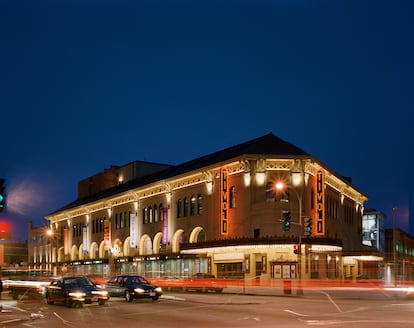
The iconic GALA Hispanic Theater in Washington, D.C., a pioneer in presenting Spanish-language plays in the U.S. capital, hasn’t been immune to the impact of Donald Trump’s aggressive immigration policies. Faced with the intensification of raids by Immigration and Customs Enforcement (ICE) across D.C., this center for Hispanic culture has become a refuge for the Latino community on more than one occasion.
“When things were really bad in this area, there was a time when we couldn’t leave the theater after the 10 p.m. rehearsal. We had to stay put until 5 a.m., with two actors who were crying the whole time,” Gustavo Ott sighs. Born in Venezuela, he’s the artistic director at the theater, which is now celebrating its 50th anniversary. The young Latinos studying acting under his supervision suffered persecution by ICE agents, who followed them home to arrest their parents.
The neighborhood where the theater is located, Columbia Heights, was one of the first where residents confronted agents, blowing whistles to alert locals about their presence and putting chalk on the wheels of unmarked ICE vehicles. And the anguish and resilience of the community will be brought to the stage at GALA this season. In June of 2027, the theater will present Botiquín de mariachis de Columbia Heights (with the English title Columbia Heights Mariachi Bar), by Mexican playwright Jaime Chabaud. It’s a portrait of resilience, hope and quiet resistance, reflecting the current reality. “We’ve lived through major crises here,” Ott points out.
Role reversal
The theater troupe’s support for the Latino community dates back to its origins. GALA — an acronym for Grupo de Artistas Latinoamericanos (“Group of Latin American Artists”) — was founded in 1976, in order to promote Hispanic culture in a country where the Spanish language wasn’t widely spoken and the traditions were different. The gamble taken by the founding couple, Hugo and Rebecca Medrano — a theater director born in Argentina and an American dancer — was innovative. Putting on Spanish-language plays in Washington, D.C. and in the mid-1970s, at that, by no means guaranteed success.
Being the only theater in town that offered plays in Spanish attracted the Latino audience, a growing community in the city. And, for everyone else, the couple decided to use subtitles. At the time, this was an unusual role reversal and it has continued to this day.
Upon entering the theater – located in a century-old building in the Columbia Heights neighborhood – the three screens surrounding the stage immediately catch your eye: one on each side, with another one above it. And then, the cascade of English-language phrases begins. This is a nod to the experience of segments of the Latino community, who are accustomed to having to read the dialogue when their lack of knowledge of the most widely-spoken language in the country prevents them from following a story.
“It’s magnificent. I speak some Spanish, but the person accompanying me doesn’t. So, they can read the subtitles. It’s a way to promote Hispanic culture and it’s part of the Washington community,” says Rochelle Granat, an American woman seated in the theater’s bar.
The beginnings were modest. Hugo – an actor, who emigrated to Spain after the 1966 military coup in Argentina – didn’t want to stay in the European country, which was emerging from Francisco Franco’s dictatorship. And so, he decided to try his luck in the United States. Unwilling to give up his acting career, he and his wife decided to found a theater to serve the Latino community and offer them what wasn’t available at the time: culture in their own language.

“It was a great opportunity for the Latino community to have access to theater. The fact that it’s in Spanish is what I like most,” says Álvaro García, a Colombian man who has been attending GALA’s plays for three decades. On Thursday, September 17, he and his American wife attended the performance. His Colombian friend and the man’s partner (also regular theatergoers) joined them.
Hugo and Rebecca started their venture in a garage in the Adams Morgan neighborhood. They later moved to a warehouse and a convent school, until the opportunity arose to set up shop in the Columbia Heights building. The property is steeped in history: it served as a grand musical theater in the 1920s, before becoming a movie theater.
The building was one of the few to survive in a predominantly African American neighborhood where, in 1968, following the assasination of Martin Luther King Jr., numerous riots took place. The locals, who had grown up going to the theater, marked it, in order to prevent it from being burned down.
The area became conflict-ridden and the theater was eventually abandoned. It stood empty for many years, until it re-emerged as a survivor from a previous era.
Lorca, with subtitles
The neighborhood has changed, and so has the audience. There are increasingly more spectators who don’t speak Spanish and have to read the subtitles, including younger generations of Latinos.
“Nowadays, we’re very surprised. Because, for example, we performed The House of Bernarda Alba (1936) in January and February of this year. And [the theater] was full of people who didn’t speak the language. It’s [by Federico García] Lorca and they came to read [the subtitles],” Ott notes.
He explains that one of the reasons for the theater’s success is the quality of the translations. “We believe that the translation has to be of a high, literary standard. It can’t simply be an AI thing,” he says. “It’s not just about communicating with the audience. The audience has to feel pleasure because they’re reading something worthwhile. Our translations are very literary,” he emphasizes. Last year, the subtitles were written in verse for the translation of Lope de Vega’s Fuenteovejuna (1619).
One of the keys to survival is adaptation. Hence, the GALA Hispanic Theater is now looking to attract new generations of Latinos who don’t speak Spanish, while also expanding its audience by focusing on bilingualism during performances.
Approximately 30% of GALA’s audience doesn’t speak Spanish. Accordingly, the theater has begun introducing English through musicals.
Garbo, the unsung Spanish hero
To make their performances accessible to non-Spanish speakers, the production company has chosen to stage Garbo: The Actor Who Saved the World, a play running until September 27. Garbo is the code name of Juan Pujol, a Spanish spy who became a key figure in the success of the D-Day landings that helped bring an end to World War II.
Ott wrote the script. He explains that Garbo “is a hero whose story resonates with the traditional American community that doesn’t speak Spanish, because they recognize elements of World War II and they’re familiar with what happened in Normandy.”
Pujol, without any prior training, became a double agent who invented an imaginary network of spies to deceive the Germans into believing that the Allies would launch their attack at Pas-de-Calais, not Normandy. As a result, the Nazi army concentrated its resources in the wrong place. For the British, his name was Garbo; for the Germans, he was Arabel. His cover was so successful that he received military decorations from both sides of the conflict: he was awarded the Iron Cross by the Nazis and was made a Member of the Order of the British Empire.
Preparations for the 2027-2028 theatrical season have already begun. The selection of plays to be performed is based on GALA’s “seasonal themes.” And, this time around, they’re looking ahead to the 2028 presidential elections. “‘Confrontation,’ for example, might be one of the words we use. We’ll also keep in mind that our community is constantly being persecuted, even around the theater. So, ‘persecution’ will be another one,” Ott affirms.
Sign up for our weekly newsletter to get more English-language news coverage from EL PAÍS USA Edition






America
El Gobierno Evita Responder A Un Informe De CBS Que Reaviva La Posibilidad De Una Acción Militar En Cuba

America
ICE Wasted Millions Of Dollars On Its Expansion Of Detention Centers, According To A Government Report


Millions of dollars earmarked to expand U.S. immigration detention capacity ended up in warehouses that will now be sold, in tents that never housed a detainee, and in food purchased for empty facilities. These are the findings of a report by the Government Accountability Office (GAO), which documents how the rapid expansion of U.S. Immigration and Customs Enforcement (ICE) has left behind abandoned projects, sunk costs, and new financial commitments.
The report, released Thursday, notes that the agency undertook six major initiatives without a comprehensive strategic plan to determine where it needed to expand its capacity, how much it would cost to maintain it, and which facilities would actually be necessary. The lack of planning led to course corrections, stalled projects, and wasted resources just as ICE prepares to manage tens of billions of additional dollars.
The expansion accelerated during Donald Trump’s second term. The number of people in ICE custody rose from about 39,000 detainees in January 2025 to approximately 67,000 on July 30, 2026. At the same time, Congress approved $45 billion to increase the agency’s detention capacity as part of the legislation known as the One Big Beautiful Bill Act.

One of the clearest examples of the spending questioned by the GAO involves the warehouses that ICE acquired to convert into detention centers. The agency spent approximately $1.07 billion to purchase 11 facilities but later decided to put seven of them up for sale. None of the warehouses ever housed detainees.
The operation also resulted in nearly $20 million in unrecoverable expenses related to services, security, utilities, and other costs associated with the properties. The other four warehouses have not yet begun to house migrants either. At two of them, located in Arizona and Maryland, renovation plans were put on hold due to legal challenges, while the investment needed to bring them up to standard was estimated at hundreds of millions of dollars.
Meanwhile, in Guantánamo, ICE spent $2.85 million on tents with a capacity for about 5,000 people, but never used them to house detainees because the facilities did not meet federal standards. By June, the average number of migrants detained there was just 16 people per day.
Another instance occurred at Camp East Montana in El Paso, Texas. The government purchased $7.1 million worth of food that it ultimately did not need for the facility. In addition, it spent another $11.5 million on services over a two-week period while the center remained empty.

In Florida, the federal government allocated up to $608 million to reimburse the state for the costs of operating the facility known as Alligator Alcatraz. According to the report, the cost per detainee reached $249 per day, compared to the $92 that ICE normally pays—a difference of 171 percent. The facility closed in June.
ICE also used facilities operated by the Federal Bureau of Prisons. The agreement covers eight centers and requires the immigration agency to cover the full cost of maintaining them, including expenses related to overtime and temporary staff. The average cost amounts to $182 per day per detainee.
While some of these projects were abandoned or put on hold, ICE continued to purchase existing facilities. In July, the agency acquired two private detention centers in California for $1.47 billion, and in August, it purchased two more in Kansas and Minnesota for $734 million. The GAO noted that ICE had not assessed how much it would cost to maintain those facilities in the long term.
The federal agency believes that the absence of an overall strategy has contributed to the agency moving forward with, halting, and modifying projects without sufficient planning. Heather MacLeod, the GAO’s director for Homeland Security and Justice, summed up the problem by noting that the lack of planning had led to “stops and starts” that ultimately resulted in waste.
The Department of Homeland Security, for its part, has defended the pace at which ICE is expanding its capacity and has noted that the new funding approved by Congress allows the agency to move forward with its operations.


Vox Se Impone Al PP En La Manifestación De “ultimátum” Al Gobierno En Madrid, Con La Mitad De Participación Que La Del Pasado Mayo

El Papa Llama A “ver A Quienes Son Invisibilizados” En Un Centro De Ayuda A Migrantes De París

Ferragamo, Sensualidad A Flor De Piel


-
Latest2 weeks ago
The Vocabulary You Need To Understand The Spanish Citizenship Process
-

 Argentina2 weeks ago
The Falklands: The Open Wound That Unites Argentines
-

 Alex Saab2 weeks ago
Maduro Ally Alex Saab Pleads Guilty In US Money-Laundering Case
-

 New Developments2 weeks ago
How To Get A Tourist Rental Licence In Andalusia (Spain) – Step-By-Step Guide 2025
-

 Uncategorized2 weeks ago
‘Lewis will never trust Charles again’ – F1 journalist issues shocking Ferrari statement – GPFans.com
-

 %2 weeks ago
Benahavis Wildfire Stabilised: 300 Hectares Burnt
-
Best airlines1 week ago
Spanish airline Vueling named Europe’s best low-cost carrier for 2026
-
Latest2 weeks ago
Italy And Spain Extend Tit-For-Tat Border Checks In Wake Of Migrant Rush