
Foreign demand
Market Snapshot: French Market In Q2 2026

Author:  Mark Stücklin
Posted on
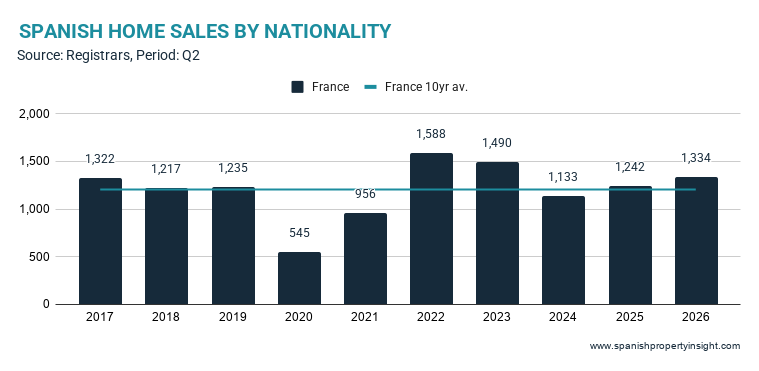
French demand for Spanish property has recovered over the last two years, raising an interesting question: could growing political instability and economic uncertainty in France be encouraging more French buyers to look across the Pyrenees?
French buyers were involved in 1,334 Spanish property purchases in Q2 2026, up 7.4% compared with the same period last year. This follows growth of 9.6% in Q2 2025, suggesting a partial recovery after the sharp decline of 24% recorded in 2024.
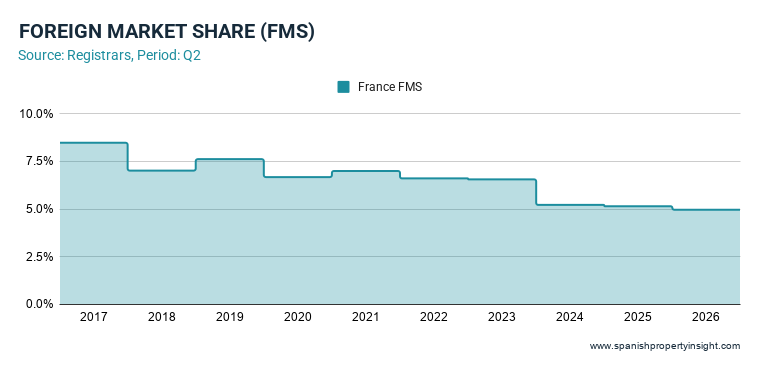
However, French demand for Spanish property is still growing more slowly than the foreign market as a whole, which expanded by 11.3% in Q2. As a result, the French share of foreign purchases slipped to 5%, down from 5.2% a year earlier and 8.5% in 2017.
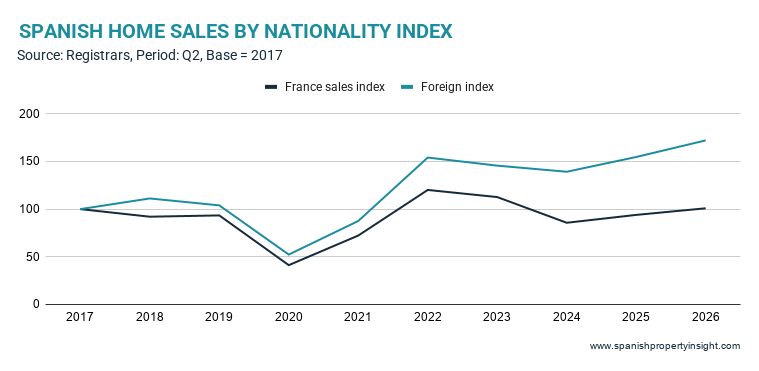
Using Q2 2017 as an index of 100, French demand now stands at 101, compared with 172 for the overall foreign market. In other words, French purchases are barely above their 2017 level, whilst total foreign demand has grown by 72%.
Is France’s political turmoil encouraging buyers?
The recovery in French demand is particularly interesting against the backdrop of growing political and economic uncertainty in France.
With political polarisation, social tensions, government instability and mounting public debt raising concerns about the country’s financial outlook, some French households may be looking to diversify their assets or establish a foothold abroad.
Spain, with its proximity, relatively attractive property prices and familiar lifestyle, is an obvious destination.
Could the recent recovery in French purchases partly reflect a desire to hedge against political and financial risks at home? It’s a plausible explanation, though the property data alone cannot establish a connection.
The rolling trend tells a more cautious story
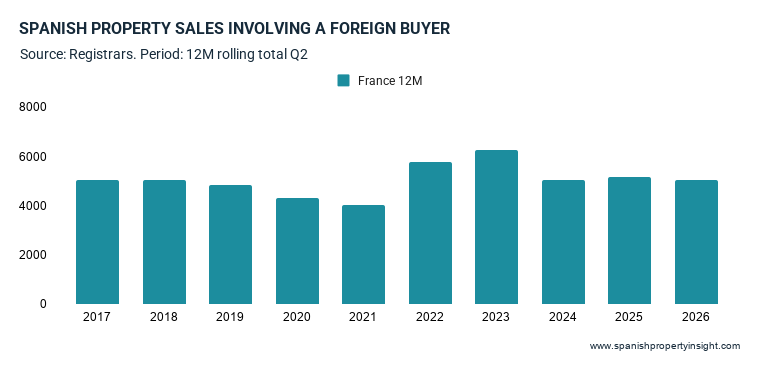
The four-quarter rolling total, which smooths out fluctuations in individual quarters, suggests the French market is more stable than the recent quarterly growth figures might imply.
French buyers were involved in 5,052 Spanish property purchases in the four quarters to the end of Q2 2026, down 2.3% compared with the equivalent 12-month period a year earlier.
That leaves rolling demand close to its level in 2017 and well below the post-pandemic peak of 6,262 reached in 2023.
So whilst the last two second quarters have shown encouraging growth, there is little evidence yet of a sustained surge in French demand. Given the political and financial uncertainty across the border, however, this is a market worth watching.











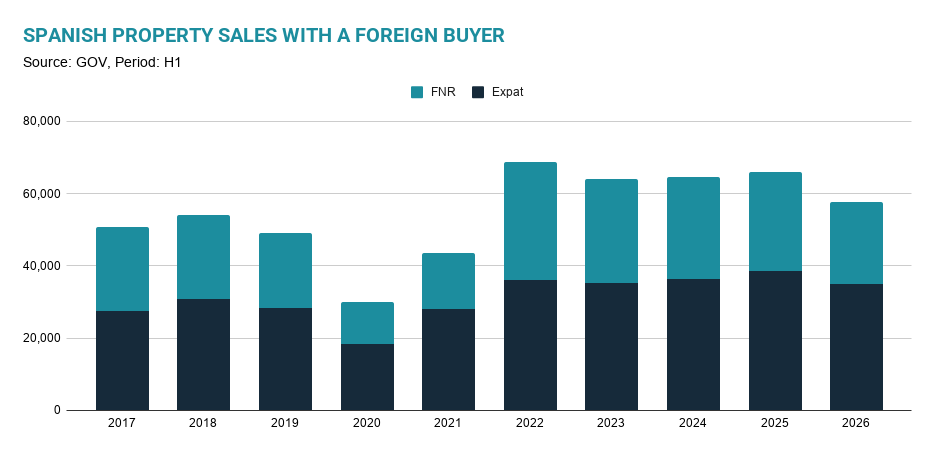
Foreign buyers purchased 13% fewer homes in Spain in the first half of 2026, with holiday-home demand falling even faster. But after a record-breaking 2025, the latest figures suggest a market cooling down rather than falling off a cliff.
The latest figures from Spain’s Housing Ministry show that 353,557 homes were sold in the first half of the year (H1), down 7.1% compared to the same period last year. These figures are based on transactions completed before notaries, providing a timely picture of how the market is performing, particularly when it comes to foreign demand.
Foreign demand falls faster than domestic demand
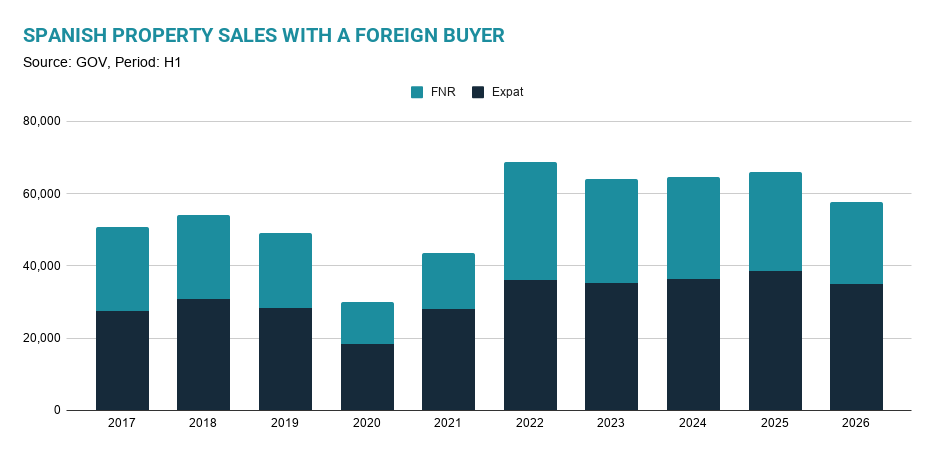
Foreign buyers purchased 57,595 homes in H1, down 12.6% year-on-year, compared to a 6.1% decline in purchases by Spanish buyers.
Foreign non-residents (FNRs) — predominantly holiday-home and second-home buyers — led the decline, with purchases falling 17% to 22,610 transactions. Foreign residents living in Spain, or expats, reduced their purchases by a more modest 9.6% to 34,985.
As a result, foreign buyers accounted for 16.3% of the market (FMS), down from 17.3% in the same period last year.
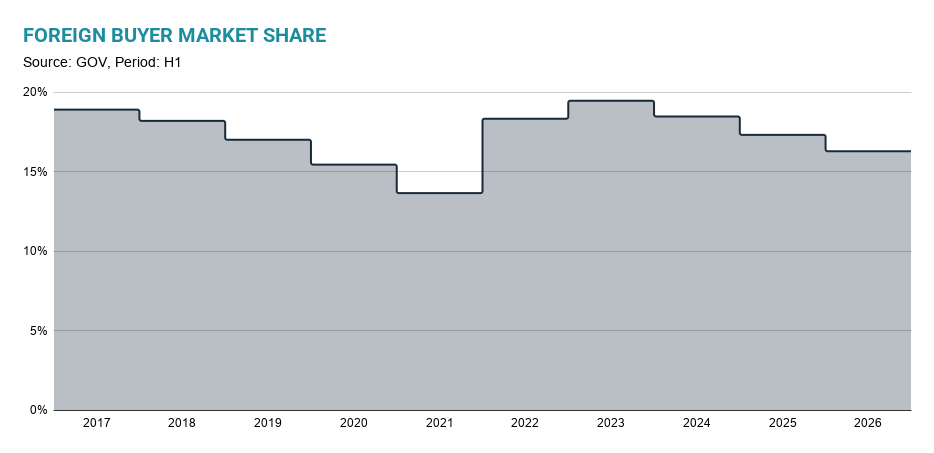
There was, however, one encouraging sign. Total foreign purchases declined by 14.6% in Q1 but by a smaller 10.7% in Q2, suggesting that the market might have started to recover as the year progressed. That would bode well for the second half, although it’s not necessarily consistent with what I’m hearing from estate agents on the ground.
Holiday-home demand weakens across Spain
Looking specifically at foreign non-resident buyers, the segment most relevant to holiday-home markets popular with northern Europeans and other international buyers, the picture is uniformly negative but with some important regional differences.
All the major foreign holiday-home destinations recorded double-digit declines in FNR purchases in H1, with Madrid down 44% and Catalonia down 24%. Madrid’s percentage decline is dramatic, though its relatively small FNR market limits the wider impact.
Andalusia, home to the Costa del Sol, performed best, with purchases down 14% in H1 and just 2% in Q2. That suggests a significant improvement as the year progressed.
Elsewhere, the picture was less encouraging. FNR demand in the Balearics, Canaries and Catalonia continued to decline by more than 20% in Q2. The Valencian Region and Murcia also recorded substantial falls.
In other words, there are signs of stabilisation in some markets, particularly Andalusia, but no convincing evidence yet of a broad recovery in foreign holiday-home demand.
A soft landing after a record year?
The important context is that 2025 was the strongest year on record for Spanish home sales, and the first half of 2026 was still the second strongest. So, despite all the red figures, we’re not looking at a market slump. At least not yet.
A soft landing after an extraordinary post-pandemic boom is a more reasonable interpretation of the data.
Nevertheless, the market faces some significant headwinds. Rising house prices have stretched affordability, whilst limited supply continues to restrict choice. Higher interest rates, increasing Spanish political and regulatory risk, and growing geopolitical uncertainty all threaten to dampen demand further.
The question is whether 2025 will turn out to have been the peak of this cycle, with 2026 marking the beginning of a downward shift in gear.
For owners thinking of selling in the next couple of years, that possibility is worth taking seriously. Market conditions remain relatively favourable for sellers, but they might not get any better. Indeed, they could easily deteriorate.
If you’ve already been considering a sale, this might be a sensible time to turn that intention into a plan, whilst demand remains historically strong and prices are still high.
Are you thinking of selling your property in Spain?
Whether you are thinking of selling or simply want to understand the market around one of your most valuable assets, an SPI personalised market report gives you unique, expert insight into your local market segment and what it means for you, so you can make informed decisions. Fill in this form to find out more.
Author:  Mark Stücklin
Posted on
German demand for Spanish property continued to grow in the second quarter, but once again failed to keep pace with the wider foreign market. As a result, German buyers’ share of foreign demand fell to its lowest level in this series.
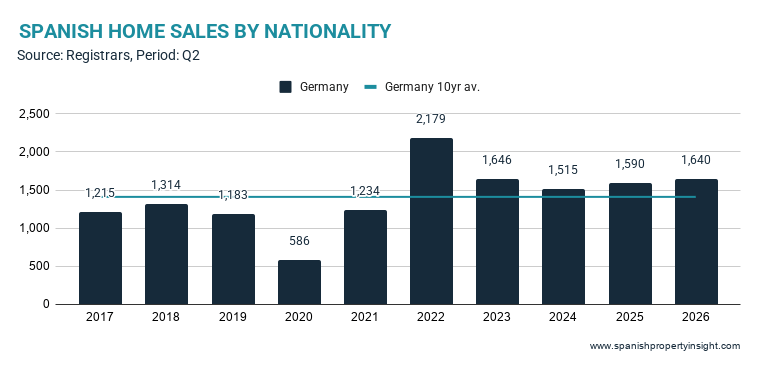
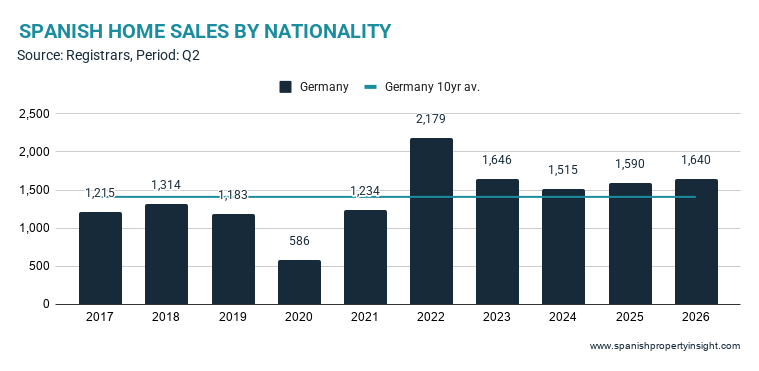
German buyers were involved in 1,640 Spanish property purchases in Q2 2026, up 3.1% compared with the same period last year. That was the second consecutive year of Q2 growth following declines in 2023 and 2024.
However, total foreign demand grew much faster, rising 11.3% year-on-year to 26,836 purchases. So although more Germans were buying, their relative importance to the foreign market continued to decline.
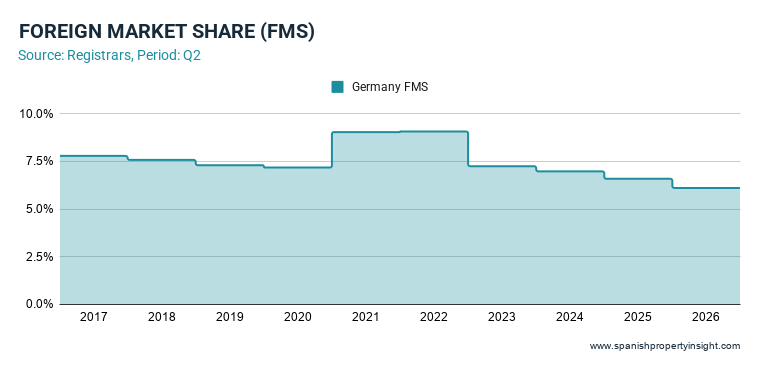
German buyers accounted for 6.1% of all foreign purchases in Q2, down from 6.6% a year earlier and 9.1% at the recent peak in 2022. That is also the lowest German foreign market share (FMS) in the period covered by this data, going back to 2017.
The first-half figures were slightly weaker. German buyers acquired 3,149 homes in H1 2026, down 2.1% compared with 3,216 in the same period last year.
Above average, but losing relative momentum
In absolute terms, German demand remains reasonably healthy. Q2 sales were 16% above the ten-year average of 1,410 transactions and 35% higher than in Q2 2017.
But that growth looks modest beside the foreign market as a whole. Using Q2 2017 as an index of 100, German demand now stands at 135, whilst total foreign demand has climbed to 172.
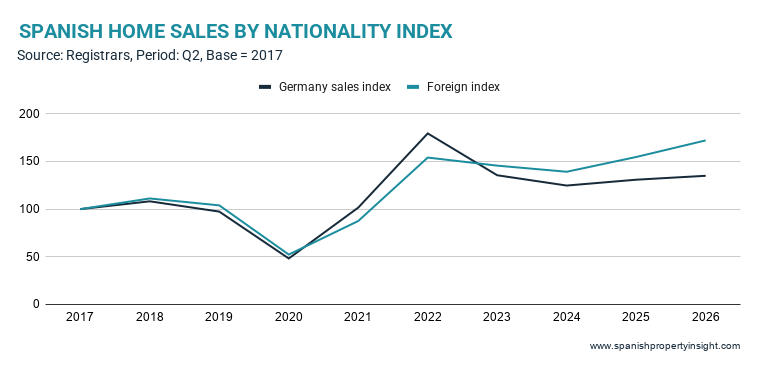
The picture is therefore quite different from booming markets such as the Netherlands. German demand remains substantial and is still growing on a quarterly basis, but other foreign nationalities are expanding faster and gradually taking a bigger slice of the market.
The rolling trend points to a broadly stable market
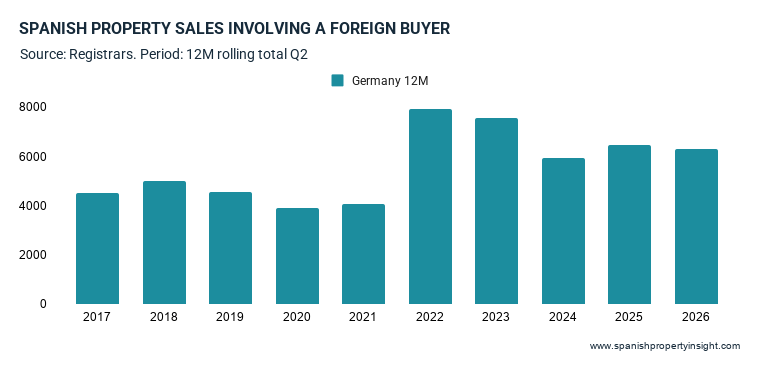
Looking at the four-quarter rolling total, which smooths out fluctuations in individual quarters, German demand appears broadly stable but slightly weaker than a year ago. German buyers were involved in 6,292 Spanish property purchases in the four quarters to the end of Q2 2026, down 2.8% compared with the equivalent 12-month total a year earlier. That follows a 9.2% recovery in the previous 12-month period. The rolling total remains well below the post-pandemic peak of almost 8,000 reached in 2022, but comfortably above the levels seen before the pandemic.

Lance Stroll gives three-word interview after new Aston Martin nightmare in Singapore

Maricarmen Y Las Elecciones Del 29-N, En Directo | Sánchez Se Compromete En Un Mitin En Sevilla A “reforzar Y Mantener” Los Decretos De Vivienda

Ucrania Golpea Una Gran Terminal Petrolera Rusa Tras El Acuerdo Del Diésel De Trump Y Putin


-

 Uncategorized2 weeks ago
F1 Bahrain Grand Prix will be live and FREE on TV this weekend
-
Latest1 week ago
Spain’s Government Dealt Huge Blow As MPs Reject Housing Crisis Laws
-
Latest1 week ago
Why You Can’t Donate Blood In Spain If You Don’t Speak Spanish
-
 Foreign demand2 weeks ago
Market Snapshot: German Market In Q2 2026
-

 Housing access / crisis / affordability1 week ago
Radical Housing Decrees Defeated As Snap Election Talk Grows
-

 Uncategorized1 week ago
Lewis Hamilton F1 wish could come true as stunning plans for new track revealed
-
Blackout preparedness1 week ago
Brussels takes action against Spain over failure to update blackout plan
-
Latest1 week ago
Spain’s PM Welcomes Burnham’s Openness To UK Rejoining EU