The camp in the capital’s emblematic Puerta del Sol square now hosts hundreds of people and has morphed into a mini-city equipped with a canteen, a clinic and a space for meetings.
It sprang up on September 26th following the police eviction of an 87-year-old pensioner from her lifelong Madrid home, after the real estate company that owned the apartment drastically hiked the rent.
That sparked nationwide protests against runaway housing costs and a lack of tenant protections, with tens of thousands of demonstrators hitting the streets and camps appearing in other Spanish cities.
Attempting to placate the anger, Socialist Prime Minister Pedro Sánchez’s government presented two urgent housing laws that included curbs on evictions and indefinite tenant contracts.
But his minority government failed to pass them in parliament, prompting Sánchez to call an early general election for November 29th.
Don’t miss our journalists’ daily news roundup from Spain
“We’ve achieved quite a lot of things, we’ve managed to bring forward the elections,” said Marcos Navarro, a 22-year-old laboratory technician, who has been sleeping in Sol since September 27th.
He pledged that the camp would occupy Sol “until they kick us out or until things really change… We will keep growing, no matter who governs. We will always defend our rights.”
‘Dystopian’
The pensioner, Maricarmen Abascal, died earlier this month. A shrine of candles and flowers is dedicated to her in Sol.
The rows of tents, assembled below a canopy of protective sheets, have become “streets” and “squares” named after several causes: “Anger”, “Tear Down the Walls”, Gaza and Maricarmen Abascal.
Sol is “a modern dystopian micropolis”, said Sufian Ben, a 32-year-old anthropologist and dancer, as he guided AFP through the labyrinth, which also boasts a library and a place offering spare parts for tents.
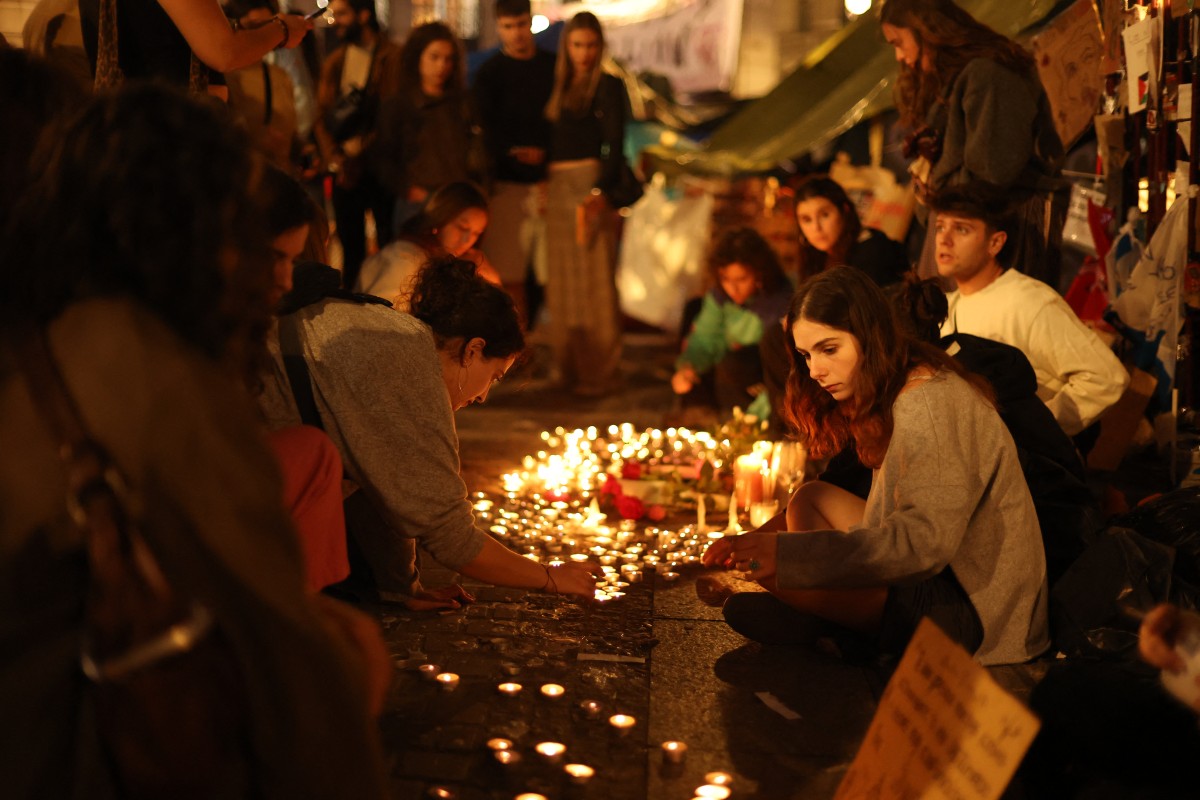
People gather for a vigil in the Puerta del Sol after learning that Maricarmen Abascal, the 87-year-old pensioner whose eviction triggered nationwide protests over Spain’s chronic housing crisis, had died in hospital in Madrid on October 7th 2026. (Photo by Thomas COEX / AFP)
Health worker Orlando Santander, 42, explained that nurses, doctors, psychologists and social workers work shifts to keep the clinic running, handing a pill for headaches to a young protester.
“We mainly offer first aid” to treat truncheon blows from the police, said Santander, while other doctors in the area offer private appointments to receive cancer patients.
The government has ruled out clearing the camp, in contrast to the dismantling of similar housing protests by police in neighbouring Portugal, irritating the conservative-run city and regional authorities.
“They are going to kill all the business in central Madrid. But not just that, it’s also Spain’s image before the world,” said the Madrid region’s leader Isabel Díaz Ayuso, a virulent critic of Sánchez.
Her government has unsuccessfully sought to remove the camp via legal avenues, while police have blocked far-right groups that have attempted to confront the activists and raze the tents.
‘Fighting spirit’
Some local businesses share Ayuso’s concerns. Pedro Mora, who owns a nearby leatherwork shop, says he has lost “a third” of his income due to the protest.
But others have sided with the demonstrators, including feminist bookshop “Mujeres” (“Women”), which lets the protesters use the bathroom, charge their phones, store items and rest.
“I thought about menstruation, about managing it in a space like the camp, and I quickly made a handmade poster” advertising the bathroom, the shop’s owner Alba Varela told AFP.
Not having access to a bathroom is just one of the discomforts.
“At the start it’s a little tricky, because you’re not used to sleeping on the floor,” said health worker Santander.
But for the activists in Madrid, where housing costs frequently swallow half of the average Spanish wage, foregoing some creature comforts is worth it.
“It breaks my heart that due to speculation… there are so many people who wouldn’t be living on the street if prices were regulated,” said Navarro.
READ ALSO: Unrest in Europe – What’s behind the protests in France, Spain and Italy?
The activists in Sol have taken heart from the spread of their movement across Spain and from demonstrations in other European countries, as protests rock France, Italy and Albania.
“We inspire a lot, definitely in Europe, and I think Spain is a country that has always had a lot of fighting spirit,” said Ayla Herrero, a 26-year-old anthropologist.
Article by Diego Urdaneta