
Latest
What The US Midterm Results Mean For Americans In Spain


Add The Local as a preferred source
The Democrats’ landslide win in the US midterms marks a historic shift in political power midway through Trump’s second term. The Local spoke to several political analysts about how this ‘blue wave’ affects US-Spain relations and Americans in Spain.
Become a member or log in to continue reading
More
Comments (1)
See Also





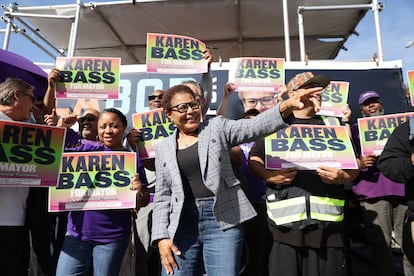
Karen Bass, a Democrat, had never lost an election. Until now. It became clear on Thursday that Nithya Raman, also a Democrat, will be the next mayor of Los Angeles.
Raman, who was born in India, graduated from Harvard University and is the mother of two children, will take the helm of the second-most-populous city in the United States, behind only New York City. She will be only the second woman to hold the office, following her predecessor, Bass, whom she defeated by a margin of 35,000 votes out of 824,000 counted. She will also be the first person of Asian descent, specifically South Asian, to serve as mayor of the city.
With 76% of ballots counted on Thursday morning, more than 36 hours after polls closed, Raman — a council member representing the Fourth District — held a commanding lead with 52.1% of the vote, compared with 47.9% for her opponent.
The results took time to emerge from an election night that also determined control of the federal Congress and saw Democrat Xavier Becerra elected governor of the state of California.
For several weeks, polls had projected Raman as the winner. Some showed her leading by only a couple of points, while others gave her an advantage of as much as 11. Yet just a week before Election Day, local media reported that Bass had closed the gap.
On Election Day, the race was effectively tied, and the gap between the two candidates remained razor-thin for hours. The final results, however, showed that Raman, as most forecasts had suggested, would ultimately prevail and take office.

Raman was virtually unknown outside local political circles until this summer, when she launched her primary campaign. But she steadily gained ground with voters through her ability to explain her ideas in simple terms and her focus on everyday concerns such as street maintenance, pollution and taxes. Some residents of her Fourth District, however, have criticized her precisely for what they see as a poor record on those bread-and-butter issues. When she entered the race, not a single member of the city council, on which she serves, endorsed her.
But Bass had been losing support after a difficult term, particularly because of her handling of the wildfires that swept through Pacific Palisades in January 2025. The blazes, which also devastated Altadena and Pasadena, although those areas are outside her jurisdiction, burned through 16,000 hectares, killed 25 people, forced 180,000 residents to evacuate and caused billions of dollars in damage, including the destruction of more than 11,000 homes.
“Where is our mayor?” That was the question Raman posed in a recent campaign video, underscoring her argument that Bass had failed to deliver on key promises, among them tackling homelessness.
On her first day in office, in December 2022, Bass made the issue a top priority, declaring a state of emergency and launching initiatives aimed at getting unhoused people off the streets and into permanent housing. But she failed to reverse the trend. In fact, the numbers have worsened in recent months: more than 73,000 people are homeless in Los Angeles, according to a report commissioned by the city. From 2025 to 2026, the homeless population increased by 3.4% in the city and 1.2% across Los Angeles County.
From now on, Raman will try to tackle those challenges, as well as the city’s housing crisis, a pressing issue in a place where the median home value stands at $928,000, according to the real estate website Zillow.
She has pledged to streamline the lengthy and cumbersome permitting process for new construction and create an office dedicated to protecting tenants. She has also promised greater transparency in the use of tax revenues, including the creation of a financial watchdog position that does not currently exist at City Hall.
The mayor-elect also plans to launch crews to repair streets and streetlights, hire more 911 operators, and expand the use of unarmed patrols and rapid-response teams to assist homeless residents and people experiencing mental health crises. She aims to open more parks, revitalize the city’s major thoroughfares, including the semi-neglected Hollywood Boulevard, and improve connections between Los Angeles and its main airport.
One of the biggest challenges Raman will face, and one that is likely to define her legacy, is the 2028 Olympic Games. The event will make Los Angeles a three-time Olympic host, the only city in the Americas to achieve that distinction.
In just 600 days, a sprawling and often chaotic city, with limited housing options, a deep reliance on cars, inadequate public transportation, chronic traffic congestion and poor links to its main airport, will have to welcome some four million visitors in need of accommodation and transportation.
How Los Angeles rises to that challenge will shape Raman’s tenure and may ultimately define it.
Sign up for our weekly newsletter to get more English-language news coverage from EL PAÍS USA Edition


El Brighton Deja Sin Margen De Error Al Getafe En La Conference

Nithya Raman Defeats Karen Bass To Become Los Angeles’ First Asian-American Mayor

Data Centers Also Lost At The Ballot Box In The United States


-
DGT3 weeks ago
Viral video in Spain sparks fury over drivers who ‘have no idea how to drive’
-

 Arabia Saudí4 weeks ago
Un Ataque De Los Hutíes Contra El Aeropuerto De Riad Causa Al Menos 12 Muertos Y Más De 300 Heridos
-

 America4 weeks ago
Un Tirador Mata A Ocho Personas En Una Vivienda En Pensilvania
-
Costa Blanca North4 weeks ago
Jávea opens historic lighthouse to the public with a new whale-watching viewpoint
-
Automated supermarket3 weeks ago
Spain’s 24-hour shop with no tills expands to Barcelona Airport
-

 %4 weeks ago
Concrete Balcony Slabs Collapse Onto Marbella Street
-

 America4 weeks ago
Trump Llega A Un Acuerdo Con Putin Para Que Rusia Libere Miles De Barriles De Diésel En Los Mercados Mundiales
-

 Uncategorized4 weeks ago
Williams F1 driver caught up in four-car pit lane pileup
Join the conversation in our comments section below. Share your own views and experience and if you have a question or suggestion for our journalists then email us at news@thelocal.es.
Please keep comments civil, constructive and on topic – and make sure to read our terms of use before getting involved.
Please log in here to leave a comment.
We are still counting our days until our move to Spain in June ’27. The blue wave that happened this week however gave my family some hope that while we are gone for 1-, 2-, maybe 5 years onwards that America will begin to restore itself and move forward once again toward democracy. Albeit in our absence.