
DGT
Viral video in Spain sparks fury over drivers who ‘have no idea how to drive’

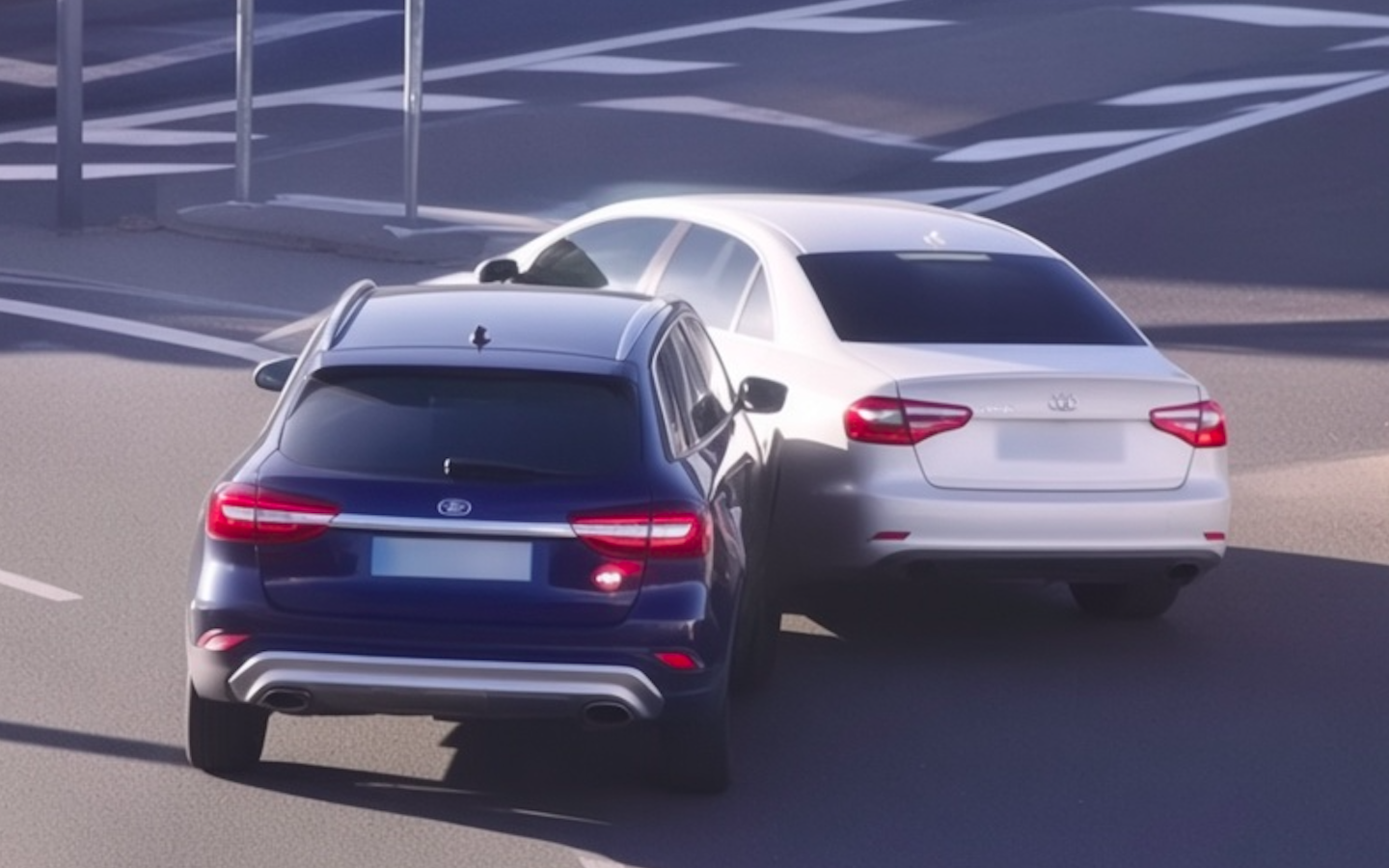
The incident has exposed a common source of confusion on Spanish roads. Photo credit: @Pacoxo on X
There are few things more infuriating than driving along in Spain and watching another motorist cut across your path as if the rules of the road simply do not apply to them. Roundabouts are a particularly familiar battleground, with drivers changing lanes without warning, taking exits from the wrong position and apparently expecting everyone else to get out of the way.
Now, a crash between two cars at a roundabout has prompted another furious debate online, after footage showed one driver attempting to leave the junction from an inside lane while another continued around it in the outside lane. The video, shared on X, has attracted attention from motorists arguing over who was responsible. But according to Spanish traffic regulations, the key mistake was made by the driver trying to exit directly from the inner lane.
Who was in the wrong in the Spanish roundabout crash?
The incident has exposed a common source of confusion on Spanish roads: being in the correct lane to travel around a roundabout does not necessarily mean you can leave it from that position. Under Article 74.2 of Spain’s General Traffic Regulations, a driver changing lanes must respect the priority of vehicles already travelling in the lane they want to enter. The Dirección General de Tráfico (DGT) also makes clear that, as a general rule, drivers must leave a roundabout from the outside, right-hand lane. Cutting across from an inner lane can put a vehicle directly in the path of another motorist who is continuing around the junction.
That does not mean drivers must take the first exit simply because they are travelling in the outside lane. A motorist can continue around the roundabout in that lane, provided they do so safely and in accordance with the road layout and traffic conditions. Drivers intending to take a later exit can use an inner lane where appropriate, but must move into the outside lane in good time, signalling and giving way to vehicles already there. If traffic prevents a safe lane change before the exit, the DGT’s advice is simple: go around again rather than force your way across.
Rotonda de dos carriles. El de adentro quiere salir y el de afuera quiere seguir girando 💥
¿Quién es responsable por el choque según la ley? https://t.co/q5hrQ0lr1H
— Derecho enZapatillas (@dzapatillas) October 4, 2026
Do Spanish drivers really know how to use roundabouts?
It’s the question we’ve all been asking and the frustration expressed online is not new. The DGT has repeatedly warned that motorists continue to misunderstand the rules for entering, navigating and exiting roundabouts, despite these junctions having been part of Spain’s road network for decades, which leads to the question: How did they get their driving license?
A 2015 study by road-safety training association Formaster, reported by 20minutos, found that 80 per cent of drivers made mistakes when using roundabouts. The most common problem was not knowing which lane to use to exit, while crossing lanes in a straight line was identified as particularly dangerous. Those figures are historical, rather than a measure of current driving behaviour.
More recent figures underline why the issue matters. According to data from the DGT cited in a study by Automovilistas Europeos Asociados (AEA), 309 people died and more than 54,000 were injured in crashes at roundabouts between 2020 and 2024. In 2024 alone, 59 people died and 10,758 were injured in these collisions. Those figures do not prove that Spanish drivers are worse than motorists elsewhere. They do, however, show that mistakes at roundabouts can have serious consequences, rather than simply causing an irritating moment in traffic.
The driving habits that put everyone at risk
The problem is not unique to Spain, and a viral clip cannot tell us how well the country’s motorists drive overall but we can judge by it. Anyone using the roads knows how quickly a small mistake can turn into a dangerous situation when another driver fails to anticipate traffic or refuses to give way. Roundabouts demand more than knowing which exit to take. Drivers must check their mirrors, judge the position and speed of other vehicles, signal their intentions and change lanes without cutting across someone else’s path.
The DGT advises motorists to approach slowly, give priority to vehicles already on the roundabout and choose their position according to their intended exit. If they cannot get into the correct lane safely, taking another circuit is far better than risking a collision. For drivers caught up in the daily frustrations of Spanish traffic, it is a reminder that being in a hurry does not give anyone the right to force their way through a junction. And when a roundabout becomes a test of who is willing to give way, it is often everyone else on the road who pays the price.








Spain’s blue and yellow Pegasus traffic surveillance helicopters have reportedly stopped flying from three bases after the company contracted to operate them entered preliminary insolvency proceedings.
Eliance, the private operator awarded a contract worth more than €51 million, has reportedly informed its workforce of around 230 employees that it is taking steps to protect the business and try to maintain operations.
According to the CCOO trade union, helicopters based in Malaga, Seville and Santiago de Compostela have stopped flying, leaving large areas without their usual aerial traffic surveillance. The union has raised concerns with Interior Minister Fernando Grande-Marlaska about the future of the service. Many critics are expressing satisfaction as they have always claimed the helicopters were used for collecting fines rather than improving road safety.
Why are Spain’s traffic helicopters grounded?
Eliance won the contract following a contract award process that initially struggled to attract a bidder. The agreement covered the operation and modernisation of the DGT’s aircraft, with the intention of increasing annual flying hours from around 2,700 to approximately 5,500.
The company’s reported financial difficulties raise questions about whether that expansion can be delivered. According to reports, Eliance recorded losses of €24 million last year. CCOO says it warned more than a year ago about awarding the contract to a private company that had already experienced problems with public-sector agreements.
Galicia’s emergency medical service, 061, terminated its contract with Eliance in March 2025 following repeated contractual problems, according to regional reporting. The company subsequently continued operating aircraft at Santiago and Ourense while replacement arrangements were pending.
The DGT has also faced problems with ageing helicopters, obsolete components and staffing shortages. Questions now remain over how it will maintain aerial surveillance if the operator cannot fulfil its obligations.
Speed cameras collect €246m in fines
The financial questions extend beyond the helicopters. Spain’s speed cameras generated a record €246.8 million in fines during 2025, according to drivers’ association Automovilistas Europeos Asociados (AEA). That was 14 per cent more than in 2024.
The association attributed the increase partly to new radar installations. Speeding penalties accounted for 41.5 per cent of traffic-fine revenue in the areas covered by its figures, excluding Catalonia and the Basque Country, which manage their own traffic enforcement.
How much does traffic enforcement really cost?
The DGT’s helicopter contract is worth €51.15 million for the initial service period, with additional extensions potentially taking the overall commitment higher. The agreement was intended to increase annual flying time to more than 5,500 hours.
Spending on roadside enforcement is continuing, too. In April 2026, the DGT awarded contracts worth around €1.02 million for new mobile speed camera equipment for Guardia Civil traffic patrol cars.
However, a complete comparison between enforcement costs and fine income is difficult. Spain’s Transparency Council has previously highlighted difficulties in obtaining a consolidated historical figure for the installation and maintenance of fixed speed cameras. Nor does the €246.8 million figure represent revenue from Pegasus helicopters: it covers fines generated by speed cameras.
The latest disruption nevertheless raises questions about how effectively Spain is investing in road safety and what contingency plans exist when a contractor responsible for a major public service faces financial difficulties.
Czech football coach goes viral for avoiding reporter’s gaze to keep his wife happy
Spain’s elite Guardia Civil unit welcomes a new colleague with a wild side
Viral video in Spain sparks fury over drivers who ‘have no idea how to drive’


-

 Uncategorized3 weeks ago
F1 Bahrain Grand Prix will be live and FREE on TV this weekend
-
EU2 weeks ago
EU nicotine crackdown sparks warning that ex-smokers could be driven back to cigarettes
-
Blackout preparedness2 weeks ago
Brussels takes action against Spain over failure to update blackout plan
-

 Uncategorized2 weeks ago
Lewis Hamilton F1 wish could come true as stunning plans for new track revealed
-

 Foreign demand3 weeks ago
Market Snapshot: German Market In Q2 2026
-

 Housing access / crisis / affordability2 weeks ago
Radical Housing Decrees Defeated As Snap Election Talk Grows
-

 New Developments3 weeks ago
How To Get A Tourist Rental Licence In Andalusia (Spain) – Step-By-Step Guide 2025
-
Latest1 week ago
The Changes To Spain’s IRNR Non-Resident Property Tax In 2027