
Housing politics
Barcelona Rent Controls: Prices Under Control, Tenants Locked Out

Barcelona’s rent controls have kept official rental prices in check, as intended. But the latest figures for H1 2026 reveal a rental market still struggling to recover from a collapse in new contracts, leaving thousands of prospective tenants unable to find a home.
The Catalan government (Generalitat) has published the latest INCASÒL rental statistics for the first half of 2026, offering another opportunity to assess Barcelona’s rent control experiment, introduced in March 2024.
And, predictably, the Generalitat is celebrating the results. Rents are under control, we’re told. Unfortunately, that tells us remarkably little about whether people can actually find somewhere to live.
Controlled rents are controlled. What a surprise.
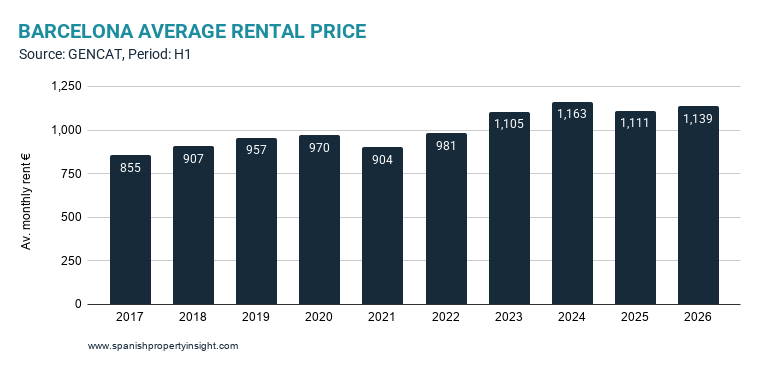
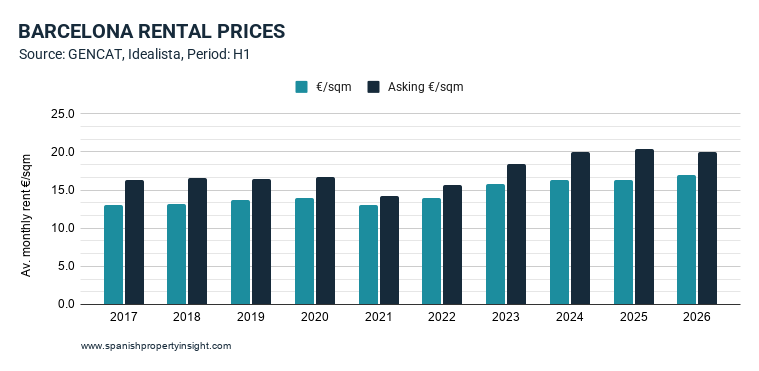
According to the latest figures, Barcelona’s average monthly rent increased by 2.5% year-on-year to €1,139 in H1 2026, whilst the price per square metre rose by 3.9% to €17.
The government presents this restraint as evidence of success. But when rental prices are controlled by law, it’s hardly surprising that the prices declared in official contracts remain constrained.
The real question is what happens to the market when prices are no longer allowed to balance supply and demand.
The collapse in rental contracts tells a different story
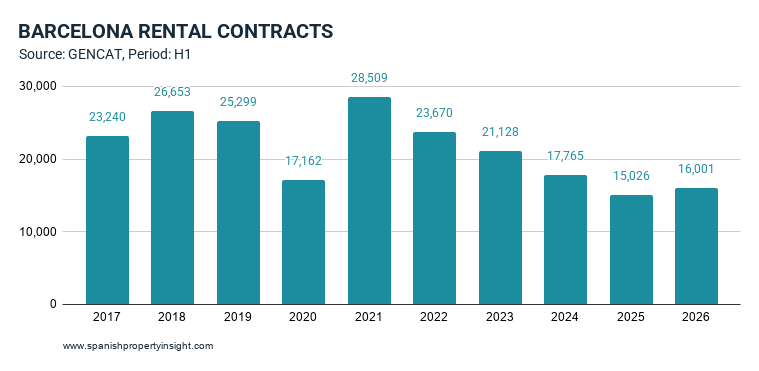
The number of new rental contracts increased by 6.5% to 16,001 in H1 2026, suggesting that the relentless decline following the introduction of rent controls may finally have bottomed out.
But before the politicians start opening the champagne, some perspective is needed.
There were 26,653 contracts signed in H1 2018, compared to just 16,001 this year—a decline of 40%. Even compared to the ten-year average, the number of contracts remains 27% lower.
In Q2 alone, just 7,845 contracts were signed, compared to 13,672 in the same quarter of 2018—a collapse of 43%.
And these figures refer to residential rental contracts lasting more than a year. Seasonal rentals are recorded separately by the Generalitat, so they cannot explain away the decline in ordinary rental contracts.
Asking prices fall, but what is really available?
Meanwhile, advertised rents on Idealista fell by 2% year-on-year to €20/sqm, narrowing the gap with official contract prices, which had widened dramatically after rent controls were introduced.
That is an interesting development, but asking prices are becoming an increasingly questionable guide to market conditions when so little accommodation is genuinely available.
A rough search of Idealista suggests around 2,000 rental listings in Barcelona, of which perhaps 650 are for long-term accommodation. And even an advertised flat is no guarantee of availability. Enquire about one and you may discover it has conveniently just gone, but the agent will happily add you to a waiting list.
In such a starved market, listings can serve as much to generate enquiries as to advertise genuinely available homes.
Meanwhile, the widening gap between asking and declared rents in recent years raises another uncomfortable question: how much rent is now being paid unofficially, including cash payments that never appear in INCASÒL statistics? The figures cannot tell us, but the incentives for undeclared payments are obvious.
The people who don’t appear in the statistics
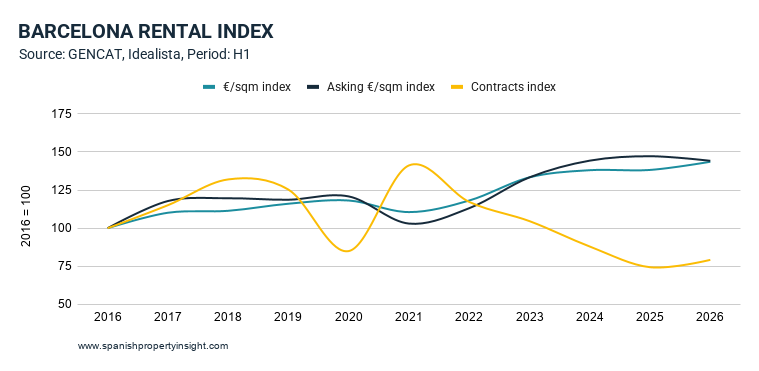
The index chart below illustrates the bigger picture. Since 2016, contract rents per square metre and asking rents have both risen by around 44%, whilst new rental contracts have fallen by 21%.
More strikingly, rental transactions have plunged since 2022, whilst prices have continued rising.
The people most disadvantaged by this situation don’t appear in the rental-price statistics at all. They are the prospective tenants who cannot find a home, even if they could afford a higher rent.
Rent controls favour sitting tenants and applicants with impeccable financial profiles. But when landlords have dozens of applicants competing for the same property at a controlled price, why take a chance on anyone with a less-than-perfect profile?
The least fortunate get pushed to the back of the queue, which is a strange outcome for a policy supposedly designed to help the vulnerable.
A government victory lap around a shrinking market
The Generalitat boasts that rent increases remain below inflation and that the overall stock of active rental contracts is growing. But that can happen simply because sitting tenants stay put for longer, reducing turnover and opportunities for newcomers.
Two years into Barcelona’s latest experiment with rent controls, the picture is becoming clear. The fall in new contracts may have stabilised, but rental opportunities remain dramatically below historical levels, whilst official rents are rising again.
Politicians can control what landlords charge on paper. They cannot legislate homes into existence.
And for the thousands of people who cannot find anywhere to rent, the government’s celebrated price containment is of precisely no use whatsoever.









Socialist Prime Minister Pedro Sánchez recently appeared on television defending rent controls and greater government intervention in Spain’s housing market. His interview on La Revuelta brought several questionable arguments and important omissions into focus. Here’s a closer look.
With Spain heading towards a general election on 29 November, Sánchez is seeking to make housing a central issue. After eight years in power, his government faces criticism over worsening affordability and insufficient housebuilding.
In an interview on La Revuelta on 22 October, Sánchez argued that Spain needs both more construction and greater regulation. He described them as the two pedals of a bicycle.
But his defence of that approach raises some awkward questions.
1. The property bubble supposedly disproves supply and demand
Sánchez argued that Spain built 4.5 million homes before the financial crisis, yet house prices continued rising. He suggested that the relationship between supply and demand was therefore not so straightforward.
The same argument appears in the preamble to the government’s housing decree of 6 October, which notes that more than 3.5 million homes were built in five years without containing prices.
But this was a speculative bubble, fuelled by excessive credit and expectations of ever-rising prices. Construction and prices were both responding to extraordinary speculative demand.
The fact that prices rose whilst supply increased doesn’t demonstrate that additional supply was ineffective. Prices might have risen even faster without it.
It’s rather like arguing that because tulip prices rose during the Dutch speculative mania of the 1630s, growing more tulips doesn’t help contain their price.
The last property bubble illustrates how speculative demand can overwhelm supply, not that the laws of supply and demand cease to apply.
Sánchez is anything but stupid. I’m sure he knows that building more affordable housing within commuting distance of hot markets would help keep a lid on house prices, but he needs to undermine this argument in favour of regulations that punish landlords, which is what his left-wing comrades want more than anything else. These argument helps keep the hard-left on board.
2. Barcelona as a rent-control success story
Sánchez held up Barcelona, where rent controls apply, as an example of rents rising much more slowly than Madrid, where they don’t.
There is evidence of greater price restraint in Barcelona. According to the Generalitat’s official rental-contract figures, the average monthly rent on new contracts was €1,137 in Q1 2026, down 4.7% from immediately before the controls began in 2024, though up 4.6% year-on-year.
But prices are only part of the story. What about availability?
The number of new rental contracts signed in Barcelona fell from 53,524 in 2018 to 30,789 in 2025, a decline of 42.5%. Even comparing Q1 2026 with Q1 2024, new contracts were down 17%.
Fewer new contracts do not necessarily mean fewer homes in the total rental stock. Longer tenancies also reduce turnover. But they do mean fewer opportunities for people looking for somewhere to rent.
Rent controls can protect sitting tenants whilst making life harder for newcomers competing for the limited number of homes becoming available.
Sánchez mentioned the restrained prices, but not the collapse in new contracts.
3. A million new homes built?
Sánchez also claimed that one million homes had been built in recent years, with around 13% classified as protected housing.
He didn’t specify which years. According to official figures examined by fact-checking organisation Newtral, Spain completed approximately 722,000 homes between 2018, when Sánchez came to power, and Q1 2026.
The distinction matters when assessing a government’s record on construction, particularly when housing supply is one of the central issues in the election campaign.
4. A market that supposedly needs more intervention
Sánchez repeatedly argued that the housing market wasn’t working and therefore needed greater public intervention.
But Spain’s housing market is already heavily regulated. Planning restrictions, lengthy administrative procedures and construction requirements constrain development, whilst rental legislation governs prices, contract terms and landlords’ rights.
The question is not simply whether intervention is needed, but whether existing intervention is contributing to the problems the government wants to solve.
A market struggling to respond to demand does not necessarily need more regulation. It might need some of the existing obstacles removed.
5. Two pedals pulling in different directions?
Sánchez’s bicycle analogy sounds reasonable: build more homes whilst regulating the market.
But construction and rental investment depend on expected returns, costs and risks. Regulations that make projects less viable or reduce returns can discourage the very investment needed to increase supply.
Barcelona’s requirement to reserve 30% of certain new developments for protected housing illustrates the difficulty. Introduced in 2018, it has produced far fewer protected homes than originally expected, and even the Socialist-led city council has sought to make the rules more flexible.
Sánchez also argued that his government supports small landlords through tax incentives, whilst directing its criticism towards large investors and so-called vulture funds.
The incentives exist. But the relevant question is whether they outweigh the additional costs, restrictions and risks of renting out a property. That matters in a market where individual owners account for the overwhelming majority of privately rented homes.
What the interview leaves unanswered
There are legitimate arguments for protecting tenants, restraining rents and expanding affordable housing. But the benefits of intervention need to be weighed against its effects on supply, investment and access for prospective tenants.
The interview emphasised construction and regulation as complementary solutions, yet gave little attention to the possibility that some regulations make additional housing less likely to materialise.
Nor did it adequately distinguish the speculative excesses of the 2000s from today’s shortage of homes.
With this sort of reasoning informing housing policy, it’s hardly surprising that Spain’s housing crisis has deteriorated during Sánchez’s eight years in power. I sometimes wonder whether a Socialist government with an absolute majority of its own would have taken a more pragmatic approach, rather than being pulled further towards intervention by its partners on the hard left, who’ve made housing their signature issue. But without a majority of his own, Sánchez remains dependent on those partners to govern. If that arrangement continues, and the underlying thinking doesn’t change, it’s difficult to see Spain’s housing problems getting any better. Indeed, there’s every risk they’ll get worse.


Barcelona City Council has approved plans to increase property taxes by up to 150% on owners with multiple tourist rental licences, adding another financial burden to a sector already facing extinction in 2028.
Barcelona City Council’s Economy and Finance Committee has approved a proposal to increase the annual property tax (IBI) on tourist rental properties, with the biggest increases targeting owners and operators holding four or more tourist accommodation licences.
The measure was supported by the Socialists (PSC), Barcelona en Comú and ERC, with Junts abstaining and the PP and Vox voting against.
Under the proposal, the increases would be:
- 150% for holders of four or more tourist rental licences, affecting approximately 6,000 licences, or 60% of the city’s total.
- 100% for holders of two or three licences, affecting around 1,200 licences, or 11% of the total.
- No increase for owners holding just one tourist rental licence.
The proposal is not yet final. It must go through a period for objections before being submitted for approval at the December council meeting.
Another blow to Barcelona’s tourist rental sector
Deputy Mayor for Economic Affairs Jordi Valls explained that the objective is to make tourist rentals less attractive financially until the city’s planned elimination of tourist rental licences takes effect in 2028.
Valls argued that the tax increases primarily target companies operating tourist accommodation as a business, rather than individual owners renting out a single property.
Barcelona currently has around 10,000 licensed tourist flats, all of which are scheduled to lose their tourist rental licences in 2028 under the city’s controversial plan to eliminate this form of accommodation.
The latest tax proposal adds to the growing regulatory and financial pressure on the sector, potentially reducing profitability well before the licences themselves disappear.
Will higher taxes solve Barcelona’s housing shortage?
Supporters of the measure argue that discouraging tourist rentals will help tackle Barcelona’s housing problems. However, there is no guarantee that increasing taxes on tourist accommodation will make more homes available for long-term residential use.
The opposition has questioned both the effectiveness and proportionality of the proposal. Junts warned of growing legal uncertainty, whilst the PP described the increase as a punitive tax measure targeting a particular group of property owners.
Vox argued that the measure does nothing to guarantee more residential housing, suggesting that the council would achieve more by encouraging construction and removing restrictions on development.
The underlying problem remains Barcelona’s chronic shortage of housing supply. Increasing taxes on existing accommodation, or eliminating tourist rentals altogether, does nothing directly to encourage the construction of new homes.
For owners and investors in Barcelona’s tourist rental market, the message from City Hall is increasingly clear: the authorities intend to make the business less attractive long before the planned ban arrives in 2028.
Author:  Mark Stücklin
Posted on
Barcelona City Council has approved plans to increase property taxes by up to 150% on owners with multiple tourist rental licences, adding another financial burden to a sector already facing extinction in 2028.
Barcelona City Council’s Economy and Finance Committee has approved a proposal to increase the annual property tax (IBI) on tourist rental properties, with the biggest increases targeting owners and operators holding four or more tourist accommodation licences.
The measure was supported by the Socialists (PSC), Barcelona en Comú and ERC, with Junts abstaining and the PP and Vox voting against.
Under the proposal, the increases would be:
- 150% for holders of four or more tourist rental licences, affecting approximately 6,000 licences, or 60% of the city’s total.
- 100% for holders of two or three licences, affecting around 1,200 licences, or 11% of the total.
- No increase for owners holding just one tourist rental licence.
The proposal is not yet final. It must go through a period for objections before being submitted for approval at the December council meeting.
Another blow to Barcelona’s tourist rental sector
Deputy Mayor for Economic Affairs Jordi Valls explained that the objective is to make tourist rentals less attractive financially until the city’s planned elimination of tourist rental licences takes effect in 2028.
Valls argued that the tax increases primarily target companies operating tourist accommodation as a business, rather than individual owners renting out a single property.
Barcelona currently has around 10,000 licensed tourist flats, all of which are scheduled to lose their tourist rental licences in 2028 under the city’s controversial plan to eliminate this form of accommodation.
The latest tax proposal adds to the growing regulatory and financial pressure on the sector, potentially reducing profitability well before the licences themselves disappear.
Will higher taxes solve Barcelona’s housing shortage?
Supporters of the measure argue that discouraging tourist rentals will help tackle Barcelona’s housing problems. However, there is no guarantee that increasing taxes on tourist accommodation will make more homes available for long-term residential use.
The opposition has questioned both the effectiveness and proportionality of the proposal. Junts warned of growing legal uncertainty, whilst the PP described the increase as a punitive tax measure targeting a particular group of property owners.
Vox argued that the measure does nothing to guarantee more residential housing, suggesting that the council would achieve more by encouraging construction and removing restrictions on development.
The underlying problem remains Barcelona’s chronic shortage of housing supply. Increasing taxes on existing accommodation, or eliminating tourist rentals altogether, does nothing directly to encourage the construction of new homes.
For owners and investors in Barcelona’s tourist rental market, the message from City Hall is increasingly clear: the authorities intend to make the business less attractive long before the planned ban arrives in 2028.

Última Hora De La Actualidad Política, En Directo | Marlaska Ordena Una Investigación Sobre Las Cargas Policiales En Las Manifestaciones Por La Vivienda Y Pide Que No Se Use Gas Lacrimógeno

Spain Faces Wave Of Bomb Scares As Madrid And Guadarrama Trigger Major Security Operations
Spain rocked by strike violence as police clash with protesters and businesses are targeted
Viral video in Spain sparks fury over drivers who ‘have no idea how to drive’
Spain’s pet owners face fines of up to €200,000 for animal welfare offences
Halloween lunch sells out as 51 join Marbella get-together


-
DGT4 weeks ago
Viral video in Spain sparks fury over drivers who ‘have no idea how to drive’
-
Keeping cats and dogs outside4 weeks ago
Spain’s pet owners face fines of up to €200,000 for animal welfare offences
-
Age Concern Marbella - San Pedro2 weeks ago
Halloween lunch sells out as 51 join Marbella get-together
-
Council tax (IBI)4 weeks ago
Barcelona plans 150% property tax increase on tourist flats ahead of 2028 ban
-
Consumer Rights Spain4 weeks ago
EU offers extra year of warranty on phones, but Spain faces delays
-
airports4 weeks ago
Travelling between Spain and Italy? The extra border checks could soon end
-

 %4 weeks ago
Santa Pola Museo Del Mar
-

 New Developments2 weeks ago
How To Get A Tourist Rental Licence In Andalusia (Spain) – Step-By-Step Guide 2025