Connect with us

Claudia Sheinbaum

Spain Becomes Mexico’s Last Chance To Pursue $150 Million Embezzlement Case Against Inés Gómez Mont


Published

on

spain-becomes-mexico’s-last-chance-to-pursue-$150-million-embezzlement-case-against-ines-gomez-mont

Claudia Sheinbaum’s administration has turned the case against actress Inés Gómez Mont and her husband, attorney Víctor Manuel Álvarez Puga, into a symbol of the fight against white-collar corruption. The couple, however, has managed to evade the Mexican justice system for five years; they are accused of leading a lucrative criminal business known as factureras — shell companies that sell fake tax receipts to individuals and businesses to embezzle public funds, launder money, and evade taxes. Mexico came close to apprehending Gómez Mont, but the United States —where she had been living since 2021 — allowed her to flee to Spain, a country of which the actress is also a citizen, even though the Sheinbaum administration had requested her arrest and extradition from Washington a year ago. The president has criticized this betrayal by her main trading partner and has turned to the government of Pedro Sánchez, whom she has also asked to arrest and extradite Gómez Mont, emphasizing how important it is for Mexico to punish the couple and send a message against impunity.

The Mexican Attorney General’s Office (FGR) accuses Gómez Mont and Álvarez Puga of embezzling and laundering nearly three billion pesos (about $152 million) from the Ministry of the Interior in 2016. According to the investigations, a network of shell companies created by the couple pocketed those funds through a rigged contract and then laundered them through multiple bank transactions. At least 18 million pesos ended up in the couple’s accounts. Another portion of the money went to dozens of recipients, including relatives of politicians, businesspeople, lawyers, former government officials, and celebrities. The FGR accuses the couple of organized crime, money laundering, and tax evasion involving enormous sums.

A corruption scheme like this leaves a massive hole in Mexico’s treasury. For this reason, Sheinbaum believes that the Gómez Mont case “is highly significant because of the impunity it represents.” On Thursday, the Mexican president asked the Spanish government to apply the Extradition Treaty and hand over the actress. The FGR has confirmed that it has already formally initiated the procedures to make this happen. Sheinbaum has placed her last hope in Pedro Sánchez before Gómez Mont goes on the run again — a highly likely scenario.

A few weeks ago, Interpol revoked the Red Notice it had issued at Mexico’s request to arrest Gómez Mont and Álvarez Puga in any country. The unilateral decision surprised the Sheinbaum administration, which demanded an explanation. The Attorney General’s Office has explained that the international organization “decided to remove the data on the wanted person, considering that retaining it was not compatible with the Interpol Statute and the Regulations on Data Processing.” Mexico, according to the Attorney General’s Office, filed a new request for a Red Notice against Gómez Mont, but Interpol rejected it in October. “It is of fundamental importance to note that, following Interpol’s unilateral decision to remove from its records the Red Notice previously issued against Inés N, she was not detained by Spanish authorities,” the Prosecutor’s Office explained. After arriving in Spain, Gómez Mont reactivated her Instagram account, where she promoted a website that uses a bot to refute media reports against her.

Gómez Mont left the United States on a commercial flight and landed in Madrid early Tuesday morning. The actress, a member of a prominent family of lawyers in Mexico, had been detained by ICE in October due to irregularities in her immigration status, which had expired in mid-2021. During her three-week detention, Gómez Mont filed a petition against her detention — known as habeas corpus — and requested a hearing to seek release on bond, but ultimately, facing the risk of being extradited to Mexico, she opted for voluntary deportation and chose Spain as her destination. In reality, now that the sword of Damocles in the form of an Interpol warrant no longer hangs over her head, she can travel to any destination on the planet.

If that happens before the Spanish government catches up with her, Mexico can consider the case lost. It is unknown whether Álvarez Puga accompanied his wife or remained in Florida, where the couple lived — in undeniable luxury — until recently. Sheinbaum voiced her complaint to the Trump administration over its lack of cooperation in the Gómez Mont case, pointing out that Mexico, by contrast, has deported large numbers of criminals of great interest to Washington. Not all the blame, however, can be placed on the U.S., as it took Mexico four years to formally request the couple’s extradition — a period during which the couple continued to live the high life and purchase luxurious properties in Florida.

Sign up for our weekly newsletter to get more English-language news coverage from EL PAÍS USA Edition

America

El Gobierno Mexicano Pide A España Que Aplique El Tratado De Extradición Con Inés Gómez Mont

Published

on

el-gobierno-mexicano-pide-a-espana-que-aplique-el-tratado-de-extradicion-con-ines-gomez-mont

Claudia Sheinbaum espera la respuesta de España. La presidenta de México ha pedido este jueves que el país europeo aplique el tratado de extradición en el caso de la presentadora Inés Gómez Mont. La mandataria ha lamentado que su Gobierno aún no haya recibido una respuesta de Madrid. En la noche del miércoles, la Fiscalía General de la República (FGR) solicitó formalmente al Ejecutivo de Pedro Sánchez que extradite a la actriz, que aterrizó en la capital española el martes después de ser deportada por Estados Unidos. El Ministerio Público la acusa de los delitos de delincuencia organizada, operaciones con recursos de procedencia ilícita y defraudación fiscal equiparada.

Seguir leyendo

Continue Reading

Andrés Manuel López Obrador

Chapo Isidro’s Arrest Reveals The Depth Of US-Mexico Intelligence Cooperation

Published

on

chapo-isidro’s-arrest-reveals-the-depth-of-us-mexico-intelligence-cooperation

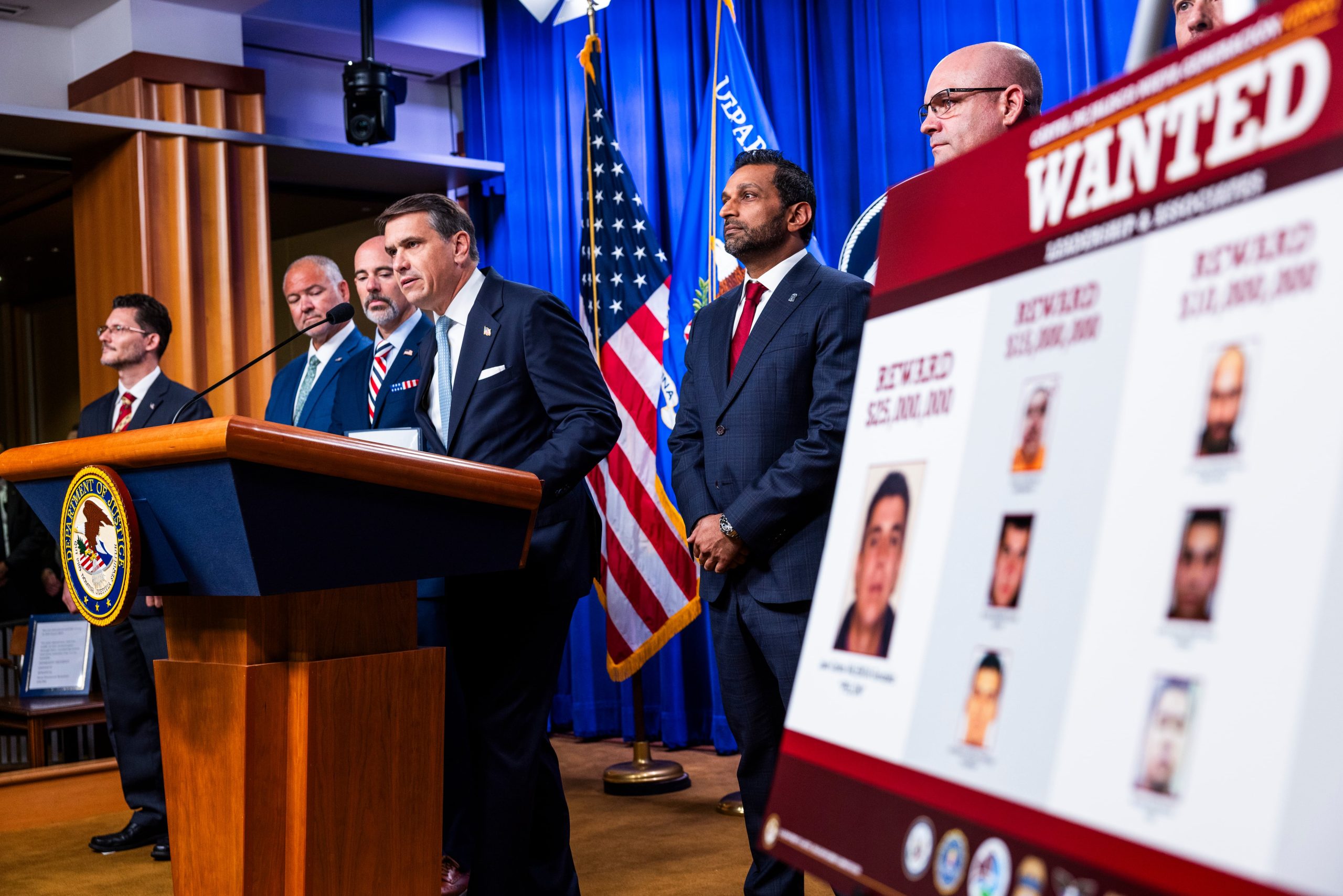
Mexico has embraced U.S. support in the fight against organized crime, a partnership that has become increasingly entrenched and reached levels that would have been almost unthinkable not so many years ago. The capture of “Chapo Isidro” on Friday, one of the major drug traffickers operating in northwestern Mexico, is a case in point, as senior Trump administration officials have been quick to point out.

Cooperation is deepening. The growing flow of intelligence from north to south has enabled operations such as Friday’s arrest, as well as the killing months earlier of Nemesio Oseguera, known as “El Mencho,” leader of the Jalisco New Generation Cartel (CJNG). Each success born of this cooperation further dispels the paradigm of mistrust that characterized the Mexican administration of Andrés Manuel López Obrador (2018-2024).

Everything has changed under Mexican President Claudia Sheinbaum, the former president’s protégé, who has broken with the past on security policy, a shift viewed with suspicion by the hardline wing of her party, Morena. The emergence of Omar García Harfuch, now the coordinator of the Security Cabinet, as a key player on the national political stage, together with his deployment across civilian security agencies, where he exercises near-total control, has brought the executive branch closer to the Drug Enforcement Administration (DEA) and the Federal Bureau of Investigation (FBI), among other U.S. agencies.

The Trump administration’s designation of several Mexican criminal organizations as terrorist groups has also brought the Mexican armed forces, particularly the Army, closer to their U.S. counterparts, which have made combating cross-border criminal networks a greater priority.

Praise has largely prevailed, interrupted only occasionally by broadsides from Trump or one of his chief advisers, Stephen Miller, who continue to insist that the cartels govern Mexico. Even so, cooperation has remained remarkably fluid. The operation against Chapo Isidro, whose real name is Fausto Isidro Meza, offers a clear example.

In a message posted on X on Saturday, U.S. Attorney General Todd Blanche praised the Mexican authorities and highlighted that the “operation by the Mexican Government [was] supported by a coordinated interagency effort that included the Homeland Security Task Force (HSTK),” one of the pillars of U.S. law enforcement.

The Secretary of Homeland Security, Markwayne Mullin, was, if anything, even more explicit: “The arrest of Chapo Isidro demonstrates the outstanding strength and reach of HSTK,” he posted on X.

Officially, little is known about the extent of U.S. involvement in the operation against Chapo Isidro, particularly the significance of the intelligence shared by Washington. Aware of the sensitivity surrounding any participation by its northern neighbor, Mexican authorities have offered only sparse explanations. Yet U.S. technology appears to have transformed the capabilities of Mexico’s security forces.

The New York Times reported on Saturday that the United States deployed drones over Mexican territory to track Chapo Isidro’s movements, a revelation that would likely have sparked a major controversy during López Obrador’s presidency. The newspaper also reported that a task force from the U.S. Army’s Northern Command provided critical intelligence to its Mexican counterparts before the operation was launched.

The Mexican government has reported a string of successes against organized crime over the past year and a half, including the capture of Chapo Isidro and the killings of El Mencho and his former lieutenant, “El Jardinero,” but the growing cooperation with the United States behind those operations carries significant political risks. Since taking office in October 2024, Sheinbaum has repeatedly stressed that security cooperation with the United States is based on “coordination without subordination.” Faced with Trump’s attacks and his threats to carry out operations on Mexican soil, the president has held firm. In the narrow political space occupied by cooperation without submission, any misstep can prove costly. For the government, the saving grace has been that the most damaging lapses so far have come from political actors outside the ruling party, mistakes for which local officials have paid a heavy price.

What happened in the state of Chihuahua is a clear example. In April, two CIA agents were killed in a traffic accident in the mountains of Chihuahua, in northern Mexico. Although their presence ran afoul of Mexican law, they and other U.S. agents had been embedded with task forces in the state prosecutor’s office, in a state governed by the opposition National Action Party (PAN). On the day of the crash, the agents had taken part in the seizure of a synthetic-drug laboratory in the Sierra Madre. On their return journey, their vehicle veered off the road. Their deaths exposed the extent of the U.S. agents’ activities in Mexico and triggered a political earthquake that ultimately led to the arrest of the state attorney general, who now faces charges of treason. The government’s forceful response reinforced a familiar message: “Coordination without subordination.”

As Sheinbaum enters the second half of her term, the question is whether this path of constructive cooperation can remain broad enough to satisfy Mexico’s insistence on sovereignty. Any account of bilateral cooperation in recent years inevitably leads back to the tensions of the López Obrador era. The 2020 arrest in Los Angeles of former defense secretary general Salvador Cienfuegos on drug-trafficking charges infuriated the president, who responded by tightening restrictions on foreign agents operating in Mexico, particularly those from the DEA, the agency leading the investigation into the military chief.

Few traces remain of those turbulent days. The waters are far calmer now. Maintaining the balance is no easy task, but so far the Sheinbaum years suggest it is holding.

Sign up for our weekly newsletter to get more English-language news coverage from EL PAÍS USA Edition

Continue Reading

Chiapas

The Migrant Caravan Crossing Mexico That Has Triggered Trump’s New Tariff Threat: ‘Our Fear Is That The Mexican President Will Send Us Back’

Published

on

the-migrant-caravan-crossing-mexico-that-has-triggered-trump’s-new-tariff-threat:-‘our-fear-is-that-the-mexican-president-will-send-us-back’

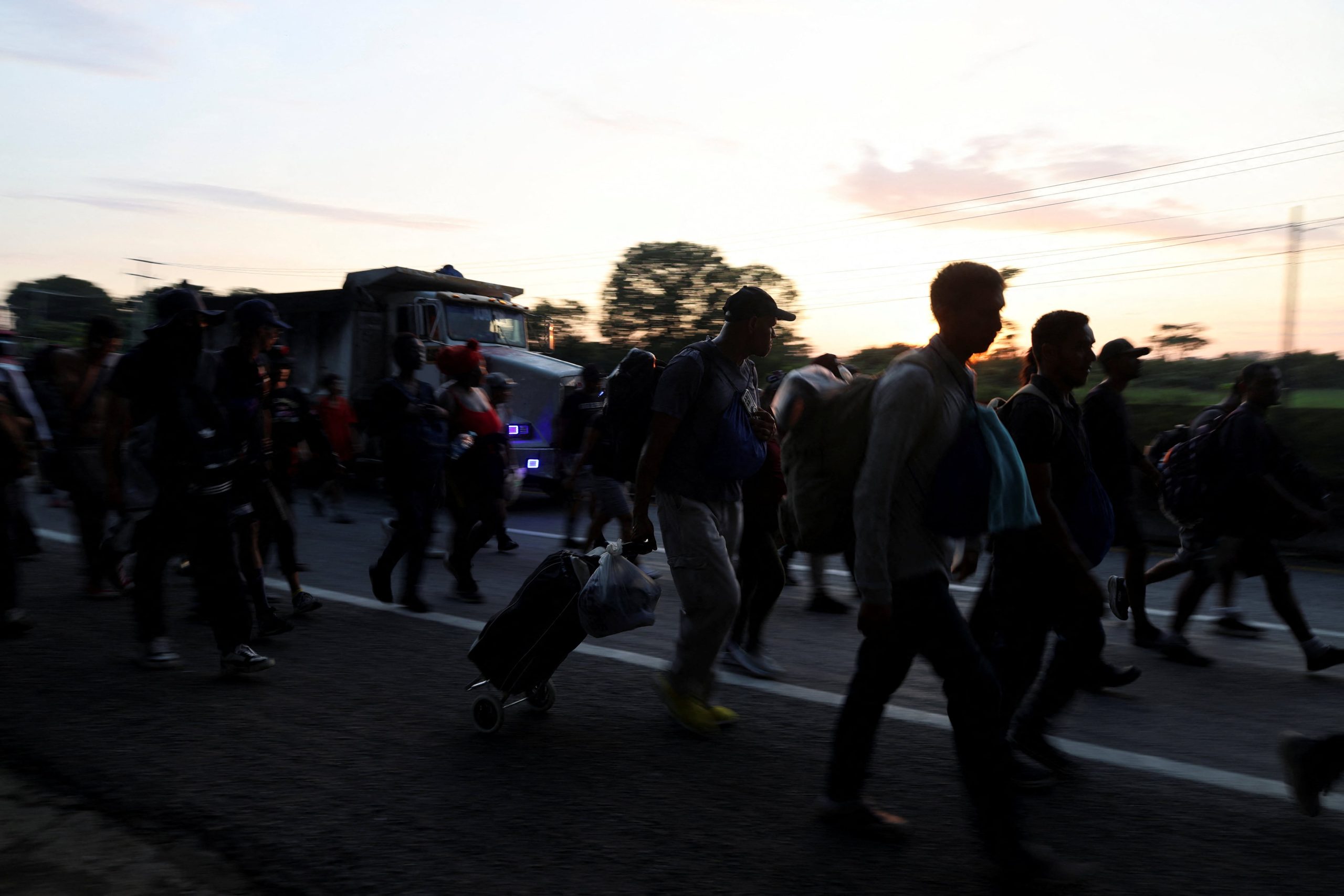
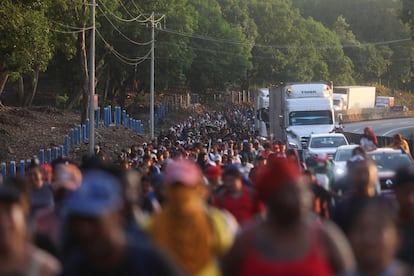
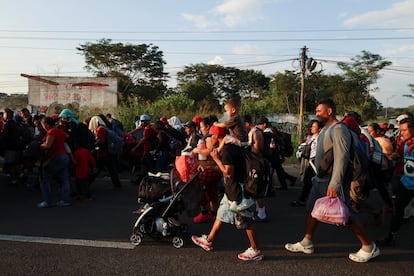
As millions of Americans voted in the November 3 midterm elections, Álvaro Vanega was once again leaving Nicaragua. The 31-year-old left his two daughters in El Viejo and set out on what has been his only concern since they were born: to leave them something so they do not have to live the life he has lived — without a home of his own, without an education, working hard for low pay in the fields. He slept in Tegucigalpa, the Honduran capital, while, to the north, a powerful president suffered an electoral defeat. He reached Guatemala and walked until his feet gave out. On September 6, in Tecún Umán, at the border with Mexico, he joined others like him. There are about 1,500 of them walking together. So far they have only advanced as far as the Mexican town of Huixtla (about 80 kilometers or 50 miles from the border), but they already represent the migrant caravan that has sparked Donald Trump’s latest bout of ire.

In two years of Claudia Sheinbaum’s administration, this is the 24th caravan that has departed from the southern state of Chiapas, according to activist Luis Villagrán’s count, and the 10th, according to the federal government. It is the largest one this year, although a few months ago nearly 1,200 migrants gathered to travel the same route. At that time, the president of the United States published nothing, much less threatened the Mexican government with doubling tariffs if the caravan was not stopped. But between that episode and now, the midterms took place and Trump lost control of both chambers of Congress. Facing a crisis, the Republican has lashed out at two of his usual scapegoats: Mexico and migrants.
“The INVASION of our Country is taking place again,” Trump wrote Thursday on his social network Truth, where he blamed the Democratic Party for the migrants’ attempt to arrive (even though the elected officials have not yet taken office and therefore have not been able to change a single comma of current immigration policy). “Many of the people in these Caravans are those that various countries don’t want,” the president shouted online: “MEXICO MUST STOP THEM, NOW! and if they do not do so, the Tariffs on Mexico will be IMMEDIATELY DOUBLED.”

The message was received at the Mexican National Palace, where Sheinbaum calmly explained that “since President Trump took office no migrant caravan has reached the northern border.” And that is true. Human rights defender Villagrán notes that almost all the caravans have crossed Chiapas to the town of Arriaga, adjacent to the state of Oaxaca, and from there migrants have been moved to Tuxtla Gutiérrez or to the city of Oaxaca itself, where they are normally given a 30-day free transit permit.

“We inform people in the caravan that if their goal is to reach the United States, they will not be able to achieve it because that possibility does not exist,” Sheinbaum said, adding they are being offered the option to return “safely” or to stay in Mexico under “certain conditions.” “But the vast majority return to their countries of origin once they learn they will not be able to cross into the United States.” That happened with the caravan that left a few days ago with about 600 people. “They are in Arriaga and now fewer than 100 remain,” the Mexican president said. The remaining group has stayed behind waiting for the larger one that is now coming, Álvaro Vanega’s caravan.
Trump’s message on Thursday also reached the caravan. Vanega learned of it early (“I watch all the news programs”) and he admits to feeling fear. “There are 1,500 of us and we walk and contribute a little to the Mexican economy,” he says, alluding to purchases of water and some food and paying to use restrooms. He knows that this cannot compare to the trade between Mexico and the United States, its main commercial partner. “If the [U.S.] government doubles tariffs, it could be pressure on Mexico’s president and she might take action and say, ‘Well, it’s not in my interest to have tariffs raised; I’ll have to send those caravans back.’ That is the real terror,” he reasons.

The caravan is mostly made up of Hondurans, but there are also several dozen Nicaraguans, about 100 Guatemalans, and also Haitians, Venezuelans, Cubans, and Ecuadorians: “Oh, and a Turk too!,” Vanega adds. He learned about the group through social media, especially TikTok, Instagram, and WhatsApp channels: “There are no organizers.” For now, the migrants have decided to rest in Huixtla, where they are receiving care from several medical brigades. They were planning to continue the journey Friday afternoon. Meanwhile, another caravan is forming in Honduras, which Villagrán estimates has about 2,000 more people. “We are risking our lives on this road, but we are definitely giving it our all,” Álvaro says: “We tell Mexico’s president: ‘We are here honestly.’”

No change yet in migration policy

After his return to the White House in 2025, Trump rescinded all of his predecessor Joe Biden’s border policies that allowed migrants to request asylum in the United States. He also declared an emergency across the southern border and with that effectively halted nearly all entry of immigrants from Mexico. The president additionally launched accelerated deportation procedures for anyone who crossed at unauthorized points. That has kept arrests at the border at historically low levels since February 2025. Those measures will remain, at least until 2028, when a new president is elected. Although some Democratic lawmakers have already called for immigration reform, so far nothing has changed as a result of the midterms.

At the local level, attention is focused on Texas, which shares the longest stretch of border with Mexico and has historically had the largest number of migrant crossings. After Democrat Gina Hinojosa’s midterm victory for governor of Texas, it is expected that the state’s cooperation with the federal government on immigration could be reduced. But it is not an issue that the newly elected politician has yet addressed in detail.
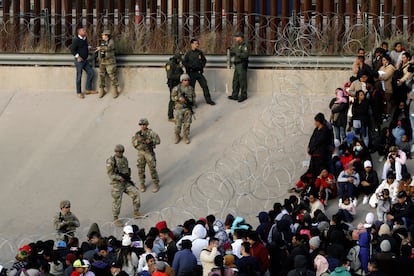
After 12 consecutive years in office, the Republican governor Greg Abbott has implemented — either by decree or with the consent of the Republican-controlled state assembly — multimillion-dollar measures to fortify the border with military forces on land, river, and air. He also issued and renewed disaster declarations (about 69 times) to freely mobilize resources and impose criminal penalties on migrants who crossed, and even announced that the state has financed almost 100 miles of border wall. On the campaign trail, Hinojosa called these measures “political grandstanding” that do not increase security in border communities. She promised to review their effectiveness, but so far she has not firmly committed to rescinding these measures.

Under threat of losing essential funding, Abbott also forced local authorities to cooperate with federal agents in detaining and deporting migrants across the state. This was one of the issues that motivated the shift from Republican to Democratic control in Texas, especially in border communities that voted for Trump in 2024.

Abbott’s handling of immigration has been harshly criticized by rights organizations, members of Congress, and analysts, who say he overstepped his authority by deciding on matters that are the exclusive competence of the federal government, such as immigration policy. On Thursday, Trump said everyone involved had been warned: “MEXICO, THE GOVERNOR OF TEXAS, THE VERY LIBERAL NEW GOVERNOR OF TEXAS, OUR GREAT BORDER PATROL, & ICE, HAVE BEEN SO INFORMED. There will be no leniency!,” he wrote. Any major changes in Texas will be seen starting January 19; they will not affect this particular caravan.

Sign up for our weekly newsletter to get more English-language news coverage from EL PAÍS USA Edition

Continue Reading
Advertisement
Advertisement

Spanish Real Estate Agents

Tags

Trending

Copyright © 2017 Spanish Property & News