
America
The US Library Of Congress Opens Up To The Americas

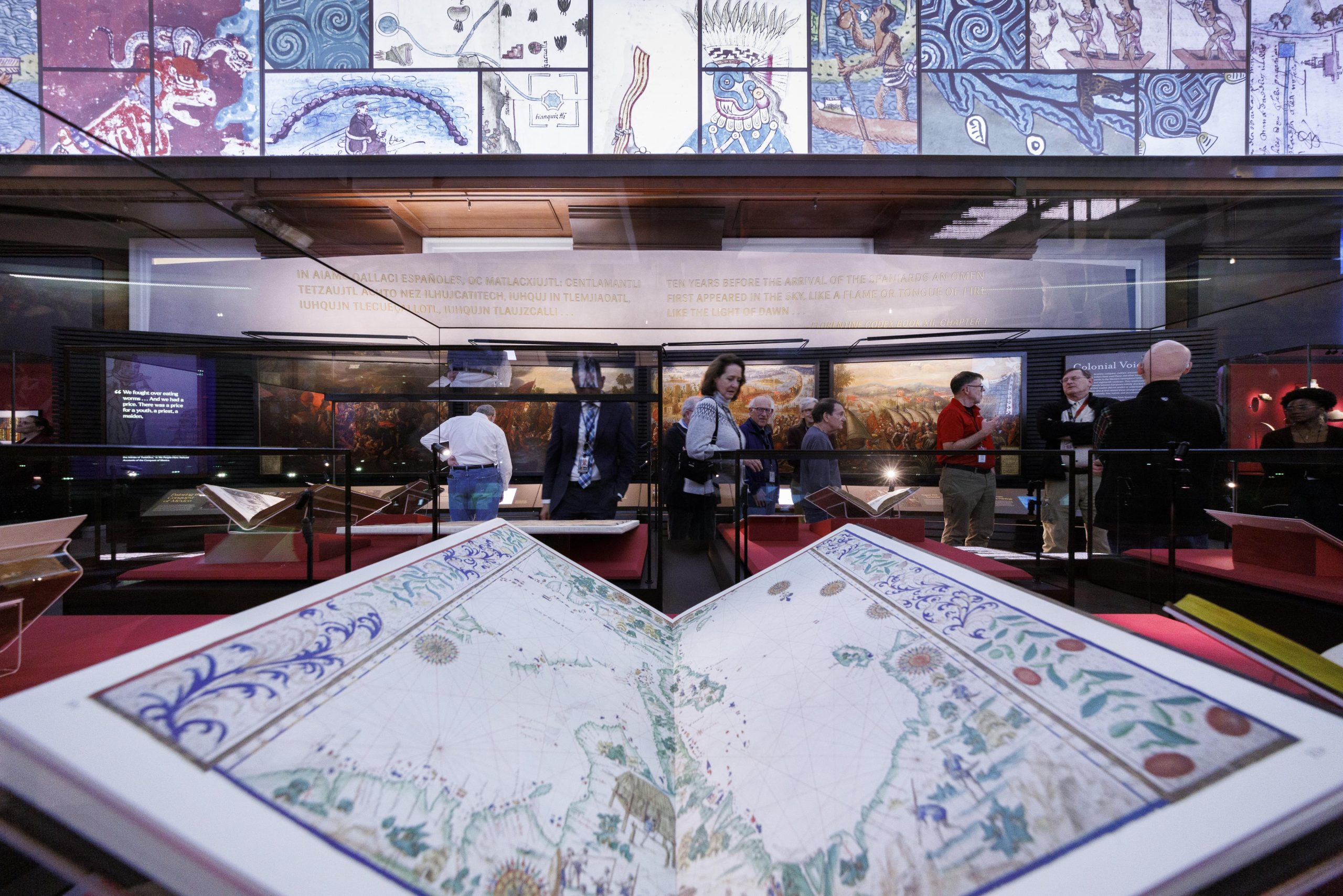
The Library of Congress in Washington offers a new journey through space and time starting this month. It begins at the end of a gallery that tells the history of the United States from its founding in 1776, a history that now marks 250 years. The following rooms, on the second floor of the imposing Jefferson building, take visitors through the indigenous civilizations of the American continent through an extraordinary collection of archaeological objects, paintings, and bibliographic gems.
The gallery’s contents include items from Mesoamerica (a historical region encompassing parts of modern-day Mexico, Guatemala, El Salvador, Belize, Honduras, Costa Rica and Nicaragua), the Caribbean, and the Andes. The earliest artifacts on display are three-thousand-year-old jade stones called chalchihuitl in Nahuatl; yax tun, in Maya; and dzeque, in Mixtec. And the timeline reaches all the way to the present.
The institution — the largest library in the world — brings together these treasures in a new permanent exhibition about the “Voices of the Early Americas.” The exhibition occupies what was once the reading room for Africa and the Middle East, and around 80% of it comes from the donation of 4,000 objects made to the institution by real estate developer and philanthropist Jay I. Kislak (1922-2018), according to an estimate by Stephanie Stillo, head of the Rare Books and Special Collections division.
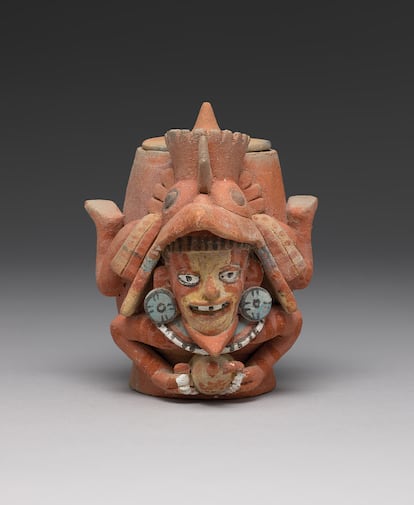
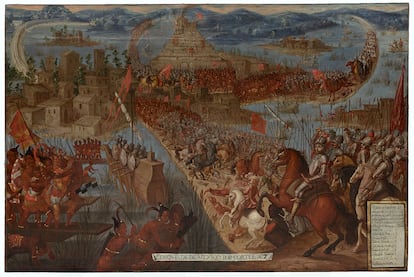
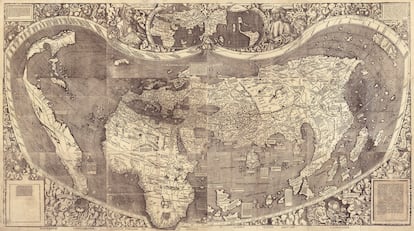
Four years ago, a foundation named after the businessman from Florida donated $10 million to the Library of Congress for the development of the new space. The result is a museographic display that showcases everything from Waldseemüller’s map (1507), the oldest known document featuring the word “America,” to a series of Taíno carvings, and the Huexotzinco Codex, from 1531. There are high-definition screens that put those early stories into context; and the restoration of a series of late 17th-century paintings depicting the Spanish conquest is presented.
Matthew Robb, Mesoamerica specialist at the Library of Congress, considers the presentation a “new beginning” in the institution’s relationship with the “study of the Americas.”
“It’s a long story,” he explains to EL PAÍS in the newly opened rooms. “If we go back to the origins of the library, we see that the first book collectors in what is now the United States wanted to know more about the history of other regions of the continent. That is especially relevant now that we are celebrating the 250th anniversary: ideas around independence from empires were topics of great importance, shared throughout the Western Hemisphere. For example, they were interested in the Aztec legacy of New Spain as a means to distinguish themselves from Europe, and as part of a different history.”
To underline this idea, Robb recalls that in the sculptural frieze of the great rotunda of the Capitol, a review of the milestones of the young nation, there is an Aztec sunstone in the scene depicting the meeting between Hernán Cortés and Moctezuma in 1509.
The new tour begins in a room with a large circular display case that holds pieces such as sophisticated Olmec ceramics from thirty centuries ago, a seated woman found at a site in Jalisco, or the so-called Tortuguero box, one of the highlights of the exhibition; a wooden artifact with hieroglyphic inscriptions that tell the story of a Maya dynasty.
A panel warns that the “voices of the early Americas” used to title the new presentation combine those of indigenous peoples who navigated “worlds profoundly transformed in their own terms, claiming and affirming their capacity to decide over their own lives” with those of Europeans, who “created books, letters, maps, and paintings to justify, debate, and describe the subjugation of those peoples,” with the certainty that “language was always a companion of the empire.”
Another panel in that first space reads (like the rest, in English) as a kind of justification, in which curators give examples of how words traveled through time, geography, and culture to make it possible to hear those voices in their own language. Thus, the description in Nahuatl of a mid-16th-century codex says: “Ten years before the arrival of the Spanish, an omen appeared for the first time in the sky: something like a flame or tongue of fire, like the light of dawn (In aiamo oallic españoles, oc matlacxiuht:centlamantli tetzauhtl achtoc nez ilhuicactich, ihuqqui in tlemjaoatl, ihuqquin tlecuecallotl, ihuqquin tlaujzcalli)”.
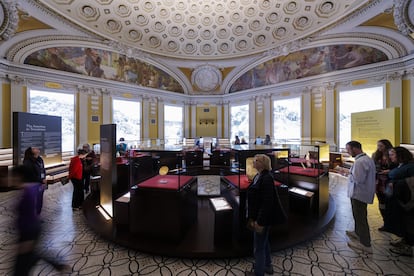
The transition between the first and second rooms is marked by the arrival of the Spanish, with their laws, maps, dictionaries, and projects for the Christianization of the indigenous people and the extraction of resources from the New World in places like Cerro Potosí, in present-day Bolivia. Those riches (“80% of the world’s silver”) are reported in a copy of the Crónica del Perú (1553) by Pedro de Cieza León.
The story then moves on to the efforts of the colonies in the 18th and 19th centuries to understand their past as a tool to “articulate new national identities” on the road toward independence. And it focuses on the Spanish translation of the Popol Vuh, a touchstone of Quiché Maya mythology. Proof of its cultural impact is a gouache on paper that Diego Rivera made, drawing inspiration from the story of the twin gods Hunahpú and Ixbalanqué.
At the end of the tour, the voices of about 10 contemporary poets can be heard reciting their verses in Maya, Nahuatl, Mapuche, Zapotec, and Quechua, alongside images from the Chiapas Photography Project, which has been documenting indigenous lives in that Mexican state since the 1990s through the eyes of photographers from those communities. Closing the narrative of the new space with this dual proposal serves to “emphasize that these are living cultures, that have a past, in whose context they must be seen, but also a future,” according to librarian Catalina Gómez, in charge of the PALABRA archive.
It is a project that brings together nearly a thousand original sound recordings by Portuguese-Hispanic writers of the 20th and 21st centuries, reading excerpts from their works. Among them are the verses of Acatlán, by the Nahua poet Ateri Miyahuatl. They say: “Lágrimas brotan / miedo que traga /deseo que ahoga / tengo a mi pueblo en la punta de la lengua / lo sé de memoria / y no lo recuerdo”. (Tears spring / fear that swallows / desire that drowns / I have my people on the tip of my tongue / I know it by heart / and I don’t remember it.”
Sign up for our weekly newsletter to get more English-language news coverage from EL PAÍS USA Edition

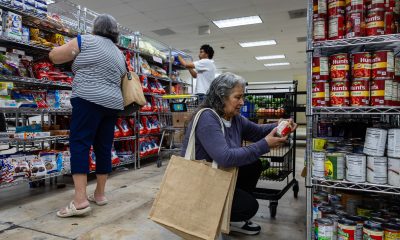








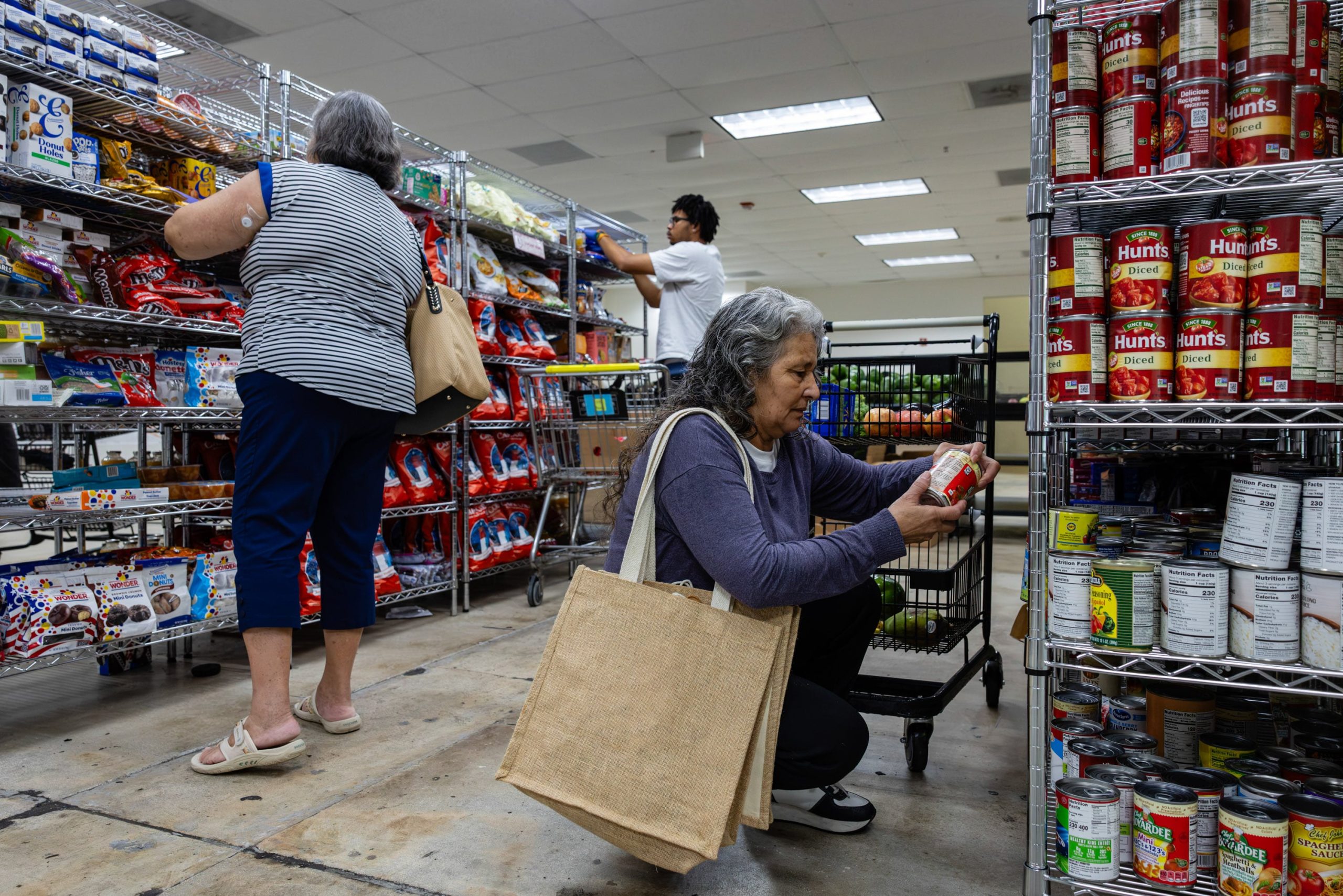
There are times of the year like Thanksgiving, when schools where some children receive food are closed, and the hunger crisis in Miami —one of the most expensive cities in the United States — is most noticeable. Despite heavy rains and the risk of flash flooding this Wednesday, hundreds of people, mostly working families, turned to free food pantries and food banks to secure a turkey and vegetables for the traditional dinner, and to offset the expenses that keep rising with inflation and the war against Iran.
At 60 years old and with three jobs, Sonia still needs to go at least once to pick up free food to complete the month’s diet. She cleans houses, takes care of children and pets, and earns $15 an hour. She bikes to work so she doesn’t have to spend on car, insurance, and fuel. What she earns goes to pay rent, electricity, and her son’s university in Chile, her home country. There she worked almost two decades as a secretary in a local government, and in the U.S. she has been changing fields as opportunities arise. She is now saving for dental treatment, which without health insurance costs thousands of dollars.
“I’ve been coming for about eight months and I keep seeing more people,” says Sonia, who prefers not to use her full name. She’s not surprised, because all the prices of all the products have gone up, “even at Dollar Tree,” the American store chain that boasted of selling all its products for one dollar.
The cost of living in Miami has risen so much that many families’ incomes are not enough to pay the minimum: shelter, food, and utilities.
In a 2026 survey conducted by Aspect Strategic for No Kid Hungry Florida, 82% of respondents said that the cost of food had increased more than their income in the past year. Around 70% indicated that their economic situation has worsened as a result of rising food prices, and 49% admitted to going into debt to cover that expense. One in two families also say they skip meals or eat less, and two out of three families have had to choose between buying food or paying essential bills.
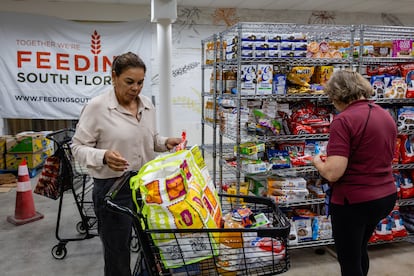
Demand for free food pantries has skyrocketed, explains Jessica Benites, chief of staff at Feeding South Florida, a nonprofit organization that receives and distributes donations in four counties in the region through 300 branches. “We are experiencing a very large increase in families coming to Florida to ask for food aid and we’ve had to expand our operations. Before, we served until 5:00 p.m., now we are serving until 8:00 p.m. We also had to increase Saturdays and Sundays to meet the very high demand we have now,” she says.
Federal and state aid for low-income families and elderly people to buy food has been reduced. Just over a year ago, the Donald Trump Administration approved the largest reduction of the Supplemental Nutrition Assistance Program (SNAP) since its creation in 1939. As a result, about two million people lost the benefit. In Florida alone, enrollment in the program fell by 22%, according to data calculated by the Associated Press agency.
The federal government’s immigration policy, which has set out to deport as many undocumented immigrants as possible, has also added pressure to the hunger crisis in the southern part of the state. Miami and the surrounding cities are home to the largest diasporas of Haitians and Venezuelans and other communities that have lost work permits and protections granted by TPS, the Temporary Protected Status that Trump has been chipping away at since returning to the White House.
On an average day, about 200 families look for food at Feeding South Florida’s largest location, in the Hallandale Beach area, about half an hour from downtown Miami. Many of them are immigrant families who have lost their work permits and mixed-status families—where at least one member has U.S. citizenship and access to public benefits—who have chosen not to apply for the SNAP benefit for fear of retaliation.
“Many people are already afraid to share the information, and sometimes people prefer not to apply because they feel exposed and don’t receive as much money as they used to,” says Benites. “And with TPS, people could work and can’t anymore, and when they lose their jobs, they have to look for organizations that can help them. In our case, with food.”
Sign up for our weekly newsletter to get more English-language news coverage from EL PAÍS USA Edition



España – Austria, En Directo, Los Cuartos De Final De La Copa Davis En Vivo | Rodionov Se Lleva El Primer Set Ante Jódar

Moreno Carga Contra Adelante Andalucía: “Imitan A Bildu Y A ERC”

Ferran Bassas, El Base De España Que Monta Pistas De ‘pickleball’


-

 New Developments4 weeks ago
Luxury Villas For Sale, Estepona – ProjectL1
-

 New Developments3 weeks ago
The San Roque Club – Townhouses For Sale
-
costa blanca live music4 weeks ago
Beatles tribute: The Liverpool Band returns to Orihuela Costa
-
countryside4 weeks ago
Rural revival: Five Almeria villages make moving inland easier and more enticing
-

 New Developments4 weeks ago
Stylish 3-Bedroom Apartment With Panoramic Sea Views – Benalmádena
-

 America3 weeks ago
Así Ha Sido La Primera Jornada Del World In Progress 2026: Del Anuncio De Sánchez De Ayudas Para Las Víctimas De Urda A La Reivindicación De Rebeca Grynspan Del Papel De La ONU
-
Eating out in Gibraltar4 weeks ago
Young woman left horrified after Gibraltar restaurant receipt carries shocking racist slur
-
All Saints4 weeks ago
Driving to Andalucía this weekend? DGT warns of extra traffic after train crash