Connect with us

ElPais

Spain Kicks Off An Electoral Supercycle In Europe

Published

on

spain-kicks-off-an-electoral-supercycle-in-europe

Echoes of Macbeth: “Look like th’ innocent flower, but be the serpent under’t.” Most of the world’s far-right figures are sanding down their rough edges so as not to frighten anyone. With that formula, looking like the innocent flower, the far-right tide has reached an average height of more than 25% of the vote, with peaks of 40%, and it already holds power in many countries.

The optimists suggest the pendulum is swinging back. Innocent flowers again: they point to Viktor Orbán’s surprise defeat in Hungary, young people putting their foot down in Serbia, the against-the-odds turnaround in the runoff in Luiz Inácio Lula da Silva’s Brazil, Benjamin Netanyahu’s scare in Israel, and Trumpism’s resounding, crushing defeat in the midterm elections. Many others, however, believe that the serpent is still there.

The barriers holding it back are clearer today than they were yesterday. There are eddies generating waves that have swept away some of the stars of the far-right universe. And a political center that seemed to be crumbling has sketched out the beginnings of a strategy: refocusing on purchasing power, on the material conditions of people’s lives. But far-right populism, that serpentine mutation of contemporary politics, is more like a tide than a wave. And tides don’t recede easily, as may become clear today in Spain, the first stop on a European electoral supercycle that moves on to France next spring.

Hungary, Serbia, Brazil, Israel, and the United States form a kind of dotted line. Some connect the dots to predict a plot twist, a change of course, or at least a turning point. Geopolitics (and journalism, for that matter) is a narrative discipline. It tends to want to see orderly processes and to manufacture stories, to impose order where there is uncertainty and chaos. But it is too early to draw conclusions.

“There is a tiresome cycle that goes straight from ‘populism is unstoppable’ to ‘populism is dead.’ Neither is true, and that obscures all the other debates,” says Cas Mudde, one of the leading intellectual authorities on the phenomenon. Less than 10 years ago, Mudde wrote an illuminating book, Populism, which, among other things, explained brilliantly why there was no far right in Spain. But that’s another story.
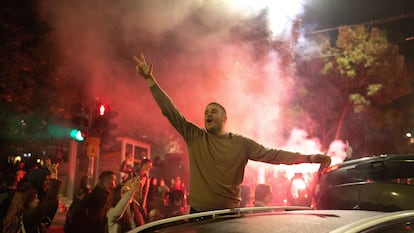
Supporters of the Student List celebrate their victory in the Serbian elections in Belgrade on October 26.

Because the story right now is whether the tide is going out or not. And that matters because Spain’s election will be followed by Italy’s (in 2027, not yet called), France’s (April 2027) and Poland’s (November 2027). Of the EU’s large countries, only Germany falls outside that cycle, and even that remains to be seen: Chancellor Friedrich Merz is in serious trouble, the far-right AfD leads the polls, and there are elections in half a dozen states, including a key one: North Rhine-Westphalia.

In Spain, too, the polls say Vox is going to enter government, and in Italy, Giorgia Meloni, heir to Mussolini’s fascism, will stay in office. The far right is locked in a standoff with Donald Tusk in Poland. The list goes on and on: there will soon be elections in Estonia, Finland, Slovakia and Greece, and possibly in Belgium too if there is no budget before the end of the year.

But France is the mother of all battles. There, Marine Le Pen leads the polls, and Jean-Luc Mélenchon’s far left comes in as the second force. The tale of the boy who cried wolf has a French version thanks to La Fontaine’s fables. Politics can be very literary at times, though its current version is closer to Stephen King than to the fabulists.

Outside Europe, political scientists see green shoots on the other side of the Atlantic. U.S. Democrats wasted no time ringing the bells after the November 3 midterms, and the Center for American Progress speaks openly of a “turning point.” But populism is not a passing fad. Trumpism will outlive Donald Trump. Bolsonaro’s son lost with 48% of the vote.

In the end, the structural causes of the far right’s rise are still there: inflation, the housing crisis, political disaffection, and institutional distrust continue to fuel resentment. Far-right parties are visibly worn down where they have already governed. But in those same places, far-right rhetoric has been normalized, the parties have colonized institutions, and they show rock-solid resilience. When they win, they are capable of governing in coalition and setting the agenda. And when they lose, they keep waiting for their chance: they don’t disappear.

The law of the pendulum

Just a few weeks ago everyone was talking about the Trumpification of Latin America after a string of decisive victories in recent years: Javier Milei (2023), José Antonio Kast (2025), Keiko Fujimori (2026) and Abelardo de la Espriella (2026) in Argentina, Chile, Peru, and Colombia. But the tune has changed since the defeats of Flávio Bolsonaro and Trump.

The same can be said of Europe and beyond. The far right has generally suffered resounding defeats before (Poland, India, Bolsonaro senior himself in Brazil), and yet it is still here, alive and kicking. In 2018, Robert Fico seemed finished in Slovakia, and he went on to stage a triumphant comeback. Trump returned in 2025 after bowing to Joe Biden. And Janez Janša has just become prime minister of Slovenia after spending time in prison for corruption. “There is no clear trend. We’re seeing random eddies more than a receding tide. We could only talk about a pendulum swing after Spain, Italy, Poland and France, and frankly, it doesn’t look good,” says Kurt Weyland of the University of Texas.

The Americas and Europe

“Europeans see in the Americas a personalist, highly political populism. But people in the Americas see in Europe an economic populism: for the Latin American far right, the welfare state is left-wing populism, to the point that Milei puts Nazism and socialism on the same level,” notes Argentine political scientist Andrés Malamud from Lisbon. The phenomenon shares common features on both sides of the Atlantic, but migration and Islam are only an issue for Trump and the European far right, while Latin America is more focused on security and violence.

In Europe, moreover, several leaders have taken a pragmatic turn. Alice Weidel with AfD and Santiago Abascal with Vox are the exception, but Le Pen, Meloni and many others have moderated along the way. “In the Americas, populists show unusual staying power even when they lose. In Europe, it will depend on what the center-right does in the period ahead: if the moderate right normalizes them, it runs the risk of becoming indistinguishable from the far right and being swallowed by it,” says Malamud, referring to Spain and other cases.

Malamud doesn’t buy the supposed turning point either: “Brazil brought an end to a domino effect that seemed inexorable. Most of the Americas has been Trumpified, but the three big countries, Brazil, Canada, and Mexico, are holding out. And Trump’s drubbing looks like the start of something. But it’s still early.”

Javier Milei

Europe’s far-right leaders are distancing themselves from Trump. Is the reactionary International cracking as a result? “With Hungary [Viktor Orbán’s defeat last April], we were already talking about a change of cycle. And now with Trump and Bolsonaro, it’s the same story. It’s important for gauging the emotional mood, and it has given rise to a different discourse among progressives, but those shifts take time,” agrees Colombian anthropologist Carlos Granés, author of El rugido de nuestro tiempo (The Roar of Our Time).

There are hardly any elections in the Americas in the next two years, with one notable exception: Argentina’s presidential election is scheduled for the fall of 2027, with the economy beginning to turn its back on Milei’s libertarian experiment.

Argentine essayist Pablo Stefanoni, who holds a PhD in history from the University of Buenos Aires, argues that Latin America is well ahead of Europe when it comes to the populist movement: “Right-wing populism is a mirror image of the left-wing populism we had decades ago. The forms are the same. What’s new is that the ideology has switched sides toward the chainsaw. In the Americas it hasn’t taken on ethnonationalist forms. It has leaned more toward security, and it also has a religious bent. But that populism has anti-progressive, anti-woke roots, like its European and American counterparts,” he says.

“Its two biggest successes are that it is holding firm after defeats and that it is contaminating the center, or swallowing it,” he adds. And yet the far-right movement cannot point to a single success story: “Populists are good at destroying things, but when they govern, their shortcomings are exposed. They haven’t managed to create a new political or economic order. Trump tried and has failed. Milei is headed for failure too. It’s an unstable tide that ebbs and flows, but it holds on,” Stefanoni concludes.

Resilience and collapse

“Democracy is very good at postponing disaster,” wrote David Runciman of the University of Cambridge years ago. It is resilient, a beautiful word that comes from engineering, describing materials that can bend and recover their original shape without breaking. “The far right has learned to be resilient too. It’s here to stay, because the underlying causes of populism are still there,” predicts historian Steven Forti of the Autonomous University of Barcelona.

Anger, discontent, and the anti-political mood accelerated sharply in 2008 and have not gone away. The far right’s resilience coexists with the collapse of centrist parties. “The world has shifted to the right, and that tide is hard to reverse. Because the far right is pulling the center-right toward the extreme, as we see in Spain. And because progressives have been lost for a long time, although we’ll see what happens in the U.S.,” Forti says.

France: always France

France is going through a political crisis because of Emmanuel Macron’s repeated mistakes. It is in the middle of a social crisis. It is heading toward a recession. Its deficit stands at 6% of GDP and its debt at 120% of GDP, and the markets are circling its risk premium. “France is the crisis. Because of the ineffectiveness of its center-left and center-right governments, followed by the disaster of the technocratic government. Because it shows the limits of the cordon sanitaire when the far right crosses high thresholds of support. And because, ultimately, what happens in France will have a tremendous impact on the EU,” says Granés.

“I’m afraid the far-right pendulum will keep rising before it starts to fall,” he adds, “because politics is still completely unhinged.” Spain, with the first results starting to come in at nine o’clock tonight, will begin to offer more clues.

Echoes of Macbeth, in short, with a French accent and put through the grinder of modernity: there is a curious study fresh out of the oven in France linking the rise of Le Pen’s movement to the closure of cafés. Spain refutes that hypothesis, since the polls show a strong rise for Vox and new cafés keep opening. But “France is France,” as the powers that be in Brussels like to say. George Steiner must be turning in his grave: “As long as there are cafés, the idea of Europe will have meaning,” he used to say.

Sign up for our weekly newsletter to get more English-language news coverage from EL PAÍS USA Edition

Continue Reading
Click to comment

Leave a Reply

Your email address will not be published.

El Hierro

National Priority Takes Over The Narrative

Published

on

national-priority-takes-over-the-narrative

More than 2,000 people arrived on El Hierro in cayucos —the long wooden boats used by migrants heading for the Canary Islands from West Africa— in just 24 hours, while we were busy counting the crowds at campaign rallies, also in the thousands. A baby was born during the crossing and was four days old when it was treated on the island. Its mother had set out from Gambia. Of all the political voices heard that Tuesday, five days before this Sunday’s vote, only one spoke with his heart in his mouth.

It was Fernando Clavijo, of Coalición Canaria, the president of the Canary Islands, who was on Cadena SER radio that night: “That’s the reality we have to live with. Until you’ve stood at the end of the pier and watched them arrive exhausted, you can’t grasp it. It breaks your heart. I think it’s madness to use the politics of fear to try to scrape together a handful of votes. Vox brought down five regional governments over taking in two or three children in a country of fifty-odd million people. Then they beat their chests and call themselves practicing Catholics and Christians, but, as the Pope said, you have to practice through deeds.”

The Canary Islands president’s remarks were a slap of reality in a political debate that has veered away from the protection of human rights. That is the course the European Union has taken in applauding five member states’ decision to set up deportation centers for migrants in Rwanda. It is also the thinking behind Teresa Jiménez-Becerril’s reorganization of the Ombudsman’s Office as soon as she took over as acting ombudsman. The former PP member of the European Parliament has moved to fold the migration unit into a broader department that also covers Security and Justice. More than 400 civil society organizations have signed a manifesto demanding dedicated staff and resources to handle complaints from migrants.

Neither of those moves has taken up much space in a campaign in which immigration has been discussed at length, but from the perspective of how it affects Spaniards or how they perceive it. Whether it suits us that they come, whether they make us richer or poorer, whether we need them for care work, whether our cities are more or less safe with them around, and how many are still left to be removed from Ceuta.

Alberto Núñez Feijóo visited El Hierro and later promised to deploy the armed forces “when national security requires it.” He also explicitly backed the deportations to Rwanda, while his potential coalition partner, Santiago Abascal, promises “remigration” on the posters hanging from lampposts. Where they already share power, the PP and Vox are already cutting international development aid aimed at improving living conditions in countries of origin. For the first time in more than three decades, Aragón has completely eliminated its budget lines for international aid.

Many human beings depend on those decisions, which don’t appear among the country’s major concerns. After the Ceuta crisis, Daniel Innerarity warned in EL PAÍS: “Fear of the far right’s growth can lead us to fight it by accepting its description of the world.” Humanitarian organizations, meanwhile, pointed to the risk of society becoming desensitized to migrants’ vulnerability. Has the left mentioned the regularization process during this campaign? It has, but the government’s priority in the campaign has been to avoid stirring up the cocktail of recrimination and emotion unleashed by last July’s mass entry.

The positive case has been toned down during the election period, which is why former minister José Bono’s remarks, in which he set votes against dignity, resonated so strongly. No prepackaged message, video or podcast communicates better than the authenticity of words that haven’t been weighed in advance. Like those of the Socialist veteran, blurting out that what matters is “a person who falls down and is hungry.” Or those of the Canary Islands president, overwhelmed on the pier by the vulnerability of the men, women, and so many children who matter so little in public debate. “National priority”, Vox’s, campaign slogan, has taken over the migration narrative.

Sign up for our weekly newsletter to get more English-language news coverage from EL PAÍS USA Edition

Continue Reading

Alberto Núñez Feijóo

Huesca: A Vote-By-Vote Battle In The City That Most Closely Resembles Spain

Published

on

huesca:-a-vote-by-vote-battle-in-the-city-that-most-closely-resembles-spain

In Huesca, a quiet city in the Aragón region at the foot of the Pyrenees, compact enough to walk across in just over 30 minutes, there is room these days for the entire political spectrum. With its cathedral, former casino, two Michelin-starred restaurants, maze-like old quarter and elegant cobbled streets, it is a kind of Spain in miniature. The first snow is already visible in the distance, and winter is closing in.

“I’m going to vote for Vox because I don’t think Spain is heading in the right direction,” says Hugo Vitales, an 18-year-old from Huesca, speaking at the Higher Polytechnic School of Huesca, flanked by several classmates from the Agricultural Engineering program. “The change we need has to be more radical than what the Popular Party is proposing.”

Several of his friends joke around, tease him, nod in agreement. In a quick straw poll, five of the 11 say they too will vote for the far-right party Vox; two for the Popular Party (PP). The rest either have not decided yet (“a small party or a blank ballot”) or prefer not to say.

The only woman in the group, however, remains silent until her classmates have left. Valeria Serna, 18, a Spaniard of Colombian origin born in Cali and living in Huesca since she was 10, is the daughter of bakers and the first member of her family to attend university. She speaks of her “fear” that “something could happen” to abortion rights, mentions “gains such as feminism” that could disappear, and defends people who come from abroad, like herself. “People aren’t fully informed. Anyone can commit a crime, but immigrants get blamed. Many of them work and help sustain Spain,” she says. Voting for a small party may not make much sense in her constituency, she notes. She will “probably” vote for the Spanish Socialist Workers’ Party (PSOE), led by Prime Minister Pedro Sánchez, although the corruption scandals have upset her.

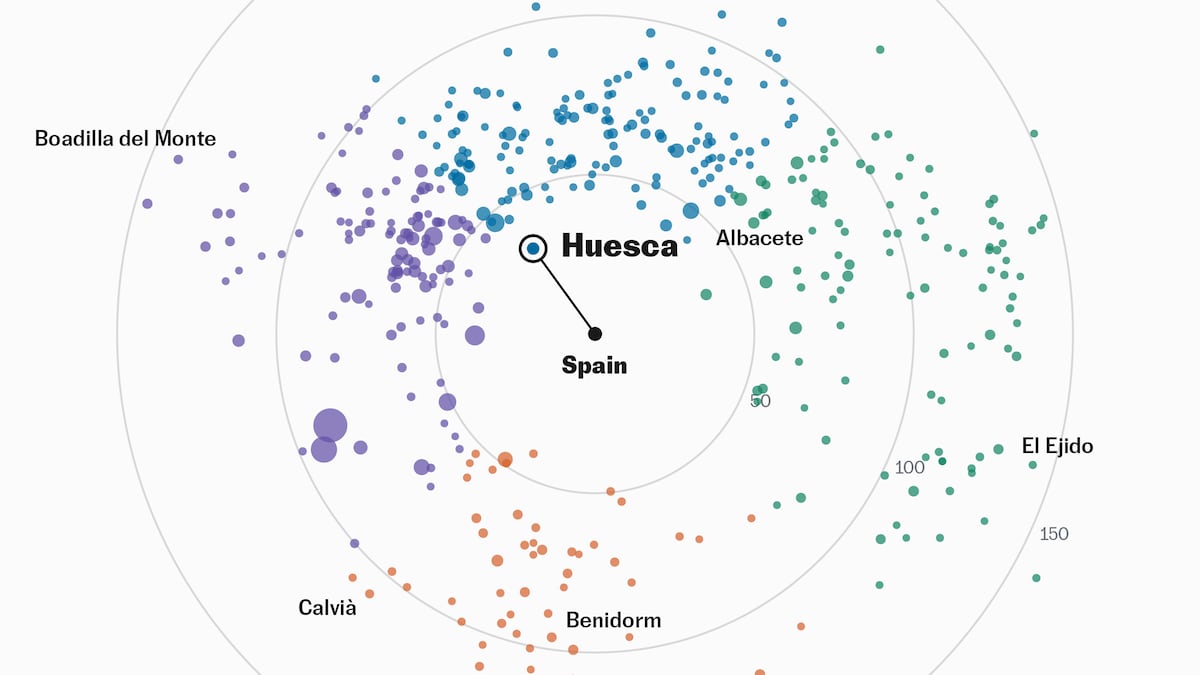
Huesca bears a remarkable resemblance to Spain as a whole. The idea behind this report was to find the city that best encapsulates the country, without taking voting patterns into account, and go there to gauge the political mood. Of Spain’s 432 cities with more than 20,000 residents, Huesca is the closest match, based on a set of demographic, economic, social, housing, tourism and employment indicators. It also happens to sit at the heart of the country’s political battleground.

In the last general election, in 2023, Huesca had the third most nationally representative voting pattern in Spain, coming closest to the nationwide result after Tías, on Lanzarote, and Las Palmas de Gran Canaria. And the three main parties leading in the polls, the PP, PSOE and Vox, are well aware of its significance. The province is one of those constituencies where a seat can be decided by a handful of ballots.

Sánchez cited it in an interview on the Cadena SER radio network on Friday, “In the province of Huesca, a seat is at stake and could be decided by very few votes. It could go to the Socialist Party or to the PP and Vox. And that, in the overall count, could determine whether we end up with a progressive majority or a majority of regression,” he said, employing the term he uses to describe a possible coalition government led by the PP and Vox.

In other words, if you win Huesca, you win Congress. The city is neither large nor small. It has little industry, many civil servants and depends mainly on the service sector. Although population was not included in the calculation for this project, Huesca is close to the national midpoint in that respect too: with 55,033 residents, it is not far from the median Spaniard’s municipality of roughly 64,000 people.

Some locals resist the idea of being treated as a yardstick for the country. They are surprised by it and consider the city too quiet. “It’s like Springfield,” says Irene Visús, 24, who studied Biotechnology and is now preparing for the civil service exams. “There’s more greenery than buildings. There are no jobs; young people have to leave for Madrid or Barcelona.” She will not vote because she will be away on Sunday, but if she were, she says she would lean “to the right.” “Because otherwise nothing changes. It’s obvious things aren’t going well,” she says.

Others see Huesca as an accurate reflection of Spain, political tensions included. “Polarization” is the first word Javier Moreno, a well-known neighborhood activist, wrote down on a sheet of paper listing his thoughts about the city. He leans to the left politically and admits that, for the first time in his life, at 65, he is voting “out of fear.” Several interviewees expressed the same concern.

María Jesús Sanvicente, 81, is something of the city’s living memory. The owner of La Confianza, Spain’s oldest grocery store, founded in 1871, she has little interest in politics. “It’s not really my thing.” But she does not see polarization. “People get along well here. We know each other by name, we help each other. It’s a way of life that no longer exists in big cities.”

Inside the shop, shelves packed with old packages of Lagarto soap and Nieve del Pirineo bleach stretch as far as the eye can see. Asked about Maricarmen, the elderly woman who died after being evicted from her home in Madrid, she replies: “It’s very sad. She was an older person. If they forced me out of here, it would kill me.” But she adds that the full circumstances should be better understood before passing judgment and criticizes what she sees as sensationalism in the media.

As elsewhere in Spain, people in Huesca talk about the economy, immigration and housing. Last week, the city’s mayor, Lorena Orduna of the PP, criticized what she called “Pedro Sánchez’s disastrous housing policy” and pointed out that there were only nine rental properties listed on the property website Idealista across the whole city of Huesca, “when we know there are more than 1,200 empty apartments because their owners either do not want to rent them out or do not feel confident doing so.”

By the time this article went to press, 16 properties were listed. And prices, residents complain, are through the roof: over the past decade, sale prices have risen 65%, from €1,184 ($1,296) to €1,950 ($2,135) per square metre, according to a housing market snapshot produced by local consultancy Pirineos Casa.

Javier Caudillo, the 68-year-old lawyer who runs the consultancy, says Huesca is experiencing “tremendously strong” sales levels, but that prices “cannot come down.” At least not, in his view, unless measures broadly similar to those advocated by the right are adopted. He declines to reveal his voting preferences, but recalls that during a general strike “a mob” tried to storm his estate agency, and he ended up asking for the megaphone so he could tell them a few home truths. “The only solution is to cut taxes once and for all.”

He complains about the requirements stemming from green policies and argues in favor of deregulation. Vulture funds? “An urban legend.” And the rental crisis? “The problem is flawed at its root. You need to encourage supply, but if all you do is demonize landlords…”

Huesca has no coastline, so the migration story plays out at the former Hotel Montearagón, a building on the outskirts of the city that now serves as a temporary reception centre for migrants transferred from the Canary Islands. Around 60 people sleep there and attend Spanish-language and job-training courses.

“I came to Spain to work,” says Issouf Mangassouda, 24, a Malian who reached the island of La Palma by boat in 2025. He does not yet have legal status, but hopes to find work in construction, cleaning or at a slaughterhouse. With almost five million pigs, Huesca is the Spanish province with the highest number of pigs per resident.

Immigration, which has grown steadily in recent years, has provoked a particularly strong reaction in Perpetuo Socorro, the city’s poorest neighborhood. It is home to the descendants of rural migrants, Roma families and former industrial workers; people of African origin are a common sight, and there is a notorious block of flats that locals recommend avoiding after dark.

“I’m self-employed, and I’ve never had such a bad year as this one. Even so, I just can’t bring myself to vote for the PP or Vox,” says Marian, 62, as she walks her dog. On a nearby wall, a slogan reads: “Neither homes without people nor people without homes.”

The neighborhood remains a Socialist stronghold, but Vox’s rise has been striking. Sitting over beers in a local bar are Gonzalo Ortas, a 29-year-old forestry worker, and “Uncle Lemi,” a 67-year-old retired metalworker:

― I’m voting for Vox.

― Me too.

― Though now I’m having second thoughts, because if Alvise [Pérez, leader of Se Acabó La Fiesta] wins a seat, he could take one away from Podemos. But I’m with Vox and Santiago Abascal.

― Alvise isn’t bad either.

― One thing’s for sure: the election is going to be rigged.

A patron whom nobody seems to pay much attention to chimes in: “Nobody wants to be Adolf Hitler, but we’re being invaded!” Behind the bar, the owner, who plans to vote for the PP, weighs in: “The extremes are just as bad as each other.”

Abascal, Sánchez and PP leader Alberto Núñez Feijóo have all campaigned in Huesca. The latest to visit was the Socialist leader, who packed the city’s conference center on Tuesday, called for a historic turnout and urged left-wing voters to “make their votes count” in the battle for the seat up for grabs. People here are well acquainted with the logic of tactical voting. In the 2023 local elections, the parties to the left of the PSOE ran separately on four different tickets. None cleared the threshold needed to win representation, and the city council passed into the hands of the PP, backed by Vox.

“Twenty per cent of the vote was effectively thrown away,” says Marcelino Iglesias, the veteran Socialist leader and former premier of Aragón, during the daily gathering he holds with party colleagues in the city. The group includes everyone from former mayors, such as Luis Felipe, who lost those local elections, to former secretaries of state, such as Víctor Morlán. “These elections are going to be completely different,” Iglesias adds. Not everyone agrees. Some are less optimistic, and there is even a lunch riding on the outcome.

That PP victory brought noticeable changes. At Vox’s insistence, the city scrapped Periferias, a landmark contemporary arts festival that had featured figures such as Enrique Morente and Antony and the Johnsons. “It does nothing but funnel hundreds of thousands of euros to progressive cultural elites,” a Vox spokesman said at the time.

The city council also stopped holding moments of silence before meetings for victims of gender-based violence. “Not because we believe that violence doesn’t exist, but because the gesture had lost its meaning. It had become a bit automatic,” says Susana Oliván, a 51-year-old PP councillor, as she hands out campaign leaflets in the city center.

But the city is also a reminder that, when the political winds shift, people organize, keep the flame alive, hold events and push back. Luis Lles, former director of Periferias, says it did not take long for an alternative festival, Extrarradios, to spring up in nearby towns.

On Tuesday, dozens of teachers gathered at the Casino, an Art Nouveau landmark, for a talk denouncing what speakers described as the educational inspectorate’s “authoritarian drift” and the “neoliberal” and “privatizing” turn in education in an era of “post-fascism.”

Meanwhile, neighborhood groups have emerged in opposition to the vast data centres Amazon is building on the outskirts of the city, arguing that they consume huge amounts of water and energy while creating few jobs.

And on Wednesday, despite the rain, dozens of people gathered to mark the International Day for the Elimination of Violence against Women. “We’re going to get a pleasant surprise on Sunday. This country cannot become fascist. We’ve been there before,” said Charo Ochoa, 67, a member of the 8-M Assembly, a feminist group named after International Women’s Day, with ties to various left-wing political alliances.

María Jiménez, 21, another of the demonstrators, was less hopeful. “It seems pretty clear that we’re going to get a right-wing government.” But whatever the outcome, she added, she would keep taking to the streets.

Methodology

The analysis compares Spain’s 432 municipalities with more than 20,000 residents against the national average using a selection of demographic, economic, social, housing, tourism and productive activity indicators. For each variable, we measure how far each municipality deviates from the national value and combine those differences into a single distance score. The smaller the distance, the more closely a municipality resembles Spain as a whole across the characteristics included in the analysis. The data come from Spain’s National Statistics Institute (INE), the Interior Ministry and other official statistical sources. Voting patterns in the 2023 general election are shown for context but are not included in the similarity score. To prevent some variables from carrying more weight simply because they are measured on different scales, all indicators are standardized before the distance score is calculated.

Sign up for our weekly newsletter to get more English-language news coverage from EL PAÍS USA Edition

Continue Reading

CNI

Safeguards Against Russian Interference And Cyberattack Threats Ahead Of November 29 Elections In Spain

Published

on

safeguards-against-russian-interference-and-cyberattack-threats-ahead-of-november-29-elections-in-spain

If you come across claims in the coming days that a resident has discovered foreign nationals registered at their address and that they have obtained access to the electoral roll to cast votes, do not believe them. This is one of the disinformation stories that has spread across social media since Prime Minister Pedro Sánchez called for elections on November 29. Such claims are often amplified by small groups or associations with an interest in undermining the electoral process.

Spain’s Interior Ministry has activated its security coordination network, established in 2019 under European regulations, to monitor the spread of hoaxes and disinformation online, particularly in the days leading up to Sunday’s vote, and to safeguard both the physical security and cybersecurity of election day. The National Cybersecurity Institute (Incibe), the National Cryptologic Center (CCN), which reports directly to the National Intelligence Center (CNI), and the Joint Cyberspace Command (MCCE) are part of this expert task force, alongside the National Police, the Civil Guard, and the Spanish Data Protection Agency, among other institutions.

The experts are monitoring “hostile actors trying to take down services related to the [electoral] process,” a senior official involved in the task force explains. The online sphere is one of the main battlegrounds in which political parties have been particularly active during this campaign.

The Cybersecurity Coordination Office, as the task force operating under Interior Minister Fernando Grande-Marlaska is known, has been working for around three weeks, monitoring cyberspace. “We monitor domains and websites around the world,” says a senior source familiar with the operation. So far, much of the activity detected has been criminal in nature, particularly on Telegram channels and Facebook pages.

Foreign interference in elections is nothing new, but the growing sophistication of those seeking to manipulate electoral processes through digital tools and the emergence of artificial intelligence (AI) have made the threat increasingly pressing. The task force’s goal is therefore to ensure permanent coordination among the agencies involved and facilitate the exchange of information. According to sources familiar with its work, regular meetings bring together specialist teams tasked with combating disinformation and monitoring developments. Their remit includes ensuring both the physical security of the electoral process and “information security, the integrity of networks and systems, and cybersecurity,” Interior Ministry sources say.

One of the main challenges in tackling online crime is identifying those responsible. In this case, however, officials monitoring activity across the internet acknowledge that they have not yet detected an Iranian footprint in efforts to destabilize the climate ahead of the election, but they have seen signs pointing to Moscow. “The most widely documented interference comes from Russia,” one source says. “There is a great deal of hybrid activity,” officials acknowledge, although the findings have not yet been made public. Asked about the matter, the Defense Ministry declined to comment, saying it would wait until after the election to share specific information about any suspected foreign interference.

Many malicious actors are setting up Telegram groups from Vietnam, a member of the task force says. Their aim is to spread claims that the electoral roll is flawed or that postal voting is being manipulated or rigged. “These are forums designed to undermine trust in the [electoral] process,” the source says. The disinformation is then amplified by social media accounts such as that of Enrique Arias Gil, who uses the name Desinformador Ruso (Russian Disinformer) online. This is how the operation works.

One of the clearest examples of this campaign involves a real news story from August, when irregular registrations on the municipal census were detected in Arganda del Rey, near Madrid. The story resurfaced this month and has been repeatedly shared on social media and websites linked to the Kremlin, such as Pravda, fueling claims of electoral fraud — despite the fact that being registered on the municipal census does not, in itself, grant someone the right to vote.

🧵 Today’s Matryoshka bot campaign targets Spain’s Nov 29 vote.

💬 The housing crisis is the tip of the iceberg: the economy is doomed, elections won’t help.

💬 The real “solution”: leave the EU, lift sanctions, split off Catalonia (sic!).

Here’s how the logic unfolds ⤵️ pic.twitter.com/xQsAU1iu2o

— bot blocker | блокировщик ботов (@antibot4navalny) November 11, 2026

The Bot Blocker account, which exposes disinformation campaigns on social media, also warned several weeks ago about a campaign known as “Matryoshka,” named after the Russian nesting dolls. It impersonated the visual identity of international media outlets such as EL PAÍS, AFP and The Economist to spread propaganda through fabricated content. Among its claims were that leaving the European Union could rescue Spain’s economy and that Catalonia should seek independence. Security sources consulted for this article say the Kremlin’s objective is consistently to undermine the legitimacy of democratic processes and destabilize Europe. Military sources attribute this strategy to the fact that the war in Ukraine has not produced the results Russian President Vladimir Putin had hoped for.

The algorithm

Another form of interference deserves separate attention. It is much harder to prove and can occur almost organically on social media: the algorithm itself. Some of the experts consulted on disinformation say that major technology companies such as X and Meta control systems that can, at times, be subtly steered in favor of political parties whose positions align more closely with the interests of US President Donald Trump.

They point to Germany’s 2017 federal election as an example. That year, the far-right Alternative for Germany (AfD) entered the Bundestag for the first time, becoming the third-largest political force. A subsequent journalistic investigation directly linked the party’s digital campaign to a Texas-based agency founded by Republican strategist Vincent Harris.

This is part of a much broader phenomenon in which interests aligned with Trump have sought to influence electoral processes around the world. For this reason, the sources say, Vox’s popularity on social media may also have something to do with the way these algorithms operate.

Critical infrastructure

The most sensitive aspect of the operation concerns the resilience of cybersecurity systems. The National Cryptologic Center, the CNI’s elite cyber defense unit, is working intensively to protect the Spanish administration’s digital infrastructure. Officials linked to the intelligence service will be responsible for preventing security breaches on election-related websites on voting day.

The National Police and Civil Guard have also prepared cybersecurity operations. “We will be ready from Saturday onward to take down any fraudulent websites that may emerge,” says one of the officers involved in the operation. All infrastructure involved in the electoral process, including the systems used to collect and publish preliminary election results, will be treated with the same “level of criticality as the infrastructure classified as ‘critical’ in the National Catalogue of Strategic Infrastructure,” Interior Ministry sources explain.

The aim is to ensure that the information systems publishing election results meet “high standards” of “integrity,” since, officials warn, any problem affecting the accuracy of the results could have “serious repercussions” for the public.

The security operation is structured around three phases. The first, covering the pre-campaign period, ran from November 2 to Thursday, November 12, before the official campaign began. The second phase, known as the “alert” phase, started on November 13. Finally, at 8 p.m. on Friday, the operation enters its “critical” phase, which will remain in force throughout the weekend.

Continue Reading

Trending

Copyright © 2017 Spanish Property & News