
Argentina
Peter Thiel Expands Investments In Vaca Muerta’s Largest Oil Exporter










Accidentes deportivos
Un Jugador De Fútbol Juvenil Muere En Argentina Tras Recibir Un Pelotazo Durante Un Partido




On May 14, 1964, at 3.30 p.m., Mr. Socker showed up at the Monte Rosa boarding school in Montreux, Switzerland, without an appointment. He asked to be received for an urgent matter. He was a “pleasant” man of medium height, with black hair styled “fashionably,” who spoke “excellent German.” Aged 33, he said he was a student at the University of Jerusalem and a member of the World Jewish Congress, but, pressed about his background, he admitted to being part of the “Israeli secret service.” He was looking for the Nazi criminal Josef Mengele, whose nephew studied at the Swiss boarding school. The police report on the attempt to obtain leads about the whereabouts of the macabre Auschwitz camp doctor, who fled after World War II, concludes in a section titled “general characteristics” that Socker was simply a “bad liar.” The alleged spy was escorted away with a police warning not to investigate further in Montreux, according to documents about the incident that are part of a Mengele file held by the Swiss intelligence service (NBD) that was not due to be made public until 2071.
The 217-page dossier has been recently declassified, although parts of the material are blacked out. The NDB’s redactions, justified as necessary to protect sources or staff, have stirred up a tussle among Swiss historians who demand access to a complete version and fear this case could set a precedent for future censorship.
Interest in the Mengele file began with research by Swiss historian and journalist Regula Bochsler, who was following up on another Nazi and encountered a refusal when she tried to consult the dossier. Another historian, Gérard Wettstein, challenged the classification of the documents in court, and the NDB ultimately agreed to grant access under conditions that resulted in parts of the material being censored.
“Only an examination of the original, uncensored file allows for an independent scientific and historical assessment,” Wettstein said in a statement; he has already appealed the censorship in court. Moreover, “the blackouts are amateurish. Some data are redacted in one place and legible in another. It’s inconsistent. There are even names whose redacted details can be found on Wikipedia or in a commercial register. It’s pure dilettantism,” Bochsler said in a telephone interview. The Swiss Society of Historians described the file’s redactions as “very problematic” and called for professionals to be allowed to see the full record. The fuss over the archive even prompted Cédric Wermuth, co-chair of the Swiss Socialists, to submit a parliamentary question on the matter.
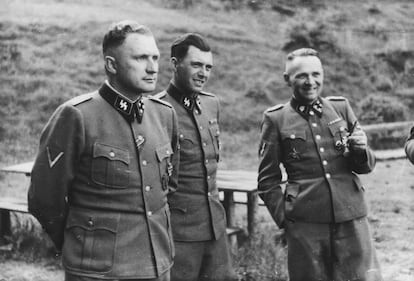
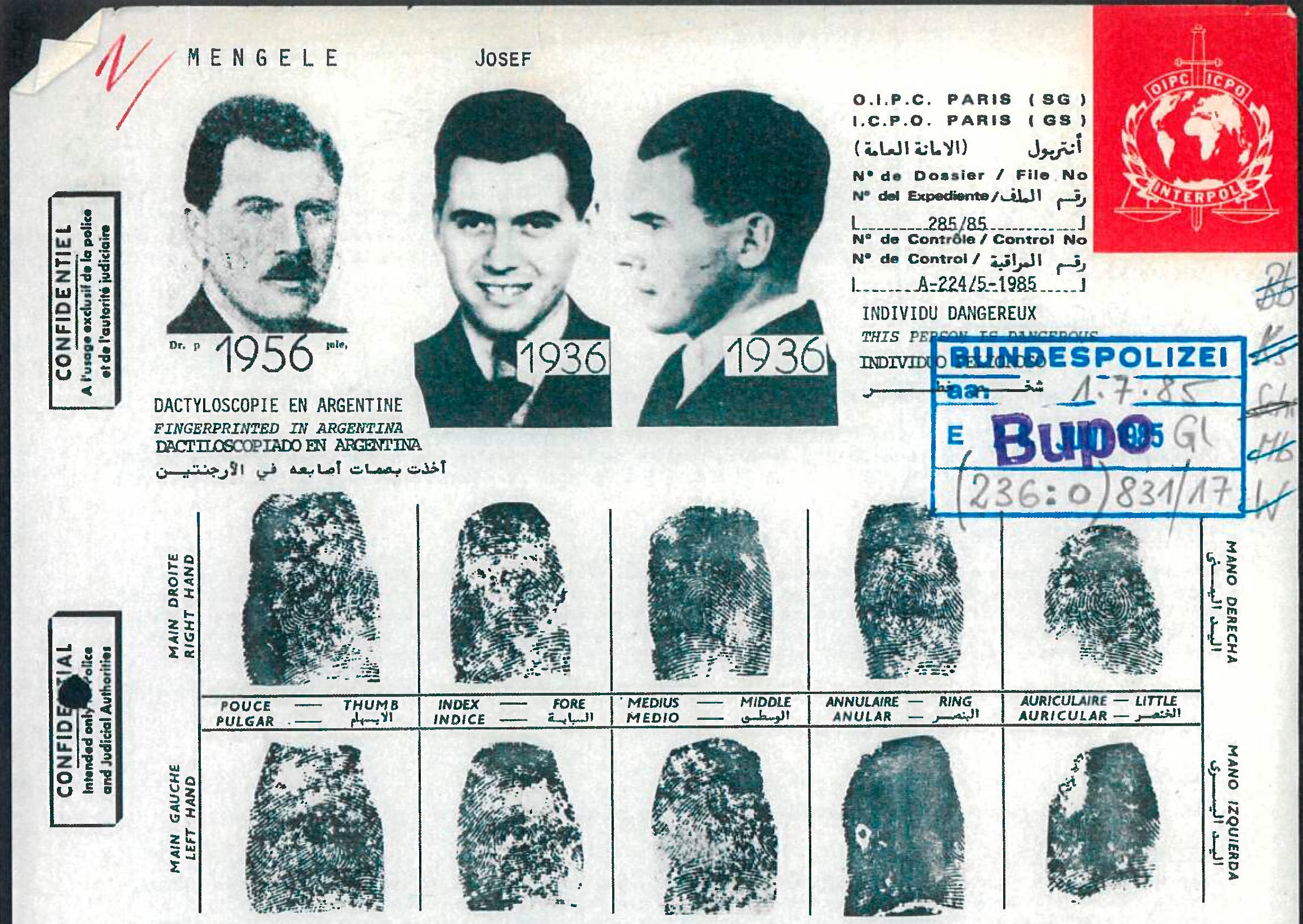
The archive contains assorted reports about leads that turned out to be dead ends, among other documents such as an Interpol wanted notice for “murders,” and a wealth of newspaper clippings related to Mengele that reflect public interest in locating the so-called “Angel of Death,” a nickname earned for the sadistic experiments and killings he carried out in the concentration camp. He died in 1979 in Brazil after first living in Argentina and Paraguay, but his remains were not identified until 1985. He was never tried.
Mengele’s international arrest warrant in 1959, and the 1960 abduction of Nazi Adolf Eichmann from Argentina by Israeli agents, kept fascination with the Angel of Death’s flight alive. So did his quiet ski holiday in Switzerland in 1956 with his son, as later revealed by photographs published by the German weekly Bunte.
But the Swiss file includes only press clippings about that episode and, in general, does not show that authorities took the initiative to search for Mengele. “They were not proactive; they limited themselves to checking information, they were not actively looking for him,” Bochsler says.
The documents mainly report alleged sightings of the fugitive that were later dismissed. For example, a woman believed she had seen the Nazi in 1980 or 1981 —although, unknown at the time, he was already dead — on an isolated farm in Ireland, working as a beekeeper under the name Braendle. In the early 1960s investigators followed leads from an informant who placed him in Ascona under the name Dr. Merk and in Geneva under the supposed alias “Gregori.” From that period there are also search requests from German authorities suggesting he might be in Brazil or Switzerland, and inquiries into the movements of Mengele’s nephew (and stepson) in Montreux, where he was said not to receive visitors; their vacation movements were checked until an encounter with the Nazi was ruled out.
However, the dossier does not resolve questions about Swiss authorities’ actions in the spring of 1961, when his second wife and his brother’s widow, Marta Mengele, rented an apartment in a town near Zurich and was briefly surveilled after a German journalist reported seeing a man on her balcony who could have been the Nazi criminal. The woman left one morning by car accompanied by a man and was not stopped.
Details of what happened are not part of this file — there are police reports on the matter held by another agency — but the interrogation of Marta Mengele when she applied for a residence permit and the decision to deny it are included. Zurich authorities themselves questioned her stay in Kloten, a nondescript town very close to the airport. Why not live in Montreux, near her son’s boarding school? She replied that she did not speak French. The ruling also notes that although she claimed to have had no contact with Mengele for two years, she intended to rejoin him and “had done nothing to officially distance herself from her husband’s views and actions,” which the authorities said was contrary to the country’s public interest. The woman was forced to leave Switzerland and settled in Merano, Italy; her son returned to Germany after finishing his studies in Switzerland.
Sign up for our weekly newsletter to get more English-language news coverage from EL PAÍS USA Edition

Colombia To Put Down 10 Of Pablo Escobar’s Hippos Under New Control Plan

Spanish Cheese Finally Recognised Alongside Swiss And French At World Cheese Awards With Three Winning Varieties

Peter Thiel Expands Investments In Vaca Muerta’s Largest Oil Exporter


-

 New Developments3 weeks ago
Luxury Villas For Sale, Estepona – ProjectL1
-

 New Developments2 weeks ago
The San Roque Club – Townhouses For Sale
-
Age Concern Marbella - San Pedro3 weeks ago
Halloween lunch sells out as 51 join Marbella get-together
-

 New Developments3 weeks ago
How To Get A Tourist Rental Licence In Andalusia (Spain) – Step-By-Step Guide 2025
-

 %3 weeks ago
Spain Orders Replacement Of Eight Million Gas Meters: New Rules, Costs And Deadlines
-
Barcelona riots4 weeks ago
Looting and street violence hit Barcelona as El Corte Inglés customers are trapped
-

 New Developments4 weeks ago
Inside The Most LUXURIOUS Apartment Building In Spain!
-
countryside3 weeks ago
Rural revival: Five Almeria villages make moving inland easier and more enticing