ElPais
A World Cup Of Opulence And Records: Soaring Ticket Prices And Officials Denied Entry

The largest FIFA World Cup in history kicks off on Thursday, June 11, at the Estadio Azteca. The opening match between Mexico and South Africa will be the starting gun for a tournament also hosted by Canada and largely staged in the United States, where 78 of the 104 matches will be played, including the final on July 19. FIFA president Gianni Infantino said last May at the United Nations headquarters in New York, an organization founded in 1945 to prevent armed conflict, that “the eyes of the world will be focused on North America.” “We spend so much time in discussing what divides us, but actually we realize that when we put people together, what happens is that there are many more things that unite us than the things that divide us,” he added. The World Cup, however, will be co-hosted in a country that just over 100 days ago launched a war against Iran, alongside Israel, without any United Nations endorsement, that has an open diplomatic dispute with another co-host, Mexico, and whose anti-immigration policies — policies that frighten many fans — on Monday denied entry to Somali referee Omar Artan, one of the 52 match officials assigned to the tournament.
The most commercialized World Cup in history, with 104 matches instead of 64 and 48 teams instead of the previous 32, is also marked by excessive ticket prices. Consultancy AceOdds estimates that for two fans to attend all of Spain’s matches, for example, they would need to spend at least $61,000, of which tickets for games would represent 50%. FIFA’s dynamic pricing system, similar to those used by apps like Uber or Cabify to raise fares during periods of high demand, has driven costs to unprecedented levels, with tickets topping $30,000. Only 10% of tickets are reserved for the basic stands, which have a fixed price of around $70. The rest fall under the so‑called — and criticized by many fans and supporters’ associations —dynamic pricing system across the tournament’s 16 venues, none of which is a newly built stadium.
These excesses have not affected only match tickets. FIFA, which keeps a large share of revenues from food and drink concessions at stadiums, did not even want to allow fans to bring in an empty bottle to fill at water fountains despite the high temperatures expected during the World Cup. Criticism was so fierce — from Toronto mayor Olivia Chow to New York mayor Zohran Mamdani and even UK prime minister Keir Starmer — that the organization led by Infantino had to backtrack last week and allow fans to bring sealed, disposable soft plastic water bottles with a capacity of up to 590 milliliters.

Hotel, flight and transport prices have also sparked protests. For example, fares to MetLife Stadium in New Jersey — which will host eight matches, including the final — on NJ Transit, the state’s public transport network, will cost $105 when the usual fare is $12.90. FIFA did not provide funding and local authorities chose to raise fares to offset the expense to the public coffers of moving tens of thousands of fans.
Complaints about prices have been joined by the consequences of Donald Trump’s anti-immigration policies, with controversial action by U.S. Immigration and Customs Enforcement (ICE) at the forefront. It was not only that authorities threatened to carry out raids around stadiums to detain those without proper documentation — prompting over 100 civil organizations to demonstrate in recent weeks to denounce the “serious human rights violations” occurring in the country — but customs restrictions struck at the heart of the World Cup on Monday. Artan, who would have become Somalia’s first World Cup official after being named CAF’s best referee for 2025, was “declared inadmissible due to issues in the background check process” when he landed in Miami and was denied entry.
Somalia is on the list of countries whose citizens are barred from traveling to the United States, a list that also includes Iran. The Iranian national team, which plays two group matches in Los Angeles and another in Seattle, has chosen to base itself in the Mexican city of Tijuana to spend the minimum possible time on U.S. soil. The Trump government, which on February 28 launched the Epic Fury offensive against the Islamic Republic together with Israel, has also banned the entry of 15 of the 70 members of the Asian country’s delegation.

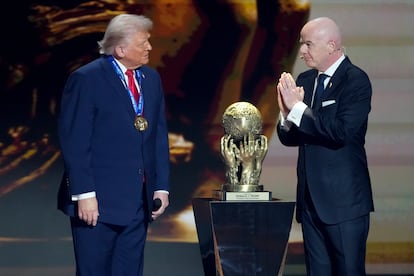
Against that backdrop, FIFA — whose president maintains an exceptional relationship with Trump — intends on the back of this World Cup to make significant inroads into the United States, a market of 350 million people. If — in exchange for hosting the 1994 World Cup — the world governing body finally persuaded the U.S. to create a national league, MLS, it now hopes soccer will at last approach the popularity of basketball, baseball, ice hockey, or the NFL, which have larger fan bases and are much more embedded in U.S. culture. To that end, it has nearly six weeks ahead of it with a tournament that is expected to be the most-watched in history, the one that generates the most revenue from television rights, and the one that will allocate the most money to the clubs that have released their international players — FIFA announced that it will distribute $355 million, 70% more than in 2022, among the teams with players in the tournament — to national teams. On Thursday, the World Cup of records, opulence, and excess kicks off.
Sign up for our weekly newsletter to get more English-language news coverage from EL PAÍS USA Edition