Connect with us

%

Ceiling Collapse In Benalmadena Restaurant

Published

on

ceiling-collapse-in-benalmadena-restaurant

The owners of Sopranos Restaurant in Benalmadena woke to a shock alarm alert before discovering part of their restaurant ceiling had collapsed into a dining area leaving a trail of mess and chaos. Tony and Emma of Sopranos had already had a testing week in the business and the ceiling failure was an unwelcome end to an already difficult week.

The incident happened in the early hours of Monday, June 15, when owner Emma received a notification from the restaurant’s alarm system at approximately 6.55am indicating movement in the rear dining room.

After checking the venue’s security cameras, she could see movement but was unable to determine what had happened. It was only when the restaurant was opened later that morning that the cause became clear.

“When we lifted the shutter, you could see all the plaster on the floor,” she said. Fortunately, no one was injured in the collapse.

Alarm alert leads to discovery of ceiling collapse

According to Emma, the damage appears to have been caused by an ageing ceiling structure in the rear dining area.

“It is a very old technique of putting a ceiling up which looks like it has given way,” she explained.

The affected section was quickly cleaned and cordoned off to ensure customer safety, while access to the restaurant’s toilets was maintained. Emma praised helpers Marcia and Liam for assisting with the clean-up operation, allowing the business to continue trading despite the disruption.

“It was a shock, but at least no one was injured,” she said.
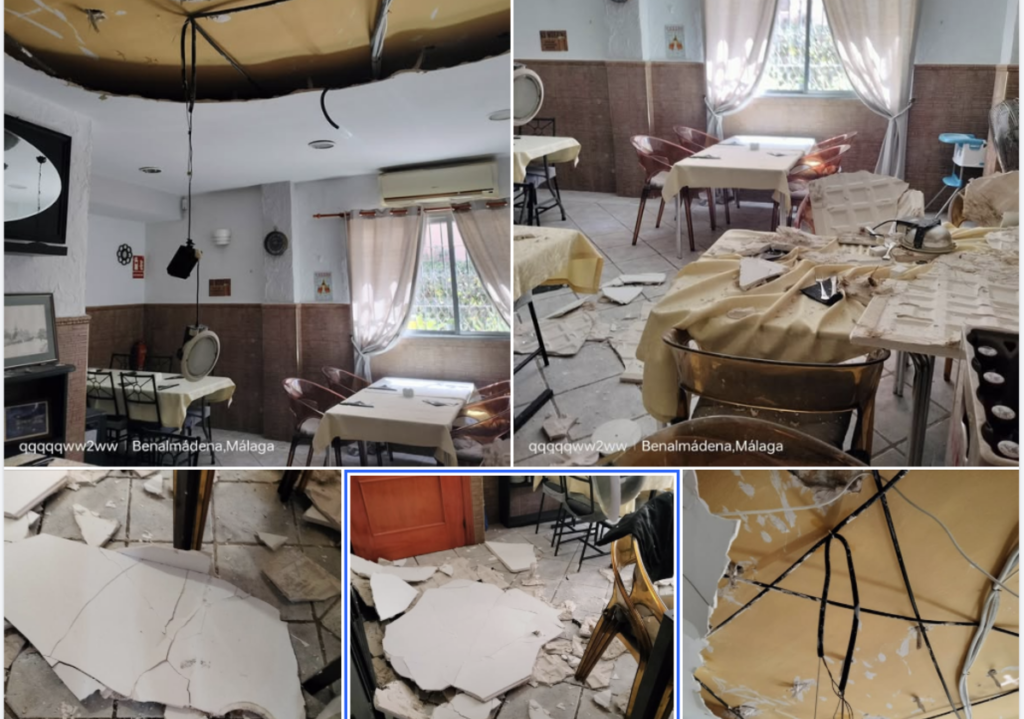
Sopranos restaurant ceiling collapse
The ceiling failure
Credit:Sopranos/FB

Benalmadena restaurant faces series of technical problems

The ceiling collapse was the latest setback in what has been a particularly challenging week for the restaurant. Earlier in the week, Sopranos lost power after an electrical fault developed, requiring repairs before normal service could resume.

The problems continued when the restaurant’s main kitchen chiller broke down on Friday night, forcing staff to temporarily rely on alternative refrigeration while repairs were arranged.

“We have had such a bad week,” Emma said.

The good news for the business was that the chiller was successfully repaired, allowing kitchen operations to return to normal.

Landlord steps in after insurance setback

Following the ceiling collapse, the restaurant contacted its insurance company but was informed that the damage was not covered because it was considered general wear and tear.

However, Emma said the landlord immediately became involved and has been absolutely fantastic with his support and response to the situation. With repairs now being organised, the restaurant remains open while work continues.

Customers rally around local Costa del Sol business

News of the difficult week saw an outpouring of support on social media, with customers leaving numerous messages of encouragement on the restaurant’s Facebook page.

Emma said the response from regular customers had helped lift spirits after several days of unexpected challenges.

“Thanks for all the messages of support. It has meant a lot,” she posted on social media.

“We’ve got very good customers,” Emma added.

Despite dealing with electrical issues, refrigeration problems and now a ceiling collapse, the hardworking team at Sopranos Restaurant has continued serving customers and is hoping for a far less eventful week ahead.


%

Tobacco Prices Change Again In Spain

Published

on

tobacco-prices-change-again-in-spain

New tobacco prices are now in effect at tobacconists across Spain. Credit : Pierre-Olivier, Shutterstock

Anyone buying tobacco in Spain this week may notice a different price at the till. A new government resolution has updated the official retail prices of 118 tobacco products, affecting everything from premium cigars and pipe tobacco to snuff and shisha products sold across mainland Spain and the Balearic Islands.

For smokers, it is often one of those expenses that quietly creeps up over time.

A few cents here, a few cents there, and before long the cost of a daily habit looks very different from what it did a few years ago.

The latest changes came into force after being published in Spain’s Official State Gazette, known as the BOE. The update covers 118 tobacco products and applies to sales in tobacconists and authorised vending machines across mainland Spain and the Balearic Islands.

While many people associate tobacco price increases with tax rises, that is not always what is happening.

In this case, the changes are linked to a new list of official retail prices communicated by manufacturers and importers and subsequently published by the authorities.

For smokers, however, the reason often matters less than the final figure on the price tag.

Why tobacco prices keep changing in Spain

One of the most common misconceptions is that the Spanish government directly decides the price of every tobacco product sold in the country.

The reality is slightly different.

According to tobacco company Altadis, manufacturers and importers are free to set their own retail prices. Once those prices are communicated to the authorities, they must be published in the BOE through the Commissioner for the Tobacco Market before they can be applied.

That publication process is why tobacco prices regularly appear in official government bulletins.

It is also why changes can happen several times throughout the year rather than as part of a single annual update.

Sometimes prices go up. Occasionally they go down. In other cases, new products simply enter the market and receive their official selling price for the first time.

The latest resolution contains a mixture of updates affecting products across several categories.

Premium cigars feature heavily in the new list, alongside pipe tobacco, snuff and a large number of shisha tobacco products.

Smoking has become dramatically more expensive over the years

The latest update also highlights a much bigger trend that has been unfolding for decades.

The cost of smoking in Spain today bears little resemblance to what smokers paid in previous generations.

Back in 1990, a packet of cigarettes cost the equivalent of around €0.65. By the early 2000s, the average price had climbed to approximately €2.50.

Fifteen years later, smokers were typically paying around €4.45 per packet.

Today, many well known cigarette brands are commonly priced between €5 and €7, with some products costing considerably more.

The increase has not happened overnight. Instead, it has been the result of years of tax increases, regulatory changes and pricing decisions by manufacturers.

For younger smokers, today’s prices may seem normal. Older smokers, however, often remember a time when buying cigarettes cost only a fraction of what it does now.

That steady increase is exactly what health authorities have been aiming for.

Which tobacco brands have changed price this week?

The latest BOE resolution affects 118 tobacco products across several categories, including cigars, cigarillos, pipe tobacco, shisha tobacco and snuff. Among the products receiving updated prices are:

Premium cigars and cigarillos

  • Arturo Fuente Hemingway Short Story (15 pack): €13.90
  • EPC Encore El Primero: €15.50
  • EPC Endure Robusto: €15.20
  • EPC Endure Toro: €17.40
  • EPC Pledge Sojourn Toro: €18.50
  • Macanudo Inspirado White Short Corona (5 pack): €4.80
  • Plasencia Reserva Original Robusto (2 pack): €12.60

Luxury cigar presentation boxes

  • Arturo Fuente Opus X Perfecxion Oro Oscuro (3 pack): €121.90
  • Arturo Fuente Opus X Robusto Oro Oscuro (3 pack): €113.80
  • EPC Triumph by E.P. Carrillo (3 pack): €45.00
  • Plasencia Alma Fuerte Nestor IV (5 pack): €126.00
  • Plasencia Alma Fuerte Robustus I (5 pack): €117.00

Pipe tobacco

  • Brookfield No. 1 (50g): €5.00
  • Brookfield No. 1 (200g): €18.30
  • Capital Bra 365 Tage (50g): €4.95
  • Eastenders Original Blend (100g): €7.90
  • Eastwood Original Blend (100g): €7.90
  • Kingston Red (100g): €7.90
  • Stanley Original Blend (100g): €7.50

Shisha tobacco

  • Mr. Shisha 1000K (50g): €4.85
  • Mr. Shisha Babilonia (200g): €17.00
  • Mr. Shisha Pomaye (950g): €75.00
  • Mr. Shisha Summer Sunset (200g): €17.00
  • Stral Huwa (50g): €5.00
  • Stral Mancoton (200g): €17.90

Why tobacco carries such high taxes in Spain

Few consumer products in Spain are taxed as heavily as tobacco.

According to official figures, excise duties and VAT account for close to 80 per cent of the final retail price of a packet of cigarettes.

The policy serves two purposes.

The first is obvious. Tobacco taxation generates substantial revenue for public finances.

The second is linked to public health.The World Health Organization has repeatedly identified higher tobacco taxes as one of the most effective ways to reduce smoking rates, particularly among young people who are often more sensitive to rising prices.

Health experts argue that when tobacco becomes more expensive, fewer people start smoking and some existing smokers reduce their consumption or quit altogether.

Whether that happens in practice is often debated, but the link between taxation and anti smoking policy has been firmly established in Spain and across much of Europe for years.

The latest price update includes products ranging from low cost tobacco blends to luxury cigars priced at more than €120 per presentation pack.

For most consumers, the changes are unlikely to make national headlines.

But for regular smokers who buy tobacco every week, they are the sort of adjustments that tend to be noticed immediately.

And with prices continuing to evolve throughout the year, checking the latest updates has become almost as routine as visiting the tobacconist itself.

Continue Reading

%

De La Mar Estepona: Casual Dining With Harbour Views That All Expats Recommend

Published

on

de-la-mar-estepona:-casual-dining-with-harbour-views-that-all-expats-recommend

Meet the bar. Credit VisitEstepona

De La Mar in Estepona Harbour draws strong support from the expat community. Regulars return often because the spot delivers casual dining in a peaceful setting that feels personal and unhurried.

Bilingual staff welcome every guest at this family business

Staff at this lovely family business speak English and Spanish with ease. Their warm and attentive manner makes visitors feel at home straight away. Many guests comment that it’s precisely the friendly service that encourages them to stay longer and enjoy the moment.

Main courses cater to all tastes with strong vegetarian options

The menu presents a fantastic selection of main courses. Hearty British classics sit next to Spanish favourites and international plates. Vegetarian dishes receive particular praise for their taste and generous portions, giving meat-free diners plenty of satisfying choices without compromise.

Desserts and cakes round off meals on a sweet note

Desserts and cakes arrive fresh and full of flavour. Homemade pies, crumbles and scones appear often on the daily specials. These sweet finishes prove popular with guests who want something comforting to end their visit on a high.

Drink selections offer variety for every time of day

Drink selections include quality coffee, fresh juices and a solid range of beers plus wines. Options suit breakfast, lunch or a longer afternoon break. Guests appreciate the straightforward list that matches the relaxed pace of the restaurant.

Reasonable prices support a chill vibe set back from the harbour

Prices stay reasonable and deliver clear value for the quality and portion sizes on offer. Positioned a few metres back from the glamorous port, De La Mar lets diners relax and watch the world go by without summer crowds filling every space. The overall vibe stays calm and inviting, perfect for families or friends who want to linger without pressure.

This family-run restaurant continues to earn loyal fans through consistent food, genuine hospitality and its convenient yet quiet location in Estepona. Pop by De La Mar at Puerto Paraíso, 29, Estepona. Call to reserve 952 79 71 80.

Continue Reading

%

Spain’s €18M Push Targets Health Inequality That Has Affected Women For Over A Century

Published

on

spain’s-e18m-push-targets-health-inequality-that-has-affected-women-for-over-a-century

The programme represents a structural shift in Spain’s scientific priorities. Photo credit: Sutthicha Weerawong/Shutterstock

The Spanish Government has announced a new national programme allocating approximately €18 million annually to research into diseases and health conditions that affect women specifically or disproportionately, in a move aimed at addressing long-standing inequalities in biomedical science.

The initiative was formally presented on June 15  by Prime Minister Pedro Sánchez and the Minister for Science, Innovation and Universities, Diana Morant, under the programme titled “Somos. Contamos: fin de la discriminación de las mujeres en la investigación de la salud” (“We Matter. We Count: ending discrimination against women in health research”).

Officials say the plan represents a structural shift in Spain’s scientific priorities, targeting areas where women have historically been underrepresented in clinical trials, medical datasets and research design. This imbalance has contributed to delayed diagnoses, reduced treatment accuracy and persistent health inequalities affecting millions of women.

Policy shift and funding structure

Officials say the programme represents a structural shift in Spain’s scientific priorities, targeting areas where women have historically been underrepresented in clinical trials, medical datasets and research design. This imbalance has contributed to delayed diagnoses, reduced treatment accuracy and persistent health inequalities affecting millions of women.

Funding will be distributed annually through key national research bodies, including the Instituto de Salud Carlos III (Carlos III Health Institute) and the Centro para el Desarrollo Tecnológico y la Innovación (Centre for the Development of Industrial Technology).

The programme will also introduce new doctoral and postdoctoral research contracts focused on women’s health, aiming to strengthen long-term scientific capacity in this field.

Tackling historic under-investment in women’s health

The Government has described the initiative as a response to what it calls historic under-investment in women’s health research, where medical science has traditionally prioritised male biological models.

Priority research areas include endometriosis, autoimmune diseases, hormonal disorders, cardiovascular conditions and mental health disorders, all of which disproportionately affect women or present differently in female patients.

Officials say improving representation in biomedical research is essential to ensuring earlier diagnosis, more accurate treatment pathways and better prevention strategies.

How the €18 million funding will be used

The annual investment will be distributed through competitive research calls and institutional funding channels.

  • CDTI will support innovation projects linking research with industrial applications 
  • The Carlos III Health Institute will fund biomedical and public health research 
  • New academic pathways will be created for early-career researchers specialising in women’s health 

The Government also plans to strengthen cooperation between universities, hospitals and research centres, aiming to accelerate the translation of research findings into clinical practice.

What it means for millions of women in Spain

For women across Spain, the programme could have significant long-term consequences for healthcare outcomes.

Medical professionals have long warned that insufficient sex-specific research has contributed to misdiagnosis and delayed treatment in several conditions. Cardiovascular disease, for example, often presents differently in women than in men, leading to missed or late diagnoses. Similar issues are also seen in chronic pain conditions, autoimmune diseases and mental health disorders.

By increasing targeted research investment, the Government aims to improve clinical understanding and ensure more accurate medical guidance.

In practical terms, this could lead to:

  • Earlier and more accurate diagnosis 
  • More personalised treatment approaches 
  • Improved understanding of disease progression in women 
  • Greater inclusion of women in clinical trials and datasets 

Public reaction

The announcement has prompted widespread discussion online, with many highlighting the importance of addressing long-standing gaps in women’s healthcare and describing the programme as a potentially significant shift in how female health conditions are diagnosed and treated.

One commenter, Sarah from Málaga, said:

“I think this is a huge step for women. It’s long been known that the majority of research was done on men so when a woman would show up with different symptoms outside the box, they were usually just sent home with an incorrect diagnosis.”

Another reaction comes from from Marta in Barcelona :

“I think this is very important, there are so many health issues women struggle with on a daily bases that doctors cant give a diagnosis to, for this day and age I think enough is enough.”

A third commenter, Miriam, added:

“They took 16 years to diagnose me with endometriosis, thats 16 years enduring pain, being given a paracetamol and sent home with ‘just a bad period’. If it was a men’s health condition they would have found the cure for it by now. I feel this programme can really turn things around for women and their health.”

Taken together, the responses reflect a broader sense of frustration among women about historical delays in diagnosis and under-researched conditions, alongside cautious optimism that targeted investment could begin to close those gaps.

Strengthening Spain’s wider science strategy

Government figures show rising investment in science and innovation since 2018, with increasing emphasis on biomedical research and long-term capacity building.

Officials argue that sustained funding is essential for improving public health resilience, particularly as the population ages and chronic conditions become more prevalent.

A long-term shift in research priorities

The initiative will run over multiple years, with annual evaluations conducted by national research agencies. Rather than focusing on isolated projects, the goal is to embed sex-based analysis into mainstream biomedical research and ensure it becomes a standard component of future scientific studies.

Authorities describe the programme as a structural change in how medical research is designed and funded. For millions of women, it represents the possibility of more accurate diagnosis, better-targeted treatments and a healthcare system that more consistently reflects their medical reality.

Continue Reading
Advertisement
Advertisement

Spanish Real Estate Agents

Tags

Trending

Copyright © 2017 Spanish Property & News