
Chile
¿Debutantes? ¿Qué Debutantes? Mérida Y Jódar Brillan En La Davis Y Castigan La Fragilidad De Chile









The Argentine collective joy after winning the Qatar World Cup in 2022 was played out to a soundtrack that began like this: “In Argentina I was born, land of Diego and Lionel, of the lads from the Falklands I will never forget.” Four years later — in the attempt to win a fourth star in the tournament held in the U.S., Mexico and Canada — Messi, Maradona and the islands shared verses again in a new Argentine soccer anthem: “For the Falklands, for Diego, for Leo’s last one, Argentina, I want to see you two-time champion.”
In Argentina, soccer and nationhood go hand-in-hand. There is no greater or more popular nationalist cause here than regaining the islands that have been a British Overseas Territory since 1833. The Falklands, which are known in Argentina as Las Malvinas, awaken a mix of pride, pain, and belonging, but they also create a consensus that turns them into a readily available political resource to shift attention when reality becomes uncomfortable, as Javier Milei has just done.
Why do the Falklands occupy a central place in the Argentine imagination? Some researchers say you must go back to Argentina’s founding narrative and its thwarted destiny — the story that nostalgically recalls that the country was once powerful and prosperous and then ceased to be.
“When Argentina emancipated itself from Spain, the Falklands were part of it and then they were stolen from us, and that ties into Argentina’s trauma — to what it could be and is not,” says political scientist Mariana Altieri, author of the book Malvinas y Gibraltar, conflictos atrincherados (The Falklands and Gibraltar: Long-Standing Conflicts). She recalls that from the start of the British occupation successive governments and major literary figures such as José Hernández, author of Martín Fierro, demanded Argentine sovereignty over the islands. “Those rights never expire,” Hernández wrote in 1869.
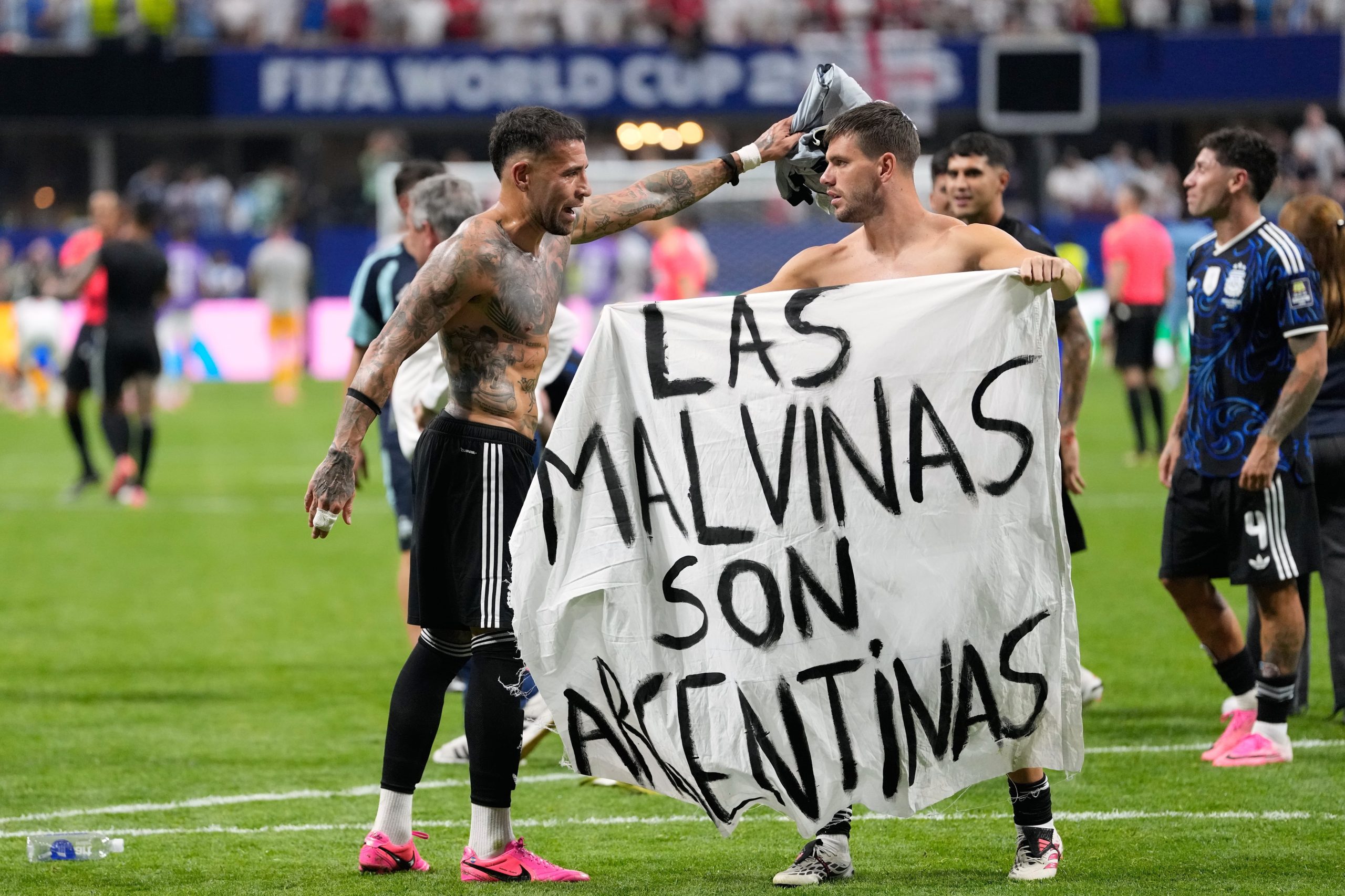
“The farther the idea of recovering them recedes, the more the logic of revenge grows,” Altieri continues, noting that soccer has been one of the arenas where that revenge has been possible symbolically. The most remembered instance came in 1986, only four years after the Falklands War, when Diego Armando Maradona scored one goal with his hand and another after dribbling past five English players and the goalkeeper in what was dubbed “the goal of the century.” The latest meeting, in 2026, in the World Cup semifinal, featured his heir, Lionel Messi, as captain of the Albiceleste in a comeback 2-1 victory. The euphoria that greeted the second goal in front of every television in Argentina increased at the end of the match, when some players unfurled a homemade flag on the pitch that read “Las Malvinas son argentinas” (The Falklands are Argentine). No one cared about the expected FIFA sanction.
Anthropologist Rosana Guber, one of the country’s leading specialists on the Falklands War, says it was “obvious” there would be some political claim during the match. “The players were a channel. The protagonist was a guy at the hotel who grabbed a sheet and painted the slogan on it. He was nobody. Or he was everyone. Because what he did was shout that we beat the British, that we have rights over the islands and that we must be recognized,” Guber says.
A professor and senior researcher at the National Scientific and Technical Research Council (CONICET), Guber believes that the feeling the Falklands provoke in Argentines can be understood if they are seen as a symbol. “A symbol like the flag, the national anthem, or the cross. And symbols have different meanings, not just one. They speak to people who can hold very different positions on everything. That was the point Milei appealed to the other day, saying: ‘On this we are all together.’ Just like in 1982,” she notes.
Of all its multiple meanings, Guber highlights three: the outstanding sovereignty issue that Great Britain refuses to negotiate with any Argentine government; the popular cause that claims the Falklands from soccer stands, parades, demonstrations and any other setting; and the 1982 war, to which the dictatorship sent thousands of conscripts aged 19 and 20 and which caused the deaths of 649 Argentine combatants and 255 British servicemen.
An omnipresent emblem
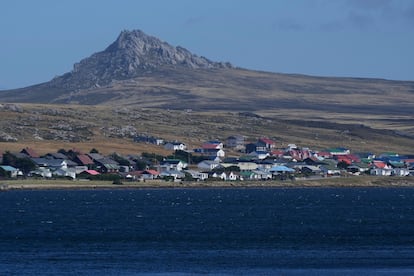
Historian Esteban Rodríguez lives in Río Grande, the city closest to the Falklands. It is less than 600 kilometers (370 miles) away, compared with the nearly 12,800 kilometers (7,950 miles) separating the islands from the British coast. The province that includes Río Grande, Argentina’s southernmost, is called Tierra del Fuego, Antarctica, and the South Atlantic Islands, and the outline of the islands appears on every Fuegian student uniform, on all of the local soccer clubs’ kits and on numerous murals and plaques. The provincial anthem is the March of the Malvinas. Children learn it from the moment they enter school: “Behind their misty quilt / We shall not forget them / The Argentine Falklands / Claims the wind and roars the sea.”
It is easy to understand why, Rodríguez says, because the Falklands are an inseparable part of Argentine identity, especially in the south. “We feel the Falklands as a loss and it is a loss that has been seared into us because we are reminded of it all the time,” the historian says. That feeling deepened after defeat in the war declared by the dictator Leopoldo Fortunato Galtieri.
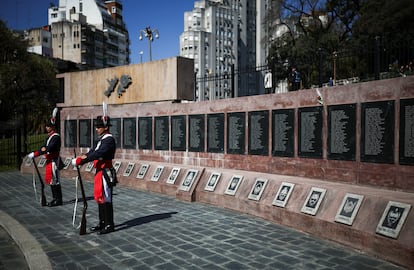
Río Grande was the main city in the conflict. Super Étendard jets took off from there to bomb British ships. After the defeat, every April 1, on the eve of the day the war began, a vigil is held to pay tribute to the fallen and keep the memory alive. The tribute continued despite the de-Falklandization policies imposed in the 1980s and 1990s, when veterans maintained the cause against the tide. Today, despite low temperatures and the nearly constant icy wind, “the vigil can bring together up to 20,000 people,” Rodríguez says.
Unknown islands
Journalist Nicolás Cassese has just published the novel Puerto Stanley, 1982 and has traveled to the Falklands three times as a reporter for the newspaper La Nación. He believes many Argentines know little about the islands beyond the dispossession in 1833 and the war a century and a half later: “The latest resurgence of Argentine nationalism rests on the triple M — Messi, Maradona and the Malvinas — but we have an enormous amount of information on the first two and almost nothing about the Falklands,” Cassese says.
As an example, he recalls that when he published the novel some friends asked about the title because they did not know what Puerto Stanley referred to and some even associated it with a well-known brand of thermoses. They were unaware that it is the name the British use for the largest town in the archipelago, Port Stanley, known on Argentine maps as Puerto Argentino. Although he was accused on social media of being a traitor, he explains that the town was founded in 1845, when the British already controlled the islands, and that Argentines themselves used that name for decades. Also little known are the strong cultural and commercial ties that once existed between the Falklands, Tierra del Fuego, and the far south of Chile. “The first sheep brought to Santa Cruz at the end of the 19th century came from the Falklands,” he says by way of example.
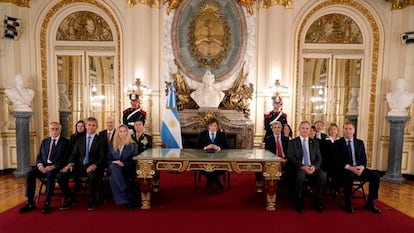
Knowledge about the islands is rarely firsthand. Fewer than 1% of Argentines have visited the Falklands. The journey is very expensive, requires staying at least a week and accepting that your passport will be stamped. Yet they are an indispensable part of the historical construction of national identity. “In the 19th century, Argentina was a new country with many immigrants who spoke different languages, and education was crucial to creating a common identity. The Falklands were part of that narrative,” Cassese says. Others, like Guber, believe the school’s role was lesser than often claimed, even minimal.
Experts speak of the Falklands as a symbol, a place of mourning and an open wound. But the islands are also one of the few points of unity in a society split in two. That unity has made them politically useful on numerous occasions. Milei took advantage of a remark by Donald Trump that hinted the United States might revisit its historic neutrality in the sovereignty dispute over the islands to defend, on national television, the statement “the Falklands are Argentine.” In his speech, which ended with “viva la patria” (long live the homeland), he announced sanctions against companies operating in the area without Argentine authorization and promised to build a military base in the south.
Given that a 2011 law already imposes those sanctions and that construction of the announced base had already begun before he halted it, the opposition accused him of opportunism and of “galtierizing” the cause, in reference to the former dictator. The La Plata Veterans’ Center (CECIM) branded Milei a hypocrite and criticized his use of the Falklands as a “life preserver to hide his miseries.”
Cassese, by contrast, argues that “for Milei embracing the Falklands cause is all gain” and notes that with it he shields “one of his weak flanks; the accusation of being a sellout,” since he has tried to reform the law that caps foreign ownership of land.
Argentina’s foreign policy on the Falklands has swung for decades between confrontation and attempts at rapprochement. Altieri believes Milei has so far chosen the cooperative line, like Mauricio Macri before him. In 2025, Milei expressed support for self-determination for the Falkland Islanders: “We hope that the Malvinas people will one day decide to vote with their feet for us. That is why we seek to make Argentina such a power that they will prefer to be Argentines.” By contrast, his televised speech on Thursday “was a 180-degree turn,” says Altieri.
While Milei’s economic course divides society, “the announcement of sanctions, of imposing costs on the British, generates a lot of support; the majority agree that that is what must be done,” Altieri adds. In his third year in office, Milei has just discovered the power of a flag that transcends the divide.
Sign up for our weekly newsletter to get more English-language news coverage from EL PAÍS USA Edition
Arthur C. Clarke
Héctor Socas, Astrophysicist: ‘If A More Advanced Civilization Contacted Us, They Should Be More Afraid Of Us Than We Are Of Them’

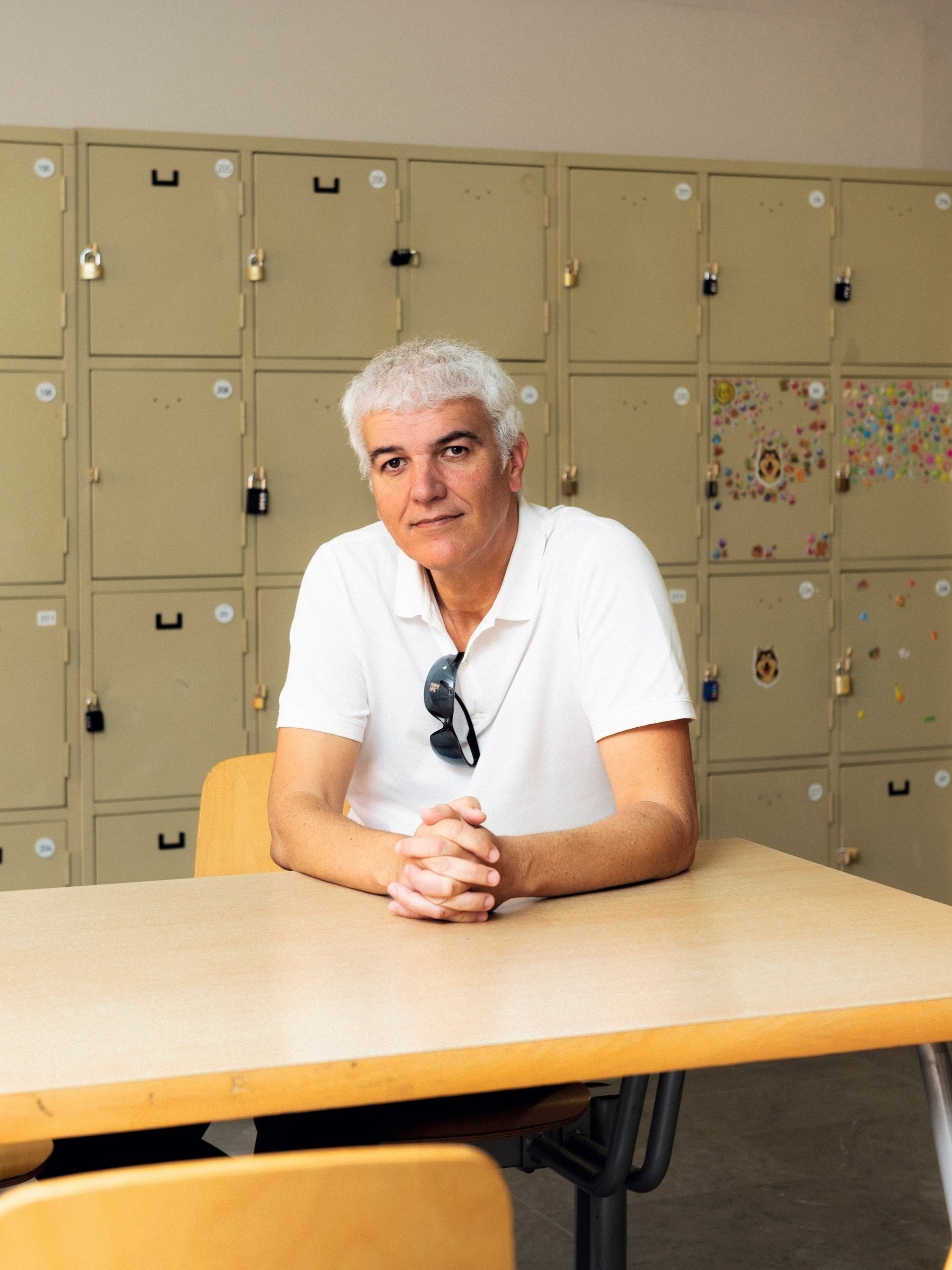
Classes are over at Madrid’s Complutense University, and the corridors of the Faculty of Physical Sciences are nearly empty. But Héctor Socas, 53, a researcher at Spain’s Institute of Astrophysics of the Canary Islands, is spending part of an early summer morning in a meeting of the international AtLAST consortium, which is promoting the construction of a major radio telescope in Chile. Socas also directs the European Solar Telescope Foundation, one of Spain’s most ambitious astronomy projects.
One of his main research interests is solar physics: he wants to learn how to predict solar storms — whose effects on satellites, GPS systems and electronics could be “potentially catastrophic” — “a few days in advance, just as we do with terrestrial weather.” But he also finds time for what he calls “the archaeology of the Sun and the planets,” searching alongside his IAC colleague Ignacio Trujillo for the hypothetical Planet Nine, whose elusive discovery, he says, “would help us understand how the Solar System was formed.”
On an early June morning, sunlight filters through the leaves in the garden opposite the faculty building as birds chirp overhead. Everything seems to invite optimism, much like his book Horizontes de la civilización (Horizons of Civilization), which swims against the current of prevailing pessimism from its very subtitle: An Optimistic Look at the Future of Our Species.
For this affable science communicator, optimism means recognizing that we still have time to shape our own destiny. Sitting on a stone bench, Socas speaks with EL PAÍS about a book that looks to the future while also journeying back to humanity’s origins. Or so we think because, as he points out, “time does not flow, we do.”
“We are at a moment when many doors are opening, and we have to decide which paths to take,” says the creator of Coffee Break: Señal y Ruido (Coffee Break: Signal and Noise), a weekly podcast on science and current affairs. And he is leaving none of those doors unexplored: autonomous artificial intelligence, the search for intelligent life, the meaning of work, planetary risks. All of it serves as a reminder that, to paraphrase Spider-Man, with greater power comes greater responsibility.
Question: Championing optimism can seem naïve to many people who believe the apocalypse is near.
Answer: Some people think it’s a long way off but say so pessimistically [laughs]. Pessimism is in fashion. We are obsessed with it, and that’s a mistake. First, because it isn’t true: we are living in the best period humanity has ever known. We have a psychological bias, understandable from an evolutionary perspective, that makes us pay more attention to bad news. But there is also a kind of intellectual pessimism that has taken hold. When I was young, I read stories that imagined extraordinary futures; now, almost everything is a dystopia. That shapes the collective psyche.
Not only is it incorrect, but it is also counterproductive, because we are on the verge of a collective depression. And the worst part is that, at a certain point, you no longer even want to be cured. I’m optimistic because another future is possible. There are many advances opening up new possibilities for a better world, but achieving it will require a great deal of effort. We are at a historic crossroads, and we cannot face it with apathy. We need enthusiasm.
Q. You open your book with a quotation suggesting that “the universe is not only queerer than we suppose, but queerer than we can suppose.” If, for instance, an ant were to walk beneath this bench right now, it would have no way of knowing that we are here having a conversation. What does that tell us about our own ability to understand the universe?
A. I really like that quote from John Haldane because it reflects an idea that is very present in science today: we have learned to be more humble. We may never fully comprehend the universe. It is possible that achieving that would require an intelligence different from or superior to ours, but we can continue to expand our knowledge and enjoy the pleasure of discovery. Human beings are explorers by nature; we like to learn and uncover new things. I champion science as a human pleasure as well as something that makes life better. In addition, it moves us away from the very human concepts of magic and superstition — the idea that we must do certain things to avoid punishment from some higher being. That more rational worldview makes us freer.
Q. Why did you become interested in science communication?
A. Because the science I consumed when I was young affected me deeply. It not only made me want to pursue science; it also shaped my personality and my way of seeing the world and life. We live in an era in which citizens need scientific literacy to take part in fundamental conversations, which is almost a moral obligation: the risks and opportunities of AI, ethical dilemmas, how to ensure progress leaves no one behind… Those debates require an informed society.
Q. Could an AI come to understand the universe better than we do?
A. Yes, it’s a possibility. You don’t even need singularity; reaching superhuman intelligence would be enough, which is perfectly feasible. It would be wonderful if it could help us understand the universe better, although we might never match its level of comprehension. Just as evolution produced a species with greater cognitive capacity than previous ones, it is possible that we are giving rise to other beings that have a deeper understanding of the universe than we do.
Q. And where would that leave us?
A. That’s a very recurring concern. Some fear that an AI will do literature, music or science better than we do. I stopped worrying about that long ago. There are already people far more intelligent than I am or who write better, and I don’t see that as a threat but as something to enjoy and learn from. Just as I don’t think that a more intelligent person would want to deceive me, I don’t believe a superior intelligence would necessarily become a problem or act malevolently simply because it is superior. Machines also don’t have motivations like power or money. Those stories belong more to science fiction. We train neural networks and AI systems to achieve the objectives we give them; not to self-preserve or destroy humanity.
Q. You explain that, for the first time in history, technological development is advancing faster than generational turnover. Are we prepared to manage that power responsibly?
A. We struggle to adapt to changes this rapid, especially as we age. We must rethink education so it becomes lifelong learning and find ways for older people not to be excluded. Climate change shows we have acquired enormous power to transform the planet and that we are now learning to assume that responsibility, but reversing a process more than a century in the making is like trying to stop a runaway train. Still, I see signs of progress. Today there is an environmental awareness that would have been unthinkable before. We are moving forward, though perhaps not as quickly as we need to.
Q. Speaking of education, you also question the idea of spending your whole life doing the same job.
A. Yes, we tend to understand work as the price we pay to enjoy the rest of life. But time is the most valuable thing we have. I am privileged because I enjoy my work, and I believe progress should lead humans to do increasingly human tasks — less repetitive and more creative— leaving the hardest, most dangerous or most boring jobs to machines. But the scenario in which we no longer need to work also comes with risks. Work gives us routine and purpose. If machines did everything for us, we would need to find new motivations: writing a book, discovering a planet, helping others… The future of work is doing something that fulfills you.
Q. But today work also defines our identity.
A. I think a further step in the evolution of our social model would be to reach a point where people are no longer defined by how they make a living, but by what they choose to do. I find that a very appealing prospect. The risk is that, if we fail to find a sense of purpose, a society of abundance could also give rise to apathy or self-destructive behavior.
Q. What is the probability that we will survive our technological adolescence, this moment when our own development could end up destroying us?
A. We don’t have data to calculate that probability. We would need to find other civilizations because even discovering the remains of an extinct one would give us clues about how long a technological species can survive. Still, I am optimistic: if, as I explain in the book, we apply Gott’s argument [the Princeton astrophysics professor], with 95% probability, we have between 40,000 and 8 million years left on this planet. In other words, it looks like we will live for thousands of years, so I think we will make it.
Q. Of all possible apocalyptic scenarios, which one do you think is most plausible?
A. I don’t think the greatest danger is our disappearance, but rather the loss of our human identity. The worst future I can imagine is the one depicted in WALL·E: a society where everything is so taken care of that people live in a permanent vacation, no longer creating, investigating, helping others or pursuing new challenges. What worries me more is a humanity that has lost its sense of purpose.
Q. If we encounter extraterrestrial intelligence, would it be closer to E.T., Arrival or Mars Attacks!?
A. I would say Arrival or E.T. To start with, I very much doubt we would have physical contact: the distances between stars are enormous and a conversation by signals may not even be feasible. Beyond that, a civilization capable of establishing that contact would have had to overcome its own technological adolescence. It would be a society not only more advanced technologically but also socially.
Q. Should they therefore fear us more than we fear them?
A. Yes, the more advanced civilization should fear the less advanced one. History shows that as we progress, we tend to become more careful. Today, for example, we sterilize space probes to avoid contaminating other worlds. I don’t see the point of stories like Independence Day or V in which extraterrestrials come to invade us to steal our water, eat us or enslave us. A civilization so advanced would likely have those needs covered. The most logical motive would be curiosity to study us, just as we study a newly discovered species.
Q. You advocate moving toward global governance to face challenges such as climate change or the risk of an asteroid impact. Yet the world seems to be moving in the opposite direction.
A. I am not proposing abolishing nations. Just as there are different levels of government today — municipal, regional, state or European — I think there should also be planetary-level competencies. There are problems, such as pandemics, bioengineering and climate change, that can no longer be solved by a single country. But, like any deep transformation, it must start from society. First we must understand that there are problems requiring a global perspective; only then can we demand that institutions take action. You cannot impose a governance model from the top and expect it to endure. We must begin to think as citizens of the 21st century.
Q. You recall in the book that “we stand on the shoulders of giants.” What do you think Carl Sagan would say today about the horizons of civilization?
A. I like to think he would largely agree with what is said in the book. My way of understanding the world is heavily influenced by [Carl Sagan, [Isaac] Asimov and Arthur C. Clarke. Obviously, they wrote in the context of the Cold War and we are facing different challenges, but I believe the principles remain the same: a rational, humanist outlook open to the future.
Q. Would they also share that optimism about our species?
A. I have no doubt.
Sign up for our weekly newsletter to get more English-language news coverage from EL PAÍS USA Edition

British Couple On Holiday In Morocco Face Bizarre Roadside Encounter On Final Day

The Spanish City Where Britain Built A Neighbourhood, Started Football And Introduced Golf

Un Barcelona Muy Atlético Se Venga Del Valencia Y Accede A La Final De La Supercopa

EXPLAINER: Inside The Row Over The Right-Wing Mayor Of Madrid’s €6m Penthouse – And Why It Could Offer A Lifeline To Pedro Sanchez

Stylish 3-Bedroom Apartment With Panoramic Sea Views – Benalmádena
Ibiza council hits illegal tourist rental with €793,000 fine – but will the owner pay that much?


-
 Chamberi2 weeks ago
EXPLAINER: Inside The Row Over The Right-Wing Mayor Of Madrid’s €6m Penthouse – And Why It Could Offer A Lifeline To Pedro Sanchez
-
 New Developments2 weeks ago
Stylish 3-Bedroom Apartment With Panoramic Sea Views – Benalmádena
-
Holiday rentals1 week ago
Ibiza council hits illegal tourist rental with €793,000 fine – but will the owner pay that much?
-

 Energy efficiency & certificates1 week ago
94% Of Spanish Homes Are Energy Inefficient – Could Tighter Rules Be Coming?
-
bravery2 weeks ago
10-year-old jumps from burning French farmhouse, saves two dogs and teddy
-

 Uncategorized2 weeks ago
Max Verstappen hails
-

 Andalucia2 weeks ago
There’s One Chief Consultant Orthopaedic And Trauma Surgeon In Marbella You Can Trust Under The Knife
-
Affordable homes Spain2 weeks ago
Costa Blanca renters may be missing out on Spain’s new affordable homes