Argentina
Dinosaur Fossils, The Latest Obsession Of The Ultra-Rich: ‘Some Enjoy Knowing Only They Can Admire It’

“Look, with this I can solve the origin of vipers,” a European collector snapped at Argentine paleontologist Federico Agnolín a few years ago. Then he shut the drawer, consigning the fossil to darkness. “It was like a little blind viper, a creature that never saw the light of science. It’s a very complicated issue. I can’t say much more,” the scientist admits today.
This summer, The Guardian revealed that one of the most spectacular collections of Jurassic fossils in the United Kingdom had been sold to a museum in Abu Dhabi, a move British experts described as an irreparable loss for a country more used to seeing prized collections arrive on its shores than leave them. The 318 specimens assembled by a private fossil collector fetched “an eight-figure sum.”
Public fossil auctions, such as those regularly organized by Sotheby’s, are becoming increasingly common and lucrative. Prices have soared from the more than $8 million paid for Sue, the Tyrannosaurus Rex, in 1997 to the more than $50.1 million spent this year on Gus, another specimen of the species, in a bidding war that lasted barely 10 minutes. High-profile actors have bought dinosaurs of their own, including Leonardo DiCaprio, Russell Crowe and Nicolas Cage. Cage was forced to return a Tarbosaurus skull for which he had paid $276,000 after it emerged that it had been looted from Mongolia. The fossil craze can lead to dubious acquisitions, even when everything initially appears legal.
“A fossil is priceless because it is a unique item created by nature. Its value is exclusively scientific,” Agnolín argues. “There are collectors, people with a lot of money who don’t know what to do with it and devote themselves to collecting fossils. We cannot allow humanity to be deprived of knowledge simply because someone likes a piece and wants it on their windowsill. And that happens a lot.”
Agnolín has come across scenes like the one with the blind viper many times and is convinced that fossils have become the latest trophy for the wealthy. “Collectors seek out the unusual. I know that world very well. There’s the guy who has the Tyrannosaurus rex, who wants to show it off to his friends, and there’s the guy who has a new species — one not yet classified by science — who takes pleasure in knowing that only he can admire it, even though that specimen might solve an important scientific problem.”

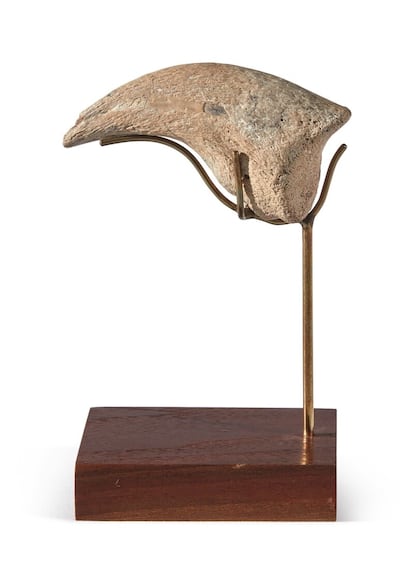
That lies at the heart of the controversy. As multimillionaires pour money into fossils, scientists worry that the trend could hinder research.
Legal grey areas
In many places where the fossil trade is legal, owners are under no obligation to inform scientific institutions about specimens they acquire, even though it is their scientific value that makes them important in the first place. Without the technical knowledge attached to them, any fossil would be little more than a bone or an oddly shaped rock.
The fossil market is legal in the United States and in parts of Europe, although regulations vary considerably depending on the jurisdiction and the type of land where a specimen was found. In Spain and Latin America, by contrast, such transactions are generally prohibited, and fossil discoveries are considered part of the national heritage. With no international framework establishing even minimum rules for the trade, collectors can exploit legal grey areas while traffickers take advantage of the differences between national laws.
“Often those legal gray areas are used to carry out what is known as huaquerismo, which is the extraction of archaeological or paleontological remains to take them out of the country,” warns paleontologist Horacio Padula, deputy manager in the Buenos Aires City Heritage Directorate and one of the architects of Argentina’s 2003 reform of its Archaeological and Paleontological Heritage Protection Law. “I have seen it, as many people have; there used to be a market selling fossils at the door of the Natural Sciences Museum,” Padula recalls.
Selling an Argentine fossil abroad is illegal, but selling a U.S. one is not. “These countries — where the fossil trade is lawful — have a different policy. What the state cannot or does not want to protect becomes appropriable,” says María Luz Endere, a PhD in archaeology and researcher specializing in cultural heritage law and management. “That is where speculation comes in, because it’s a form of investment, like buying art. You can buy a dinosaur as an investment,” she compares.
“How do you legislate to decide that fossils can be bought, but only those irrelevant to science? How do you know which one won’t solve a scientific puzzle?” Agnolín asks. “Once we went to study material in Germany, which is the great repository for fossils from the rest of the world, and there was a feathered dinosaur from China that had a sternum like a chicken’s. It’s the bone that allows birds to open their wings to fly. It was the perfect transition between a dinosaur and a bird. It had been bought illegally,” he remembers, still outraged.
The long tradition of trading prehistory
In the English-speaking world, the buying and selling of prehistoric specimens is not only legal but an old tradition. The Tucson Gem and Mineral Show in Arizona has been running for more than 70 years and is the world’s most important event of its kind. Thousands of exhibitors offer minerals, gemstones and fossils.
Fossil trading has always been legal in the United Kingdom. It was in this context that pioneers such as Mary Anning emerged, making a living and earning fame by selling the fossils she discovered along the coast of Lyme Regis. Today, there are numerous fossil shops and preparation workshops, where specimens are meticulously cleaned and restored.
On sites such as Dorset’s Jurassic Coast, collectors follow a general code of conduct that distinguishes between two categories of fossils: those of high scientific importance and those of more limited significance. Only the former, including potentially new species, rare finds or exceptionally well-preserved specimens, must be formally reported and recorded.
But even Britain can no longer keep such treasures at home: the fossils that ended up in Abu Dhabi made that journey because no British museum could afford to buy them. Hundreds of marine creatures, including ichthyosaurs and species that may yet prove new to science, were shipped to another continent.
For paleontologist Sebastián Apesteguía, the growing appetite of the wealthy for fossils reflects the return of a kind of imperial inequality. “It’s like a return to the Roman world, when the power gap between the rich and the plebeians was so great that they could afford to own impossible objects.”
The Inca Empire did something similar, he argues. “When Túpac Yupanqui sailed to Polynesia, he brought whale remains to keep in the palace, a brass chair and very dark-skinned slaves. He brought them as trophies to display objects from other parts of the world,” says Apesteguía, who also studies the Indigenous peoples of the Americas.
In Agnolín’s view, permissive legislation is perfect for plundering nations. “They’re tailor-made for them, because they need to allow the entry of fossils from other countries,” he argues.
What underlies the trend, the Argentine scientist believes, is a troubling idea: that money can buy anything and satisfy every whim. “Increasingly, real-world villains resemble those from comic books, who think they can achieve eternal life,” he says. “This madness happening with fossils is part of that — it’s the work of villains who seem straight out of Batman. States should put a stop to it. This is about understanding the history of life on Earth, and that belongs to humanity.”
The price of history
- Gus, the T. rex. Sold in July of this year by auction house Sotheby’s in New York for $50.1 million in 10 minutes. It is one of the most complete Tyrannosaurus rex skeletons.
- Ceratosaurus nasicornis. Sold in 2025 for $30.5 million by Sotheby’s. It is 150 million years old. Only four exist in the world. The one sold is the only juvenile specimen. It belonged to the Museum of Ancient Life in Utah, United States. The anonymous buyer promised to loan it to another institution for continued display, but its whereabouts remain undisclosed. A meteorite was also sold at the same auction.
- Apex, the stegosaurus. Sold in 2024 for $44.6 million to financier Ken Griffin. The magnate loaned it to the American Museum of Natural History, where it can be seen through 2028. It was discovered in 2022, and there are 80 specimens worldwide. Apex is one of the most complete skeletons. Griffin pledged to fund research that could yield more details about its species, growth, metabolism and skeletal development.
- Stan, the T. rex. Sold in 2020 for $31,847,500 to an anonymous buyer in a virtual auction alongside works of art in the U.S. It was missing for two years until the Abu Dhabi Natural History Museum, which opened in late 2025, announced it would be exhibited there. The 67‑million‑year‑old specimen was discovered in 1987 in South Dakota’s Hell Creek Formation and is one of the most complete T. rex skeletons ever found. It is, to date, the most expensive fossil in history.
- Allosaurus and Diplodocus skeletons. Sold in 2018 by Binoche et Giquello in Paris for €1.15 million ($1.33 million) and €1.18 million ($1.36 million), respectively.
- Triceratops skull, sold in 2017 (also in Paris) for €177,800 ($205,000) to a Chinese multimillionaire who owns a hotel chain.
- Allosaurus and a Siberian mammoth. Sold in 2016 and 2017 by auction house Aguttes for more than €1.1 million ($1.27 million) and €548,000 ($632,000), respectively.
- Tarbosaurus skull. The 67‑million‑year‑old fossil, from a close relative of T. rex, was purchased by Nicolas Cage in 2007 for $276,000. He was later forced to return it after investigators determined it had been illegally smuggled out of Mongolia, highlighting the risks and legal ambiguities that can accompany the booming fossil trade.
- Sue, the T. rex. Sold in 1997 for $8.3 million to the Field Museum in Chicago.
Sign up for our weekly newsletter to get more English-language news coverage from EL PAÍS USA Edition