
Argentina
Dinosaur Fossils, The Latest Obsession Of The Ultra-Rich: ‘Some Enjoy Knowing Only They Can Admire It’

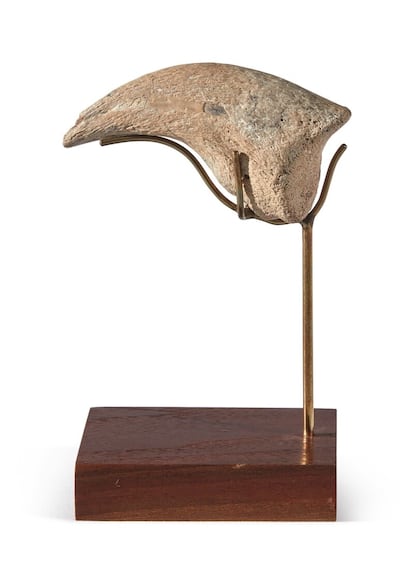
“Look, with this I can solve the origin of vipers,” a European collector snapped at Argentine paleontologist Federico Agnolín a few years ago. Then he shut the drawer, consigning the fossil to darkness. “It was like a little blind viper, a creature that never saw the light of science. It’s a very complicated issue. I can’t say much more,” the scientist admits today.
This summer, The Guardian revealed that one of the most spectacular collections of Jurassic fossils in the United Kingdom had been sold to a museum in Abu Dhabi, a move British experts described as an irreparable loss for a country more used to seeing prized collections arrive on its shores than leave them. The 318 specimens assembled by a private fossil collector fetched “an eight-figure sum.”
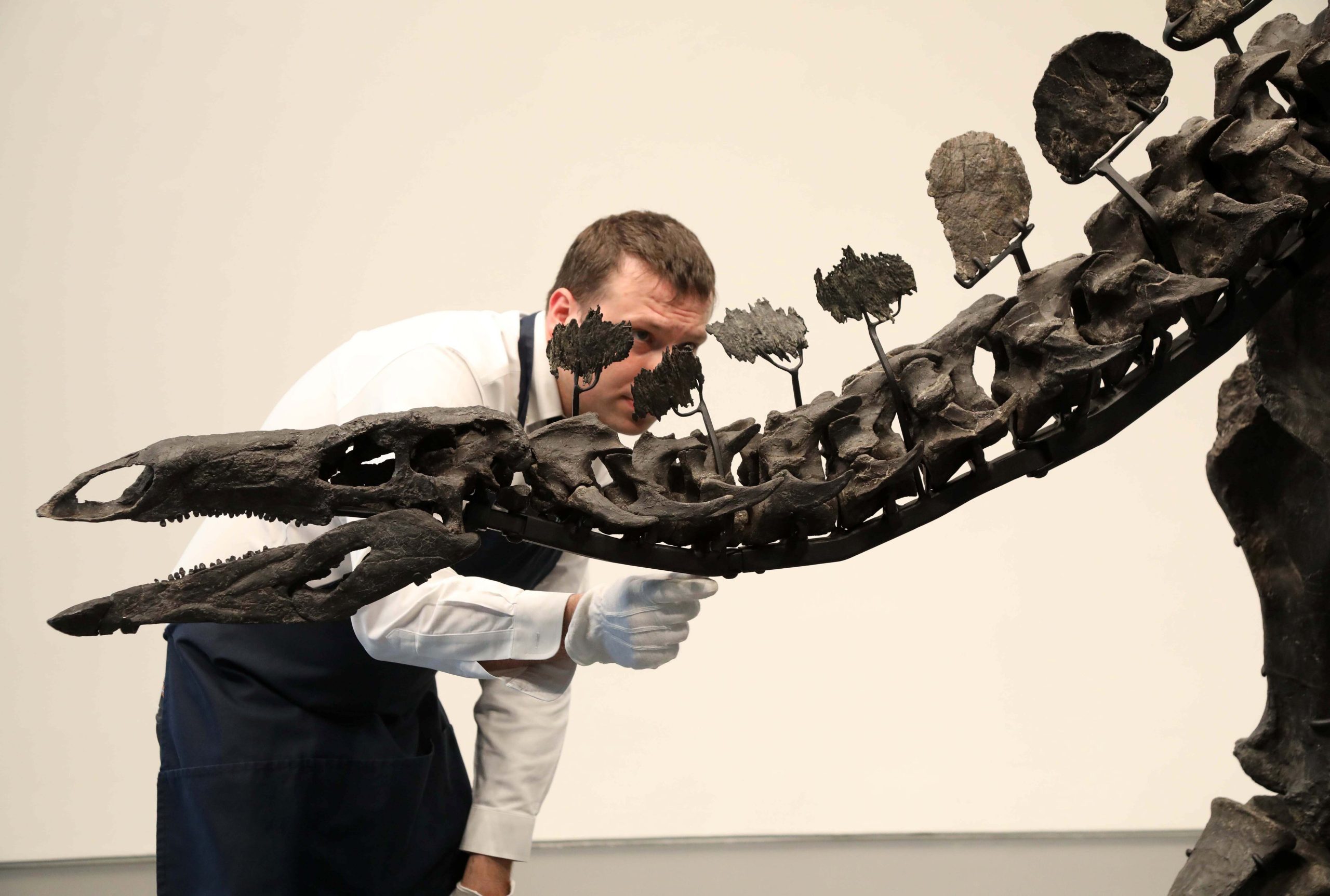
Public fossil auctions, such as those regularly organized by Sotheby’s, are becoming increasingly common and lucrative. Prices have soared from the more than $8 million paid for Sue, the Tyrannosaurus Rex, in 1997 to the more than $50.1 million spent this year on Gus, another specimen of the species, in a bidding war that lasted barely 10 minutes. High-profile actors have bought dinosaurs of their own, including Leonardo DiCaprio, Russell Crowe and Nicolas Cage. Cage was forced to return a Tarbosaurus skull for which he had paid $276,000 after it emerged that it had been looted from Mongolia. The fossil craze can lead to dubious acquisitions, even when everything initially appears legal.
“A fossil is priceless because it is a unique item created by nature. Its value is exclusively scientific,” Agnolín argues. “There are collectors, people with a lot of money who don’t know what to do with it and devote themselves to collecting fossils. We cannot allow humanity to be deprived of knowledge simply because someone likes a piece and wants it on their windowsill. And that happens a lot.”
Agnolín has come across scenes like the one with the blind viper many times and is convinced that fossils have become the latest trophy for the wealthy. “Collectors seek out the unusual. I know that world very well. There’s the guy who has the Tyrannosaurus rex, who wants to show it off to his friends, and there’s the guy who has a new species — one not yet classified by science — who takes pleasure in knowing that only he can admire it, even though that specimen might solve an important scientific problem.”
That lies at the heart of the controversy. As multimillionaires pour money into fossils, scientists worry that the trend could hinder research.
Legal grey areas
In many places where the fossil trade is legal, owners are under no obligation to inform scientific institutions about specimens they acquire, even though it is their scientific value that makes them important in the first place. Without the technical knowledge attached to them, any fossil would be little more than a bone or an oddly shaped rock.
The fossil market is legal in the United States and in parts of Europe, although regulations vary considerably depending on the jurisdiction and the type of land where a specimen was found. In Spain and Latin America, by contrast, such transactions are generally prohibited, and fossil discoveries are considered part of the national heritage. With no international framework establishing even minimum rules for the trade, collectors can exploit legal grey areas while traffickers take advantage of the differences between national laws.
“Often those legal gray areas are used to carry out what is known as huaquerismo, which is the extraction of archaeological or paleontological remains to take them out of the country,” warns paleontologist Horacio Padula, deputy manager in the Buenos Aires City Heritage Directorate and one of the architects of Argentina’s 2003 reform of its Archaeological and Paleontological Heritage Protection Law. “I have seen it, as many people have; there used to be a market selling fossils at the door of the Natural Sciences Museum,” Padula recalls.
Selling an Argentine fossil abroad is illegal, but selling a U.S. one is not. “These countries — where the fossil trade is lawful — have a different policy. What the state cannot or does not want to protect becomes appropriable,” says María Luz Endere, a PhD in archaeology and researcher specializing in cultural heritage law and management. “That is where speculation comes in, because it’s a form of investment, like buying art. You can buy a dinosaur as an investment,” she compares.
“How do you legislate to decide that fossils can be bought, but only those irrelevant to science? How do you know which one won’t solve a scientific puzzle?” Agnolín asks. “Once we went to study material in Germany, which is the great repository for fossils from the rest of the world, and there was a feathered dinosaur from China that had a sternum like a chicken’s. It’s the bone that allows birds to open their wings to fly. It was the perfect transition between a dinosaur and a bird. It had been bought illegally,” he remembers, still outraged.
The long tradition of trading prehistory
In the English-speaking world, the buying and selling of prehistoric specimens is not only legal but an old tradition. The Tucson Gem and Mineral Show in Arizona has been running for more than 70 years and is the world’s most important event of its kind. Thousands of exhibitors offer minerals, gemstones and fossils.
Fossil trading has always been legal in the United Kingdom. It was in this context that pioneers such as Mary Anning emerged, making a living and earning fame by selling the fossils she discovered along the coast of Lyme Regis. Today, there are numerous fossil shops and preparation workshops, where specimens are meticulously cleaned and restored.
On sites such as Dorset’s Jurassic Coast, collectors follow a general code of conduct that distinguishes between two categories of fossils: those of high scientific importance and those of more limited significance. Only the former, including potentially new species, rare finds or exceptionally well-preserved specimens, must be formally reported and recorded.
But even Britain can no longer keep such treasures at home: the fossils that ended up in Abu Dhabi made that journey because no British museum could afford to buy them. Hundreds of marine creatures, including ichthyosaurs and species that may yet prove new to science, were shipped to another continent.
For paleontologist Sebastián Apesteguía, the growing appetite of the wealthy for fossils reflects the return of a kind of imperial inequality. “It’s like a return to the Roman world, when the power gap between the rich and the plebeians was so great that they could afford to own impossible objects.”
The Inca Empire did something similar, he argues. “When Túpac Yupanqui sailed to Polynesia, he brought whale remains to keep in the palace, a brass chair and very dark-skinned slaves. He brought them as trophies to display objects from other parts of the world,” says Apesteguía, who also studies the Indigenous peoples of the Americas.
In Agnolín’s view, permissive legislation is perfect for plundering nations. “They’re tailor-made for them, because they need to allow the entry of fossils from other countries,” he argues.
What underlies the trend, the Argentine scientist believes, is a troubling idea: that money can buy anything and satisfy every whim. “Increasingly, real-world villains resemble those from comic books, who think they can achieve eternal life,” he says. “This madness happening with fossils is part of that — it’s the work of villains who seem straight out of Batman. States should put a stop to it. This is about understanding the history of life on Earth, and that belongs to humanity.”
The price of history
- Gus, the T. rex. Sold in July of this year by auction house Sotheby’s in New York for $50.1 million in 10 minutes. It is one of the most complete Tyrannosaurus rex skeletons.
- Ceratosaurus nasicornis. Sold in 2025 for $30.5 million by Sotheby’s. It is 150 million years old. Only four exist in the world. The one sold is the only juvenile specimen. It belonged to the Museum of Ancient Life in Utah, United States. The anonymous buyer promised to loan it to another institution for continued display, but its whereabouts remain undisclosed. A meteorite was also sold at the same auction.
- Apex, the stegosaurus. Sold in 2024 for $44.6 million to financier Ken Griffin. The magnate loaned it to the American Museum of Natural History, where it can be seen through 2028. It was discovered in 2022, and there are 80 specimens worldwide. Apex is one of the most complete skeletons. Griffin pledged to fund research that could yield more details about its species, growth, metabolism and skeletal development.
- Stan, the T. rex. Sold in 2020 for $31,847,500 to an anonymous buyer in a virtual auction alongside works of art in the U.S. It was missing for two years until the Abu Dhabi Natural History Museum, which opened in late 2025, announced it would be exhibited there. The 67‑million‑year‑old specimen was discovered in 1987 in South Dakota’s Hell Creek Formation and is one of the most complete T. rex skeletons ever found. It is, to date, the most expensive fossil in history.
- Allosaurus and Diplodocus skeletons. Sold in 2018 by Binoche et Giquello in Paris for €1.15 million ($1.33 million) and €1.18 million ($1.36 million), respectively.
- Triceratops skull, sold in 2017 (also in Paris) for €177,800 ($205,000) to a Chinese multimillionaire who owns a hotel chain.
- Allosaurus and a Siberian mammoth. Sold in 2016 and 2017 by auction house Aguttes for more than €1.1 million ($1.27 million) and €548,000 ($632,000), respectively.
- Tarbosaurus skull. The 67‑million‑year‑old fossil, from a close relative of T. rex, was purchased by Nicolas Cage in 2007 for $276,000. He was later forced to return it after investigators determined it had been illegally smuggled out of Mongolia, highlighting the risks and legal ambiguities that can accompany the booming fossil trade.
- Sue, the T. rex. Sold in 1997 for $8.3 million to the Field Museum in Chicago.
Sign up for our weekly newsletter to get more English-language news coverage from EL PAÍS USA Edition








The Argentine collective joy after winning the Qatar World Cup in 2022 was played out to a soundtrack that began like this: “In Argentina I was born, land of Diego and Lionel, of the lads from the Falklands I will never forget.” Four years later — in the attempt to win a fourth star in the tournament held in the U.S., Mexico and Canada — Messi, Maradona and the islands shared verses again in a new Argentine soccer anthem: “For the Falklands, for Diego, for Leo’s last one, Argentina, I want to see you two-time champion.”
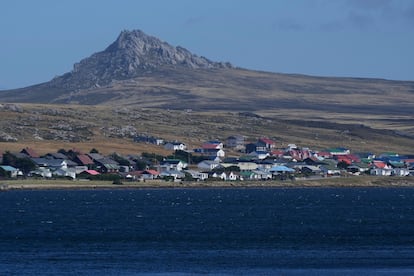
In Argentina, soccer and nationhood go hand-in-hand. There is no greater or more popular nationalist cause here than regaining the islands that have been a British Overseas Territory since 1833. The Falklands, which are known in Argentina as Las Malvinas, awaken a mix of pride, pain, and belonging, but they also create a consensus that turns them into a readily available political resource to shift attention when reality becomes uncomfortable, as Javier Milei has just done.
Why do the Falklands occupy a central place in the Argentine imagination? Some researchers say you must go back to Argentina’s founding narrative and its thwarted destiny — the story that nostalgically recalls that the country was once powerful and prosperous and then ceased to be.
“When Argentina emancipated itself from Spain, the Falklands were part of it and then they were stolen from us, and that ties into Argentina’s trauma — to what it could be and is not,” says political scientist Mariana Altieri, author of the book Malvinas y Gibraltar, conflictos atrincherados (The Falklands and Gibraltar: Long-Standing Conflicts). She recalls that from the start of the British occupation successive governments and major literary figures such as José Hernández, author of Martín Fierro, demanded Argentine sovereignty over the islands. “Those rights never expire,” Hernández wrote in 1869.
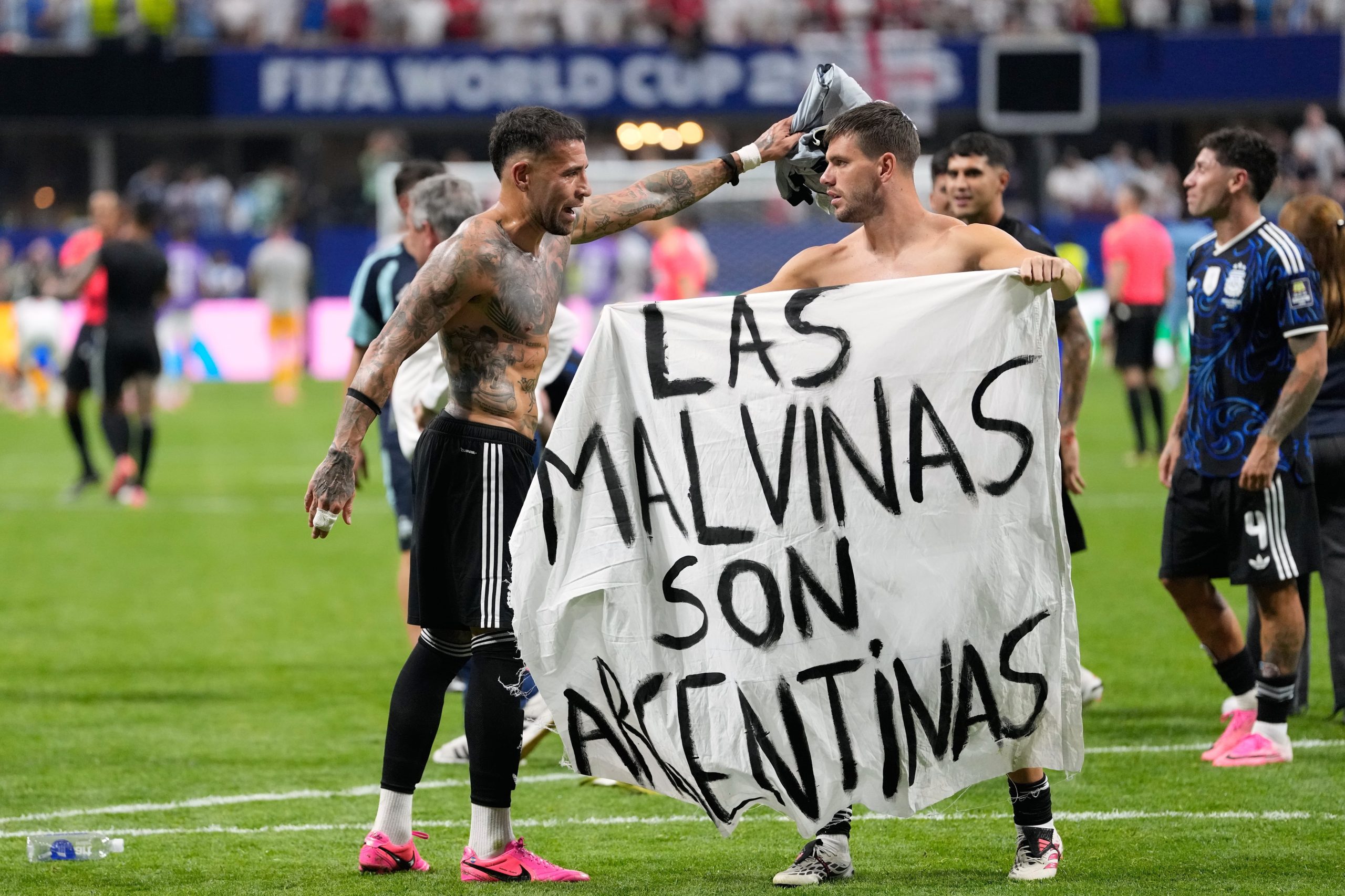
“The farther the idea of recovering them recedes, the more the logic of revenge grows,” Altieri continues, noting that soccer has been one of the arenas where that revenge has been possible symbolically. The most remembered instance came in 1986, only four years after the Falklands War, when Diego Armando Maradona scored one goal with his hand and another after dribbling past five English players and the goalkeeper in what was dubbed “the goal of the century.” The latest meeting, in 2026, in the World Cup semifinal, featured his heir, Lionel Messi, as captain of the Albiceleste in a comeback 2-1 victory. The euphoria that greeted the second goal in front of every television in Argentina increased at the end of the match, when some players unfurled a homemade flag on the pitch that read “Las Malvinas son argentinas” (The Falklands are Argentine). No one cared about the expected FIFA sanction.
Anthropologist Rosana Guber, one of the country’s leading specialists on the Falklands War, says it was “obvious” there would be some political claim during the match. “The players were a channel. The protagonist was a guy at the hotel who grabbed a sheet and painted the slogan on it. He was nobody. Or he was everyone. Because what he did was shout that we beat the British, that we have rights over the islands and that we must be recognized,” Guber says.
A professor and senior researcher at the National Scientific and Technical Research Council (CONICET), Guber believes that the feeling the Falklands provoke in Argentines can be understood if they are seen as a symbol. “A symbol like the flag, the national anthem, or the cross. And symbols have different meanings, not just one. They speak to people who can hold very different positions on everything. That was the point Milei appealed to the other day, saying: ‘On this we are all together.’ Just like in 1982,” she notes.
Of all its multiple meanings, Guber highlights three: the outstanding sovereignty issue that Great Britain refuses to negotiate with any Argentine government; the popular cause that claims the Falklands from soccer stands, parades, demonstrations and any other setting; and the 1982 war, to which the dictatorship sent thousands of conscripts aged 19 and 20 and which caused the deaths of 649 Argentine combatants and 255 British servicemen.
An omnipresent emblem
Historian Esteban Rodríguez lives in Río Grande, the city closest to the Falklands. It is less than 600 kilometers (370 miles) away, compared with the nearly 12,800 kilometers (7,950 miles) separating the islands from the British coast. The province that includes Río Grande, Argentina’s southernmost, is called Tierra del Fuego, Antarctica, and the South Atlantic Islands, and the outline of the islands appears on every Fuegian student uniform, on all of the local soccer clubs’ kits and on numerous murals and plaques. The provincial anthem is the March of the Malvinas. Children learn it from the moment they enter school: “Behind their misty quilt / We shall not forget them / The Argentine Falklands / Claims the wind and roars the sea.”
It is easy to understand why, Rodríguez says, because the Falklands are an inseparable part of Argentine identity, especially in the south. “We feel the Falklands as a loss and it is a loss that has been seared into us because we are reminded of it all the time,” the historian says. That feeling deepened after defeat in the war declared by the dictator Leopoldo Fortunato Galtieri.
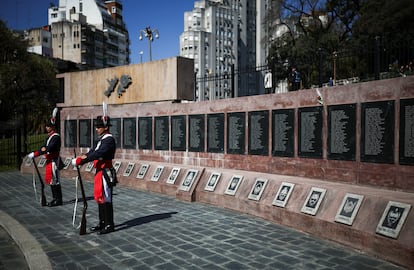
Río Grande was the main city in the conflict. Super Étendard jets took off from there to bomb British ships. After the defeat, every April 1, on the eve of the day the war began, a vigil is held to pay tribute to the fallen and keep the memory alive. The tribute continued despite the de-Falklandization policies imposed in the 1980s and 1990s, when veterans maintained the cause against the tide. Today, despite low temperatures and the nearly constant icy wind, “the vigil can bring together up to 20,000 people,” Rodríguez says.
Unknown islands
Journalist Nicolás Cassese has just published the novel Puerto Stanley, 1982 and has traveled to the Falklands three times as a reporter for the newspaper La Nación. He believes many Argentines know little about the islands beyond the dispossession in 1833 and the war a century and a half later: “The latest resurgence of Argentine nationalism rests on the triple M — Messi, Maradona and the Malvinas — but we have an enormous amount of information on the first two and almost nothing about the Falklands,” Cassese says.
As an example, he recalls that when he published the novel some friends asked about the title because they did not know what Puerto Stanley referred to and some even associated it with a well-known brand of thermoses. They were unaware that it is the name the British use for the largest town in the archipelago, Port Stanley, known on Argentine maps as Puerto Argentino. Although he was accused on social media of being a traitor, he explains that the town was founded in 1845, when the British already controlled the islands, and that Argentines themselves used that name for decades. Also little known are the strong cultural and commercial ties that once existed between the Falklands, Tierra del Fuego, and the far south of Chile. “The first sheep brought to Santa Cruz at the end of the 19th century came from the Falklands,” he says by way of example.
Knowledge about the islands is rarely firsthand. Fewer than 1% of Argentines have visited the Falklands. The journey is very expensive, requires staying at least a week and accepting that your passport will be stamped. Yet they are an indispensable part of the historical construction of national identity. “In the 19th century, Argentina was a new country with many immigrants who spoke different languages, and education was crucial to creating a common identity. The Falklands were part of that narrative,” Cassese says. Others, like Guber, believe the school’s role was lesser than often claimed, even minimal.
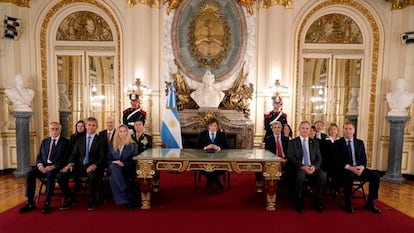
Experts speak of the Falklands as a symbol, a place of mourning and an open wound. But the islands are also one of the few points of unity in a society split in two. That unity has made them politically useful on numerous occasions. Milei took advantage of a remark by Donald Trump that hinted the United States might revisit its historic neutrality in the sovereignty dispute over the islands to defend, on national television, the statement “the Falklands are Argentine.” In his speech, which ended with “viva la patria” (long live the homeland), he announced sanctions against companies operating in the area without Argentine authorization and promised to build a military base in the south.
Given that a 2011 law already imposes those sanctions and that construction of the announced base had already begun before he halted it, the opposition accused him of opportunism and of “galtierizing” the cause, in reference to the former dictator. The La Plata Veterans’ Center (CECIM) branded Milei a hypocrite and criticized his use of the Falklands as a “life preserver to hide his miseries.”
Cassese, by contrast, argues that “for Milei embracing the Falklands cause is all gain” and notes that with it he shields “one of his weak flanks; the accusation of being a sellout,” since he has tried to reform the law that caps foreign ownership of land.
Argentina’s foreign policy on the Falklands has swung for decades between confrontation and attempts at rapprochement. Altieri believes Milei has so far chosen the cooperative line, like Mauricio Macri before him. In 2025, Milei expressed support for self-determination for the Falkland Islanders: “We hope that the Malvinas people will one day decide to vote with their feet for us. That is why we seek to make Argentina such a power that they will prefer to be Argentines.” By contrast, his televised speech on Thursday “was a 180-degree turn,” says Altieri.
While Milei’s economic course divides society, “the announcement of sanctions, of imposing costs on the British, generates a lot of support; the majority agree that that is what must be done,” Altieri adds. In his third year in office, Milei has just discovered the power of a flag that transcends the divide.
Sign up for our weekly newsletter to get more English-language news coverage from EL PAÍS USA Edition
America
Milei Celebra El Dato Más Bajo De Inflación De Argentina En Más De Un Año: 1,7% Mensual En Agosto


Ford issue official statement as Max Verstappen Le Mans rumours swirl

Opposition In Spain Vows To Bolt Country Shut

Stylish 3-Bedroom Apartment With Panoramic Sea Views – Benalmádena


-

 Uncategorized2 weeks ago
Max Verstappen hails
-
Holiday rentals1 week ago
Ibiza council hits illegal tourist rental with €793,000 fine – but will the owner pay that much?
-

 Energy efficiency & certificates1 week ago
94% Of Spanish Homes Are Energy Inefficient – Could Tighter Rules Be Coming?
-

 Andalucia2 weeks ago
There’s One Chief Consultant Orthopaedic And Trauma Surgeon In Marbella You Can Trust Under The Knife
-
easyJet1 week ago
146 slide off easyJet flight after powerbank fire at Milan airport
-
Affordable homes Spain2 weeks ago
Costa Blanca renters may be missing out on Spain’s new affordable homes
-

 Caitlin Clark2 weeks ago
Zhang Ziyu, The 2.23-Meter World Cup Sensation
-

 Alex Saab5 days ago
Maduro Ally Alex Saab Pleads Guilty In US Money-Laundering Case