Connect with us

%

Dirty Air And Hotter Weather Could Mean Higher Blood Sugar For You, Even Without Diabetes

Published

on

dirty-air-and-hotter-weather-could-mean-higher-blood-sugar-for-you,-even-without-diabetes

Dirty air and heat were linked to higher blood sugar, even in people without diabetes. Credit: Iren_Geo / Shutterstock

A large European study that included 5,464 volunteers from Cataluña has found that even people with no diabetes showed higher average blood sugar when they were exposed to dirtier air or hotter, more changeable temperatures.. The researchers stress that it shows a link between the two, but isn’t yet proof that one causes the other. 

The study looked at 21,259 people without diabetes

Researchers pooled data on 21,259 people across nine European cohorts, all of them without diabetes. Of those, 5,464 came from GCAT|Genomes for Life, a Catalan project run by the Germans Trias i Pujol Research Institute (IGTP).

The work was led by the Swiss Tropical and Public Health Institute and the University of Basel, and it was published in Environment International. IGTP, which took part, announced the findings on Wednesday October 21. 

The team looked at HbA1c, a blood test that shows average blood sugar over the previous two to three months, which is also one of the tests doctors use to diagnose diabetes. 

Dirty air and heat were both linked to higher blood sugar

Higher exposure to air pollution, particularly PM10 (tiny airborne particles that come from sources including traffic, industry and dust), was linked to higher HbA1c levels. Rising temperatures and bigger swings in temperature were linked to higher levels too.

Those findings might sound worrying, but the picture is a bit more complicated. Dirty air and hot weather didn’t seem to work on their own, as the researchers found that they affected each other. Living near parks and green spaces, on the other hand, made no consistent difference to blood sugar either way.

Cleaner air looked more valuable on hotter days 

Cleaner air appeared to bring a bigger benefit when it was hotter, according to the researchers. So cleaner air could be linked to lower blood sugar, while hotter weather and bigger swings in temperature could be linked to higher levels.

GCAT researcher and co-author Natàlia Blay said environmental exposures like air pollution and temperature shouldn’t be looked at on their own. Temperature, she added, is especially relevant in today’s changing climate.

Inflammation and insulin resistance may be behind it

Scientists think inflammation in the body and insulin resistance could help explain the link. However, the study didn’t directly examine how well the body’s insulin-producing cells were working, so that remains a theory.

The study also only shows an association, and it doesn’t conclude that pollution or temperature changes cause diabetes in people who don’t have it.

More research is needed to understand how the link works and how big it really is. In the meantime, anyone worried about their own blood sugar can ask their doctor about an HbA1c test.

%

Motril Goes Into Overdrive With More Than 400 Classics

Published

on

motril-goes-into-overdrive-with-more-than-400-classics

Classic car show. Credit: Magneto

A charity car gathering in Motril is set to bring more than 400 vehicles together, with the event raising funds to give disadvantaged children a summer break in 2027. It follows other charity car gatherings in Andalucia which have brought motoring enthusiasts together to support worthwhile causes.

The first Concentración Solidaria de Motril will take place at the town’s Recinto Ferial on Saturday, November 14. Organised by Mijitas Racing Club and charity INPAVI, the event is expected to attract classic cars, sports and rally vehicles, customised models, motorcycles and trucks. The region has previously hosted other charity classic car rallies in Spain, as well as popular classic car events in Malaga Province.

Fast and Furious “drift” event

Visitors will also be able to see cars inspired by the Fast & Furious films, while a drift zone is planned for controlled driving demonstrations. Entry for the public is free, making the gathering an option for motoring enthusiasts.

Money raised will support INPAVI’s Educa Vida summer camp, which provides activities and support for children from families facing financial difficulties. Motril Town Hall says the fundraising target is to provide places for 80 children in 2027.

The summer scheme gives children a safe and structured place to go when school closes. Activities include educational support, social activities and daily meals, helping families who may struggle to afford organised childcare and holiday activities. The University of Granada’s information about Educa Vida explains the programme’s educational and social objectives.

Raffle, competitions and foodtrucks

More than 50 volunteers from INPAVI teams in Motril, Granada and Malaga are expected to help run the event. A charity raffle will offer prizes worth more than €900, while children can enjoy bouncy castles, face painting, drawing and games.

Food stalls are also planned, with burgers, hot dogs, kebabs, baked potatoes, waffles and sweets available. Vehicle exhibitors will pay €15 to enter their cars or motorcycles, with seven categories of prizes due to be awarded at 4pm.

The gathering runs from 10am to 5pm at the Recinto Ferial. Motril’s official event announcement and the official tourism calendar provide further details for anyone planning to attend. Organisers hope the combination of unusual vehicles, family activities and fundraising will draw a large crowd and help give local children a summer experience they might otherwise miss.

Continue Reading

%

Salobreña Marches Against Cancer: Around 700 People Join First Colourful Charity Event

Published

on

salobrena-marches-against-cancer:-around-700-people-join-first-colourful-charity-event

Salobreña turns pink. Credit: Ayto

Around 700 people took to the streets of Salobreña on Sunday, November 8, to support the fight against cancer at the town’s first Salobreña en Marcha contra el Cáncer.

Organised by the local branch of the Spanish Association Against Cancer (AECC), the charity event brought together residents of all ages for a colourful show of community support.

Event a show of community support

Rather than being a competitive sporting event, the initiative was designed to encourage people to get involved, enjoy themselves and contribute to an important cause. Participants joined the colourful march, helping raise funds for the AECC’s work supporting people affected by cancer, as well as its prevention programmes and scientific research.

The association provides practical and emotional assistance to cancer patients and their families, including psychological support, social services and help with financial difficulties that can accompany treatment. Research funding is another important part of its work, helping scientists develop better ways to prevent, detect and treat the disease.

The impressive turnout was particularly encouraging given that this was the first edition of the Salobreña event. Organisers had hoped to bring the community together behind the cause, and the 700 participants demonstrated considerable local support.

Pink wave sweeps through Salobreña

The march had originally been planned for October 18 but was postponed because of the weather, eventually taking place on November 8. Similar initiatives have attracted strong support elsewhere in southern Spain, including the Mijas Marea Rosa walk and cancer awareness activities in Nerja.

Salobreña’s streets were filled with colour on Sunday, but the message behind the event was serious: cancer affects families across the community, and local support can make a meaningful difference.

Continue Reading

%

Deadly Fog Causes Bulgaria’s Largest Motorway Pile-Up As 86 Vehicles Crash, 12 Dead

Published

on

deadly-fog-causes-bulgaria’s-largest-motorway-pile-up-as-86-vehicles-crash,-12-dead

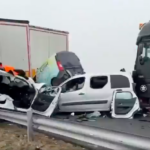
The collisions continued as vehicles approached the scene in poor visibility. Photo credit:@volkova_ma57183 on X

Thick fog can be every driver’s nightmare, but when it descends without warning, the danger is even greater. With visibility suddenly reduced to just a few metres, there may be no time to brake or avoid the traffic ahead. That is what happened on Bulgaria’s Trakia Motorway, where dozens vehicles were caught up in two devastating pile-ups.

The wreckage stretched across both carriageways of the motorway linking Sofia with the Black Sea port of Burgas. Cars and lorries were crushed together, emergency crews had to fight their way into the pile-ups, and the route was closed in both directions as rescuers worked to reach those trapped. 

Fog turns motorway into scene of mass collision

The first emergency call was received at around 7.10am local time on Tuesday, November 10. The crashes happened near the Zimnitsa junction in the Yambol region, in southeastern Bulgaria. A total of 86 vehicles were involved. Sixty-three were caught in the pile-up on the carriageway towards Burgas, while another 23 were involved in a separate collision on the opposite side, heading towards Sofia.

Officials said visibility had initially been between 70 and 80 metres before suddenly dropping to around 10 metres. The fog arrived quickly, leaving drivers with little warning of the stationary or slowing traffic ahead. The road surface was also wet, adding to the difficulty of stopping safely. 

First collision involved lorry and passenger bus

According to the initial account from the Interior Ministry, the first crash began on the Burgas-bound carriageway when a lorry blocked the path of a passenger bus. A second lorry, which was carrying grain, then became involved, followed by further vehicles crashing into the wreckage.

The collisions continued as vehicles approached the scene in poor visibility. A second chain-reaction crash developed on the opposite carriageway, where investigators believe some drivers may have become distracted by the disaster unfolding across the central reservation.

All the reported fatalities occurred on the side heading towards Burgas. Authorities have stressed that the precise causes are still being investigated, although the sudden fog, wet conditions and driving speeds unsuitable for the weather are among the factors being examined.

Drone footage reveals the horrifying scale of the tragedy on Bulgaria’s Trakia Motorway. Over 50 vehicles, including cars and trucks, were involved in the massive pile-up, leaving at least 12 people dead and dozens injured. One of Bulgaria’s deadliest road disasters. 😭 https://t.co/NfyVJyGotH

— една българка (@transbulgaria) November 10, 2026

Rescue teams work among wrecked vehicles

The scale of the crash required a major emergency operation. Police, firefighters and medical teams from neighbouring regions were sent to the scene, with 15 fire engines and hundreds of police officers involved in the response. Rescuers had to remove sections of the crash barriers to reach some of the injured. The fog also prevented helicopter evacuations, complicating efforts to move casualties quickly.

Injured people were taken to hospitals in Yambol, Sliven and Burgas, with several requiring intensive care and emergency surgery. The latest figures released on Tuesday afternoon put the death toll at 12, while around 50 people had been injured. Officials had warned earlier that the number of casualties could change as hospitals continued treating those involved. 

Bulgaria declares national day of mourning

Prime Minister Rumen Radev visited the scene and described the crashes as a tragedy for the country. The government announced that Wednesday, November 11, would be a national day of mourning for those who died.The scale of the disaster also disrupted official engagements. Radev cancelled scheduled events, while European Commission President Ursula von der Leyen, who was visiting Bulgaria, shortened her trip and expressed condolences to the victims and emergency crews. 

Two separate investigations have been opened because the crashes occurred on opposite carriageways. The National Investigation Service is expected to take over the enquiries, with investigators examining how the first collision developed and why the second pile-up followed.

The tragedy has also renewed questions about warnings for drivers in areas where fog regularly forms. Officials have raised the possibility of improving road markings and installing more reflective measures to make dangerous stretches easier to navigate when visibility deteriorates. For now, investigators must establish exactly how a sudden change in weather turned a busy motorway into Bulgaria’s worst multi-vehicle disasters.

Continue Reading

Trending

Copyright © 2017 Spanish Property & News