Connect with us

%

Fake Bank And Delivery Scam Texts Will Keep Hitting Phones In Spain This Summer

Published

on

fake-bank-and-delivery-scam-texts-will-keep-hitting-phones-in-spain-this-summer

A familiar-looking text can be all it takes for fraudsters to trick phone users into clicking. Credit: Tete_escape / Shutterstock

Fake bank and delivery scam texts will continue hitting phones across Spain this summer after the government delayed new anti fraud protections until September.

Millions of people in Spain receive suspicious text messages every year, often pretending to come from banks, parcel companies, tax offices or public services. Some are obvious scams. Others are convincing enough to catch people off guard during everyday situations like waiting for a delivery or checking a bank account.
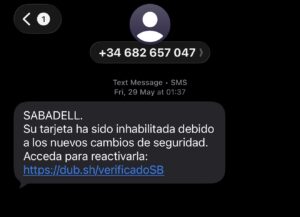
SMS scam
A standard fraudulent text message, received from a ‘supposed’ national bank.
Credit: Harry Dennis

The delayed system was supposed to block fraudulent messages using fake sender names pretending to come from trusted companies, banks and public bodies, making it harder for scammers to impersonate trusted organisations.

Why Spain delayed the new scam text protections until September

However, the start of the blocking obligation, which had been due to take effect on Sunday June 7, has now been delayed until Tuesday September 15, 2026, following changes published in the Boletin Oficial del Estado (BOE), Spain’s official state gazette.

That means scam messages using false or misleading sender names could remain a risk throughout the summer, at a time when people are regularly receiving texts about banking, parcel deliveries, medical appointments, travel bookings and official paperwork.

How Spain plans to stop fake bank and parcel scam texts

The rules focus on what Spain calls message “aliases”. These are the sender names that appear on a text message instead of a normal phone number, including names that may look like a bank, courier firm, public administration or private company.

Under the system, companies and public bodies using aliases must register them with tSpain’s National Commission on Markets and Competition (CNMC). Once the blocking rules take effect, operators involved in transmitting these messages will be required to block messages using aliases that are not in the official register, or that are sent through providers not authorised for that registered alias.

In simple terms, the system is designed to make it harder for fraudsters to send texts that appear to come from a trusted source.

Why Spain could remain exposed to scam tests all summer

The delay does not mean the anti-fraud plan has been scrapped. Instead, the official documents point to practical problems in getting the system ready.

The CNMC said more than 75,000 alias registration requests had been submitted in the first two months of the system, including both individual requests and bulk uploads from providers handling large volumes of sender names.

Operators also reported difficulties linked to digital certificates, especially for some companies or organisations outside the European Union that do not have an establishment or economic activity in Spain.

There were also concerns about the complexity of bulk registrations, the time needed to validate large volumes of aliases, and the risk that legitimate messages could be blocked if registration was not completed in time.

How to protect yourself from scam texts while the new system is delayed.

The change affects operators, messaging providers, companies and public administrations that send messages using aliases. Ordinary phone users do not need to change anything on their devices.

However, until the new blocks are in place, people should continue treating unexpected messages with caution, especially texts asking for payments, bank details, passwords, delivery fees, tax information or urgent identity checks.

Messages that appear to come from a known organisation should still be checked through official apps, secure websites or customer service numbers listed on the company’s own website, rather than through links included in the message.

Why a familiar sender name still cannot be trusted.

The delay gives operators and providers more time to adapt their systems, register aliases and test access to the official database before the blocking obligation starts, ensuring its functionality, efficiency and accuracy.

If the timetable holds, the new blocking system should begin on Tuesday September 15, 2026. Until then, the safest approach for consumers remains: do not trust a text message just because the sender name looks familiar.


%

€300m Superyacht Arrival In Puerto Banus

Published

on

e300m-superyacht-arrival-in-puerto-banus

Marbella has turned heads once again. Spotted off the coast of Puerto Banus, the magnificent 110-metre megayacht Kaos, owned by American billionaire Walmart heiress Nancy Walton Laurie, has drawn crowds of onlookers to the glamorous marinas, arriving in convoy with its 67-metre support vessel, Kalm.

A floating palace with Qatari royal origins

Kaos carries an eye-watering price tag of around €300 million, making it one of the most spectacular and valuable private vessels in international sailing. Originally built in the Netherlands by renowned shipyard Oceanco, the vessel was commissioned for the late Emir of Qatar, Sheikh Khalifa bin Hamad bin Abdullah Al Thani, before later passing into Walton Laurie’s hands.

Onboard services are designed to rival those of an ultra-luxury hotel, comfortably accommodating up to 31 guests across 15 premium cabins, including an exclusive master suite located on an entirely private deck. A dedicated crew of up to 45 professionals keeps things flawlessly running. World-class amenities include a fully equipped gymnasium, a luxury spa, a guest lift, an onboard cinema room, a certified helipad, and a private medical bay.

The optical illusion that stops people in their tracks

Much of Kaos’s fame rests on her extraordinary exterior, the work of Barcelona-based designer Igor Lobanov, who has said he “was allowed to do anything he wanted.” Cascading decks painted in different shades of blue evoke the waves of the sea, create an effect that tricks the eye into perceiving a far leaner silhouette than the vessel truly possesses. At the time of her delivery, she contained more marble and stone in her interior than any other superyacht ever recorded.

Following purchase, Walton Laurie, daughter of Walmart co-founder James “Bud” Walton and one of the world’s wealthiest women with a fortune estimated at around $10 billion, undertook a major refit in Hamburg. Over 1,500 square metres of interior spaces were redesigned, and the yacht was rechristened Kaos.

Meet Kalm, the vessel travelling in convoy

Accompanying Kaos on her Puerto Banus visit is Kalm, a 67-metre support vehicle valued at around $30 million. Carrying helicopters, tenders, jet skis, and all technical equipment required for operations at sea, Kalm ensures Kaos keeps its guest spaces completely uncluttered

Environmental scrutiny and a brush with eco-activists

Kaos has not always sailed in calm waters. Back in July 2023,she was targeted by eco-activists , defacing her hull with red and black spray paint in protest at the environmental impact of superyacht travel. During a previous stay in Spanish waters, Euro Weekly News reported on the massive strain the vessel placed on local infrastructure, revealing how the €300m superyacht drained immense amounts of electricity and shore power simply to keep its internal systems running while sitting idle at the dock in Malaga.

Puerto Banus still a magnet for the global elite

Every summer, the world’s most exclusive superyachts choose the famous port as one of their stops through Europe. Few destinations can match Marbella’s combination of glamour, infrastructure, and climate.

Continue Reading

%

British Man, 25, Dies After Hitting Rocks At Spanish Beach With No Lifeguard

Published

on

british-man,-25,-dies-after-hitting-rocks-at-spanish-beach-with-no-lifeguard

British man dies after hitting rocks while swimming in Mazarron. Photo Credit: Danipuntocom / Flickr

A young British man has passed away after smashing into rocks in the Spanish sea in the municipality of Mazarron, located in the southeastern region of Murcia. The man, 25, had gone into cardiac arrest after making impact with rocks on the Percheles Beach.

Horror incident in Spanish holiday hotspot

The tragic incident happened just after 4:00pm on the afternoon of Wednesday, June 10.  A spokesman for the local government-run emergency response coordination centre stated: “We received several 999 calls around 4:05pm yesterday afternoon reporting difficulties in getting a swimmer out of the water at Percheles Beach in Canada de Gallego, part of the municipality of Mazarron. […] According to the callers, two young English men reported that their companion had struck the rocks and was unconscious in the water.”

Emergency services race to the scene, but it is sadly too late for the young man

The young man had been holidaymaking in the popular Spanish town, and was swimming in the sea when the horror incident took place. Two of his companions drew attention to the accident, and locals managed to pull the man out of the water. Emergency responders, including the Guardia Civil, the Mazarron Local Police, the Mazarron Civil Protection, firefighters from the Murcia Region Fire and Rescue Consortium, and an ambulance from the 061 Emergency and Urgent Healthcare Service, raced to the scene. The health professionals present tried to revive him, using the CPR method as well as specialised resuscitation equipment, but they were unable to do so and the man was sadly pronounced dead.

A beach with no lifeguard: A striking and tragic reminder for holidaymakers in Spain

Questions are swirling as to the nature and safety of the beach in which the incident occurred, as well as the lack of a lifeguard on the beach. The beach in question is accessible by an unpaved road, and the closest town to the area is Cañada de Gallego.

The tragic incident has called attention to the importance of being safe while swimming at sea, particularly in secluded beaches. Beaches that do not have a lifeguard, nor access to quick emergency response in the case of an incident, should be avoided if holidaymakers want to swim.

Additionally, as peak season comes into full swing, holidaymakers and locals are reminded that the increase of alcohol consumption, late-night partying, and the holiday mindset could make accidents like these more likely, and that any tourist or resident should exercise caution when swimming, hiking, or doing any other physical activity that may result in injury, especially in low-light conditions or areas where help cannot arrive immediately.

Continue Reading

%

Dog Owners Risk €50,000 Fines In Spain For Exposing Pets To Scorching Summer Temperatures

Published

on

dog-owners-risk-e50,000-fines-in-spain-for-exposing-pets-to-scorching-summer-temperatures

If a dog begins showing signs of heatstroke it should be moved immediately to a shaded or cool location. Photo credit: Ezzolo/Shutterstock

As temperatures begin to soar across Spain, pet owners are being urged to take extra precautions when exercising their dogs. Under Spain’s Animal Welfare Law, owners have a legal responsibility to protect animals from conditions that could cause suffering or injury, with serious breaches carrying fines of up to €50,000.

The warning comes as veterinarians continue to highlight the dangers of heatstroke, dehydration and burns caused by hot pavements during the summer months. While many residents adjust their routines during periods of extreme heat, experts warn that dogs remain particularly vulnerable because they are less able to regulate their body temperature than humans.

Legal responsibility and potential penalties

Authorities may consider it a breach of an owner’s duty of care if a dog suffers harm as a result of being exposed to dangerous conditions, particularly if the animal develops heatstroke, dehydration or injuries caused by hot surfaces.

Under Spain’s animal welfare framework, serious infringements can carry fines ranging from €10,001 to €50,000. The severity of any penalty depends on the circumstances and the impact on the animal’s wellbeing.

Why hot weather can be dangerous for dogs

Unlike humans, dogs do not cool themselves efficiently through sweating. Instead, they primarily rely on panting and limited sweating through their paw pads.

During periods of extreme heat, dogs can quickly become overheated, especially when exercising, walking on hot surfaces or spending prolonged periods in direct sunlight. Certain breeds, including Bulldogs, Pugs and French Bulldogs, are particularly vulnerable because their shortened airways make cooling themselves more difficult.

Owners should also ensure that any muzzle used does not prevent panting, as this can increase the risk of overheating, particularly during hot weather.

Older dogs, puppies and animals with underlying health conditions also face an increased risk of heat-related illness. Heatstroke can develop rapidly, particularly during Spain’s summer heatwaves, making prevention essential.

How to keep your dog cool during Spain’s summer

Veterinary experts recommend walking dogs during the coolest parts of the day, ideally early in the morning or later in the evening when temperatures are lower. Strenuous exercise should be avoided during the hottest hours, typically between midday and late afternoon.

Owners should always carry fresh drinking water and offer it regularly during walks. Access to shade is equally important, particularly in urban areas where concrete and asphalt can reach extremely high temperatures.

A simple way to test whether the ground is too hot is to place the back of your hand on the pavement for several seconds. If it feels uncomfortable, it may also be hot enough to burn a dog’s paw pads.

At home, pets should have constant access to fresh water, shaded areas and adequate ventilation. Cooling mats, fans and damp towels can help reduce heat stress, while dogs should never be left unattended inside parked vehicles, where temperatures can rise to dangerous levels within minutes.

Recognising the signs of heatstroke

Heatstroke is a veterinary emergency that requires immediate attention. Early warning signs often include excessive panting, heavy drooling, restlessness and difficulty settling.

As the condition worsens, dogs may become anxious, weak, lethargic or disoriented. Other symptoms can include bright red gums or tongue, rapid breathing, vomiting, diarrhoea, excessive salivation, loss of coordination, collapse or unconsciousness.

Without prompt treatment, heatstroke can lead to organ failure and may prove fatal. For this reason, pet owners should act quickly if they suspect their dog is overheating.

What to do if you suspect heatstroke

If a dog begins showing signs of heatstroke, it should be moved immediately to a shaded or cool location. Small amounts of cool drinking water can be offered, but the animal should not be forced to drink.

Owners should begin lowering the dog’s temperature gradually using cool, rather than ice-cold, water. Wet towels can be applied to the neck, chest and abdomen to help reduce body temperature safely.

Veterinary attention should be sought as soon as possible, even if the dog appears to recover. Internal complications can develop after the initial symptoms have subsided and may not be immediately visible.

Questions and answers

Is it illegal to walk a dog in hot weather in Spain?

No. Spanish animal welfare law does not set a specific temperature at which walking a dog becomes illegal, including 40°C or above.

However, the law does require owners to avoid exposing animals to conditions that could cause suffering or injury. In extreme heat, this can include risks such as heatstroke, burns from hot asphalt, dehydration or collapse from overheating.

Whether an offence has occurred depends on the circumstances, including the time of day, duration of the walk, condition of the dog and whether reasonable precautions were taken.

Can someone really be fined €50,000?

Potentially, yes. Serious infringements under Spain’s Animal Welfare Law can carry fines of between €10,001 and €50,000 where negligence results in significant harm to an animal.

What is the safest time to walk a dog during summer?

Early morning and late evening are generally the safest times, when temperatures are lower and pavements are less likely to cause burns.

How can owners tell if the pavement is too hot?

A common guideline is to place the back of your hand on the surface for several seconds. If it feels uncomfortably hot, it may also be too hot for a dog’s paws.

What is the biggest danger during extreme heat?

Heatstroke is one of the most serious risks. It can develop rapidly and requires immediate action and veterinary treatment.

A reminder for pet owners

As Spain enters another summer of high temperatures, veterinarians and animal welfare organisations continue to stress the importance of prevention. While the law does not specifically ban dog walks during hot weather, owners are expected to act responsibly and avoid exposing animals to conditions that could jeopardise their health.

By adjusting walking times, providing plenty of water and recognising the signs of heatstroke, residents can help ensure their pets remain safe throughout the hottest months of the year while complying with their responsibilities under Spanish law.

Continue Reading

Trending

Copyright © 2017 Spanish Property & News