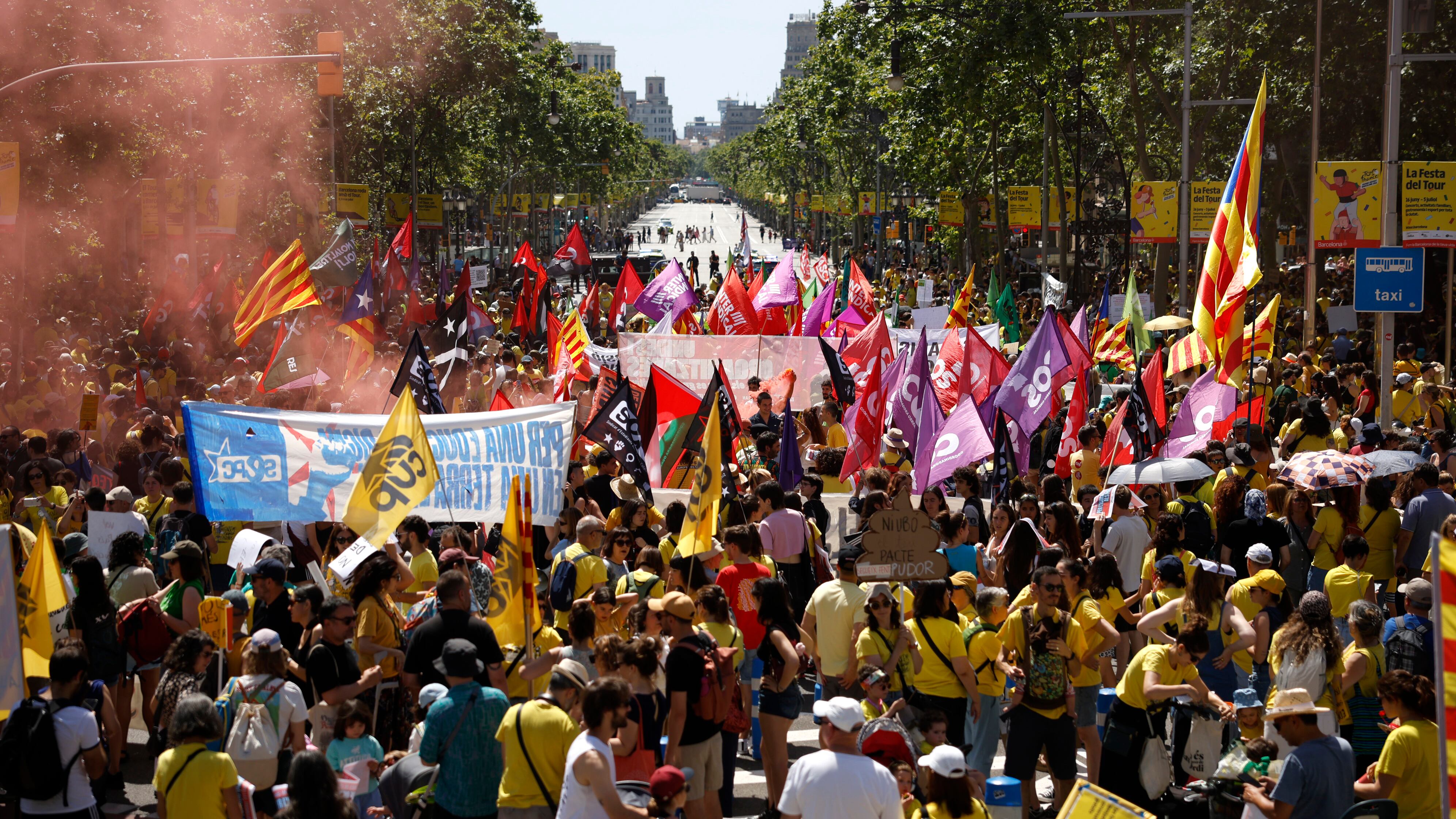
Pilot tests are being carried out in selected urban areas of Barcelona. Photo credit: Maryshot/Shutterstock
Have you ever wonder where all your olive pits go after having you tapa? I would of thought the bin, but since finding out that Barcelona is testing a new type of road surface that incorporates biochar made from agricultural waste, including olive pits, I now have my doubts!
The project is part of a municipal effort to reduce emissions from urban infrastructure and is being developed under the city’s “21st Century Street Section” programme, led by Barcelona City Council alongside BIT Habitat, BIMSA, the Polytechnic University of Cataluña (UPC), and private sector partners including ELSAN (OHLA) and AMSA.
The initiative is currently at pilot stage and is being assessed in real urban conditions. The material is not a replacement for traditional asphalt but an additive used within conventional mixtures. Olive pits, along with other organic waste such as pine residues, are processed into biochar through a high-temperature conversion process that stabilises carbon within a solid form. This biochar is then used to replace part of the mineral filler in asphalt.
How the material is made and used
Biochar is produced through the thermal treatment of biomass in low-oxygen conditions. In this case, feedstocks include olive stones and forestry by-products sourced from regional supply chains.
Once processed, the biochar is incorporated into asphalt mixtures as a partial substitute for conventional filler materials. According to technical documentation linked to the project, the aim is to maintain the structural performance of standard asphalt while altering its environmental footprint.
The trials are part of a broader effort to integrate circular economy principles into construction materials by reusing agricultural waste streams that would otherwise have limited industrial use.
Emissions reduction estimates
Project data from consortium partners and technical assessments indicate that replacing conventional filler materials with biochar could reduce the carbon footprint of asphalt production by around 75 to 76 per cent. These figures are based on modelling and controlled testing rather than long-term citywide deployment.
The reduction is attributed primarily to lower energy requirements in material processing and the ability of biochar to store carbon within the pavement structure.
The project also includes a monitoring phase to assess durability, mechanical strength, and performance under traffic loads, temperature variation, and rainfall. No decision has yet been made on large-scale adoption.
Where trials are taking place
Pilot tests are being carried out in selected urban areas of Barcelona, including sections of street infrastructure in the Eixample district. The sites are being used to evaluate real-world performance over time.
The programme is being coordinated through BIT Habitat and BIMSA, with funding support for prototype development and testing. The consortium includes engineering firms and academic partners responsible for materials design and evaluation. If successful, the approach could be expanded to additional roadworks across the city, although no implementation timeline has been confirmed.
What it could mean for residents
For people living in Barcelona, the introduction of biochar-based asphalt would not change how roads look or function in day-to-day use. The material is designed to perform similarly to conventional asphalt in terms of durability, grip, and weather resistance.
The main difference would be environmental. Road construction and resurfacing are energy-intensive processes, and the use of biochar is intended to reduce emissions associated with manufacturing materials used in those works.
Residents may see indirect effects over time if the technology is expanded, including lower environmental impact from ongoing maintenance cycles and infrastructure renewal programmes. However, any wider rollout would depend on the outcome of current testing phases.
Impact on visitors and tourism infrastructure
Barcelona, one of Europe’s most visited cities, experiences heavy pressure on its transport and pedestrian infrastructure due to high tourist numbers throughout the year.
For visitors, the immediate experience would not be affected, as the material does not alter road appearance or accessibility. However, if the system is adopted more widely, it could reduce emissions linked to frequent resurfacing works in busy tourist areas.
Construction activity is a constant feature in high-footfall districts such as the Eixample, Gothic Quarter edges, and coastal access routes. Materials that extend pavement lifespan or reduce maintenance emissions could potentially lessen the environmental footprint of this ongoing infrastructure work, although this remains under evaluation.
Research phase still ongoing
The project remains experimental, and authorities have stressed that no final decision has been made on scaling the material beyond pilot sites. Further testing is required to confirm long-term performance and cost-effectiveness compared with traditional asphalt.
Similar initiatives have previously tested recycled aggregates and alternative paving materials in Barcelona. At present, the olive pit biochar asphalt remains a controlled innovation project (and they are in the perfect country to give it a try), rather than an approved citywide policy. Its future will depend on the results of ongoing monitoring and technical validation.













 MOST people have been to the Sagrada Familia and Casa Batllo, but have you heard of these little-known Gaudi works? Every year, thousands of tourists flock to Barcelona to marvel

 WITH more than 12 million visitors last year, Barcelona’s tourism industry is going from strength to strength. While attractions such as Sagrada Familia and La Rambla remain at the heart



 %2 weeks ago
 Africa2 weeks ago
 Alberto Fujimori6 days ago
 %2 weeks ago
 Barcelona1 week ago
 Uncategorized1 week ago
 Brasil2 weeks ago