
Foreign demand
French Buyers Fall To Fourth Place In 2025



French demand for property in Spain slipped further down the rankings in 2025, falling behind the Dutch for the first time on record. Once one of the dominant buyer groups, the French now account for a steadily shrinking share of the foreign market.
For decades buyers from France were among the most important foreign purchasers of homes in Spain. Traditionally they ranked second only to buyers from the United Kingdom, forming one of the pillars of foreign demand.
That is no longer the case. In 2025 French buyers slipped to fourth place, overtaken by the Netherlands for the first time ever, according to the latest data from the Spanish Land Registrars’ Associatioin. The top positions are now held by the British, followed by buyers from Germany and the Dutch, with the French trailing behind.
French buyers acquired around 4,985 homes in Spain in 2025, a marginal year-on-year decline of just under 1%. While that might seem relatively stable in isolation, it masks a deeper shift: foreign demand overall grew by about 4.9% in the same period. In other words, French demand is losing ground relative to the rest of the international market.
The longer-term trend is even clearer. Since 2015, purchases by French buyers have grown modestly—reflected in a sales index of 121 compared to 208 for the foreign market as a whole. Their share of all foreign purchases has steadily declined, falling to around 5.1% in 2025, down from almost 8.8% at its peak.
From rich neighbours to relative parity
Historically, French buyers were drawn to Spain for a simple reason: it was cheaper. For decades the French crossed the border to buy second homes in places like Catalonia, where property offered better value than comparable homes in southern France.
But that economic logic has weakened.
In recent years Spain’s economy—particularly its housing market—has been comparatively dynamic, while France has struggled with sluggish growth and mounting structural challenges. The result is that French households no longer enjoy the same purchasing advantage they once had when buying property south of the border.
In some parts of Spain the price gap has narrowed dramatically, and in certain desirable areas the balance has even flipped. Spain is no longer simply the cheaper neighbour.
A different kind of French buyer emerging
That does not mean French demand will disappear altogether. What may emerge instead is a shift in the type of French buyer.
Rather than holiday-home purchasers, a growing number of French citizens appear to be relocating to Spain, particularly to cities such as Barcelona. Lifestyle appeal, climate, and professional opportunities are increasingly attracting French residents looking for a change of scenery.
However, this relocation trend is unlikely to compensate for the gradual decline in second-home demand. The traditional cross-border holiday-home market that once sustained strong French buying activity is simply not what it used to be.
For now, the numbers tell a clear story: French buyers remain an important presence in Spain’s property market, but their relative influence is slowly fading as new nationalities—especially the Dutch—move ahead in the rankings.







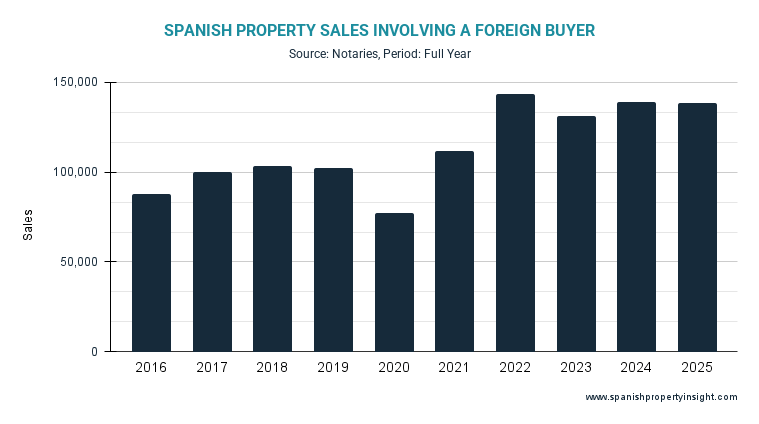
Heads-up: the latest figures from the Spanish Notaries’ Association have just landed, giving us the full picture of foreign demand for Spanish property in 2025—and the headline is a market that held steady overall but shifted beneath the surface.
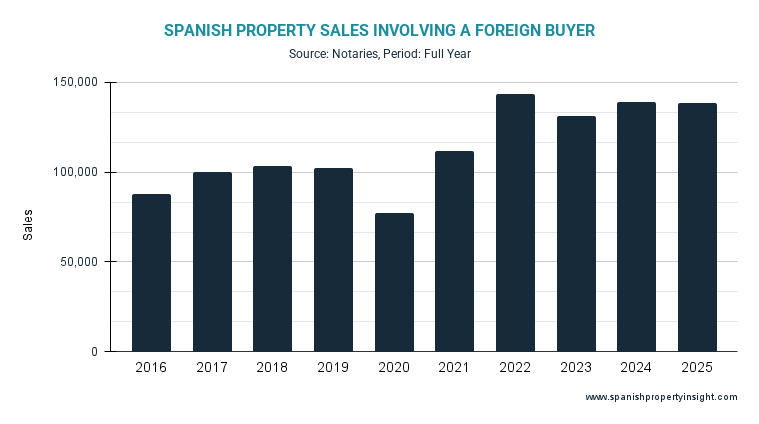
A total of 138,254 property purchases in Spain involved a foreign buyer in 2025, down just 0.6% compared to the previous year. In other words, foreign demand barely moved.
That stability looks more impressive when placed in context. Purchases involving foreign buyers remain around 22% above the ten-year average and almost 80% higher than five years ago—clear evidence of how much the international segment has expanded since the pandemic.
However, foreign demand lost some ground within the overall market. Spanish buyers increased their activity by 6.7% to 596,538 purchases, meaning the foreign market share slipped to 18.8%, down from 19.9% a year earlier. The foreign share remains well within the range seen over the last decade but clearly eased in 2025.
British still number one—but declining
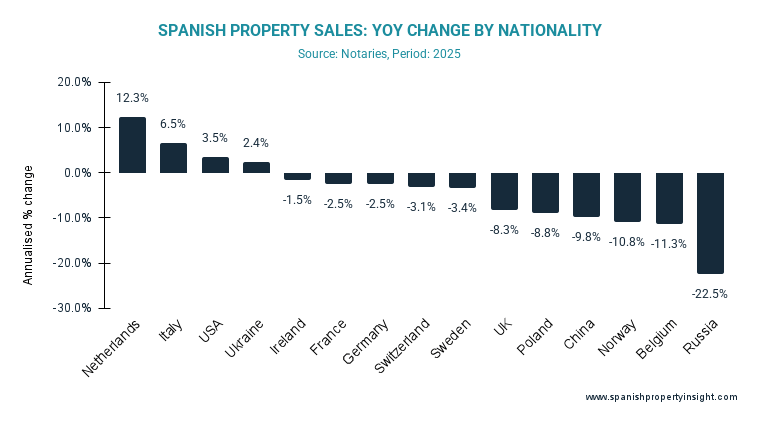
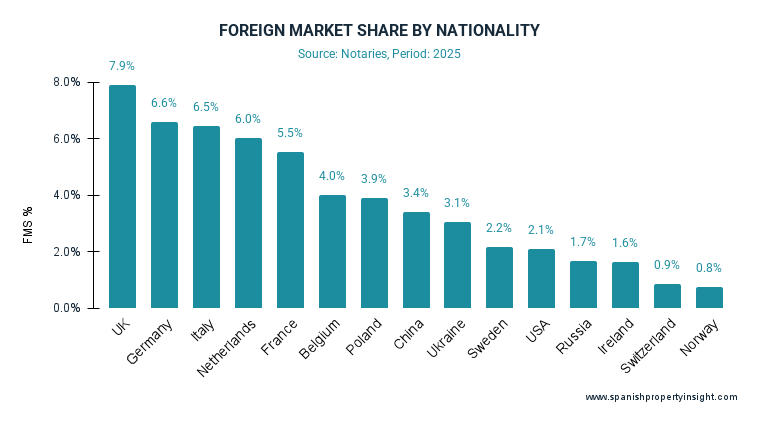
By nationality, the UK remains the biggest foreign market, with 10,925 purchases, though British demand fell by 8.3% year-on-year. Germans remained in second place with 9,126 purchases, also down slightly.
Italy moved into third place with 8,948 purchases after growing 6.5%, while Dutch buyers continued their impressive expansion, rising 12.3% to 8,354 transactions. The Netherlands is now one of the fastest-growing segments of the foreign market.
French buyers, historically one of Spain’s largest groups, declined slightly to 7,654 purchases.
Further down the ranking, several markets had a difficult year. Belgian demand fell by 11%, Polish demand dropped nearly 9%, and Chinese buyers declined almost 10%. Russian demand continued its long contraction, plunging 22%.
On the positive side, Portuguese buyers surged 20%, while Americans increased purchases by 3.5% and Ukrainians by 2.3%.
Valencian Region dominates the map as usual
By region, the Valencian Community remained the undisputed centre of foreign demand with 39,338 purchases—almost 29% of the entire foreign market—despite a 5% year-on-year decline.
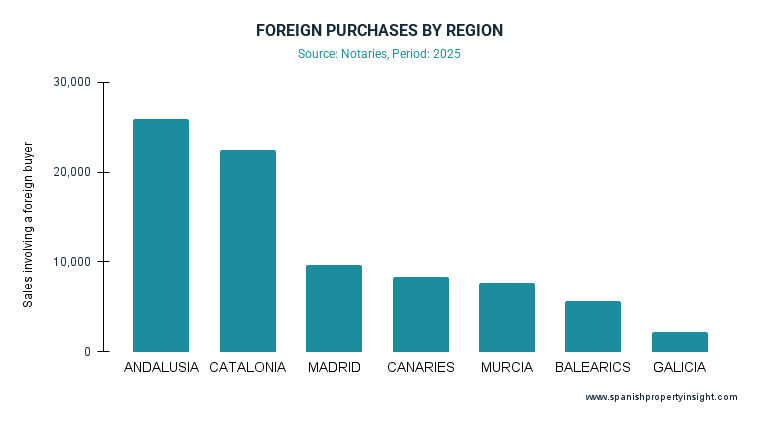
Andalusia came second with 25,947 purchases, and was one of the few large regions to grow, edging up 1.5%.
Catalonia also performed well, rising 4.3% to 22,465 purchases.
Elsewhere the picture was weaker. Madrid saw foreign purchases drop almost 9%, while both the Canary Islands and the Balearic Islands also recorded notable declines.
One small standout was Galicia, where foreign purchases jumped 12%, albeit from a relatively low base.
Momentum fading in the second half
Taken together, the latest figures suggest a foreign market that remains large and resilient but is clearly evolving. Demand is holding up overall, but growth is becoming more selective—both by nationality and by region.
However, the full-year numbers hide a weakening trend as the year progressed. Looking just at the second half of 2025, foreign purchases were down 4.4% year-on-year, with double-digit declines from several key markets including Belgium, the UK, Russia and China. Only a handful of countries—most notably Italy and the Netherlands—managed to record growth during this period.
In other words, the relatively solid annual result was flattered by a strong first half that offset a noticeably weaker second half. The momentum going into 2026 therefore appears to have been fading rather than strengthening.


A sudden drop in second-home buyers in 2025 is the kind of signal that makes vendors nervous—but what does it really mean if you’re trying to sell on the coast or islands?
The latest figures from Spain’s Housing Ministry show a near 10% fall in foreign non-resident (FNR) buyers in 2025—the lowest level in four years.
These are the classic holiday-home buyers from northern Europe, and for coastal and island markets they have long been the lifeblood of demand. So when their numbers fall, it naturally raises a concern: fewer buyers chasing properties like yours.
On the face of it, that suggests a softening market for second homes.
Context matters: the market is still strong
Before jumping to conclusions, it’s worth zooming out.
Total home sales reached 752,098 in 2025, up 5% year-on-year and well above the long-term average. Foreign buyers still purchased more than 126,000 homes, and demand remains structurally strong.
Even among FNRs, transactions are still above the ten-year average and significantly higher than pre-pandemic levels.
So this is not a collapse—it’s more a wobble.
A changing buyer mix
Another important shift is who is buying.
Foreign resident buyers—expats—actually increased their purchases and now make up the majority of foreign demand. But they tend to buy in different segments, often at lower price points and in different locations.
For sellers of coastal or island properties, that’s not a direct substitute for lost FNR demand. In other words, not all foreign buyers are interchangeable.
What’s behind the drop—and what comes next?
There are a few possible explanations for the dip in FNR demand.
Political messaging from the Spanish government about taxing or restricting non-EU buyers may have had a chilling effect, even if no concrete measures have been implemented.
At the same time, rising geopolitical uncertainty is likely prompting some investors to sit on their hands for now. From the war in Ukraine to renewed tensions around Trump and tariffs, ongoing conflict in the Middle East, and now what some are calling Gulf War III—too recent to appear in the data but almost certainly influencing behaviour today—there are plenty of reasons for caution. When the world feels unstable, discretionary purchases like holiday homes tend to be put on hold, at least in the short term.
In the short term, that likely means a “wait and see” mindset among some buyers.
Longer term, however, instability in competing destinations such as the Gulf could play to Spain’s advantage. For many buyers, Spain looks like a safer and more predictable place to park money and lifestyle.
So what should sellers do now?
If you’re trying to sell, the instinct might be to react—cut your asking price, rush to market, or change strategy.
The best advice right now? Don’t overreact.
It’s too early to say whether the dip in FNR demand is a temporary pause or the start of a trend. Markets rarely move in straight lines, and one year’s data doesn’t make a cycle.
Instead, focus on what you can control:
- Set realistic price expectations based on current demand
- Get your paperwork and due diligence in order
- Present your property properly
- Work with a competent agent who understands your segment
In a market with slightly fewer buyers, execution matters more than ever.
A window of opportunity for prepared sellers
There’s also a possible upside.
If some buyers are hesitating now—but expect competition to increase later (for example, due to geopolitical shifts)—they may choose to act sooner rather than later. That could create a window for well-prepared sellers to capture motivated demand.
The key is to be ready.
If you’re already selling—or thinking about it—now is the time to get your strategy, pricing, and paperwork lined up properly.
Thinking of selling a property in Spain?
I’m currently testing a new tool designed to help property owners prepare for sale and manage the process more effectively. It’s something I’ve been developing for readers of Spanish Property Insight, particularly those dealing with distinctive or hard-to-sell homes to help them navigate the Spanish sales process.
I’m looking for a small number of owners who may be planning to sell and would be interested in trying it out during the early testing phase.
If that might be you, leave your details below and I’ll get in touch.


A sudden drop in second-home buyers in 2025 is the kind of signal that makes vendors nervous—but what does it really mean if you’re trying to sell on the coast or islands?
The latest figures from Spain’s Housing Ministry show a near 10% fall in foreign non-resident (FNR) buyers in 2025—the lowest level in four years.
These are the classic holiday-home buyers from northern Europe, and for coastal and island markets they have long been the lifeblood of demand. So when their numbers fall, it naturally raises a concern: fewer buyers chasing properties like yours.
On the face of it, that suggests a softening market for second homes.
Context matters: the market is still strong
Before jumping to conclusions, it’s worth zooming out.
Total home sales reached 752,098 in 2025, up 5% year-on-year and well above the long-term average. Foreign buyers still purchased more than 126,000 homes, and demand remains structurally strong.
Even among FNRs, transactions are still above the ten-year average and significantly higher than pre-pandemic levels.
So this is not a collapse—it’s more a wobble.
A changing buyer mix
Another important shift is who is buying.
Foreign resident buyers—expats—actually increased their purchases and now make up the majority of foreign demand. But they tend to buy in different segments, often at lower price points and in different locations.
For sellers of coastal or island properties, that’s not a direct substitute for lost FNR demand. In other words, not all foreign buyers are interchangeable.
What’s behind the drop—and what comes next?
There are a few possible explanations for the dip in FNR demand.
Political messaging from the Spanish government about taxing or restricting non-EU buyers may have had a chilling effect, even if no concrete measures have been implemented.
At the same time, rising geopolitical uncertainty is likely prompting some investors to sit on their hands for now. From the war in Ukraine to renewed tensions around Trump and tariffs, ongoing conflict in the Middle East, and now what some are calling Gulf War III—too recent to appear in the data but almost certainly influencing behaviour today—there are plenty of reasons for caution. When the world feels unstable, discretionary purchases like holiday homes tend to be put on hold, at least in the short term.
In the short term, that likely means a “wait and see” mindset among some buyers.
Longer term, however, instability in competing destinations such as the Gulf could play to Spain’s advantage. For many buyers, Spain looks like a safer and more predictable place to park money and lifestyle.
So what should sellers do now?
If you’re trying to sell, the instinct might be to react—cut your asking price, rush to market, or change strategy.
The best advice right now? Don’t overreact.
It’s too early to say whether the dip in FNR demand is a temporary pause or the start of a trend. Markets rarely move in straight lines, and one year’s data doesn’t make a cycle.
Instead, focus on what you can control:
- Set realistic price expectations based on current demand
- Get your paperwork and due diligence in order
- Present your property properly
- Work with a competent agent who understands your segment
In a market with slightly fewer buyers, execution matters more than ever.
A window of opportunity for prepared sellers
There’s also a possible upside.
If some buyers are hesitating now—but expect competition to increase later (for example, due to geopolitical shifts)—they may choose to act sooner rather than later. That could create a window for well-prepared sellers to capture motivated demand.
The key is to be ready.
If you’re already selling—or thinking about it—now is the time to get your strategy, pricing, and paperwork lined up properly.
Thinking of selling a property in Spain?
I’m currently testing a new tool designed to help property owners prepare for sale and manage the process more effectively. It’s something I’ve been developing for readers of Spanish Property Insight, particularly those dealing with distinctive or hard-to-sell homes to help them navigate the Spanish sales process.
I’m looking for a small number of owners who may be planning to sell and would be interested in trying it out during the early testing phase.
If that might be you, leave your details below and I’ll get in touch.

Costa Del Sol Schoolboy Wows Britain’s Got Talent Judges

British Woman Stranded In Spain After Dual Passport Rule Shock

Here’s What Will Actually Happen To Your Kindle On May 20


-

 New Developments2 weeks ago
Luxury Villas For Sale, Estepona – ProjectL1
-

 New Developments4 weeks ago
How To Get A Tourist Rental Licence In Andalusia (Spain) – Step-By-Step Guide 2025
-

 New Developments2 weeks ago
Stylish 3-Bedroom Apartment With Panoramic Sea Views – Benalmádena
-

 Uncategorized4 weeks ago
Max Verstappen left laughing after Nurburgring triumph
-

 %2 weeks ago
Poland Disconnects Utilities At Russian Consulate That Moscow Refuses To Hand Over
-

 Uncategorized3 weeks ago
Lewis Hamilton goes from Karate Kid to Samurai Warrior with Kill Bill guru
-

 Uncategorized4 weeks ago
Max Verstappen team-mate sheds light on Nurburgring mistake
-

 Foreign demand4 weeks ago
Non-Resident Foreign Buyers Retreat Sharply In 2025