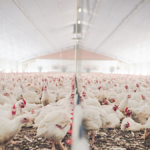
France poultry deaths expose the heat risk behind Europe’s food supply. Credit: PeopleImages / Shutterstock
Hundreds of thousands of poultry deaths in France have exposed how extreme heat is putting pressure on European farming systems, from animal housing and carcass disposal to milk output, harvests, farm workers and the food prices households may face this summer.
How poultry deaths in France exposed a bigger farming problem
Hundreds of thousands of poultry have died during France’s record-breaking heatwave, turning an extreme weather event into a warning about the pressure now facing European farms.
Reports confirm the losses have been concentrated in Brittany and Pays de la Loire, France’s two biggest poultry-producing regions, which together account for nearly 60 per cent of the country’s poultry flock. The French poultry industry group ANVOL described the losses as “massive”, while carcass collection services were reportedly overwhelmed.
That makes this more than an animal welfare story. It raises practical questions about whether barns are cool enough, whether farms have enough ventilation and water capacity, how many animals are kept in confined spaces, and what happens when large numbers die at once.
For households, the bigger issue is that extreme heat can disrupt the systems that keep meat, eggs, milk and crops moving through Europe’s food chain.
Why hot barns can become fatal faster than many realise
Poultry are particularly vulnerable to heat stress because birds do not cool themselves like people do. University of Minnesota Extension guidance says poultry heat stress can cause panting, higher water intake, reduced feed consumption and eventually death when core body temperature rises too far.
Ventilation is central. In a poultry shed, airflow at bird level helps remove heat. If a barn is naturally ventilated and the air is still, or if mechanical ventilation is not powerful enough for the number of birds inside, heat can build quickly.
Stocking density also matters. More birds in a warm building means more body heat, more pressure on water systems and less room for animals to move away from hot spots. Outdoor and indoor systems can both be exposed when temperatures push towards 40C and nights stay warm.
Times like these are when we’re reinforced with just how extremely necessary these climate adaptations are. Better insulation, shade, backup power, misting systems, emergency fans, cooler water and adjusted feeding schedules are no longer optional upgrades in the hottest periods. They are becoming part of whether farms can keep animals alive.
Why dead animals can create a second crisis for farms
The French case has also exposed a less visible weak point: carcass disposal.
Dead farm animals are normally collected and treated through regulated animal by-product systems. European Union rules exist because carcasses can create disease, environmental and biosecurity risks if they are not handled properly.
Reports stated that collection services were overwhelmed by the scale of poultry deaths, with farmers advised to use sawdust or wood shavings to absorb liquids while authorities considered controlled on-farm burial after technical and environmental checks.
This pressure on the system shows how a heatwave can create several emergencies at once: animal suffering, farm losses, waste management, odour, groundwater concerns and public confidence.
How milk, harvests and outdoor work are also being tested
Poultry farms are not the only part of agriculture feeling the heat. Reports also showed pressure on dairy farmers, including one farmer near Angers who said milk output from his herd had fallen by 15 to 20 per cent as cows struggled in the heat.
That kind of drop does not automatically mean shoppers will see immediate price rises. But repeated heat episodes can reduce productivity, increase costs for water and cooling, and make farming less predictable.
Harvests are also being affected. In the French department of Deux-Sèvres, local authorities temporarily banned some harvesting, mowing and pressing work between midday and 7pm because of heat and fire risk. Farmers were allowed to continue outside those hours only with safety measures, including fire-extinguishing equipment and alert systems.
The World Health Organization says heat is an occupational health hazard, particularly for people working outdoors. Agriculture sits at the centre of that risk because animals still need feeding, water systems still need checking and harvest windows can be short.
How Europe’s food system is being forced to adapt
The European Union is one of the world’s largest poultry meat producers, with annual production of around 13.4 million tonnes, according to the European Commission. Poland, Spain, France and Germany are among the major producers, meaning heat stress in one country, let alone all of them, is part of a very wide European food resilience issue.
The Food and Agriculture Organization of the United Nations and the World Meteorological Organization warned in April that extreme heat is pushing agrifood systems “to the brink”, affecting crops, livestock, fisheries, forests and the communities that depend on them.
Europe is especially exposed because it is warming faster than the global average. Copernicus, the EU climate service, says Europe is the fastest-warming continent, with temperatures rising more than twice as fast as the global average over recent decades.
For readers in Spain and across Europe, heatwaves are no longer only about personal discomfort, air conditioning bills or beach warnings. They are beginning to affect the farms behind everyday food.
The jury is still out on whether repeated heat stress starts feeding into the price of chicken, eggs, dairy or fresh produce. However readers should still watch out for temperature records, local fire restrictions, warnings to outdoor workers, disruption to harvesting and animal welfare alerts.