
Africa
Hungry Elephants Displaced By The Climate Crisis With Farmers For Food In Zambia: ‘They Ate The Maize The Whole Night’


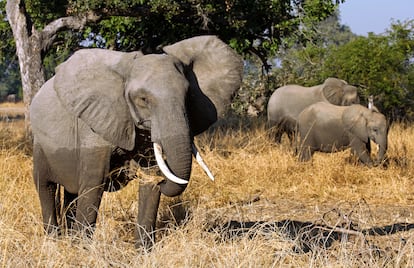
Veronica Akabondo had worked from dawn to dusk for months on her farm in southern Zambia and was confident she would have a plentiful maize harvest. But one morning she woke up and found it all gone. The culprit? A herd of hungry elephants.
“They came and ate the maize the whole night,” Akabondo says, distraught, standing in the trampled remains of her field. “They finished everything. Even the pumpkins I had planted in the same field were not spared,” adds the 60-year-old woman.
Akabondo lost about 6,000 kilograms of maize in one night, the equivalent of $2,700. She now wonders how she will support the eight children in her care. The woman’s farm is in Livingstone, a town that straddles Mosi-oa-Tunya National Park. The area, which opened in 2012, is part of the Kavango-Zambezi Transfrontier Conservation Area, between the rivers of the same names, and is the world’s largest transboundary conservation zone, covering an area larger than Spain. This vast mosaic of 36 protected areas, national parks and wildlife corridors spans Angola, Botswana, Namibia, Zambia and Zimbabwe, and aims to provide safe migratory routes for the region’s more than 200,000 elephants, the largest population of these mammals in the world.
In recent years, Zambia — one of the poorest countries in the world, where more than 60% of its 21 million people live below the poverty line — has been hit by extreme weather events that have reduced harvests and worsened malnutrition. Today, roughly one-third of Zambian children under five have stunted development due to poor nutrition. Severe droughts combined with extreme flooding have also led to a rise in violent clashes between people and elephants. Displaced from their usual migratory routes, these animals trample crops in search of water and food, at times causing deaths and plunging families into destitution by leaving them without their livelihood. As a result, some farmers have killed elephants that enter their fields.
A devastating cost
According to the United Nations Development Programme (UNDP), such incidents were once rare, but since the drought began in Zambia “more and more elephants are venturing out of Mosi-oa-Tunya National Park in search of water and food.” “For the animals, particularly the elephants, this is a matter of survival. Their water sources have dried up, and their typical food sources are dwindling. The effects of the drought are further compounded by increased elephant populations, as elephants from Botswana, Zimbabwe, and Namibia have migrated into the national park,” states a 2025 UNDP report, which says this “desperate” search for resources takes a devastating toll on humans.
More than 50 years ago, elephants moved freely on both sides of this border, which existed only on maps and was covered in dense vegetation. Today, it has been replaced by farmland within the Transfrontier Conservation Area (TFCA) established by Zambia and Malawi in 2015.
In 2022, the Malawian government reintroduced 263 elephants to Kasungu National Park, on the border with Zambia. Since then, there have been several clashes between animals and humans in the area, with at least 10 deaths linked to these encounters, not including the destruction of dozens of hectares of crops.
Elephants are also appearing much earlier than usual, and especially before farmers have harvested their crops. “In the past, elephants appeared around May to July. But this time they came while crops were still in the fields,” says 53-year-old Kennedy Muleya.
Like Akabondo, Muleya’s maize was destroyed in February by a herd of hungry elephants. It had never happened to him before. “It was during the night, so we could not go to the field because it is dangerous. Elephants can kill,” Muleya recalls. “When we went in the morning, we found everything destroyed. This is the food we depend on. Now we have nothing.”
The search for food
Rwinick Mapanza, president of the Livingstone District Farmers’ Cooperative Union, believes the heavy rains — which produced abundant fresh vegetation — likely drew elephants into Zambia in search of food, as it is a territory they prefer during wetter seasons due to its higher elevation. “These animals know where food is found,” says Mapanza.
But even knowing what drives them to these areas, it is very difficult to control them. Farmers have tried banging cans to make noise, lighting fires and using clothing soaked in chili mixed with grease — a cheap and harmless method that repels the mammals, which are highly sensitive to pepper that irritates their trunks. But it is often too late.
“Once elephants get into the fields, the damage is done,” says Wilfred Moonga, a ranger with Zambia’s Department of National Parks and Wildlife (DNPW).
Farmers are frustrated because so far they have received no compensation for lost crops nor any subsidies to help them protect themselves more effectively from elephants.
Akabondo says some government officials visited her ruined field and took photographs, but nothing has been done since then. “We are asking the government to help us because we are really suffering,” the farmers say.
When farmers reported the crop destruction to the DNPW, they were simply told to hire guards. Aside from the cost this entails, Akabondo rejects the idea, arguing the elephants are too dangerous. “We would be putting lives at risk,” she says.
Sign up for our weekly newsletter to get more English-language news coverage from EL PAÍS USA Edition














El Papa Irrumpe En El Debate Político Español Con Un Claro Alegato Contra La Polarización Y La Ultraderecha

El Real Madrid Cae Ante La Laguna Tenerife Y Se Queda Fuera De Las Semifinales De La Liga ACB 18 Años Después

El Leyma Coruña Y El Estudiantes Jugarán La Final Del ‘playoff’ De Ascenso A La Liga Endesa
In The Final Stretch Of Colombia’s Presidential Campaign, Undecided Voters Are In High Demand

How To Get A Tourist Rental Licence In Andalusia (Spain) – Step-By-Step Guide 2025
Spain heatwave 2026: When the next extreme temperatures could hit and which areas may suffer most


-
Abelardo de la Espriella2 weeks ago
In The Final Stretch Of Colombia’s Presidential Campaign, Undecided Voters Are In High Demand
-
 New Developments3 weeks ago
How To Get A Tourist Rental Licence In Andalusia (Spain) – Step-By-Step Guide 2025
-
aemet3 weeks ago
Spain heatwave 2026: When the next extreme temperatures could hit and which areas may suffer most
-
Competiciones4 weeks ago
E
-
Costa Blanca North4 weeks ago
Benidorm unveils massive new SkyFest venue expecting 200,000 visitors this summer
-

 Álvaro Arbeloa4 weeks ago
E
-

 Uncategorized3 weeks ago
FBI investigation launched over Valtteri Bottas Cadillac theft
-
buffet4 weeks ago
Toyo Japanese, Asian favours in Fuengirola