
El Guernica
In Spain, A Request To Move Picasso’s Famous ‘Guernica’ To The Basque Country Sparks National Row

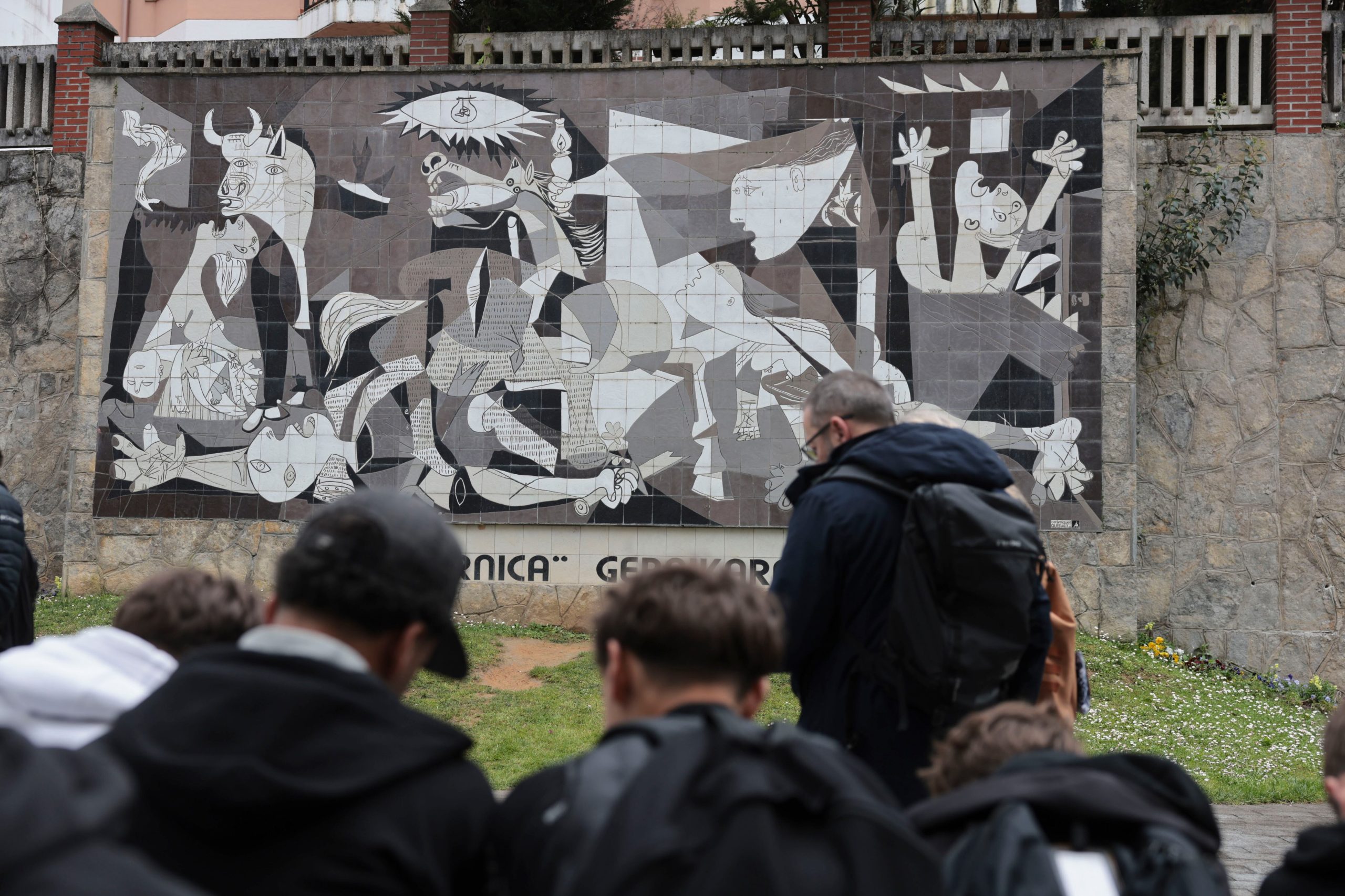
An unexpected battlefront has opened up in Spain’s national political arena after the Basque regional government made a request to national authorities to allow the temporary transfer of Pablo Picasso’s famous 1937 anti-war painting “Guernica” from its present location in Madrid to Bilbao, in the northern Spanish region.
The latest politician to join the debate is the head of the regional government of Madrid, Isabel Díaz Ayuso of the conservative Popular Party (PP), who on Monday heavily criticized the idea, even calling it small-minded: “I think it’s a parochial attitude, and I believe that culture is universal.”
But the Basque government, headed by Imanol Pradales of the Basque Nationalist Party (PNV), has made the transfer of Picasso’s painting a matter of regional pride. The artwork pays tribute to the 26 April 1937 bombing of the town of Guernica (or Gernika in its Basque spelling) by Nazi Germany and fascist Italy during the Spanish Civil War. It was exhibited at the Paris Expo of that year and eventually took on iconic status as a cry against war. Painted in Paris, the “Guernica” toured the world and ended up in New York’s MoMA until 1981, when it was sent to Spain, where it is currently housed at Madrid’s Reina Sofía museum.
Pradales has asked the central government of Spain, headed by Pedro Sánchez of the Socialist Party (PSOE), for the iconic painting to be exhibited at the Guggenheim Museum in Bilbao for nine months as a gesture of historical remembrance and “symbolic reparation” toward the Basque people on the occasion of the 90th anniversary of the bombing. Whenever Basque authorities have requested the artwork at other times in the past, they have been met with a refusal from the Spanish Ministry of Culture, which cites conservation concerns and the poor condition of the canvas to oppose the transfer.
The Reina Sofía has never granted these types of requests, not even in exceptional cases such as the one made in 2000 by MoMA in New York. “The great icon of our museum must remain, without exception, outside the institution’s loan policy,” states the Reina Sofía’s four-page report on the “history of requests” received throughout the years.
“A serious political mistake”
But at a meeting with Sánchez in late March, Pradales warned that “it would be a serious political mistake to close the door on this issue.” His political group, EAJ-PNV, has five lawmakers sitting in the 350-seat national parliament, and it is part of a contingent of small regional parties that provide support for the PSOE-led governing coalition.
Political parties of all stripes have since added fuel to the “Guernica” controversy. On Tuesday, PNV lawmakers are expected to try to force the Minister of Culture, Ernest Urtasun, to speak publicly in the Senate on the issue. Senator Igotz López will pose this question: “Why are you refusing to study the necessary conditions for the temporary transfer of ”Guernica” to the Basque Country, as proposed by the Basque government?”
The ministry requested a new report from the Reina Sofía Museum, as has been done on previous occasions when the Basque government has made the same request. And the museum replied with a study advising against moving the artwork from its current location due to the “inevitable” vibrations it would experience during transportation, which could cause “new cracks, lifting, and loss of the paint layer, as well as tears.”
“We work to improve the accessibility of culture and therefore welcome the mobility of art. But as the Ministry of Culture, we also have a duty to preserve our heritage, and experts have always advised against moving “Guernica” due to its delicate state of conservation, as it is already badly damaged,” says Urtasun’s team, which thought the matter settled following this expert report.
But the Basque government told EL PAÍS that they don’t consider that “a formal response.” “We didn’t request a report on the painting’s state of conservation—we already know its condition—but rather a report analyzing the conditions under which it would be possible to move it and temporarily relocate it to the Basque Country,” the Basque executive reiterated. “We are still waiting.”

Pradales would like the painting to travel to the Guggenheim Museum in Bilbao to go on display between October 1, 2026 and June 30, 2027, on the occasion of the 90th anniversary of the constitution of the first Basque Government and the 1937 bombing of the town.
“It would be a gesture of historical memory and symbolic reparation towards the Basque people,”said Pradales, wondering out loud if Sánchez would have “the political courage” to bring the painting to the Basque Country and that “the ball is in his court.” Meanwhile, the Ministry of Culture continues to underscore that “we will not put at risk a heritage as important as ‘Guernica’ and we have conveyed this to the [Basque] Deputy Premier.”
The Basque branch of the Socialist Party (PSOE) told EL PAÍS that “it is not appropriate to open a new chapter regarding grievances, and seeking reparations or apologies from the Spanish government.” A spokesperson said that “we have insisted on the responsibility of those who made the decision to bomb Gernika, on the responsibility of the Nazi air force, the Italian fascist air force… and on the status of the people of Gernika, the Spanish government and the Second Republic as the victims of that aggression. The Spanish government has already made gestures of condemnation, rejection and solidarity with the victims, and recognized Gernika as a site of democratic memory in 2024… we believe there is no outstanding issue in this regard.”
Amid this exchange of statements, Madrid’s regional leader Díaz Ayuso took advantage of the inauguration of a mental health center on Monday to wade into the fray and criticize the Basque government. “What we want in Madrid is for everyone to grow together. What doesn’t make sense is going back to the origins of things only when it suits us, because then we’d move all of Picasso’s work to Málaga [where the painter was born]. I think that’s a parochial attitude, and I believe that culture is universal. Besides, they know that this can’t be done, or if it is, it will put the integrity of the artwork at risk.”

Hours later, national PP authorities came out in support of Ayuso’s position but with a more moderate tone, siding with the Reina Sofía Museum’s technical staff. “We believe the controversy is largely pointless. If the technical reports allowed for the relocation, we wouldn’t consider it a bad idea, but given the warnings about potential damage, we believe a temporary transfer shouldn’t even be considered. In any case, we completely disagree with the idea of the transfer as an act of reparation,” added Juan Bravo, the PP’s Deputy Secretary for Finance, Housing, and Infrastructure.
The canvas was analyzed in 1997 after “suffering more than 30 itinerant journeys” and as many roll-ups, and it was considered at that time that “the optimal conditions for its conservation had to be necessarily stable, with strict control of climatic fluctuations, avoiding all types of vibrations.” The latest report published by the Reina Sofía Museum reaches the same conclusion, albeit in different words: “The artwork is currently maintained in stable condition thanks to rigorous environmental control. However, with regard to a possible relocation, its format, the nature of its component elements, and its state of conservation, along with the numerous damages it has suffered over time, make it particularly sensitive to all types of vibrations that are unavoidable during the transportation of works of art. These vibrations could cause new cracks, lifting, and loss of the paint layer, as well as tears in the support, which is why its relocation is strongly discouraged.”
Sign up for our weekly newsletter to get more English-language news coverage from EL PAÍS USA Edition








Aitor Esteban
Ayuso Insiste En No Trasladar El Guernica A Bilbao: “Me Parece Que Es Cateto. La Cultura Es Universal”


Un nuevo antagonista y nueva polémica asoman en el horizonte para Isabel Díaz Ayuso. La presidenta de Madrid ha vuelto a criticar este lunes la petición del Gobierno vasco de que el Guernica de Picasso sea exhibido temporalmente en el Museo Guggenheim de Bilbao. Aitor Esteban, líder del PNV, y Ayuso se han llamado provincianos mutuamente por este asunto y han iniciado un cruce de declaraciones que no parece que vaya a quedar aquí.
Ayuso se opone al traslado, que también ha sido desaconsejado “rotundamente” por un informe que el Museo Reina Sofía ha hecho público. “Desde Madrid lo que queremos es que todos crezcamos juntos, lo que no tiene sentido es ir al origen de las cosas según nos convenga porque, entonces, llevamos toda la obra de Picasso a Málaga. Me parece que es cateto y pienso que la cultura es universal. Además saben que esto no puede salir o, si sale, es poniendo en riesgo la integridad esa obra”, ha dicho la presidenta durante la inauguración de un centro de salud mental en Parla.
Así ha dado réplica a Esteban, que ayer dijo que la catetada a la que se refiere Ayuso, según él, consiste en tomar “como una reivindicación nacional tomarse una caña en una terraza”, en referencia a la política de abrir los bares que impulsó Ayuso durante la pandemia. La polémica por el cuadro se produce a raíz de que el Gobierno vasco haya comunicado al ministro de Cultura, Ernest Urtasun, la petición de traslado temporal del cuadro de Picasso a Bilbao entre el 1 de octubre de 2026 y el 30 de junio de 2027. Lo pide con motivo del 90º aniversario de la constitución del primer Gobierno en Euskadi y del bombardeo de la localidad vizcaína de Gernika durante la Guerra Civil.

La presidenta ha tratado de mostrarse a sí misma y a su región como un lugar abierto a todo el mundo. Y ha cargado contra las identidades de otros lugares de España. “El patrimonio de los españoles es de todos los españoles, lo que no se puede hacer es dividirlo por 17 estados, naciones y, de esta manera, seguir alentando ese sentimiento. Por ejemplo, ahora vamos a celebrar la Fórmula 1, que es el Gran Premio de Fórmula 1 de España, para que todos los españoles se beneficien. Viene el Papa y queremos que todas las congregaciones, que todo el mundo en España se beneficie”.
El Guernica es una apetencia recurrente de los nacionalistas vascos. El Reina Sofía nunca ha accedido a estas pretensiones, ni siquiera en casos tan excepcionales como la petición que realizó en el año 2000 el MoMA de Nueva York. “El gran icono de nuestro museo debe permanecer sin excepciones al margen de la política de préstamos de la institución”, señala el informe de cuatro páginas del Reina Sofía sobre el “histórico de peticiones” recibidas. El Guernica es un emblema para el Reina Sofía, a la altura de la importancia que tiene, por ejemplo, la Gioconda, de Leonardo, para el parisiense Museo del Louvre.
Después del receso de la Semana Santa, la actualidad política la van a centrar los juzgados. En la Audiencia Nacional arranca el juicio por el caso ‘Kitchen’, la guerra sucia del PP de su ministro de Interior hace 13 años, Jorge Fernández Díaz, y nueve presuntos colaboradores. Al tiempo se inicia la vista oral por el ‘caso Koldo’, un caso de corrupción que afecta de lleno a José Luis Ábalos, ministro de Fomento en los dos primeros Gobiernos de Pedro Sánchez, y a Santos Cerdán, exsecretario general del PSOE y alguien de la máxima confianza de Sánchez en su día.
Para Ayuso, el caso Koldo tiene mayor relieve porque la causa que afecta a su partido, el PP, se remonta a más de una década y en él no tienen nada que ver “los actuales dirigentes” de la formación. “Estamos en situaciones totalmente diferentes. Intentarán empatar”, ha dicho refiriéndose al PSOE. “Pero aún así, quiénes somos nosotros para juzgar a los jueces. Nosotros no lo vamos a hacer”.

S

British Couple’s Juice Empire In Spain Steals Spotlight On UK Television

S


-

 New Developments2 weeks ago
Luxury Villas For Sale, Estepona – ProjectL1
-

 New Developments4 weeks ago
How To Get A Tourist Rental Licence In Andalusia (Spain) – Step-By-Step Guide 2025
-

 New Developments2 weeks ago
Stylish 3-Bedroom Apartment With Panoramic Sea Views – Benalmádena
-

 Uncategorized4 weeks ago
Max Verstappen left laughing after Nurburgring triumph
-

 %2 weeks ago
Poland Disconnects Utilities At Russian Consulate That Moscow Refuses To Hand Over
-

 Uncategorized4 weeks ago
Max Verstappen team-mate sheds light on Nurburgring mistake
-

 Uncategorized3 weeks ago
Lewis Hamilton goes from Karate Kid to Samurai Warrior with Kill Bill guru
-

 %4 weeks ago
Torrevieja Spring Concert Brings Classical Music And Community Spirit