Donald Trump
Iran War Strains The Gulf States’ Strategic Relationship With The United States

On Valentine’s Day in 1945, a dying Franklin D. Roosevelt met with Abdul Aziz Ibn Saud in the waters of the Suez Canal. The U.S. president and the King of Saudi Arabia agreed on almost nothing, but they got along well. They had arranged to meet to discuss a possible state for the Jews in Palestine — Ibn Saud rejected the idea — but that conversation would end up being the seed of a strategic alliance that other Persian Gulf countries would later replicate. That historic tacit pact meant that Washington would provide security to those countries in exchange for oil. It lasted for decades, but the regional upheaval caused by the war between Israel and the United States against Iran has shown that its foundations were weaker than previously believed.
Barely a few hours had passed since the first U.S. and Israeli bombings of Tehran, on February 28, when the Islamic Republic attacked not only Israel but also the United Arab Emirates, Qatar, Kuwait, and Bahrain. In just a few days, Iranian missiles and drones struck 11 countries across the region. U.S. military bases, seen for decades as the main guarantee of security for the countries hosting them — from the Emirates to Bahrain, and Kuwait to Qatar — became a burden, a liability: far from serving as protection, they turned those countries into Iranian targets.
Washington prioritized “the defense and security of Israel,” while these states feel they were sidelined and, to some extent, “left to fend for themselves” in the face of Tehran’s military reprisals, says Leyla Hamad Zahonero, an associate researcher at the Center for Contemporary Arab Studies (Cearc), speaking by phone. The result, she says, is that the war against Iran has not only “altered the military balance of the region” but has also led those states to “recalibrate their relationship with Washington.” The decades-long strategic pact linking the U.S. with the wealthy countries of the Arabian Peninsula has begun to crack.
Heightened by the war, the fragility of that unwritten pact has become evident, both among the Gulf states and on the U.S. side. First, because of the behavior of the Gulf countries themselves over these past nearly four months: despite many of them being hostile to Iran, rather than pressuring Washington to continue the conflict — as Israel had assumed they would — they have done exactly the opposite, trying, with little success, to persuade it to hold back.
Not only because, with the Strait of Hormuz closed, they were beginning to feel the squeeze of economic suffocation. It is also because, as Hamad Zahonero points out, Iran may be “an uncomfortable neighbor,” but that neighborhood is not going to disappear. Faced with a disappointing alliance with Washington and the dictates of geography, the Gulf countries are now leaning toward trying to mend the rift opened with Iran. That will not be easy either.
On the U.S. side, the war has shown that its alliance with its Gulf partners — those petromonarchies esteemed by a Trump who has in turn been lavishly praised by the sheikhs — was less vital than it seemed. The fracking revolution has driven a surge in oil and gas production in the United States, which is approaching an energy self-sufficiency it could never even have dreamed of: any rise in oil prices still affects it, as has been shown in recent months, but supply itself is secure. The days when Roosevelt sought to control Saudi oil are therefore long gone: now, the United States simply does not need it. Or at least, not as much as it once did.
Having become, along with Israel, a prime target of Iranian retaliation, the war has “exposed the limits of the Gulf states’ outsourced security model and the fragility of an economic development closely tied to stability,” says Zahonero.
The maritime highway of the Strait of Hormuz began to come back to life on June 18, shortly after Donald Trump signed the 14 points in Versailles that promise the difficult task of peace.
The Gulf states’ disappointment with the memorandum is also significant: the document says nothing about the Iranian missiles and drones that Tehran has used to strike even critical civilian infrastructure such as desalination plants.
As for the Strait of Hormuz, the agreement itself leaves room for many interpretations. It states that the Iranian and Omani authorities “will conduct dialog with the Sultanate of Oman to define the future administration and maritime services in the Strait of Hormuz” — a formula that leaves the door open for Iran to charge some kind of fee to ships. Immediately afterward, however, it adds that the arrangement must be “in line with the applicable international law,” which does not allow any toll to be charged for navigating a maritime strait. Adding more ambiguity — and another setback endorsed by the White House.

Alternatives
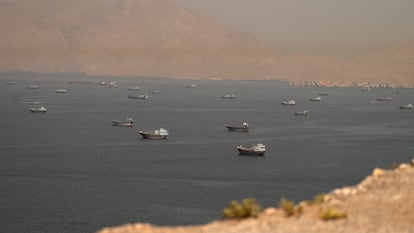
War yields countless lessons, but one stands above the rest: Iran has shown the world — and itself — that it can close the Strait of Hormuz almost at will. In short, it holds the rest of the world at its mercy. This is especially true for the Gulf countries, which export most of their hydrocarbons through that passage and, with or without an agreement, are still considering alternatives to avoid the ordeal of another shutdown. With more reason than ever: they now know for certain that U.S. military power is not enough to reopen this crucial maritime route.
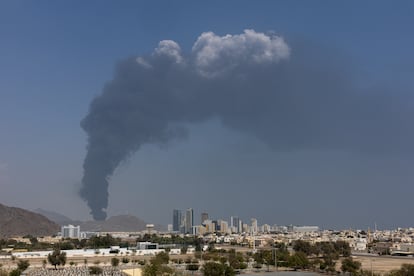
In mid-May, the United Arab Emirates announced it would accelerate its plan to double the capacity of the only pipeline that allows it to bypass the strait and ship oil already from Fujairah, on the Arabian Sea coast. The other major regional player, Saudi Arabia — the country in the region that has managed to safeguard the largest share of its oil exports — is in talks with Kuwait — one of the hardest hit — so that Kuwaiti oil could avoid Hormuz by crossing Saudi territory.
After once again seeing that the White House’s priority is Israel, not them, the Gulf countries are also seeking to increase their strategic autonomy and reduce their dependence on U.S.-supplied weapons. In March, when they began to fear that the constant Iranian attacks might deplete their stocks of interceptors used to stop Tehran’s missiles and drones, the Trump administration’s response was to shut the door, according to the specialized outlet Middle East Eye. It reported that at least one of those countries (without specifying which) asked U.S. officials about the possibility of replenishing those interceptors, only to have its request denied.
In May, Kuwait’s defense minister, Abdullah Ali Abdullah Al Salem Al-Sabah, signed a memorandum of intent with Haluk Gorgun, head of Turkey’s Defence Industry Agency, to strengthen cooperation in that field. Saudi Arabia, the United Arab Emirates and Qatar are also seeking arms deals with Turkey, particularly on drones and short-range air defense systems.
In parallel, these petro-states are also exploring joint development with Turkey of ballistic missile interceptors—a technology that Turkey itself has not yet developed but, as Hamad Zahonero notes, they are “looking into in order to jointly build that industry,” without having to rely on weapons supplies from Washington.

The usual outspokenness of Trump and his aides during this war has only further irritated the Gulf countries. For instance, when Trump singled out states such as the United Arab Emirates while mentioning the promise of a $300 billion investment fund in Iran, in which he said the U.S. would not be “putting up 10 cents.” Or by making the signing of peace with Iran conditional on the Gulf countries — especially Saudi Arabia — joining the Abraham Accords, under which four Arab states established diplomatic relations with Israel in 2020.
“Gulf leaders understand that the Iranian regime is not going anywhere, and they see no strategic benefit in trying to isolate Tehran or push it into a corner. This does not mean that Gulf states have become naïve about Iran. They remain deeply aware of the challenges and threats posed by Tehran,” Danny Citrinowicz, a former Israeli army analyst, recently posted on X (formerly Twitter). “However, their preferred strategy is de-escalation and coexistence rather than confrontation. From their perspective, maintaining channels of communication with Iran is a necessity, not a choice.”
Sign up for our weekly newsletter to get more English-language news coverage from EL PAÍS USA Edition