
News from Madrid
K-EXPO Spain 2026 brings the Hallyu Wave to Madrid this summer


Madrid hosts major Korean expo with food, beauty and culture.
Photo Credit: K-EXPO
This summer, Spain will experience the one of the largest Korean trade fairs in the world, right in the capital of Madrid: K-EXPO Spain 2026, a major event bringing together more than 100 Korean companies in celebration of the country’s gastronomy, culture, cosmetics, and entertainment, is coming to Madrid in mid-June.
The Spanish capital’s South Korean summer
The event, which has already become a major talking point in the United States, the United Arab Emirates, Japan, France, Canada, and more, is set to return to the shining capital of Madrid on June 12, for businesses and networking, and June 13, for the general public. It will take place at the Madrid Exhibition and Events Universe, in Chamartín. Not only this, the event will be completely free to attend, and is already expecting more than 5,000 visitors.
Korean entertainment, K-Beauty, and a whole lot of food: The Hallyu Wave comes to Madrid
More than 100 Korean companies will participate in this major cultural and entertainment event, more than 50 of which specialise in the food and beverage industry. The ‘K-Food’ aspect will be a major draw, as Korean restaurants in Spain surge in popularity, and many Spanish restaurants are incorporating Korean flavours into their cuisine, including ingredients like kimchi (spicy fermented vegetables) and gochujang (a savoury, sweet, and spicy fermented condiment).
Some major and popular gastronomic draws of the exposition will include drinks like Korean teas, kombucha, specialty coffees, artisanal soju, traditional liquors, functional and protein drinks; healthy food like ginseng, fermented products, honey, algae, vegan products and supplements; snacks and gourmet products like appetizers, seaweed, red ginseng, fermented vinegar, condiments and premium convenience products; Korean confectionery including traditional sweets, cookies and rice cakes; ready-to-eat products, and traditional Korean dishes.
Another major draw of the K-EXPO Spain trade fair will be the K-Beauty experiences. As one of the most lucrative markets, Korean skincare will be a talking point at the fair, with businesses exhibiting popular products. Those who attend will be able to take part in experiences, including receiving personalised skincare routines and AI-assisted skin diagnosis, as well as products like cellulose masks, ampoules, serums, and LED phototherapy devices.
Visitors will also be treated to various workshops during the fair, including doenjang and gochujang making, a kimchi demonstration with master craftsmen, and a free premium photobooth experience.
A chance for networking and connections to major Korean brands
The event will be a chance for consumers as well as companies to create greater ties with Korean businesses and contribute to the Hallyu Wave (the increasing popularity of Korean culture and products on a global scale). K-EXPO Spain 2026 is set to establish Madrid as a key hub for Korean connections in Southern Europe.
Those interested in attending the event, either as representatives for a business aiming to network with Korean companies, or as a member of the general public, can register on the event’s official website, kexpospain.com/es.





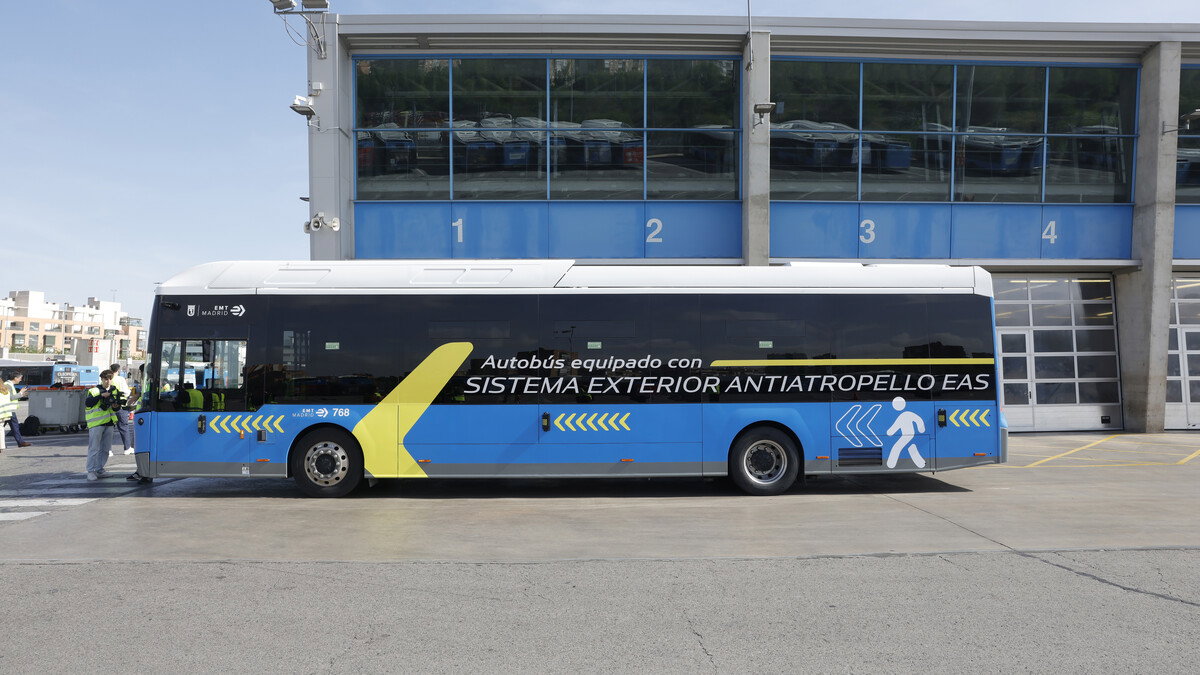
A Madrid city bus fitted with a new safety system that detects pedestrians and alerts drivers in real time
Credit: EMT Madrid
It is something most people only notice after a close call. A pedestrian steps off the pavement, a cyclist appears in a blind spot, or a vehicle brakes too late at a busy crossing. In Spain’s cities, where traffic, scooters, and foot traffic mix constantly, those moments are part of everyday life.
Now, a new bus safety system being tested could help prevent them before they happen. The pilot was rolled out on April 25, 2026, in Madrid, where buses operated by Empresa Municipal de Transportes de Madrid are now being equipped with the technology. The system is currently being used on vehicles running along the capital’s dedicated bus lanes, known as “carriles bus”, where buses share space with dense traffic and frequent pedestrian crossings.
How does the new ‘anti-runover’ bus system work?
The system uses a combination of sensors and cameras to monitor the area around the bus. It can identify pedestrians, cyclists, and other vehicles nearby, particularly in blind spots or low-visibility situations. If a potential collision is detected, the driver receives an immediate alert. In some cases, external signals can also warn pedestrians or nearby road users that a bus is approaching or that a risky situation is developing. This type of technology is already present in some modern cars, but applying it to buses is a significant step. Public transport vehicles operate in complex urban environments, often stopping frequently and interacting with large numbers of people.
Why this matters for everyday life
Pedestrian accidents remain a concern across Spain, especially in busy urban areas. Crossings, bus stops, and narrow streets can quickly become high-risk zones, particularly during peak hours.
For expats, and tourists, this system could provide an extra layer of safety. Anyone navigating unfamiliar streets or adjusting to local traffic habits knows how unpredictable city movement can feel. By supporting drivers and increasing awareness around the vehicle, the system aims to reduce those sudden, high-risk moments.
A pilot that could expand across Spain
For now, the system is limited to a pilot programme in Madrid, where it is being tested under real traffic conditions. The focus is on areas with high pedestrian activity and heavy bus traffic. If the results are positive, the technology could be rolled out more widely, both within the capital and in other cities across Spain. That possibility makes the trial particularly relevant. Rather than being a one-off initiative, it could become part of a broader push to improve road safety nationwide.
A small change with real impact
Most people will not notice the system at first. The buses look the same, and the technology works quietly in the background. But if it performs as expected, the impact could be meaningful. Fewer near misses, smoother interactions between road users, and ultimately fewer accidents. In cities where space is shared by so many, even a small improvement in awareness can go a long way.

Italian tradition meets Costa Blanca sourcing at exclusive gastronomic finale
Don’t miss your flight. 19 Million cars expected on UK roads for May bank holiday
K-EXPO Spain 2026 brings the Hallyu Wave to Madrid this summer


-

 Competiciones3 weeks ago
E
-
blackout April 20252 weeks ago
Insurance company Mapfre decides to pay out €14 million compensation for 2025 blackout
-
Costa del Sol3 weeks ago
Why home care is the new gold standard for living well in Spain
-
Bullfighter injured4 weeks ago
Second serious injury in Spain’s La Maestranza bullring reignites controversy
-
 Foreign demand2 weeks ago
Who Bought Where In The Second Half Of 2025?
-

 %4 weeks ago
Gibraltar Sees Surge In Residency Applications After Border Agreement
-

 %4 weeks ago
Portugal Confirms High-Speed Rail Link
-
Animal protection law3 weeks ago
Spain moves to redefine legal pets as draft law raises wider welfare concerns