
Donald Trump
Life In A ‘persecuted’ Migrant Community In Texas: ‘For Us, A Police Officer Is An Enemy’

Lidia and her family have become increasingly isolated at home as more neighbors are detained by local police or immigration agents. She used to walk for an hour every afternoon, going peacefully to the doctor, to do the shopping, or to take her mother-in-law to church. Not anymore. She doesn’t trust the police either: if she were in a car accident, she’d rather arrive home safely in the damaged vehicle. She lives in Colony Ridge, an immigrant neighborhood 40 minutes from Houston, which for years has been targeted by conservative politicians — including Texas Governor Greg Abbott — who consider it a magnet for undocumented immigration.
Since Donald Trump took office again in January 2025, for Lidia, those arrested in her community went from being someone’s acquaintance to being her own neighbors and friends. She recounts how the father of the family across the street was arrested and deported to El Salvador a few weeks ago; the house was abandoned as everyone subsequently left. Her neighbor on the corner was hit by a car on a nearby road and the police, instead of helping her, demanded her immigration papers and, since she didn’t have any, turned her over to Immigration and Customs Enforcement (ICE). Her 13- and 20-year-old children were left alone. A friend of her husband was also detained, and Lidia never found out if he got to try the goat meat she had just cooked for him.
“Now, when you see a police officer, you go around praying, ‘Lord, make me invisible to the enemy.’ We no longer see the police and think, ‘I’m safe.’ No. Now, for us, a police officer is an enemy,” says Lidia. That’s not her real name. She agreed to speak only under a pseudonym because she’s afraid of being recognized and detained by immigration authorities. Other residents of this community preferred not to share their stories for the same reason.
While she was talking, Lidia called a neighbor whose children were detained three days before Thanksgiving in 2025: one has already been deported to Mexico and the other has been held in an ICE facility ever since. “We had never felt like this: persecuted, harassed,” says the Honduran woman, who has lived in the United States for 13 years, 11 of them in Colony Ridge.
And she’s not just speaking for herself. Lidia says her six-year-old godson cries if his mother hasn’t arrived home by 4:15 p.m. “He’s heard the police are going to take his mom away. He starts asking where she is. It’s psychological trauma. This man [Trump] doesn’t see what he’s doing. Children have the right to feel safe.”

In January 2025, when Trump returned to the White House, Colony Ridge residents walked the streets or did their shopping without fear. They thought they couldn’t be arrested because they hadn’t committed any crimes. At that time, they believed Trump’s promises, the then-Republican candidate having stated during the 2024 election campaign that he would deport “the worst of the worst” — the criminals. They didn’t feel targeted.
However, as the months passed and they saw ICE agents, state police, and highway patrol officers stop them for any reason whatsoever — for having a burned-out taillight, for carrying tools in the trunk of the car, or simply for looking Hispanic — that feeling changed. Some families chose to keep their children at home, while others sent them to school in Ubers; American neighbors began buying for the undocumented immigrants; and some even sold their land or transferred it to relatives with legal immigration status so they wouldn’t lose it in case of deportation.
In June 2025, Alejandrina Morales, a resident of this community, summed up the neighborhood’s feelings: “We feel like we’re being hunted just for looking Hispanic.” Her husband was detained by ICE agents at his own tire shop, and after his release, she said he was never the same again.
The conservative view on Colony Ridge
The members of this community don’t call it Colony Ridge. That’s the name given to it by the media and the governor. Its residents — mostly families of mixed immigration status — refer to the six neighborhoods where they live, which have been developed by Colony Ridge Land LLC since 2013, individually: Grand San Jacinto, the first one built; Santa Fe, Camino Real, Rancho San Vicente, Montebello, and Bella Vista.
These are plots of land on the outskirts of Houston, in northeast Texas, cheaper than in the city, with access to basic services, and where owners can build homes — with restrictions — or park trailers. Lidia has lived in this community since 2015. She remembers that for years it was a safe place, where it was normal to see children playing in the street.
The fear now felt by this community — located in a county where 33% of the population is Hispanic, according to the 2024 Census — is well-founded. Along with Florida, Texas is one of the states most committed to Trump’s policy of mass detentions and deportations. According to ICE records, nearly 400 state police officers have cooperation agreements with the federal agency to hand over custody of those detained or arrested without legal immigration status. Three of these officers serve Liberty County, where Colony Ridge is located.
Governor Abbott himself has referred to this community as a “sanctuary” for undocumented immigrants, a concept he condemns. He has also taken direct action against them. In February 2025, he announced on social media that Colony Ridge would be “the target” of a joint operation between local and federal authorities to detain immigrants: 118 residents were arrested. Since then, the streets of this neighborhood look much like that day in February, some days with more officers and police, others with fewer, but they are always patrolling.
Furthermore, for the past three years, undocumented immigrants living in Texas, and in this community in particular, have felt the shadow of a law that would allow state authorities to arrest, detain, and deport them. This is the controversial SB 4. The implementation of this legislation — which has been described as one of the “most extreme” against immigration — has been blocked by the courts on several occasions. The latest setback came last week when a district judge in Austin blocked some of its provisions, ruling that they “conflict” with federal agencies, the only ones responsible for enforcing immigration law in the U.S. It remains to be seen what further legal action the state will take in its attempt to implement it.

This combination of realities is what makes Lidia and the Colony Ridge community continue to add restrictions to daily life: “We are tied hand and foot right now, hoping that God will take care of us.”
The ‘nightmare’ of deportation
Lidia says that in conversations with her neighbors there is a recurring theme: the deterioration of the mental and physical health of many of them as a result of stress.
She has high blood pressure. During a recent doctor’s visit, her doctor told her that her blood pressure was higher than normal. Lidia explained that it could be due to increased anxiety and fear that keeps her from sleeping at night.
“I have nightmares every day,” she says. “I’ve dreamt that we’re being chased and that later, when we’re in Honduras and want to go back, we can’t; that our relatives don’t answer the phone or that the phone doesn’t have our family’s numbers saved.” These dreams have taken her and her husband back to their childhood homes, which are no longer even owned by their families.
Lidia says the family doesn’t know what to do. Some days they wake up certain they must sell all their properties in the community and leave for Mexico or Honduras, where they are originally from. Other days they feel they should stay and wait for Trump’s remaining years in office to pass.
While they decide, she says she will continue to support her neighbors in any way she can. At the beginning of the year, she helped with a fundraising raffle to buy plane tickets for three children who were left alone after their parents were deported. She recalls donating about three more times, whenever she can.
Although they have lost a great deal over the past few months, Lidia is glad that this time has brought them one benefit: “A community that has learned to stick together more closely.”
Sign up for our weekly newsletter to get more English-language news coverage from EL PAÍS USA Edition








When Christine Lagarde addressed a central bank conference late last year, her frustration was clear. Europe had been debating a digital euro for years, but it was still nowhere close to being done.
Progress was so slow that it was likely her eight-year term would be up before the project saw the light of day. “This is too long,” she said. “We don’t want to be left in the dust.”
In the months since, the sense of urgency has increased among European officials. But with the first issuance of a digital central bank currency expected only in 2029, and delays still cropping up, so have fears that the bloc may have already fallen behind.
The European Central Bank president’s push is about far more than jumping on the digital currency bandwagon or creating a new crypto toy for speculators. It’s part of a broader geopolitical effort for independence and autonomy, where the bloc is less reliant on others and can reduce exposure to major economies like the U.S. and China.
It also aligns with the ambition of some euro-area officials to strengthen the global role of the euro. In Donald Trump’s unpredictable policies, they see a threat to faith in dollar stability and a chance for the single currency.
The slow headway so far is to the benefit of the U.S. and so-called dollar hegemony. In Washington, Trump’s pro-crypto administration has thrown its weight behind stablecoins, a type of cryptocurrency typically pegged to a fiat currency and backed by reserves of liquid assets. The dollar is by far the dominant force in that world.
Banks in Europe have also started to wake up to the threat of America taking an unassailable lead in the race to control the future of money. Some argue that the digital euro isn’t the only solution, and are pushing their own euro-denominated stablecoins. They also say they can be up and running faster than the ECB.
“We are here now and stablecoins are ready to go,” said Jan-Oliver Sell, chief executive of Qivalis, a consortium including big-name banks like ING Groep and UniCredit SpA, which plans to issue a coin later this year.
Europe is already vulnerable on multiple fronts, from energy to critical minerals to weaponry, which hands others leverage to exert influence. It’s also heavily dependent on US companies for its payments systems, yet another worry.
“If we lose control of our money, we lose control of our economic destiny,” ECB Executive Board member Piero Cipollone, who leads the institution’s digital project, said earlier this year. “We surrender a key attribute of sovereignty.”
Warnings
The blunt warnings about sovereignty look to be getting through to politicians, who have begun to push the digital euro topic up the priority list.
But it’s still a slog through European Union bureaucracy, disagreements over regulation, and battles between competing national interests. A European Parliament committee vote expected to take place this month has been postponed until at least June.
Banks have also lobbied against the digital central bank euro, fearing an erosion of their deposit bases.
Now, many lenders are pushing harder into stablecoins. Societe Generale SA was among the first, launching EUR CoinVertible through its digital asset unit in 2023, while another is backed by asset manager DWS Group, market maker Flow Traders, and crypto firm Galaxy. Qivalis emerged in late 2025, and participants now include BBVA SA and BNP Paribas SA.
While such private initiatives in one sense rival a central bank-backed digital euro, Qivalis sees it differently. It’s all part of a so-called payment stack ranging from central bank currencies to digital tokens to stablecoins, with the ultimate aim being independence.
“We see ourselves solving that problem,” Sell said. “The European answer to that digital dollar dominance problem.”
Unease about dollar dominance is being inflamed by Trump’s confrontational approach to international relations.
This isn’t an abstract fear. Europe’s leaders have seen firsthand how weak a position they are in when it comes to key resources. Late last year, it was Nexperia and China’s restrictions on computer chip supplies vital for carmakers. Right now, it’s the disruption to oil and gas because of the conflict in Iran, an echo of the inflation shock that followed Russia’s invasion of Ukraine in 2022.
The euro is the world’s second-largest reserve currency, though it trails well behind the dollar. A meeting of euro-area finance ministers late last year featured a heated debate around whether stablecoins would increase the greenback’s dominance, and what, if anything, Europe should do in response.
The ECB, favoring a digital central bank currency, had already fired a pre-emptive strike, pushing to ban so-called multi-issuance stablecoins. These are issued in multiple jurisdictions, which the ECB says raises concerns around supervision and contagion risks. At the meeting, some countries argued against this ban, claiming that Europe was fighting a battle it had already lost.

The US’s stablecoin push was formalized through last year’s GENIUS Act, legislation for dollar-linked tokens aimed at providing a framework for the new form of money.
“The U.S. is using regulation to shape innovation in ways that reinforce existing monetary arrangements,” Barry Eichengreen, an economist at the University of California Berkeley, wrote recently in Intereconomics, a European policy journal.
Stablecoins offer what’s effectively a 24/7, low-cost and instant dollar-based banking for anyone, anywhere in the world. As they spread beyond crypto markets into real-world payments, Trump sees them as a way to extend the U.S. currency’s influence. Of the $322 billion in stablecoins in circulation, roughly 99% are pegged to the greenback.
That’s also created demand for U.S. government debt. Figures from El Salvador-based Tether, which issues the world’s largest stablecoin, USDT, show it holds about $117 billion worth of Treasuries.
Last month, French Finance Minister Roland Lescure said the stablecoin market has been “overwhelmingly dollarized,” and spoke of strengthening sovereignty “and the role of the euro in the global economy.”
In February, European Parliament lawmakers gave their backing to the ECB’s project, saying it’s “essential to strengthening EU monetary sovereignty.” Spain has since pushed for a faster rollout than the 2029 date, saying the advance of U.S. stablecoins means there’s a greater urgency.
A delicate relationship
Europe is already heavily dependent on US firms for the plumbing behind the payments people make in their daily lives. That ranges from card transactions processed by Visa Inc. and Mastercard Inc. to mobile wallets provided by Apple Inc. and Google.
Currently, nearly two-thirds of euro-area card-based transactions are processed by non-European companies. As cash usage continues to decline, growth of stablecoins could add a new layer of reliance.
“You need to think about stablecoins as the payments rails of the world of the future,” said Marieke Flament, co-founder of Currency of Power, which advises governments and financial firms on digital money. “If you are not building the rails for the euro to be on in the future, then the euro might not exist.”
China, Russia, and Iran are also pushing ahead with versions of digital money or taking advantage of existing crypto assets to bypass traditional banking rails and controls, further underscoring the broader geopolitical contest taking place.
Russia has firsthand experience of being shut out of the global payments infrastructure. Its access was restricted after the invasion of Ukraine in 2022, inflicting an instant blow to the country’s economy.
“The rapid weaponization of SWIFT and card payment networks against Russia, as well as the growing use of geoeconomic tools by the Trump administration, helped raise awareness of the EU’s dependencies in financial markets,” said Nicola Bilotta, coordinator of the EU Supervisory Digital Finance Academy. “If systems such as Visa and Mastercard were to be weaponized, the EU would need an alternative infrastructure that is readily available and usable.”
Visa and Mastercard both said they have made long-term investments in Europe and are committed to the region.
Meanwhile, Lagarde keeps pushing. Last week, she repeated that the digital euro “will enhance Europe’s strategic autonomy.”
Conscious of the ticking clock, the ECB has also launched a wholesale digital currency initiative designed to modernize interbank settlement and support tokenised money for use between large financial institutions.
But it’s playing catch-up. At the signing of the GENIUS Act, Trump said it would “secure the dollar’s status as the world’s reserve currency for generations.”
“There has to be a realization that digital money isn’t about crypto libertarians trying to bend financial regulation or overtake banks,” said Andrew Whitworth, founder of fintech and crypto consultancy Global Policy. “It’s actually about the sovereignty of your economy. It’s a geopolitical issue.”
Sign up for our weekly newsletter to get more English-language news coverage from EL PAÍS USA Edition

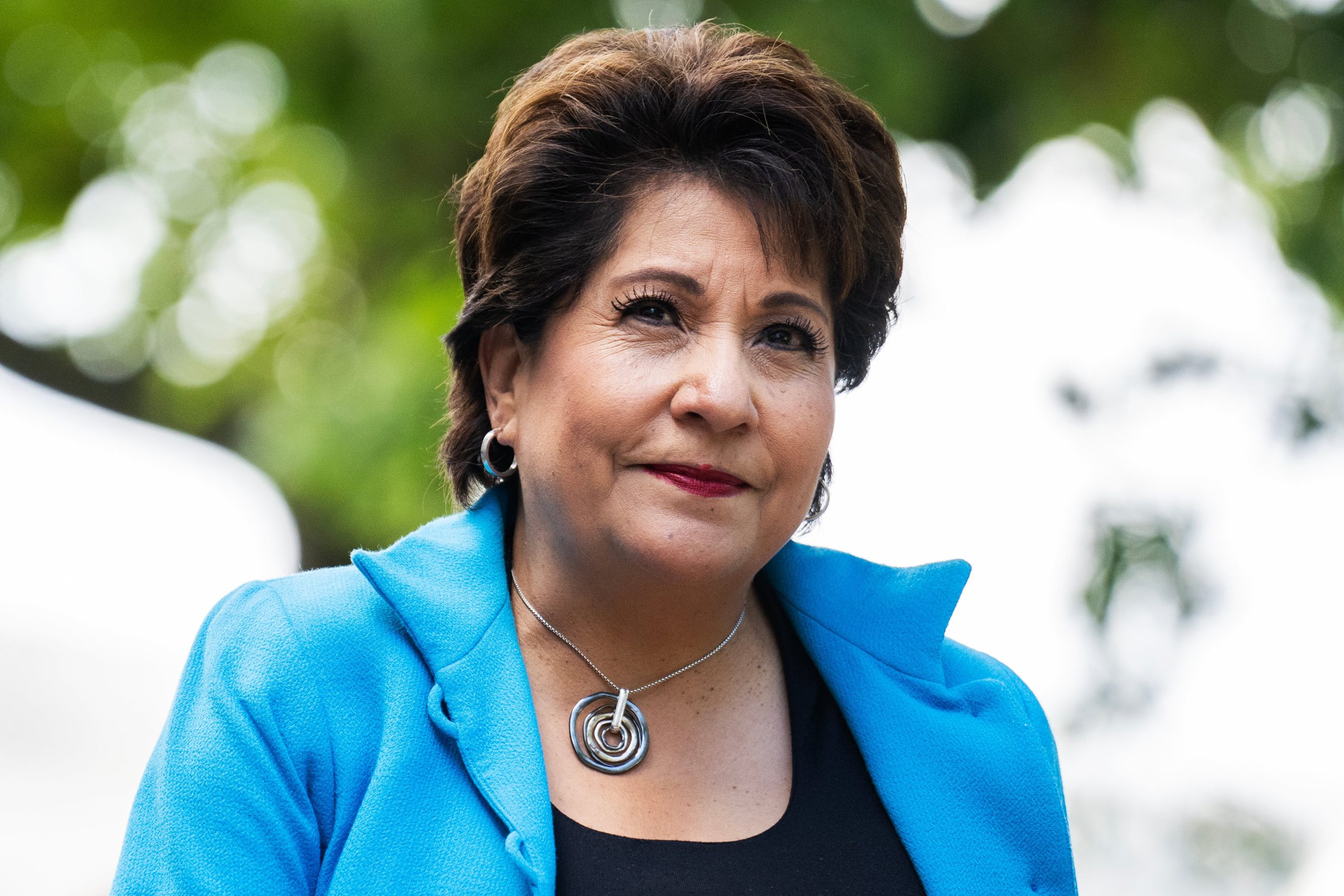
Two weeks ago, the Supreme Court dealt a severe blow to Black and Latino minorities in Louisiana, issuing a ruling that weakens the protections of the Voting Rights Act. The decision also legitimizes an aggressive redistricting effort in favor of the Republican Party that will dilute Black electoral power across the South, and by its broad reach, it strikes Latino voters equally. Days later, in Virginia, the state Supreme Court struck down a redistricting plan approved just weeks earlier by referendum, nullifying an electoral map redesign that would have allowed Democrats to gain seats through multiracial coalitions. Until then, recapturing the House of Representatives in November’s midterms had seemed almost certain. Now, no one is so sure.
Janet Murguía knows that all of this is very bad news. She has led UnidosUS, the largest Latino civil rights organization in the United States, for over 20 years. Rarely before has this minority — the largest in the country — faced a landscape this hostile: culture wars and openly aggressive policies driven from the highest levels of power. The primary target is undocumented immigrants who have crossed the southern border, but the assault reaches established Latino communities as well. And that is only one front: cuts to the health care system threaten to leave more than six million Latinos who depend on the Affordable Care Act without coverage; the Supreme Court is eroding their political representation; electoral disinformation pursues and confuses them at every turn. As Murguía says: “Misinformation is also a form of voter suppression.” In short, what’s at stake isn’t one political stance or another. It’s Latinos’ very ability to stand up for themselves. The Democratic Party’s lack of a coherent response only heightens the sense of urgency.
Murguía weighs the moment, chooses her battles, and sets her sights on what she considers the next critical juncture: the midterm elections.
Question. Over 600,000 deportations in the first year of Trump’s second term. That number has already surpassed his entire first presidency. What qualitatively differentiates these mass deportations from previous administrations, including Obama’s, which was also criticized for the harshness of its immigration enforcement? Let’s not forget Barack Obama was called the “deporter-in-chief.”
Answer. I would say it’s significantly different. This is an administration that has prioritized the policy and execution of mass deportations in a way that has an significant impact: not just from a moral perspective, not just from a civil rights perspective, but also from an economic perspective. And we’re seeing the culmination of all three of those related areas undermining the ability of our country to function and move forward. What we’re seeing is this extreme enforcement having a direct impact on the civil rights not only of our Latino community, but also on long-standing contributing immigrants, and on U.S. citizens. We’re seeing the government’s overreach and abuse impacting the entire country. This policy is a threat not only to people who look like immigrants, not only to Hispanic or Latino communities, but to every American. And I want to repeat this clearly: President Trump is targeting people who are workers and who are not criminals; people who have been described as essential workers to our economy, who have been contributing to this country for decades. That is precisely what he said he wasn’t going to do. The disruption this policy is causing in local economies is reverberating across the country, and it is undermining our overall economic strength in ways we are only beginning to fully understand.
Q. Why is a large part of the American electorate still supporting Trump? If you look at what happened in Minnesota, or what we’re seeing in Los Angeles, his support seems to be holding.
A. I don’t think we can say that a large part of the American electorate is still supporting Trump. Every poll we have seen nationally, including polls we have conducted, shows that the president is at his lowest approval rating in the history of his presidency, either in his first term or his second one. In an April poll we did with Third Way, Donald Trump’s approval rating with Latino and Hispanic voters is down by 34 points, with over 66% disapproving. On the economy, it’s close to 70%.

Q. You’re right. I should have been more precise. What I meant to ask is why his core MAGA base remains strong, despite some fractures among traditional Republicans.
A. I do think we’re seeing a splintering of sorts among traditional Republicans. What changed significantly was the Minnesota surge in enforcement, which tragically resulted in the killing, some would say the murder, of two U.S. citizens by ICE and CBP agents. We saw a political backlash from that moment. Even Republicans who had supported the hard line are now changing the way they talk about immigration because it has hurt them. And we will see that playing out in the primaries. The actions themselves have not changed dramatically, but the politics are beginning to catch up. I don’t think we’ll ever fully penetrate the MAGA base. But beyond that, we are seeing real fracturing among traditional Republicans who are acknowledging they need to approach this issue differently.
Q. Is there any real possibility that the administration moderates its immigration policy?
A. I don’t think so. They may talk about immigration differently, but the actions are unlikely to change. What I do see is institutional friction. In Congress, there is a standoff over funding for ICE precisely because guardrails have not been put in place: judicial warrants before entering homes without consent, clear identification by federal agents, protections for sensitive locations like schools, churches, and hospitals, body cameras with privacy protections and public access to footage. These are the guardrails we are insisting on, and so far there has been no agreement. Democrats have said they will not provide additional funding without them. That withholding of dollars can have some impact. But on the contrary, I do see this administration doubling and tripling down on another front: threats to elections, voter suppression, and what we are calling election subversion. If they can’t get their way on immigration, they are going to work very hard to challenge democratic norms and break them down in every way they can as it relates to elections. What we’re seeing play out right now with congressional redistricting maps is a sign of exactly that intent.

Q. You have documented that fewer than 10% of those detained in current raids have convictions for violent crimes. Is the national security narrative simply a cover for systematic racial profiling?
A. What we have seen, astonishingly, is the Supreme Court becoming so politicized that the court’s majority has given this administration the green light to use extreme tactics that anyone would describe as racial profiling: roving patrols stopping individuals based on appearance alone, without any probable cause beyond how they look. That would have been considered unconstitutional not long ago. The real catalyst for this administration’s actions has been this ruling by a Supreme Court that is acting in a political manner unlike anything we have seen in decades. That is what I think is contributing to so many of the changes we’re seeing, and why checks on the balance of power by this executive become even more important. It’s why the outcome of the midterm elections this coming November will be so consequential. We need to see whether Congress will ultimately assert its own authority and challenge this administration’s actions, many of which have been carried out by executive order, far beyond what the Constitution permits.
Q. Can citizen mobilization like the protests we saw in Minneapolis effectively pressure Congress to halt mass deportations?
A. I believe that citizen mobilization — people power, to use a phrase that’s popular right now — using our voice to mobilize, to protest peacefully, to resist in a nonviolent way, is essential. A lot of the work we’ve been doing has been part of coalitions that challenge these extreme and unconstitutional enforcement actions where we can, providing training so that people know their rights and know how to document what is happening. That very evidence, video representations of what has occurred, helps us make the case for what is true and what is not. We know that this administration, and certainly under the helm of former DHS Secretary Kristi Noem, blatantly lied about what occurred in some of these enforcement actions. Being the eyes, the ears, and the voice of people who cannot speak for themselves is something we can all do, and it can make a difference. But beyond that, we firmly believe that our vote ultimately can change things. If we’ve learned anything in these past years, it’s that who we elect matters in a very big way in terms of how our government leads and the impact its actions have on its citizenry. The November elections may be among the most important we have ever had.
Q. Looking ahead to the midterms, what is your concrete strategy to mobilize the Latino vote in key states like Arizona, Nevada, Georgia, and Pennsylvania? And how do you plan to counter the disinformation that is circulating about candidates, issues, and the voting process itself?
A. Over the last 10 to 12 years, we’ve registered over a million Hispanic voters, and we are going to continue to build on that record. We’re working in coalition with other organizations that have deep community-based connections, and voter turnout will be our top priority this year. But registration is not enough. We have to mobilize, inform, and fight disinformation. And in this cycle, disinformation is one of the biggest obstacles we face. So much of what we’re up against is the misinformation about candidates, about issues, and about actual voting processes. That is why trusted organizations like ours that are rooted in community matter so much. We are not an app or a social media account. When people don’t know who to trust, they tend to turn to those who have been there for them. We’ve been advocates for our community for decades, and we’re going to count on that authenticity as we communicate with them. We will also be using every social media platform that our community looks to. At the end of the day, people are going to turn to those who have helped them and their communities to make distinctions. We are going to make sure they are getting truthful, accurate information about how to vote, when to vote, and what is at stake.
Q. Recent analysis shows Black voters’ identification with the Democratic Party fell from 77% in 2020 to 66% in 2023. And 40% of Latino voters who voted for Trump in 2024 now consider it a mistake. Do you fear this simultaneous partisan realignment becomes an existential crisis for Democrats in 2026 and 2028?

A. There is a lot of disillusionment with the Democratic Party, and I think we have to acknowledge that plainly. In the Texas primaries this past spring, we did polling and post-election interviews, and what we found was that over 50% of Hispanic voters were not contacted by either party or either candidate. That is something both parties should be ashamed of. Democrats cannot take comfort in the fact that a lot of people are dissatisfied with President Trump and the Republican Party right now. They need to paint a vision for this country, one where Latino voters, where African American voters, see themselves as a central part of the future. And that means, inevitably, overcoming their fear of immigration. When a party is afraid of an issue, it does not lead on that issue. Democrats need to reset and think seriously about an immigration solution that is integrally tied to the economic future of this country, one that recognizes we need more workers, not fewer, and that moving a generation of people who have worked and contributed out of the shadows is not only morally right, it is an economic imperative. Until we see that kind of leadership, I don’t know that we’ll see the full-throated engagement our community needs and deserves.
Q. Latinos generate over $3 trillion in economic output, larger than all but four of the world’s largest economies. Why doesn’t that economic power translate into proportional political power?
A. The figure is $4.1 trillion. And the answer is the systematic underinvestment in our civic engagement. It is a pattern that repeats itself, and what we saw in Texas is not an exception. Both parties have underinvested in registering our community, in mobilizing eligible Latino voters, in doing the meaningful outreach that would actually move people to the polls. And now we have a new and serious threat layered on top of that: the Supreme Court’s recent decision in Louisiana v. Callais, which essentially eviscerated the safeguards Congress had enacted to protect the voting power of minority communities. That case was highlighted with Black voters in the South, but the decision will impact Hispanic representation in California, Arizona, Texas, New York, and other states across this country. So we are facing both an economic resource challenge and direct threats to our constitutional protections. But we are going to continue to engage, and to do our part to make sure that more Latino and Hispanic voters are represented in these elections.
Q. You grew up in Kansas and have said your family embodied the American dream. For millions of Latinos today, that dream seems out of reach. What is the Latino dream in 2026, and how does it differ from the traditional American dream?
A. I don’t think it differs a lot from the traditional American dream. What I do believe is that there is a very real threat to that dream today, from both an economic and a civil rights perspective. But our community does not give up easily on the big dreams and hopes they have for their future, and for their families and their children. We have proven that we are willing to work hard and sacrifice for it, that we have been resilient through all of this. The dream is still centered on what it has always been: access to health care, to education, a job, a home. Economic opportunity is central to breaking down barriers and creating a future for our community, and we have more than shown that we are worthy of that chance, and that our contributions benefit this country. But we need to be able to show our families that those contributions will benefit their lives too. We are never, ever going to give up on keeping that dream alive. It is being threatened, there is no doubt about it. But we will continue to fight for it.
Q. And not only economically. The cultural space seems to be under threat as well, the ability to contribute and be recognized culturally within this society. If that space is denied, it becomes much harder to truly belong and to thrive.
A. You’re right, and it’s an important point. Beyond the immigration policies, what we are seeing from this administration is an effort, and I’m not going to shy away from saying this, that goes beyond flirting with white supremacy and white nationalism. There are key representatives in this White House with ties to people who do not recognize the contributions of our community and want to minimize our future ability to make them. That is a deeply worrisome and concerning challenge. But in the meantime, we are going to continue to focus on what we can do to see a shift and a real check on the balance of power of this administration, which we believe has acted in ways that are unlawful and unconstitutional. That fight is not only about policy. It is about who we are, and about the place we have earned in this country.
Boris Muñoz is a journalist and editor. He founded and led the Opinion section of The New York Times en Español. He is a columnist for EL PAÍS.
Sign up for our weekly newsletter to get more English-language news coverage from EL PAÍS USA Edition
Cuba
US Supreme Court Paves Way For Companies Affected By Fidel Castro’s Expropriations To Seek Compensation From Cuba

The justices ruled in favor of Havana Docks Corporation receiving compensation after the nationalization of its docks in 1960


A new twist in the tensions between the United States and Cuba. The U.S. Supreme Court ruled on Thursday in favor of a U.S. company whose docks were confiscated by the Castro regime in 1960 after Fidel Castro came to power. The court’s decision — in a case openly supported by U.S. President Donald Trump — opens the door to future claims by other U.S. firms and citizens affected during the wave of expropriations carried out in the early years of the Cuban Revolution.
The ruling passed by a vote of eight to one. The company in question is Havana Docks Corporation. The decision comes amid the White House’s campaign to pressure Cuba, which is gripped by a severe economic and humanitarian crisis. It also comes one day after the U.S. Department of Justice indicted former president Raúl Castro (2008–2018) for his alleged role in the 1996 downing of two planes belonging to the Brothers to the Rescue organization, in which four people were killed.
This is a breaking story. Please refresh your browser for more updates.
Archived In

E

Barcelona Pauses New 24 Hour Supermarkets
Protesters March In Madrid Over Soaring Housing Costs


-

 Competiciones3 weeks ago
E
-
blackout April 20252 weeks ago
Insurance company Mapfre decides to pay out €14 million compensation for 2025 blackout
-
Costa del Sol4 weeks ago
Why home care is the new gold standard for living well in Spain
-
 Foreign demand2 weeks ago
Who Bought Where In The Second Half Of 2025?
-

 America3 weeks ago
E
-

 New Developments3 weeks ago
Luxury Villas For Sale, Estepona – ProjectL1
-

 New Developments3 weeks ago
Stylish 3-Bedroom Apartment With Panoramic Sea Views – Benalmádena
-

 Holiday rentals4 weeks ago
Why Removing Tourist Lets Isn’t Fixing Spain’s Rental Shortage