Connect with us

%

Malaga Province Rockfall Tragedy In Orange Alert

Published

on

malaga-province-rockfall-tragedy-in-orange-alert

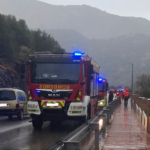
Fire crews arrive at scene of avalanche. Credit: Junta

A 41-year-old man has died after a large rock fell onto his car during Monday’s torrential rain in Malaga province, prompting renewed warnings about the dangers of driving in extreme weather.

Three other occupants of the vehicle, two men aged 21 and a woman aged 19, were injured in the incident on the MA-8400 road between Benaojan and Estacion de Benaojan, near Ronda, on Monday, October 19. They were taken to hospital for treatment, according to Andalucia’s 112 emergency service.

The accident happened at around 4.11pm, when a rock broke away from a hillside and struck the vehicle. The Guardia Civil, provincial firefighters and medical teams were called to the scene.

Orange weather alerts mean serious danger

The tragedy occurred as parts of Malaga province were experiencing intense rain and thunderstorms. The Spanish weather agency AEMET had issued orange warnings for areas including Ronda, with further warnings covering the Sol and Guadalhorce districts as the storm developed.

An orange weather warning is not simply advice to take an umbrella. AEMET classifies it as a level of important danger, meaning weather conditions could cause serious harm, particularly to people in exposed locations.

Heavy rain can make roads treacherous within minutes. Water reduces tyre grip, increases stopping distances and can cause aquaplaning. On rural and mountain roads, intense downpours can also contribute to flash flooding, landslides and falling rocks or branches. Drivers should remember that even a familiar route can become dangerous when conditions change rapidly.

What should drivers do in extreme rain?

Spain’s Directorate-General for Traffic (DGT) advises motorists to reduce their speed, increase the distance from the vehicle in front and use dipped headlights so they can be seen more easily.

Its recommendations also include:

  • Avoid unnecessary journeys: If an orange warning is in force and conditions are deteriorating, consider postponing non-essential travel.
  • Never drive through floodwater: Water depth and the condition of the road beneath it can be difficult to judge.
  • Watch for falling debris: Take particular care on roads beneath steep slopes, cliffs and exposed rock faces.
  • Avoid sudden braking: Smooth driving helps reduce the risk of losing grip on wet surfaces.
  • Stop safely if visibility becomes dangerous: Pull completely off the carriageway at a suitable place and wait for conditions to improve. Never stop in a live traffic lane.

Check the forecast before setting off

Drivers in Spain can check the latest warnings on the official AEMET website and road conditions through the DGT. Weather alerts can change during the day, so checking before departure is not always enough if a journey is lengthy.

The Benaojan accident is a stark reminder that dangerous weather is not confined to flooded streets and motorways. On exposed mountain roads, falling rocks can pose a potentially fatal risk. When an orange warning is in force, the safest journey may be the one that can wait.

%

Spain Raises Child Maintenance Aid To €300

Published

on

spain-raises-child-maintenance-aid-to-e300

Spain raises unpaid child maintenance support to €300 a month for eligible families. Credit : Lordn, Shutterstock

Children in Spain whose parent fails to pay court-ordered maintenance could receive up to €300 a month from the state under new rules approved by the Government. The maximum advance has risen from €100, and support can continue until the child turns 18 if the maintenance obligation is still in force.

The change is part of a wider package of social protection measures approved by Spain’s Council of Ministers on Tuesday, October 20. It is designed to provide greater financial security for children whose parents fail to meet their legal obligations following a separation, divorce or other court proceedings.

According to an official announcement by Spain’s Ministry of Inclusion, Social Security and Migration, the government has approved an increase in the maximum monthly advance available through the Fondo de Garantía del Pago de Alimentos, or Child Maintenance Guarantee Fund.

The reform does not mean that every single parent in Spain will automatically receive €300. The payments are intended for eligible families where court-ordered child maintenance has not been paid, and the amount depends on the maintenance awarded and the applicable conditions.

Who can receive up to €300 in child maintenance support in Spain?

Spain’s Child Maintenance Guarantee Fund provides financial advances to protect children when a parent fails to pay maintenance ordered by a court.

The scheme applies to qualifying cases involving divorce, separation, marriage annulment and legal proceedings concerning parentage or child maintenance.

Previously, the maximum payment was €100 per month for each eligible child. Under the reform approved on October 20, that ceiling increases to €300.

This is a maximum rather than a fixed entitlement. For example, if a court has ordered a parent to pay €200 a month in maintenance, the fund would not automatically provide €300. The amount of the court order remains relevant when determining the advance.

Families must also meet eligibility requirements, including financial conditions. Eligibility also depends on household income, meaning that not every family affected by unpaid maintenance will qualify for financial support.

The fund is particularly important for parents who have primary responsibility for their children but cannot rely on maintenance payments arriving regularly.

However, it is not the same as a general child benefit or a payment available to every separated parent. Applicants need to demonstrate that the maintenance obligation exists and that the required payments have not been made.

The advances are provided by the state, rather than representing an increase in the amount that a court has ordered the non-paying parent to contribute.

How long can families receive the payments under the new rules?

The second major change concerns the duration of support.

Until now, advances from the fund were limited to a maximum of 18 months, whether those months were consecutive or spread over a longer period.

The government has approved the removal of that limit. Under the approved reform, advances can continue until the maintenance obligation ends, but no later than the beneficiary’s 18th birthday.

This could make a substantial difference for families dealing with prolonged non-payment, rather than a temporary interruption in financial support.

Families considering a first application should nevertheless check the official requirements, including income limits, documentation and evidence of unpaid maintenance.

The reform was approved by the Council of Ministers on October 20. Its practical application depends on the legal text and its entry into force, so families should not assume that the higher amount is already available for payment.

The announcement forms part of a broader reform of Spain’s social protection system. Other measures include changes to support for parents caring for seriously ill children, protections for women affected by certain incapacitating health conditions, and expanded access to survivor benefits.

The government has also approved changes affecting unmarried couples with children who may qualify for a widow’s or widower’s pension. Euro Weekly News has separately reported on how unmarried parents previously refused Spain’s widow’s pension could benefit from the changes.

For parents in Spain facing unpaid child maintenance, however, the immediate significance of the latest announcement is the combination of a higher monthly ceiling and a potentially much longer period of financial support.

Instead of being restricted to €100 a month for a maximum of 18 months, eligible families could receive advances of up to €300 per child each month while the qualifying maintenance obligation continues, within the new age limit.

Continue Reading

%

Brits In Spain Could See Their Healthcare, Rent And Taxes Change Under A New PP And Vox Government

Published

on

brits-in-spain-could-see-their-healthcare,-rent-and-taxes-change-under-a-new-pp-and-vox-government

Healthcare, rent and tax could all be affected by the result on November 29. Credit: Partido Popular / Flickr

Most British residents in Spain don’t get a vote on Sunday November 29, yet the result could still reach their healthcare, rent and tax bills. With polls pointing to a possible PP and Vox majority, here’s what’s been said, what’s only speculation and what Madrid can’t change alone.

Healthcare comments target people without legal residence 

Healthcare is where the parties have said the most so far. Vox wants to remove the legal right to public healthcare for foreigners without legal residence. PP leader Alberto Núñez Feijóo said ‘irregular status cannot give rise to rights’, while PP MP Antonio Román said healthcare belongs to ‘those who abide by the law, pay their taxes and have legal residence’. Román added that emergency care would still be on the table.

However, those comments concern people without legal residence, and the report doesn’t say legal residents would be affected. 

The two parties aren’t identical on this though, as the PP voted against a Vox motion in April that would have tied migrants’ healthcare access to years of social security contributions. In regional deals in Extremadura and Aragón, PP and Vox agreed to review the cost of healthcare for foreign nationals, and not to exclude them. Vox has also made ‘national priority’ one of its three campaign themes, although its Estepona rally on Monday October 12 didn’t spell out what that would mean in practice. 

Rent caps and evictions could be rewritten

The snap election was called after PP and Vox voted down the government’s emergency housing measures. Now analysts expect a right-wing government to repeal parts of the Housing Law (Ley de Vivienda), which would remove rent caps, and say both parties have promised tougher and faster evictions.

That could cut both ways, with British landlords likely to gain and British tenants facing higher rents. These are the analysts’ predictions though, and not confirmed policy. 

Tax cuts are possible, but nothing is confirmed 

The same analysts say the PP has historically favoured cutting or scrapping the wealth tax and the temporary solidarity tax on large fortunes. Several PP-run regions have already cut inheritance and gift taxes, and a national government could go further. 

Again, that’s an expectation and not a pledge. 

Residency paperwork is partly out of Madrid’s hands 

The analysts suggest a new government reshuffling ministries or immigration rules could cause delays for residency renewals and Non-Lucrative Visas. The Golden Visa, which the current government plans to scrap, could also be reversed. 

However, the 90/180-day rule (the limit on visitor stays) is EU law, so no Spanish government can change it alone.

The polls point in different directions 

PolitPro’s election trend, updated on Monday October 19, puts the PP in front. Two polls published on Friday October 9 suggested the PP and Vox together would win about 198 seats (El País) and 200 seats (El Confidencial), above the 176 needed for a majority.

However, the state-run Centre for Sociological Research (CIS) poll on Wednesday October 14 had the PSOE (Pedro Sanchez’s party) on 34 per cent against 22.2 per cent for the PP, a lead of nearly 12 points. Meanwhile one SocioMétrica simulation for El Español gives Sánchez just a 0.1 per cent chance of stopping a right-wing absolute majority, with the PP 25 seats ahead of the PSOE.

Any coalition deal after the vote will show which of these ideas survive, and that’s when British residents will find out what, if anything, changes for them.

Continue Reading

%

The Region Of Murcia Food Bank Launches Autumn Appeal For Volunteers

Published

on

the-region-of-murcia-food-bank-launches-autumn-appeal-for-volunteers

Murcia food bank seeks volunteers to support vulnerable families this autumn. Photo Credit: Region of Murcia Food Bank

The Region of Murcia Food Bank is preparing a new wave of food collections in the municipality of Cartagena and across the region this autumn, calling on residents to volunteer their time and help support people struggling to afford everyday essentials.

Food bank calls for volunteers across the region this autumn

The initiative, called the ‘autumn of solidarity’, comes ahead of Spain’s annual Gran Recogida de Alimentos, one of the country’s largest charitable food collection campaigns. This year, the nationwide drive will take place from November 13 to 15, with food banks across Spain seeking around 80,000 volunteers to help make the collections possible.

How residents can support the national food collection

Volunteers will play a crucial role during these food collection campaigns, helping at participating supermarkets, explaining how shoppers can contribute and receiving donated products. Even a few hours of support can help ensure that more donations reach the people who need them. No previous experience is required to take part in the national campaign, making it an accessible way for newcomers and long-term residents alike to get involved in their local community.

The Region of Murcia Food Bank also relies on volunteers throughout the year. Its work involves receiving, sorting, storing and distributing donated food to organisations supporting vulnerable people. Volunteers can contribute through practical tasks, specialist skills or support for individual campaigns.

Cartagena community efforts deliver thousands of kilogrammes of food

Food banks help charities and community organisations provide essential supplies to households facing financial difficulties. Cartagena has already demonstrated the impact of collective action. A food collection organised by the municipality’s Youth Department in February raised 5,910 kilogrammes of food, with contributions from youth associations and other local groups. The donations went towards vulnerable families and organisations.

Expats encouraged to support local families this autumn

For locals, expatriates, and visitors to the Costa Calida, the campaign offers an opportunity to support the community they call home. Whether by volunteering during a supermarket collection or contributing food, every effort can help local organisations continue their work.

Residents interested in volunteering can find further information through the Region of Murcia Food Bank’s official website, as well as the national food bank federation’s Gran Recogida de Alimentos campaign.

Continue Reading

Trending

Copyright © 2017 Spanish Property & News