
%
Mallorca Solar Eclipse 2026

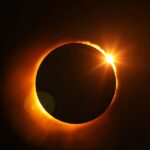
Island will offer one of Europe’s most remarkable seats for this rare celestial event – but where should you watch it from?! Credit: Shutterstock/shabir5645
On Wednesday August 12 2026, Mallorca will become one of the few places in Europe to witness a total solar eclipse, with around 90 seconds of totality transforming the island’s skies just before sunset. But unlike many astronomical events, the best view won’t simply depend on where you are on the island, it will depend on whether you have a clear view of the western horizon.
Because the eclipse reaches totality as the sun sits just a few degrees above the horizon, even a nearby hill, apartment block or line of trees could block the most dramatic moments. However, an open west-facing coastline or elevated viewpoint could provide a spectacular front-row seat to one of Europe’s rarest celestial events.
Fortunately, planning that perfect view has become much easier. Rather than recommending one official viewing spot, AstroMallorca, the island’s leading astronomy association, has launched Horitzó 2026, a free online tool that allows residents and visitors to check whether the eclipse will be visible from their chosen location. By analysing the surrounding terrain, the website helps users find a viewing point with a clear western horizon before eclipse day.
The Balearic Government is also working alongside AstroMallorca, local councils and emergency services to prepare around 30 designated Safe Observation Zones across the Balearic Islands, with the locations expected to be announced closer to the event.
The areas expected to offer Mallorca’s clearest views
Although there is no official list of “best places” to watch the eclipse, Mallorca’s geography naturally favours some parts of the island over others.
The Serra de Tramuntana is widely regarded as offering some of the strongest viewing conditions thanks to its elevated west-facing slopes overlooking the Mediterranean. Municipalities including Andratx, Banyalbufar, Estellencs, Deià, Valldemossa, Sóller, Fornalutx, Escorca and Pollença all benefit from topography that provides open views towards the setting Sun.
The southwest coast is also expected to offer excellent visibility, particularly where the coastline opens directly onto the sea.
Further south, the stretch between Cap de Regana and Cap Blanc, together with the coastline from Colònia de Sant Jordi to Cap de ses Salines, provides long, uninterrupted horizons with very little surrounding terrain, making these areas another strong option for eclipse viewing.
Rather than chasing one famous landmark, astronomers say almost any safe location with an open western horizon could provide an exceptional experience.
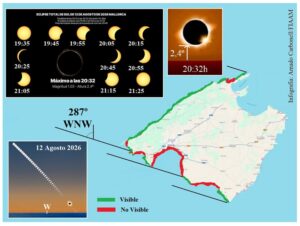
Credit: FIAMM
Will Palma still get a good view?
Yes but choosing the right location will be more important than choosing the right town.
Palma sits within the path of totality and is expected to experience around one minute and 36 seconds of darkness.
However, because the Sun will be so low above the horizon, visibility may vary significantly across the city. Waterfront areas with open views towards the west are likely to offer a better experience than streets where buildings, trees or surrounding hills block the skyline.
The same advice applies to Calvià and Llucmajor, where careful positioning may be the difference between witnessing totality or missing it altogether.
Some inland locations may offer weaker views
While the eclipse will technically be visible across Mallorca, not every part of the island offers the same viewing conditions.
Inland valleys and areas surrounded by higher ground may experience partially obstructed views because of the island’s topography. Since totality occurs just minutes before sunset, even relatively low hills can hide the Sun before the most dramatic phase begins.
For anyone staying inland, it may be worth travelling to a nearby coastal viewpoint or elevated west-facing location with a clearer horizon.
What time will the eclipse happen?
The eclipse will take place during the evening of August 12, 2026, with the partial phase beginning at around 7.30pm.
Totality is expected at approximately 8.30-8.31pm, lasting around 90 seconds, before the sun sets just a few minutes later.
Because the eclipse happens so close to sunset, Mallorca’s western horizon becomes just as important as the weather forecast.
Special eclipse experiences already on sale
Several Mallorca businesses are already preparing special experiences for the event.
The historic Sóller Railway has launched an exclusive €220 eclipse package, including a journey on its iconic wooden train from Palma, a tram ride through Sóller and a boat trip from the Port of Sóller to watch the eclipse from the Mediterranean.
Meanwhile, the historic sailing vessel Rafael Verdera is offering both day trips and multi-day eclipse voyages, allowing passengers to experience totality from open water with uninterrupted views of the horizon.
Plan ahead for eclipse day
Astronomers say a little preparation could make a huge difference.
Choose a location with a completely unobstructed west-facing horizon, rather than simply heading to the island’s most famous viewpoint.
Arrive early, especially if you’re planning to watch from the Serra de Tramuntana or the southwest coast, as roads, parking areas and popular viewpoints are expected to become extremely busy.
Only use certified eclipse glasses when viewing the sun outside the brief period of totality, and if you’re photographing the event, make sure your camera is fitted with an appropriate solar filter.
Visitors should also expect accommodation and transport demand to increase significantly during eclipse week, with many organised excursions already on sale.
For around 90 remarkable seconds, daylight will disappear over Mallorca before the Sun sinks below the Mediterranean. The island’s own astronomers say the secret isn’t finding the most famous viewpoint… it’s finding the clearest horizon.
Mallorca eclipse checklist
✔ Pick your viewpoint early
Don’t wait until eclipse day. Visit your chosen location beforehand and check that you have a completely unobstructed view of the western horizon.
✔ Aim for the west coast or south coast
Areas in the Serra de Tramuntana, the southwest coast and the coastline between Cap de Regana, Cap Blanc and Colònia de Sant Jordi are expected to offer some of Mallorca’s clearest horizons.
✔ Check your exact position
Even within the same town, visibility can vary. A nearby building, hillside or line of trees could block the low evening Sun.
✔ Arrive well ahead of time
Roads, parking and popular viewpoints are expected to be extremely busy. If you’re heading to the Tramuntana, Cap Blanc or another well-known location, allow several extra hours.
✔ Pack the essentials
- Certified solar eclipse glasses
- Water and snacks
- Sun cream and a hat
- Fully charged phone and power bank
- Fold-up chair or picnic blanket
- Torch if you’re walking back after sunset
✔ Watch the timing
- Partial eclipse begins: around 7.30pm
- Totality: around 8.30–8.31pm
- Duration of totality: around 90 seconds
- Sunset follows just minutes later
✔ Stay safe
Never look directly at the sun without certified eclipse glasses, except during the brief period of totality.
✔ Expect a busy island
Hotels, restaurants, public transport and organised excursions are expected to be much busier than a normal August evening, so book ahead wherever possible.












Dos Heridos, Uno Grave, En Un Tiroteo En Barcelona, Donde Se Busca Al Agresor

Milagro En La Iglesia De La Guaira: “Dios Quiso Que Nos Salváramos”

Panamá – Inglaterra, En Directo | El Partido Del Grupo L Del Mundial 2026, En Vivo
Torremolinos installs smart traffic lights on its beaches to warn about UV radiation levels
Dinosaurs are roaring over to Estepona this summer in a massive 5,000m² exhibition
Drivers in Spain warned: This mistake could cost you €1,000 and six licence points this summer


-
Costa del Sol2 weeks ago
Torremolinos installs smart traffic lights on its beaches to warn about UV radiation levels
-
Costa del Sol7 days ago
Dinosaurs are roaring over to Estepona this summer in a massive 5,000m² exhibition
-
Alcohol limits Spain2 weeks ago
Drivers in Spain warned: This mistake could cost you €1,000 and six licence points this summer
-

 %1 week ago
Families Caring For Elderly Parents In Spain Say Brexit Has Left Them With Impossible Choices
-

 Uncategorized2 weeks ago
Max Verstappen rules out Nurburgring return after 24 hour-heartbreak
-

 %1 week ago
One Of Spain’s Top Supermarkets Has Just Been Ranked Among Europe’s Most Innovative In A Major New Report
-
Latest1 week ago
KEY POINTS: What Changes About Life In Spain In July 2026
-
 ElPais1 week ago
Primary Elections In New York, Maryland, And Utah: Date And How To Vote