
Mercadona
Mercadona’s trial checkout rule could mean lifting everything, including heavy items, onto the belt

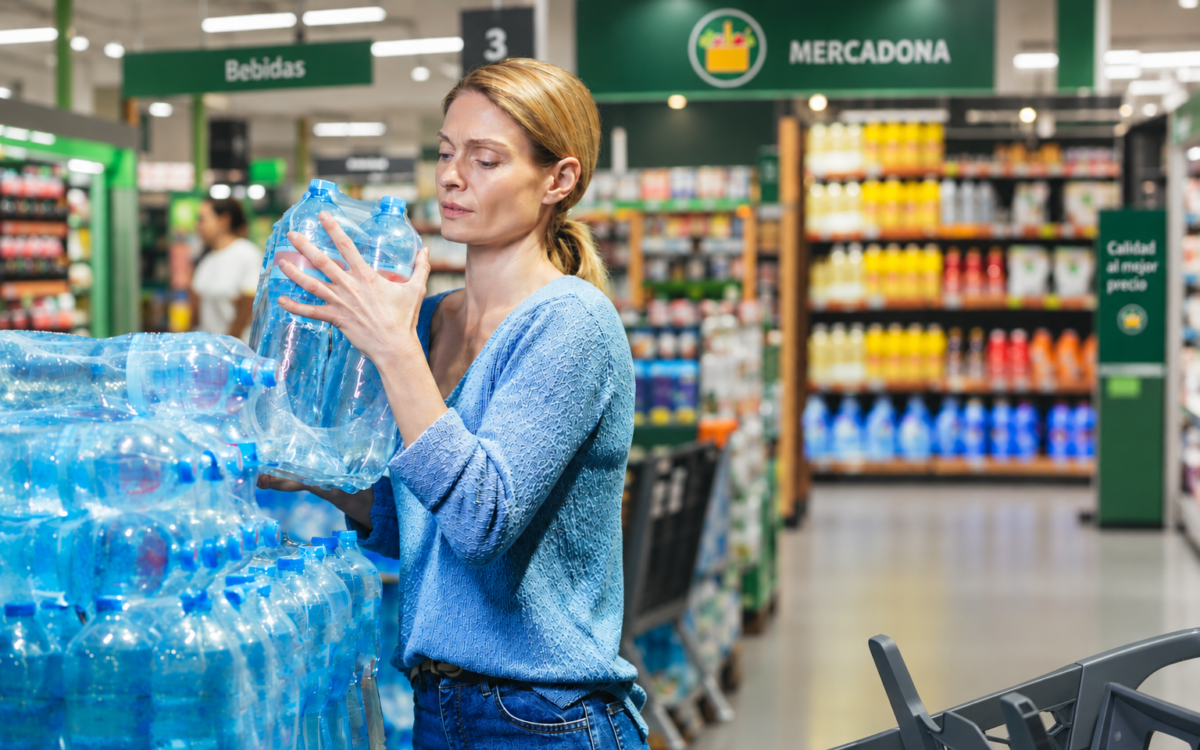
Mercadona is testing a new checkout system in Spain that could leave shoppers with a bit of weight-lifting before they can pay for their groceries.
Customers at one trial store are being told to take everything out of their trolley and put it on the checkout conveyor belt, no matter how big, including heavy items that would normally stay in the trolley while the cashier scans them.
For shoppers buying several packs of bottled water, boxes of milk, large pet food sacks or other bulky goods, that could mean considerably more lifting at the till.
Why is Mercadona changing its checkout system?
Mercadona confirmed that it is testing the new procedure at its supermarket in San Martin de Valdeiglesias, Madrid, after a customer complained about being asked to remove six-bottle packs of sparkling water and large water containers from her trolley.
Normally, when shoppers have several identical heavy products, a cashier can scan one item and enter the number being purchased. That means customers do not have to lift every heavy pack onto the belt.
Under the trial system, however, products that are still in the trolley have to be taken out and placed on the conveyor for scanning. Mercadona says the idea is to allow the cashier to check that the trolley has been completely emptied and to make sure everything has been correctly charged and that there are no sneaky packs of ham under the milk cartons. That may sound like a small change, but it could make a difference to anyone doing a large weekly shop.
What happens with heavy and bulky supermarket items?
A trolley is designed to make carrying heavy shopping easier. A shopper can put a large sack of dog food, a pack of six water bottles or several cartons of milk into the bottom and push the whole lot around the supermarket. Moving those items onto a checkout belt is a different matter.
A six-pack of large water bottles can weigh several kilograms, while bigger water containers and large bags of pet food can be awkward as well as heavy. Anyone buying several of them could suddenly find themselves lifting the same items twice, first onto the conveyor and then back into the trolley or bags after payment.
Mercadona has not published a weight limit for the conveyor belts as part of its announcement, so there is no evidence that all the belts are unsuitable for these products.
There is also no indication from the company that heavy products are falling from the belts. The practical question for shoppers is simply whether bulky items can be placed safely and comfortably on the conveyor without rolling, sliding or knocking into other shopping.
What if you cannot lift the shopping?
Mercadona appears to have considered that problem. Customers who find it difficult to empty their trolley themselves can ask the checkout worker for help, according to information given by the company about the trial. That could be essential for older shoppers or anyone who struggles with heavy lifting.
It also means customers should not assume that being unable to lift a large bag of pet food or a pack of water means they have to leave it in the trolley. Staff can help with the unloading process.
Is this new Mercadona rule coming everywhere?
Not yet. Mercadona has described the system as a trial, and the company has not announced that it will be introduced across all its Spanish supermarkets. The San Martin de Valdeiglesias store is the location specifically identified in the reports about the experiment.
For British expats in Spain, that means there is no need to start lifting every heavy purchase onto the conveyor at their local Mercadona unless their particular store tells them to do so.
Considering the latest fashion in many branches of Mercadona these days is post-exercise gym wear, perhaps the management thinks all customers are ready for some weight-lifting at the till. For now, however, the message is fairly simple: if your Mercadona asks you to empty the trolley completely, even the heavy stuff has to come out, but staff can help if you cannot manage it yourself.







Amancio Ortega
Los Españoles Desconfian De Los Tecnoligarcas Y Aprueban A Los Grandes Empresarios Locales, Con Amancio Ortega Y Juan Roig A La Cabeza



Huevos Guillén is already one of Spain’s leading egg producers. Photo credit: AlbHen/Shutterstock
Finally, some real happy news for those of us who care about where our food comes from and, more importantly, how the animals behind it are treated. We cannot change every farming practice overnight, but when one of Spain’s biggest egg producers commits hundreds of millions of euros to moving away from cages, it is a change worth celebrating.
Huevos Guillén, a major supplier of eggs to Mercadona, has announced a €200 million investment over the next four years, with the ultimate aim of producing its eggs entirely through cage-free systems. The company says the investment will help it reach 10 million laying hens by the end of 2030.
Millions of hens set for a different life
For the hens, the change is about far more than what is printed on the supermarket shelf. Cage-free systems allow laying hens to move around within their housing rather than being confined to conventional cages. Depending on the system, hens can walk, perch and interact with other birds in a much less restrictive environment. Huevos Guillén says 80 per cent of its 6.13 million hens will be housed in cage-free systems by the end of 2026. That compares with 73 per cent in 2025 and 60 per cent in 2024, showing how quickly the company is increasing its alternative production.
The producer expects to be close to 100 million dozen cage-free eggs this year, an increase of 28.6 per cent. Around 93 per cent of that production is destined for Mercadona, meaning the change will reach a huge number of shoppers across Spain. And there is an even bigger target ahead, Huevos Guillén has set 2028 as its target for all of its fresh eggs sold to consumers to come from cage-free systems, although it stresses that this depends on administrative permits being granted according to the expected timetable.
New farms designed for cage-free production
Part of the investment will go towards creating new facilities specifically designed around alternative production systems. One of the most significant is a €14.5 million free-range farm in Ribera del Fresno, Badajoz, which will eventually have capacity for 320,000 hens. The farm will consist of eight laying sheds and five production areas, with the hens able to move freely between the buildings and designated outdoor areas. The planned outdoor space provides a minimum of four square metres per hen.
At full capacity, the farm is expected to produce almost 97 million eggs a year. Its development was given environmental approval by the Junta de Extremadura earlier this year, followed by planning compatibility approval from the Ribera del Fresno town hall. The company is also expanding its cage-free operations elsewhere in Spain, adding capacity as it works towards its longer-term target.
A major change for supermarket shoppers
For people who deliberately check egg packaging before putting it in their trolley, this investment could make choosing higher-welfare options considerably easier. Huevos Guillén is already one of Spain’s leading egg producers and says its farms are certified for animal welfare under the AENOR Welfair Quality system. Its stated aim is now to move its entire egg production to cage-free systems.
The €200 million programme is also not the company’s first major investment in changing its production model. Huevos Guillén says it has already carried out projects worth almost €216 million over the past decade, with the move towards cage-free production forming an important part of that investment.
Cage-free eggs are becoming easier to find
The Spanish egg industry is moving in the same direction. In April, the sector organisation Inprovo said cage-free systems had increased by more than 10 per cent over the previous year, with alternative systems accounting for around 40 per cent of production. But this particular announcement is significant because of the sheer scale of the operation.
If Huevos Guillén reaches its targets, millions of hens will no longer be kept in conventional cages, while the producer supplying a huge proportion of its cage-free eggs to Mercadona moves towards an entirely cage-free future. For consumers, that means something simple but important: the next time you reach for a carton of eggs, there is a much better chance that the hens behind them have had more space, greater freedom of movement and a less restrictive life. After so much bad news about animal welfare, that really is something worth being happy about.

Un Barcelona Muy Atlético Se Venga Del Valencia Y Accede A La Final De La Supercopa
Breaking point for Spanish farmers as soaring diesel costs threaten to bring roads to a standstill
You can put your hands on Toby Govan’s stone sculptures in Estepona until September 30

EXPLAINER: Inside The Row Over The Right-Wing Mayor Of Madrid’s €6m Penthouse – And Why It Could Offer A Lifeline To Pedro Sanchez

Stylish 3-Bedroom Apartment With Panoramic Sea Views – Benalmádena
Ibiza council hits illegal tourist rental with €793,000 fine – but will the owner pay that much?


-
 Chamberi2 weeks ago
EXPLAINER: Inside The Row Over The Right-Wing Mayor Of Madrid’s €6m Penthouse – And Why It Could Offer A Lifeline To Pedro Sanchez
-
 New Developments2 weeks ago
Stylish 3-Bedroom Apartment With Panoramic Sea Views – Benalmádena
-
Holiday rentals1 week ago
Ibiza council hits illegal tourist rental with €793,000 fine – but will the owner pay that much?
-

 Energy efficiency & certificates1 week ago
94% Of Spanish Homes Are Energy Inefficient – Could Tighter Rules Be Coming?
-
bravery2 weeks ago
10-year-old jumps from burning French farmhouse, saves two dogs and teddy
-

 Uncategorized2 weeks ago
Max Verstappen hails
-

 Andalucia2 weeks ago
There’s One Chief Consultant Orthopaedic And Trauma Surgeon In Marbella You Can Trust Under The Knife
-

 Caitlin Clark2 weeks ago
Zhang Ziyu, The 2.23-Meter World Cup Sensation