Delcy Rodríguez
Mourning On Hold: Earthquake-Stricken Venezuela’s Desperate Search Continues

Francisco Pérez, wearing a hard hat and carrying a flashlight, has spent the past week outside the parking garage of a building that no longer exists. Somewhere beneath the rubble, several meters underground, is the car belonging to the woman he treats as his mother — his boss, Nancy Rojas, 67. He believes she is still inside.
Francisco says he managed to determine roughly where the vehicle might be and shouted questions down to her. According to him, she answered by knocking twice on the roof of the car for “yes” and three times for “no.” Others tried to convince him it could have been any noise. He refused to believe it. One knock, he said, could be a falling stone; three had to be Nancy calling for help.
Day after day, he returned to speak to Nancy, who used to call him “son,” but he has not heard her again. Given the condition of the building, rescuing her now seems impossible. The structure is so unstable that moving a single slab could bring the rest crashing down. Until Monday, he still had hope.
Francisco’s story is one among thousands.
A week after the twin earthquakes plunged Venezuela into yet another unimaginable crisis, Delcy Rodríguez’s government has declared a week of national mourning, with the official death toll standing at 2,295 and the number of injured at 11,267. On Tuesday, however, National Assembly President Jorge Rodríguez suggested that the number of fatalities could be as high as 10,000. More body bags are on the way.
Meanwhile, a platform run by supporters of opposition leader María Corina Machado — an unofficial channel that often duplicates cases already reported elsewhere — says 40,668 people are “out of contact” with relatives. Authorities report damage to 855 buildings, 189 of which have totally collapsed. They are just numbers in a country that will spend months counting and burying its dead.
Francisco has felt so powerless that for days he told anyone willing to listen that the woman trapped beneath the rubble was his mother, even though she was not.
“It was the only way to get anyone to pay attention,” he confesses. “People, when I said she was my mom and they saw how desperate I was, came to help… That’s why the lie went so far.”
Seven days after the earthquakes, Francisco no longer talks about rescuing his boss. He talks about recovering her body. And burying it with dignity.

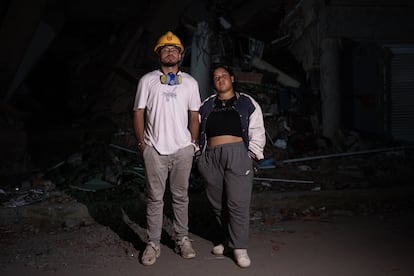
The vigil kept by the 28-year-old and his friend Scarly Rojas, Nancy’s only daughter, has become part of a ritual repeated day and night across La Guaira.
In the early hours of the morning, when there is less traffic and machinery noise, dozens of damaged buildings fall silent while rescuers — sometimes professionals, sometimes simply neighbors — call for quiet in hopes of hearing voices or knocks from beneath the debris. It is the same code Francisco used, repeated across an entire city.
Makeshift camps dot the area. Mattresses line the entrances of shattered residential complexes. People sleep there every night despite the overwhelming stench of decomposing bodies that now hangs over much of the municipality. And as long as that routine continues — as long as every night still carries even the faintest possibility of hearing something — it is difficult for an entire city to accept whatever comes next after the catastrophe.
On Tuesday, Scarly approached someone wearing a shirt emblazoned with the word “psychologist.” “I spoke to him because I also happen to be a psychiatric patient,” she explains. “I suffer from anxiety, and throughout all of this I’m still in shock. I haven’t really been able to process it or cry.”
Francisco remains stunned as well. He barely reacts and shows little emotion, but he is beginning to come to terms with reality. “Right now what’s left for me is to recover the body, give it a burial and go on with my life,” he says.
Outside another collapsed building, he stands with two young men whose girlfriends — sisters — remain buried beneath the rubble. Together they describe the wall preventing them from moving forward: they simply want to bury their dead.
“The hardest thing is that two days ago I had to do grocery shopping and it hit me hard,” Francisco tells them. “I kept thinking: ‘Damn, I’m doing something from ordinary life while my mom [referring to Nancy] is down there.’ And I can’t.”
Andrés Piñero, whose Spanish girlfriend Franchesca is one of the women still trapped inside, nods. “That’s what we want. To bury her, at least.”
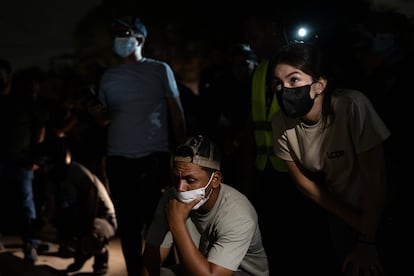
Even for families who have already recovered a loved one’s body, grief is obstructed by countless hurdles: moving from one morgue to another — some of them improvised in open-air spaces — trying to find the deceased, identify them, fill out paperwork, and arrange cremation.
Hundreds of bodies have spent days exposed to the Caribbean heat — in parking lots, vacant lots and at the port.
“Some are already unrecognizable,” says a member of Delcy Rodríguez’s government in the disaster zone.
When possible, identification is carried out through personal belongings, tattoos or dental records. When it is not, families find themselves trapped in a different kind of limbo than Francisco’s: they have a body, but no certainty that it belongs to their loved one. Given the scale of the death toll, cremations cannot wait.
The desperation to reach relatives has driven some people to bypass the authorities, who are slow to arrive. José Mesa’s daughter and her grandparents remain trapped beneath the rubble of a building that leans a little farther each day. This week he climbed onto the roof himself, hoping to pull them out with his bare hands.
“It was a bit difficult because we didn’t have the materials. We need someone to climb up and help us,” he says.
But seven days after the earthquake, rescue teams remain focused on a different priority: the living, not the dead. Like Francisco, Mesa is waiting his turn.
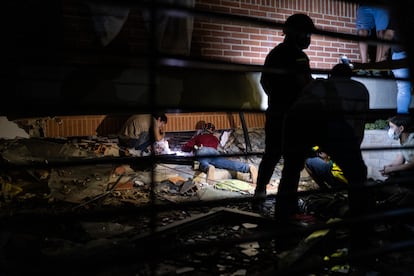
Members of international rescue teams deployed to Venezuela say that sense of helplessness has produced a phenomenon increasingly visible on social media: survivors crawling into rubble and filming themselves pretending to be trapped, hoping the videos will go viral and draw rescuers to the exact building where their loved ones remain buried. They lie so that someone will come to help.
In Venezuela — a country where even in ordinary times many people live day to day — almost nobody is talking about the future yet.
“Maybe one day you recover,” Francisco says, “but for months afterward you’ll walk into a hardware store, see a pickaxe or a shovel, and it’ll all come back to you.”
For now, neither he nor anyone else can afford to think that far ahead. There is still searching to do.
Sign up for our weekly newsletter to get more English-language news coverage from EL PAÍS USA Edition