
ElPais
Salvador Dalí At Art School: A Wayward And Insolent Student Expelled For Life

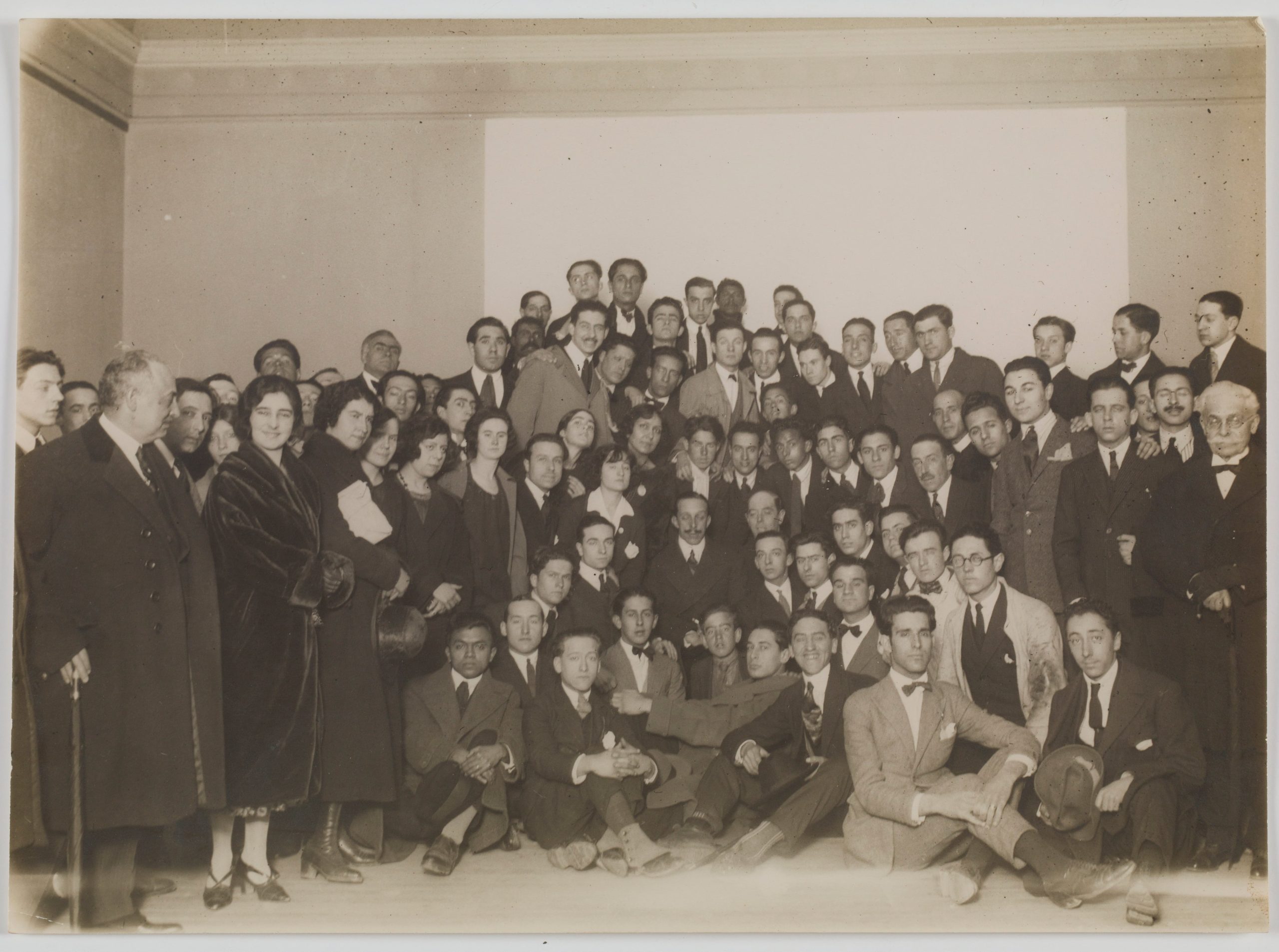
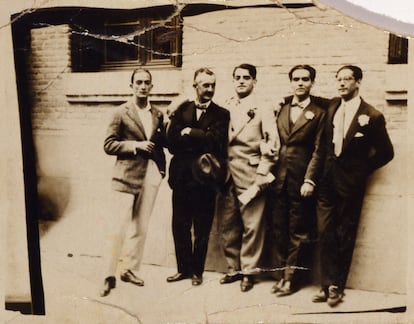
A century has passed since the day that forever changed the life of Salvador Dalí: his second dismissal, this one permanent, from the Special School of Drawing, Sculpture and Printmaking at Madrid’s prestigious San Fernando Fine Art Royal Academy. In such a rigid, rule‑bound environment, Dalí felt out of place — and perhaps for that reason, this academic period has been overshadowed in scholarly writing. What dominates the narrative of those years in Madrid — which he described as the happiest of his life— are his escapades and artistic exchanges with Federico García Lorca, Maruja Mallo, and Luis Buñuel, his companions at the Residencia de Estudiantes, a pioneering cultural and academic residence, and a circle of mutual inspiration.
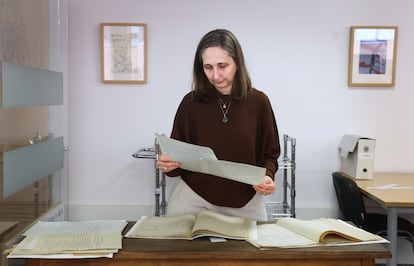
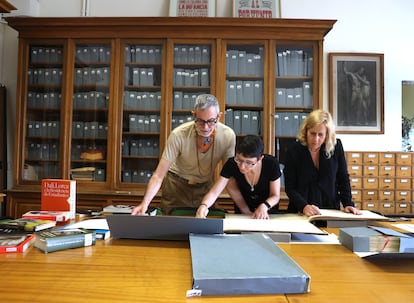
But thanks to the archives of the Complutense University of Madrid (UCM) — in 1970, the Royal Academy was converted into its School of Fine Arts — EL PAÍS can now reconstruct Dalí’s student years through grade certificates, letters from his father, and an almost‑unknown disciplinary file. These documents have circulated very little. There are records of occasional consultations by students or researchers —including the Hispanist Ian Gibson — a request from the Museo Reina Sofía art museum for an exhibition, and even an inquiry from a group of Korean filmmakers working on a movie about the artistic genius.
Dalí’s file (AGUCM 136/06-17, 40) and grade records (AGUCM 107/09-08) are preserved in the UCM’s historic archives, while the enrollment books, one of his father’s letters, and the expulsion ruling can be consulted in the Historical Archive of the Faculty of Fine Arts Library. Both archives operate with minimal staff, which means no one can devote full time to digitizing or promoting this extraordinarily valuable material. The inquiry made by this newspaper about Dalí prompted the digitization of the documents, which will now be displayed on the archive’s website.
“We provide a cross-functional service. We have an administrative role, but also a historic one. Not as many people come here to request materials as at a museum,” says Ana Rocasolano, director of the UCM’s general archive, which is located in the law department. “This university has an enormous, overwhelming heritage because of the importance it has always had; but its primary mission is not heritage — it’s education.”
Dalí moved to the Residente de Estudiantes in September 1922. Once there, he applied to the art school. Preserved today are the letter in which he requests to take the entrance exam, a chiaroscuro drawing of a sculpture, and the receipt for the application fees. Until about 30 years ago, the Faculty of Fine Arts kept an identical entrance exercise. Since 2008, there has been no specific exam, but the university entrance cutoff score is very high: 9.9 out of 14 this academic year.
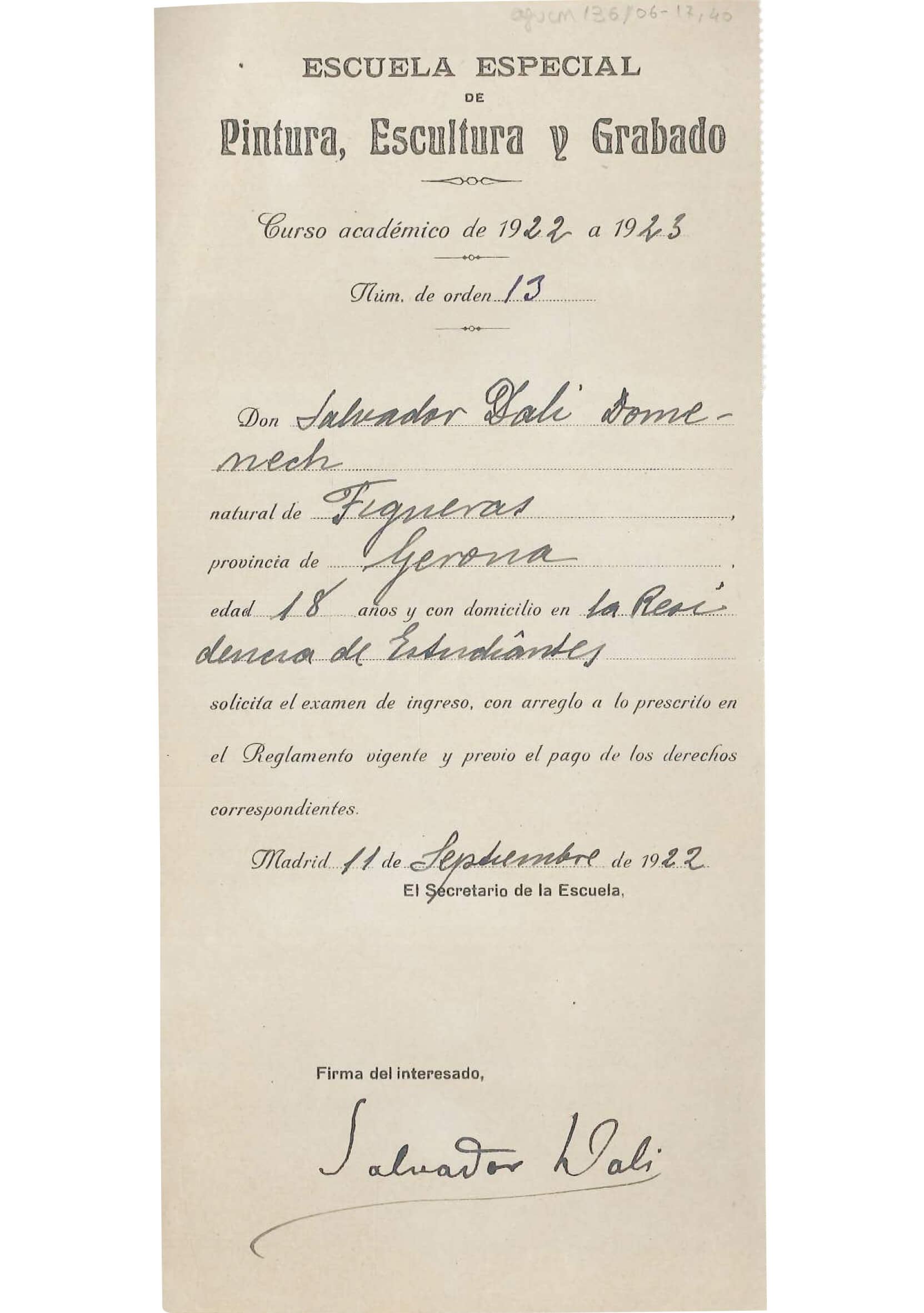

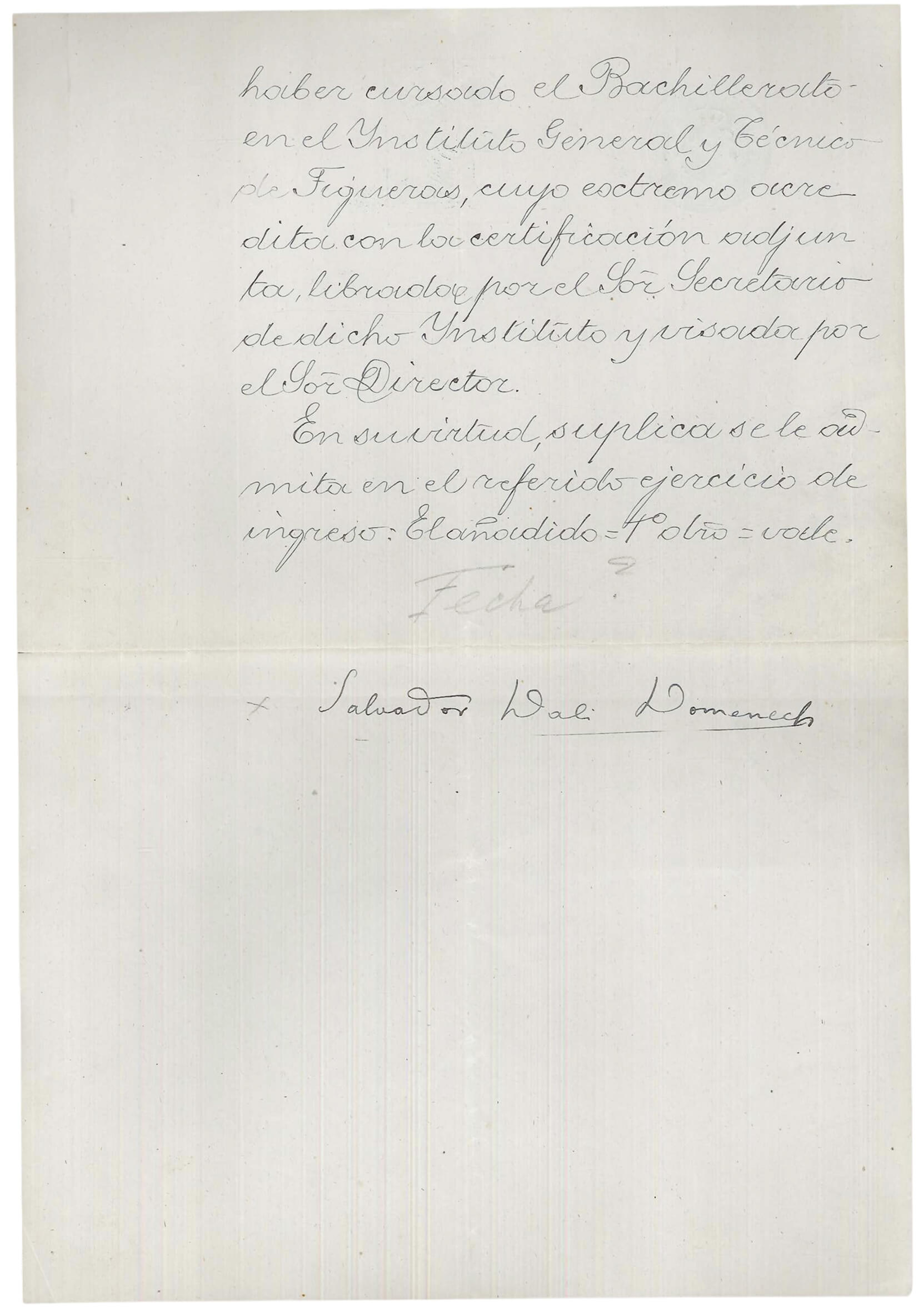


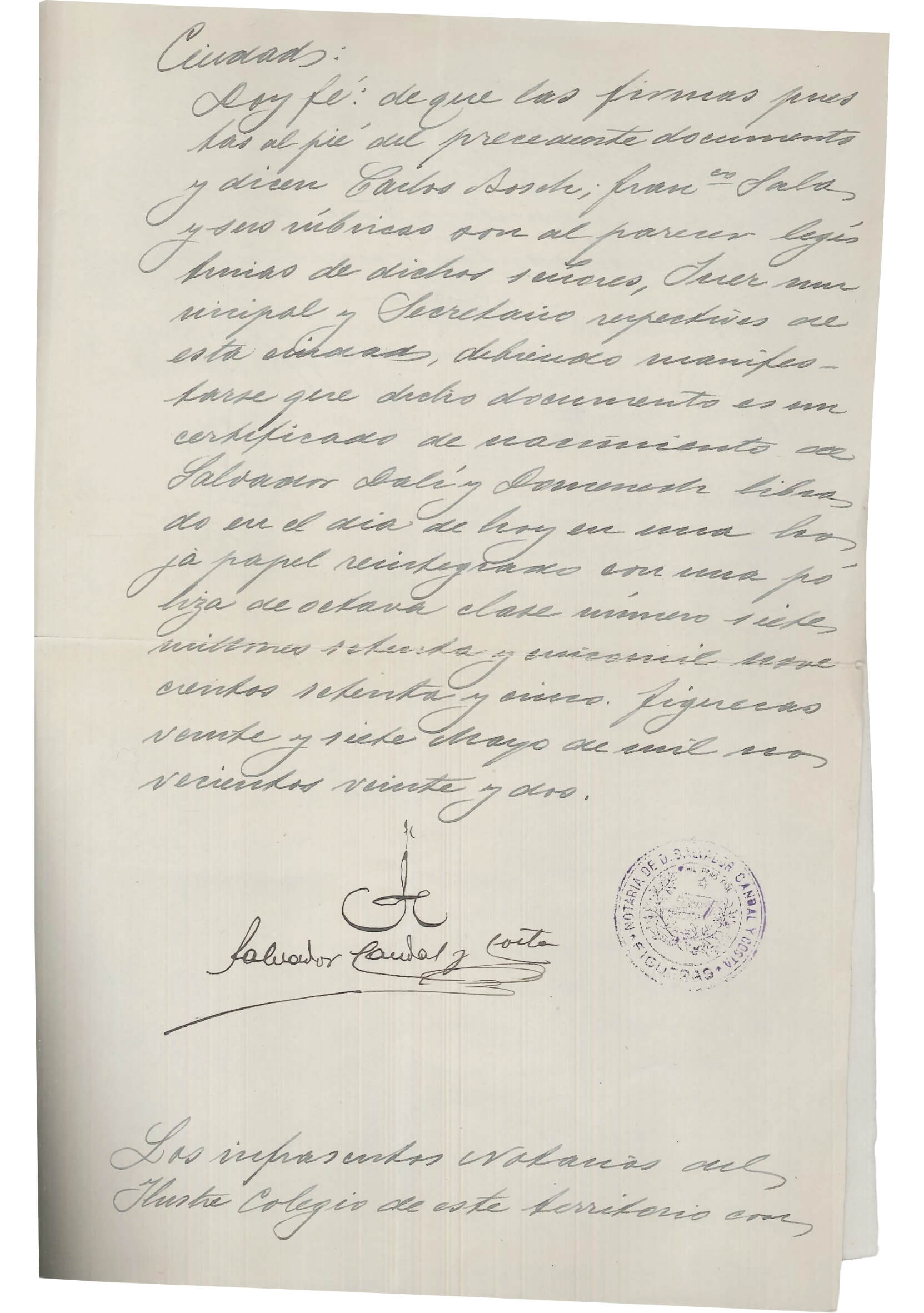


Recognizing Salvador Dalí’s artistic talents, his father agreed to his enrollment as painter at the Special School of Painting, Sculpture and Printmaking in Madrid, 435 miles from their home in Figueres, Girona. On September 11, 1922, the painter’s fees for the entry exam were paid, and he was already living at the Residente de Estudiantes.
Dalí sent an undated application letter to the director “begging” to be able to take the exam, in an exquisite handwriting that had been highly praised by his previous teachers.
He attached his birth certificate and his secondary‑school grades in order to be exempted from all entrance requirements besides the chiaroscuro sculpture drawing exercise, as these demonstrated that he had “sufficient” academic training. He was 18, and his mother had died the previous year.
Dalí also included a notarized document signed by his father, Salvador Dalí i Cusí, who was their town’s notary and with whom he maintained a tumultuous relationship. The elder Dalí would eventually disinherit his son.
The archive also features what was known as a personal academic transcript. This document included Dalí’s grades — which varied greatly — from the General and Technical Institute of Figueres for six courses, from 1916 to 1922. Dalí was a mediocre science student, but stood out in drawing, religion, calligraphy and history of literature. As early as his teen years, he wrote in his diary that one day, he’d be an art star, and he was.
At the time, Dalí was 18. His mother, Felipa Domènech, had died the previous year. That was why he had traveled to Madrid accompanied by his father, Figueres notary Salvador Dalí i Cusí — who plays a prominent role in this story — and his sister Anna Maria. Recognizing his artistic talents and hoping for his son to have a rewarding career, his father encouraged him to enroll in the school so that he could become an art teacher in the future. Dalí passed the entrance exam and enrolled in five first-year courses.
In 1920, two years before Dalí arrived at the school, female students had signed a protest letter which led to the recognition of their right to enroll in all courses. Up until that point, they had been barred from taking life drawing classes over concerns about nude models, and from painting outdoors because they were not allowed to leave their homes without being accompanied by a family member. Mallo was enrolled in the school at this time.
Dalí spent his first months in Madrid coming and going from the San Fernando Academy at Calle Alcalá 13, where the museum, no longer a school, remains to this day. At the time, he had next to no social life. His peers at the Residencia would later remember how the extremely reserved, nearly mute young man would shut himself up in his room, searching for his own painting style. He shifted between cubism, futurism and metaphysics, and in addition to self-portraits, created several still lifes, like the ones he presented at his debut solo show in the first exhibition of the Iberian Artists’ Society in 1925.

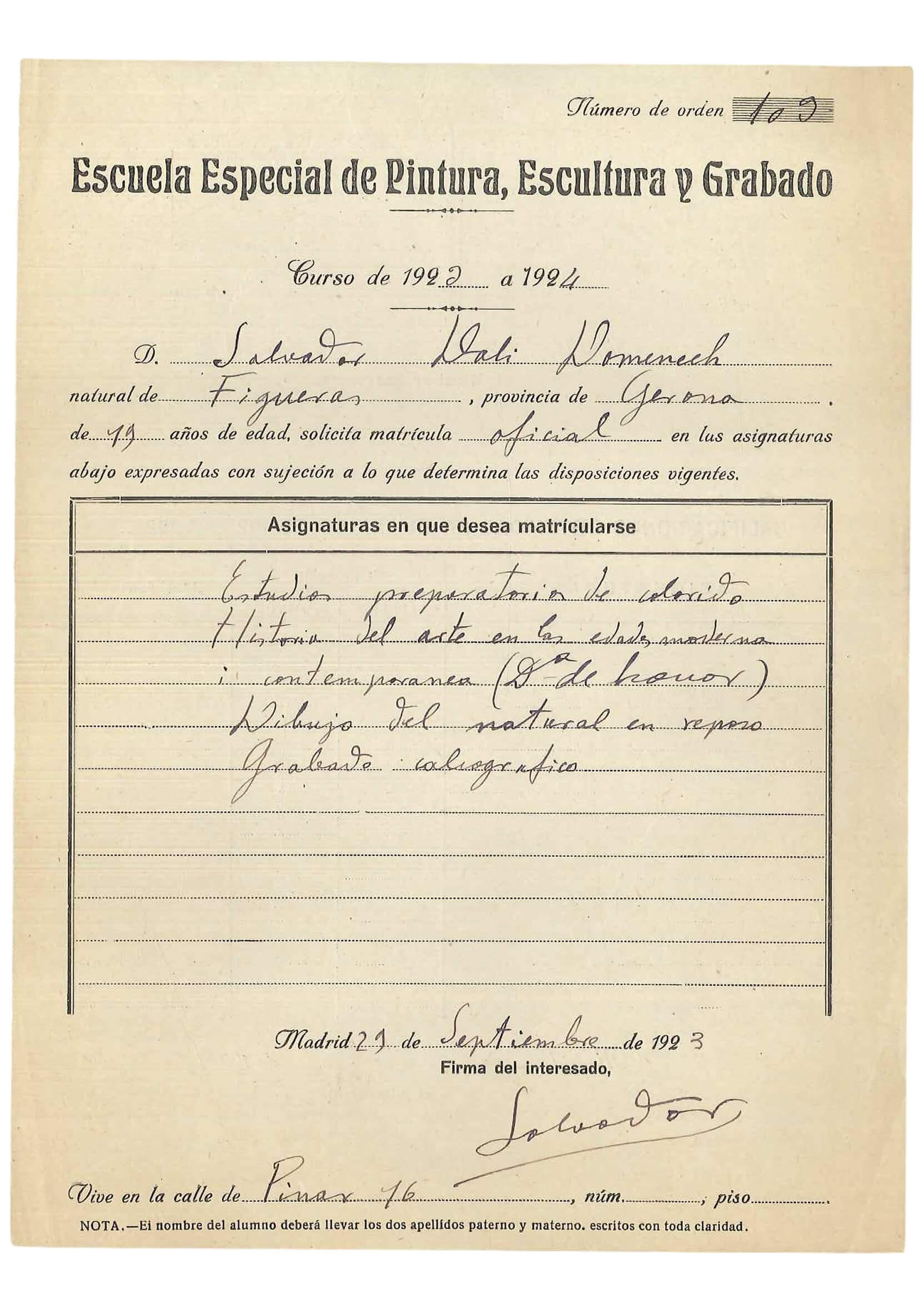


There is no document that attests to Dalí having passed the entry exam, but he seems to have, because he was enrolled at the school. On September 30, 1922, he signed up for five courses: perspective, modeling, ancient and medieval art history, and statue drawing.
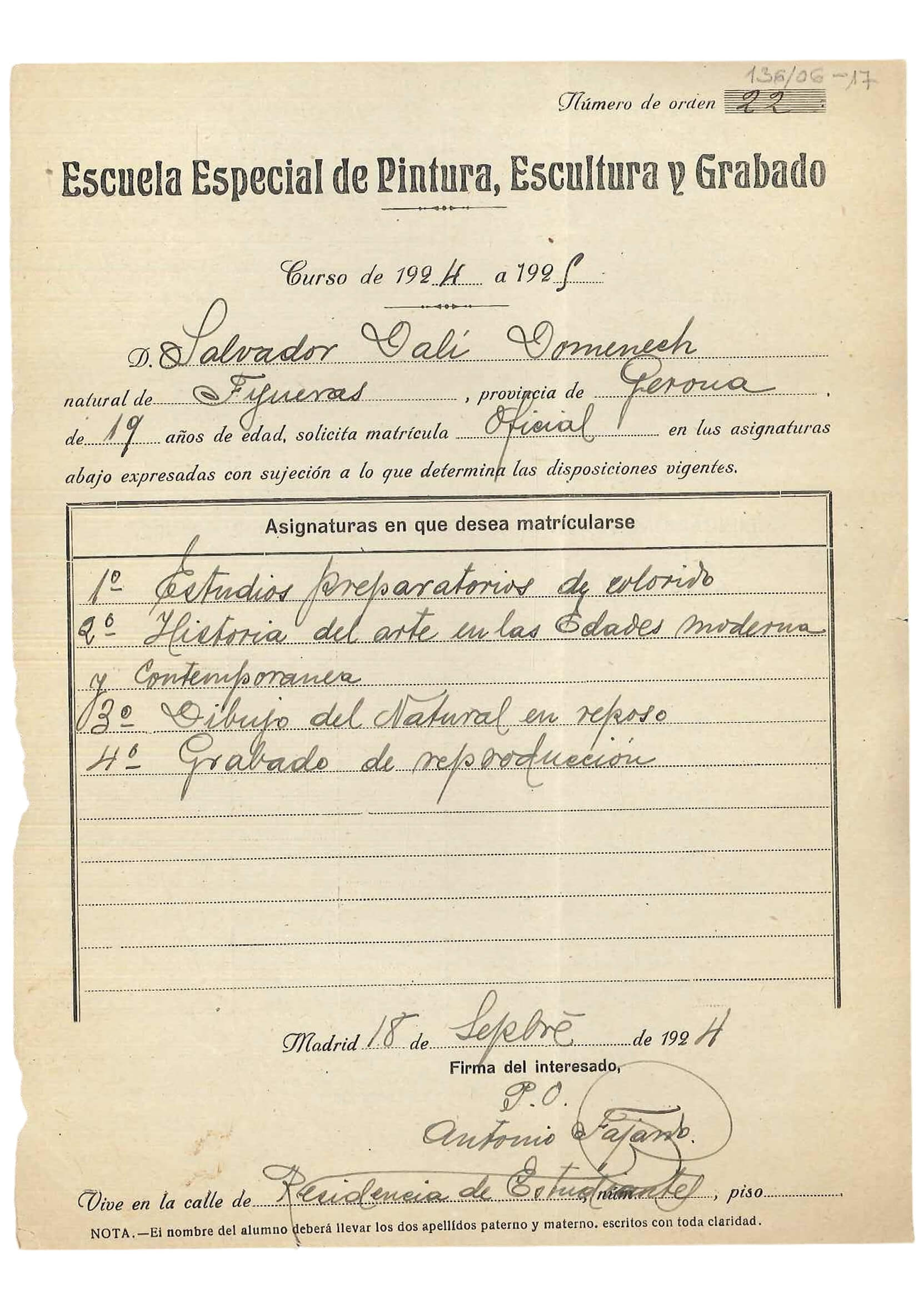
For the 1923-1924 school year, Dalí signed up for nine subjects, indicating that he passed his classes the first year. His second-year courses were color theory, life drawing, printmaking and history of modern and contemporary art. He likely did not pay a fee for this last course, having earned honors in ancient and medieval art history. That is why the previous grade is noted on his transcript. Each course cost between 10 and 25 pesetas (roughly $4 to $11 in today’s money). He continued living at the Residencia de Estudiantes.
After being suspended in 1923, which was triggered, according to Dalí, by a student revolt demanding that painter Daniel Vázquez Díaz be appointed as their teacher, he enrolled in the 1924-1925 academic year in the same courses he had taken the previous year. He started his second year of studies from zero. During the months he was away from the school of drawing, he studied with Francisco Bores, Moreno Villa and Benjamín Palencia at the Academia Libre, an independent art academy directed by Julio Moisés.
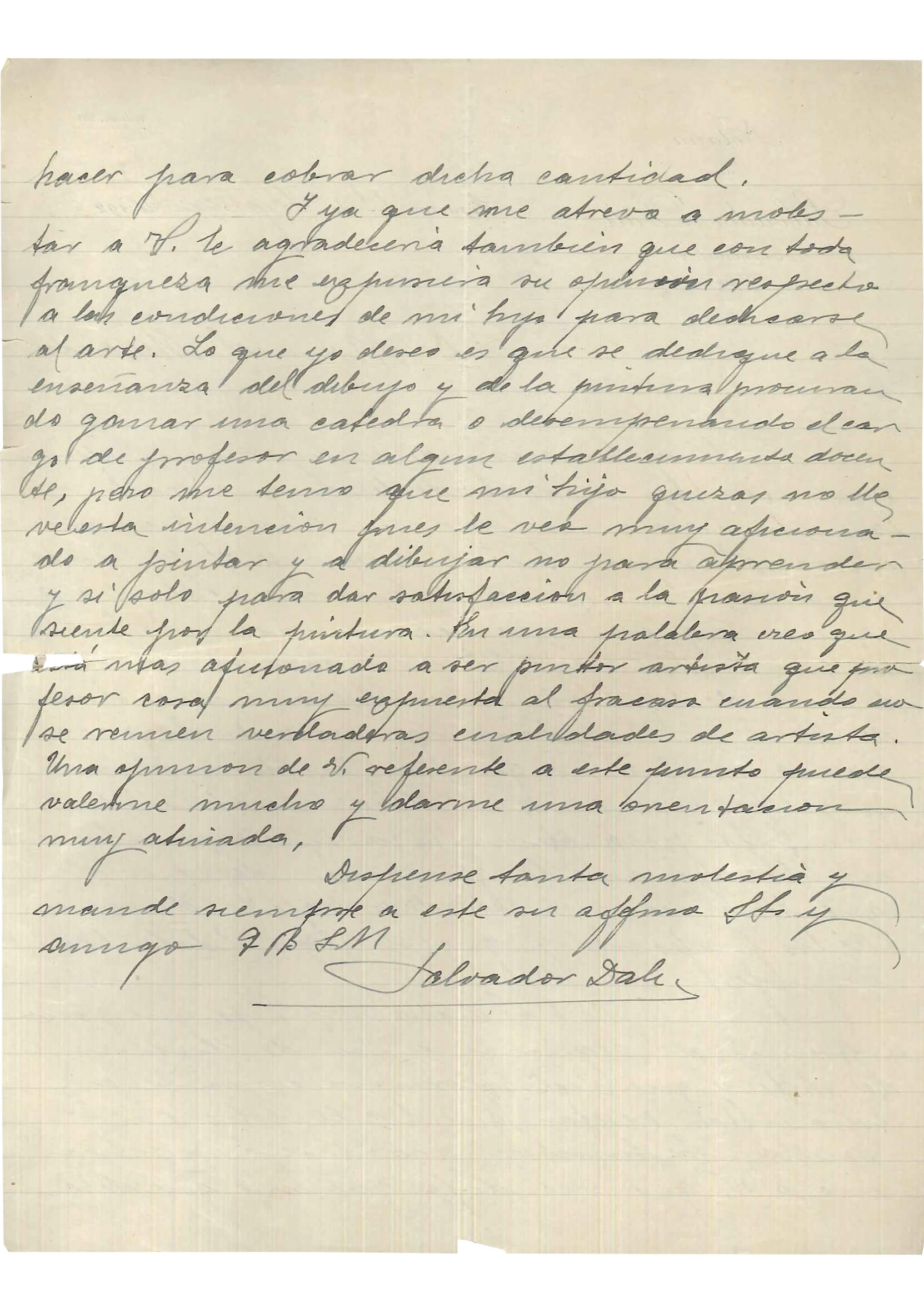
In an undated letter, Dalí’s father requests a certificate of studies from the school so that his son could defer military service.
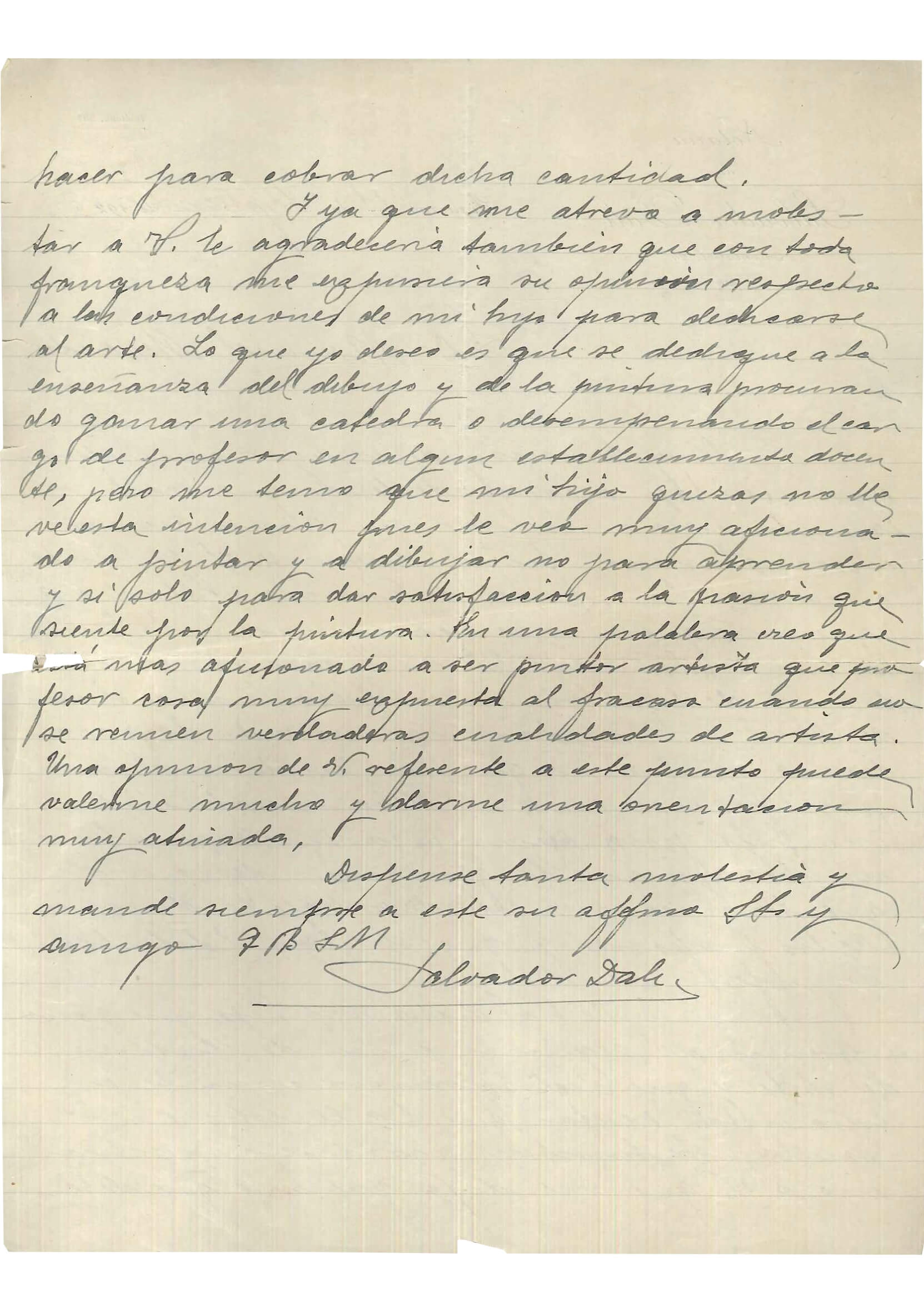
Finally, on September 11, 1925, Dalí’s father wrote on his notary letterhead to the school, informing them that his son would be studying in Figueres that academic year and would sit for exams in Madrid as an independent candidate. “Because he must undergo military training, he will not be able to enroll as a regular student this academic year.” Since he has already “dared to bother” them, he asks Manuel Menéndez about his son’s “aptitude” for art. “What I wish is for him to devote himself to the teaching of drawing and painting in order to earn a professorship […]”
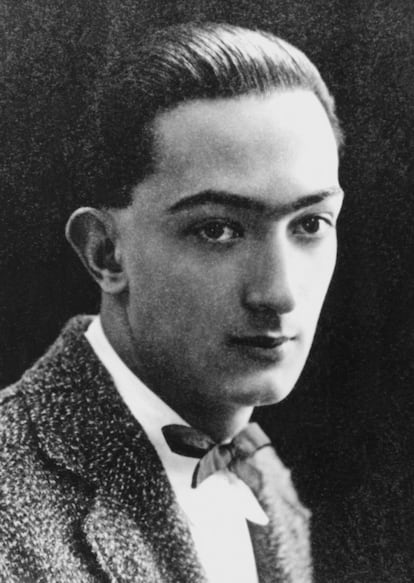
Dalí was becoming heavily influenced by what he was reading in books, catalogues and magazines, and his carefully crafted appearance ensured he never went unnoticed. Extremely thin, he wore his hair long with sideburns, oversized shoes, a trench coat, stockings, and gaiters — all in the style of Victorian painters. Later he would cut his hair and, after discovering Diego Velázquez, El Greco, and Hieronymus Bosch at the Prado Museum in Madrid, he began growing his signature mustache.
After a few months, he began socializing with his peers, and school faded into the background. “At the Residencia, Dalí and Maruja Mallo discovered many things, and many of the people they spoke with led them to rethink their situation,” says Estrella de Diego, who has been a member of the Academy for the last decade.


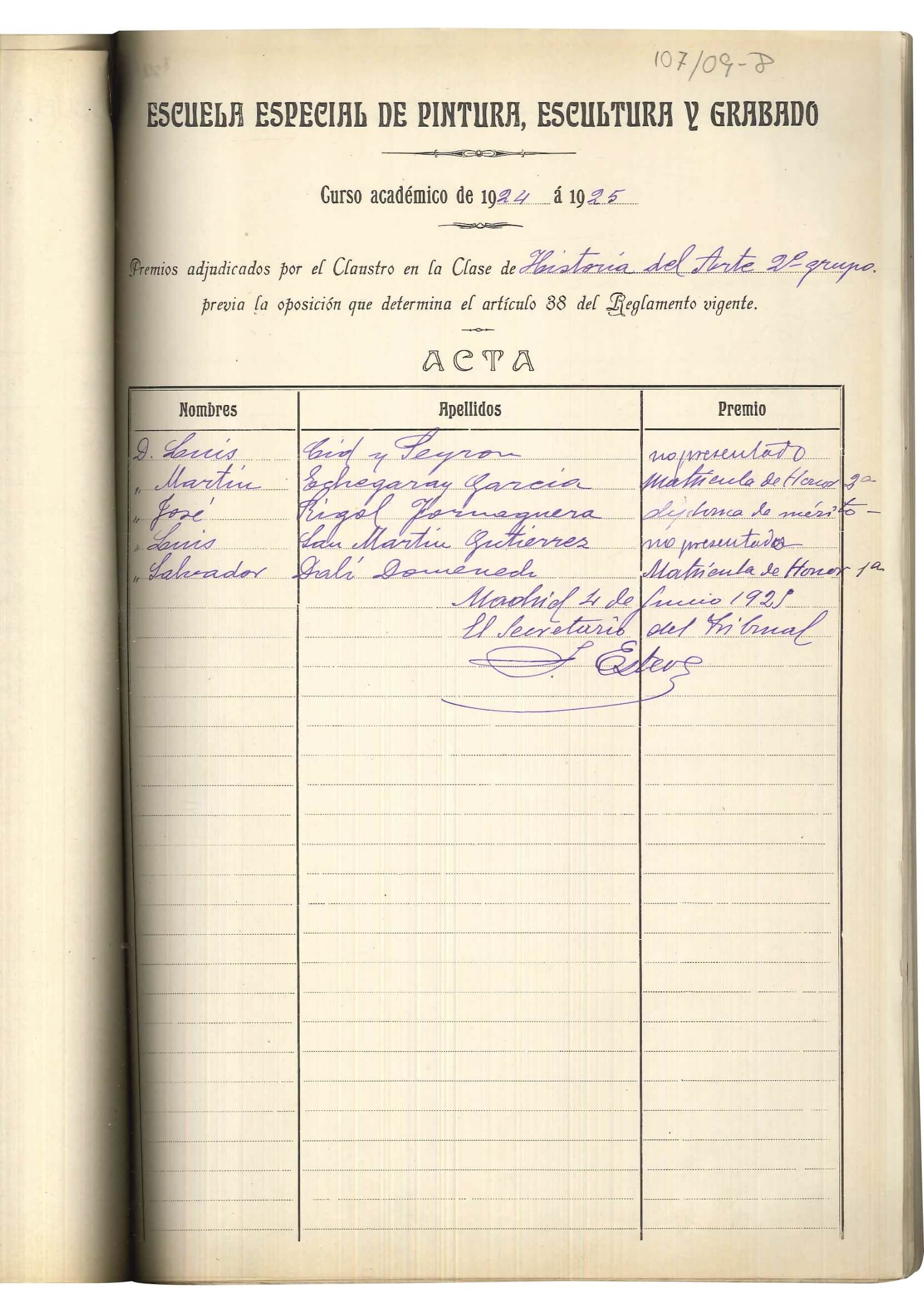

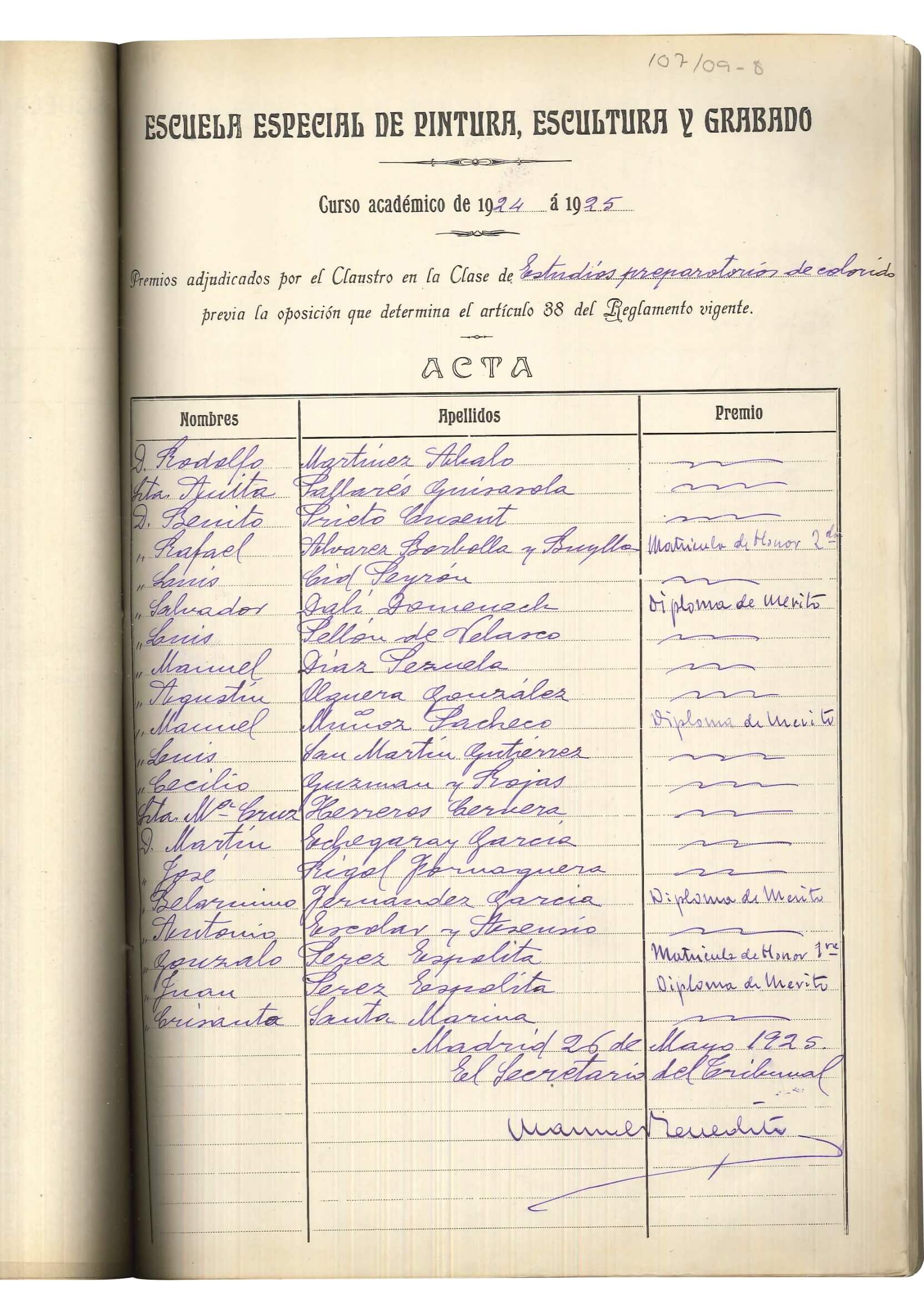
In his first year, Dalí enrolled in five courses and passed all of them except for modeling in the February exam session. Five of his classmates also failed, which was unusual.
This forced him to retake the exam for the modeling course in June 1923, but his professor did not sign off on its documentation until September.
In his first year, Dalí earned top honors in the course on ancient and medieval art history. During his secondary‑school studies in Figueres, he had already demonstrated an exceptional command of art‑historical knowledge.
Presumably, the honors he earned in the first-year art history course allowed Dalí to avoid paying tuition for the second-year modern and contemporary art history course (1925-1925). He once again received the highest grade.
In a letter to the school director dated September 11, 1925, the elder Dalí looks for confirmation that his son won “the second-year art history prize and that said prize consists of 700 pesetas, to be collected from the school,” seeking instruction on how to do so.
There are no grade records for the 1923–1924 academic year because Dalí had been suspended. When he re‑enrolled the following year, he had to register again for all four subjects. He earned a “diploma of merit” (equivalent to an outstanding grade) in preparatory studies of color.
“At this time, even the most traditional painters complained that the school was overly academic. The Residencia offered them a sense of camaraderie that the Academy, which must have been dull, did not,” says de Diego, a contemporary art professor at the UCM. “However, the school gave them some very important tools for drawing. They taught the basics to [Pablo] Picasso, Maruja and Dalí.”
Raquel Monje, dean of Fine Arts, agrees. “The school was a very conservative space,” she says. “It took many years for that to change! Our greatest strength is that academia now coexists with what’s happening in the outside world.”
Dalí easily passed his first year (1922-1923), except for his printmaking course, which he was forced to retake. He even earned top honors in ancient and medieval art history. What the records do not mention is his failed assassination attempt on Alfonso XIII on March 3, 1923 — the day the king inaugurated the school’s library. Gibson asserts in two books that a tragedy could have occurred. According to his account, Dalí — who had been anti-monarchist up to that point — planned with his friend Josep Rigol to make a “bomb to protest, not to kill” the king, as Rigol recounted, by filling an empty milk container with gunpowder. They placed the explosive in a vase on a staircase banister, but fortunately, the fuse did not ignite. Estrella de Diego says this account is questionable: “There is no evidence.”
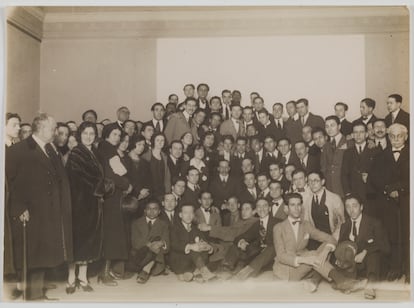
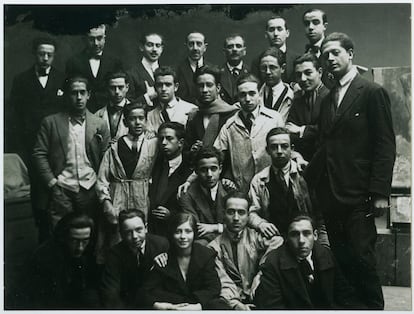
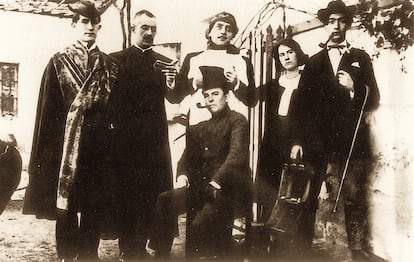
The Prado Museum in Madrid has a photograph of Dalí and Maruja Mallo’s class visiting the art gallery alongside the king. If the bomb did indeed exist, no one found out about it at the time, and in March 1923, Dalí was neither sent to jail nor home. But by September, his academic progress had stalled out. He was suspended for one year for leading a student revolt against the school’s decision — a very conservative one — to reject painter Daniel Vázquez Díaz for a professorship on the grounds that he was too avant‑garde.
A furious letter to the director from Dalí’s father is preserved in the archives. “Dear Sir, and with the utmost respect. After speaking with the students, teachers and staff at the school, I have confirmed my entirely favorable opinion of my son,” he begins. “Unable to abide by the Disciplinary Council’s decision, I have no choice but to accept his punishment with resignation.” He then predicts: “His conduct in school and his academic performance will be so impeccable that they will come to regret having punished him so severely.”

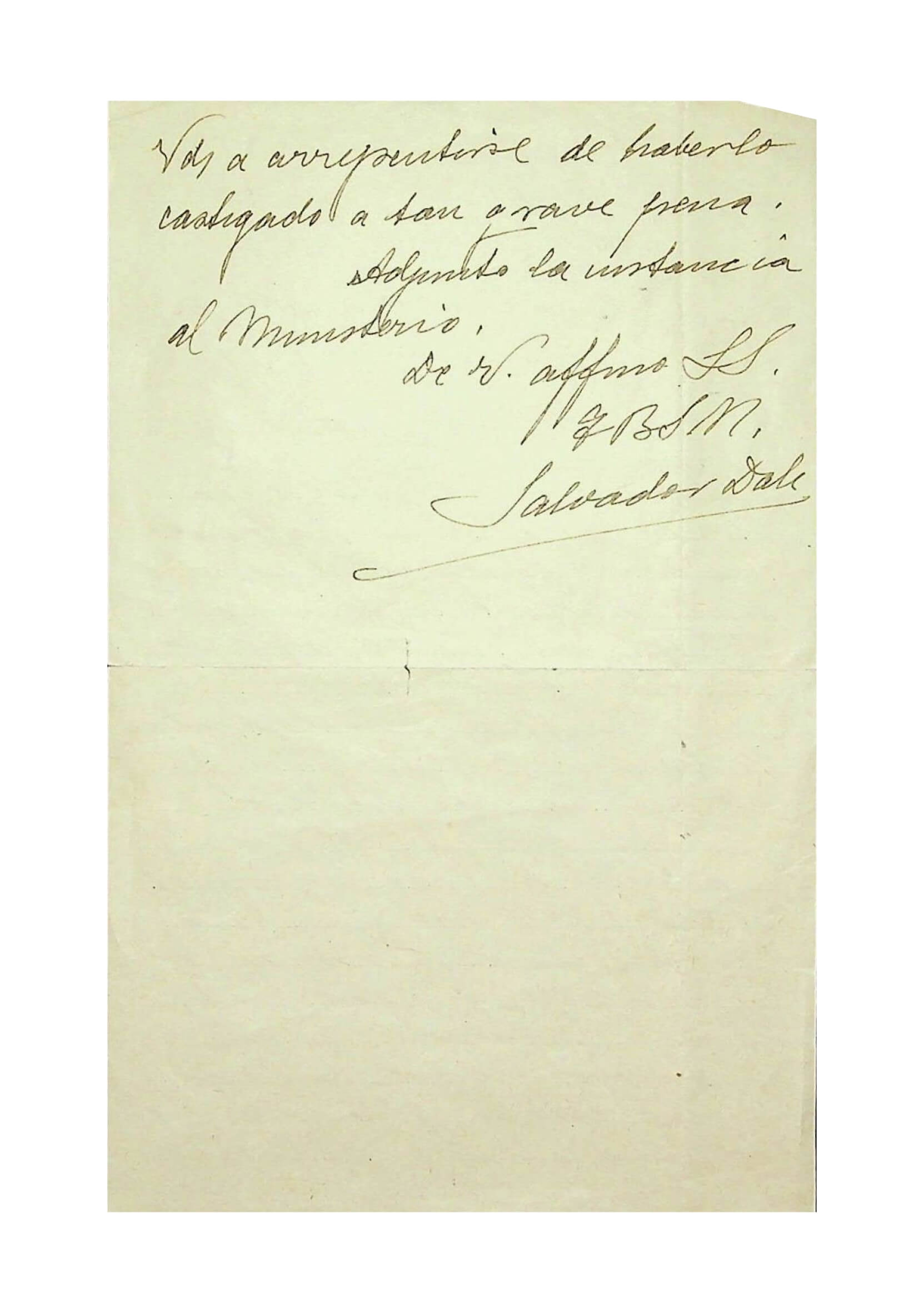


There are no administrative documents in Dalí’s file that confirm his first expulsion from the school in 1923, but it is referenced in the 1926 paperwork, which coincides with his permanent dismissal. What is preserved is a letter from his father. It is dated November 23, 1923, which means his son must have been expelled at the beginning of the academic year for leading a protest after painter Daniel Vázquez Díaz was rejected for a teaching post.
The father’s tone is furious: “His conduct in school and his academic performance will be so impeccable that they will come to regret having punished him so severely.”
The three professors who were to examine Dalí on fine arts theory on June 14, 1926, drafted a report that led to his expulsion. According to their account, at 12:30 p.m., when asked to draw three balls containing exam questions, Dalí replied verbatim: “No. Since all the professors at the San Fernando School are incompetent to judge me, I am withdrawing.”
Nine days after the incident, which led to Dalí’s expulsion, a meeting of professors was convened. Its minutes note that Rafael Domènach i Gallissà did not serve on the examination committee, even though he taught fine arts theory, so as not to be accused of bias. He chose to recuse himself following a heated confrontation with Dalí who, according to the disciplinary council, had been proclaiming around Barcelona that he had earned a passing grade in modern and contemporary art history and received an award, even though Domènach i Gallissà had initially failed him.
According to the Spanish artist, a new tribunal had been formed due to the “injustice committed.” According to the council, Domènach i Gallissà had not examined Dalí — and therefore had not failed— because the artist had been in Paris organizing an exhibition. The documents highlight the professor’s “chivalry.”
The disciplinary council notes that Dalí had been informed of his permanent expulsion, and notice of the “correction” had been hung on an announcement board to “serve as an example” to other students.
On October 22, 1926, the general directorate of fine arts upheld the penalty imposed on Dalí by the school, which in its view had acted with the utmost propriety. The decision pertaining to school regulations regarding his conduct during the exam, as it could have caused “a disturbance to academic order and discipline.”
Dalí carried out his year-long suspension in 1923-1924, but he did not stop studying entirely, and continued learning at the Academia Libre, an independent art academy, directed by Julio Moisés. In September, he once again enrolled at the Academy. His grades were better than they had been during his first year. He earned a “diploma of merit” (outstanding) in color theory and for the second time, honors in art history.
One course strained Dalí’s relationship with the school to the breaking point. According to the disciplinary council, the painter had been “proclaiming around the artistic center of Barcelona” that his professor Rafael Domènach i Gallisà had failed him and that given this “injustice,” a new panel had been convened that passed him and awarded him a prize of 700 pesetas (around $250 in today’s money).
But according to the council, Domènach i Gallisà had not examined Dalí (and therefore, failed him) because the former had been in Paris organizing the 1925 International Exhibition of Modern Decorative and Industrial Arts. The rumor came to the attention of the teacher, and he was supported by the school. But Dalí’s insolence did not end there. He studied the 1925–1926 year independently while completing his military service in Girona, and he registered in April to sit the exams.
There are two versions — one, predictably embellished — of what happened on June 14, 1926. As Dalí later recounted in his writings, after dodging the question of his fine arts theory exam, he replied to the examining board: “I know more about Raphael than all three of you put together. I refuse to answer.” And, as his friend Antonio Pitxot claimed in his book Sobre Dalí (On Dalí), examiners replied: “Well, then, come back another year, because this one is already a fail and moreover, you’re expelled.” Pitxot wrote that Dalí always ended this anecdote with: “Imagine — asking me about Rafael…” A characteristic bit of bravado.
But the minutes of the examination board and disciplinary council, as well as the ruling by the general directorate of fine arts, describe a highly tense confrontation that culminated in a permanent expulsion, not a temporary suspension. Dalí’s first offense was failing to show up for the first exam session — students only had two chances at the time — and he was informed of the next date via telephone. Domènach i Gallisà, despite being the subject’s professor, chose not to examine him so as not to be accused of bias following their previous confrontation. Three other professors made up the examination board. According to their minutes, Dalí stated, “No. Since all the professors at the San Fernando School are incompetent to judge me, I am withdrawing.”
The Faculty of Fine Arts safeguards “hundreds of thousands of documents” that librarians Javier Pérez Iglesias and Laura Bomati would like to digitize, given the volume of inquiries — especially about little‑known local artists and, increasingly, women artists. If they could, they would start with the registry books.
“What we accomplish in this department is thanks to people who are passionate about it,” says the dean. “For example, a professor and a group of students might get involved in a small project. But as always, we’d need funding to do more.”
Credits
Design: Ruth Benito
Development: Fernando Anido
Graphic design: Inés Arcones
Coordination: Brenda Valverde Rubio
Featured image: Salvador Dalí and his classmates at the Special School of Painting, Sculpture, and Engraving (Academy of San Fernando). 1922–1923. GALA-SALVADOR DALÍ FOUNDATION
Sign up for our weekly newsletter to get more English-language news coverage from EL PAÍS USA Edition








ElPais
How Social Media Platforms Keep Students Hooked: Notifications During School Hours And Paid ‘teen Ambassadors’


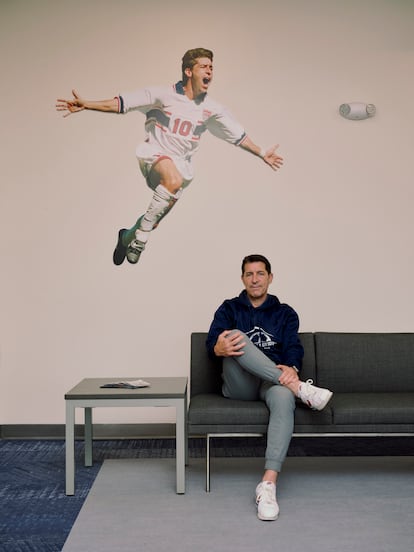
The first time U.S. soccer legend Tab Ramos played on a team in the country he had just moved to from Uruguay, Argentina was the reigning champion of the 1978 World Cup and the boy was thrilled that the jersey he was given, the Harrison Rec kit, was orange “like the Dutch one.” Ten minutes in, the coach took him off the field: he was too good to compete with that group. He was 12 years old.
“I remember the little baseball field and that I could score from the other goal,” Ramos recalled with a laugh one rainy May day at the facilities of the soccer school he is about to open in Hillsborough, New Jersey, after retiring as a coach.
After that failed attempt, the boy joined a team in the neighboring town, where Scottish immigrants had founded, as early as 1895, the Kearny Scots, who still compete in the state league as testimony to a passion rooted in this corner of the United States. There, 10 years earlier, one of the first international matches played in the country took place, in the shadow of a factory that today is the parking lot of a trendy restaurant.
Kearny is a working-class town of 40,000 inhabitants on the New Jersey side of the Hudson River. It sits in the shadow of New York, in the heart of The Sopranos country, and behaves like a close-knit, proud community whose roots are diversifying with waves of Peruvians and Ecuadorians, whose restaurants dot the main street.
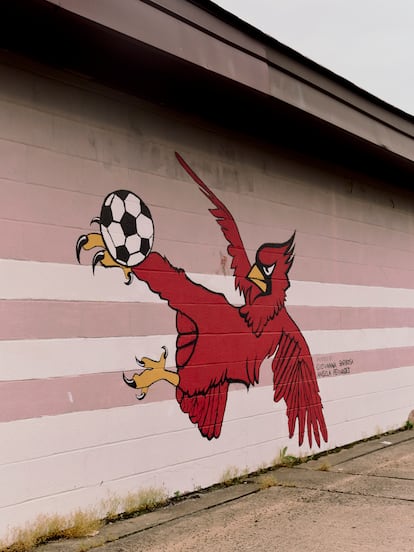
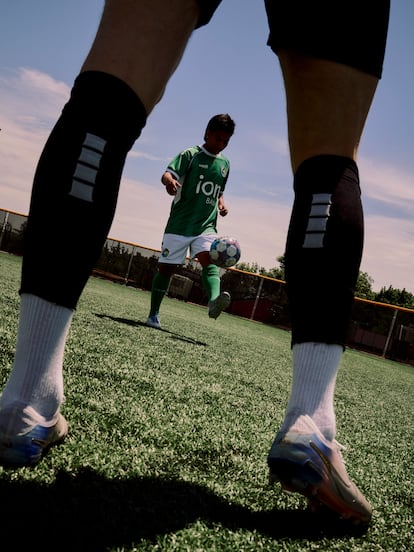
If it is known as Soccertown USA — a nickname that also titles a 2019 documentary about Kearny’s love affair with the game — it’s not only because the English and Scots brought it early. It’s also largely thanks to Ramos’s generation. Three players from Kearny (himself, goalkeeper Tony Meola and midfielder John Harkes) played in the 1990 and 1994 World Cups with the U.S. national team.
Those two tournaments are usually credited with reigniting — in this inward-looking country that long dismissed the world’s favorite sport — the spark of interest in soccer that had faded after two earlier bursts. The first was a century ago, when the United States had a strong league and achieved its best result at the inaugural World Cup in 1930: they finished third with a squad that included three other neighbors from the Kearny area.
The second flash came in the 1970s when the New York Cosmos signed Pelé. The fading superstar played three seasons in front of packed stadiums of up to 70,000 fans. “That team invented the idea of the galácticos; that’s how many stars it attracted,” says Andrew Kilpatrick, the Cosmos’ official historian, who recalls that a young Donald Trump from Queens was a fan of the team.
In 1985 both the club and the league, a victim of its own greed, disappeared. That double blow left fans in towns like Kearny alone in their work of keeping the flame alive.
Four years after the collapse, Ramos assisted Paul Cagliari’s goal against Trinidad and Tobago that in 1989 secured the USMNT’s first World Cup qualification in 40 years. As Mark Franek recalls in his newly published book American Soccer Nation, local sportswriters dubbed that play, in tribute to Ralph Waldo Emerson, “the shot heard around the world.”
By then, FIFA had already chosen the United States to host the next tournament on the condition that its federation create a professional league. The hosts fell to Brazil in the round of 16, and Ramos suffered an elbow from Leonardo that caused a skull fracture and sidelined him for six months at the worst moment: after a spell at Figueres, he was playing for Real Betis in Spain, which had just been promoted to La Liga. Because of the injury, he missed almost that entire season.
The United States did its part by creating Major League Soccer (MLS), which, 30 years later, remains the country’s top competition. Ramos was there again: he was the first player signed by MLS under one of those rules that set it apart from its bigger European cousins — the league, not individual clubs, makes the signings. There is no relegation, and part of the early-season roster renewals are decided by a draft that can send the best players to the weakest teams.
“That’s undoubtedly an incentive for fans; bear in mind there hasn’t been a repeat champion two years running in a long time. And the lack of relegation is a blessing for coaches; there’s less pressure,” Domènec Torrent, who was Pep Guardiola’s assistant at Barcelona, Bayern, and Manchester City before moving to the United States to manage New York City FC, explained in a phone interview. On arrival, he found “a league much less technical than it is now, very American, focused on spectacle, based on constant attacking without worrying about defending.” “That has changed,” he added.
Ramos belongs to an earlier incarnation. He played until 2002 with the New Jersey MetroStars, a team that in 2006 was bought by a German energy drink brand and rebranded as the New York Red Bulls. It is one of MLS’s 30 teams (15 on each coast) and plays in a stadium in Harrison, not far from where as a child he was once taken off the pitch for being too good.
The midfielder, like the rest of the U.S. soccer community — long the victim of what journalist Franklin Foer calls “the anti-soccer mafia” — wondered in the days before the World Cup opening game on June 11, which the country is hosting again alongside Canada and Mexico, whether the tournament will be the definitive boost that has never quite arrived. He also wondered whether milestones such as the cultural reach of the TV series Ted Lasso — about an unsuccessful American coach who finds redemption on the bench of a struggling English club — or the arrivals of high-profile stars like David Beckham, whose commitment to MLS included investing in Inter Miami (the league’s most recent champion), or above all Lionel Messi, have brought them closer to that tipping point.
The Argentine superstar arrived at Inter Miami in 2023 like a sporting and commercial whirlwind and promised to mark a before and after in soccer’s social penetration. With between $70 million and $80 million a season from salary, sponsorships and other income, he is the highest-paid player in a league that limits the number of foreigners and how much can be spent on them.
Jorge Mas, founder and majority owner of Inter, is the man who pursued Messi’s signing for years (and later brought over other big-name former Barça players). In a phone conversation he said his goal “has been achieved tenfold.” “And Leo’s, I believe, too. He has shown that the fanbase exists. I’d like to think bringing him and the others has contributed to the growth of the sport in the United States,” the Cuban-American businessman said.
Ramos, not given to hyperbole, admits that “soccer has changed a great deal professionally,” but warns that “its presence in American households remains limited.” “I’d say soccer ranks eighth or ninth among sports in American homes. It’s different for foreigners; we always bring it with us,” he said.
Everything will depend on whether the organization of what may be the strangest World Cup in living memory is a success, with FIFA president Gianni Infantino courting Trump with a peace prize while the latter threatens to sow terror by deploying his immigration police around the matches.
Ticket and transport prices to the New Jersey stadium that will host the final are sky-high, and there are doubts about the condition of some playing surfaces in venues designed for other sports, like baseball and NFL. Meanwhile, New York Mayor Zohran Mamdani, a soccer scholar and shareholder in Spanish club Real Oviedo, plans to raffle off 1,000 tickets at $50 each to city residents, in a metropolis where soccer is gradually gaining ground in the streets, thanks in large part to immigrants and women. The Pier 5 courts at the Brooklyn Bridge Park, overlooking the Manhattan skyline, could compete for the title of best-view pitch in the world.
It will also depend on how the national team performs. If one believes a new HBO mini-documentary entitled U.S. Against the World, it isn’t outlandish to think the hosts have a shot at the title. “We made a pact,” says Christian Pulisic, the AC Milan player and USMNT star, at the start of the film, which opens with the failure to qualify for the 2018 World Cup. “We want to change soccer in this country, and there is no better opportunity than playing a World Cup at home.”
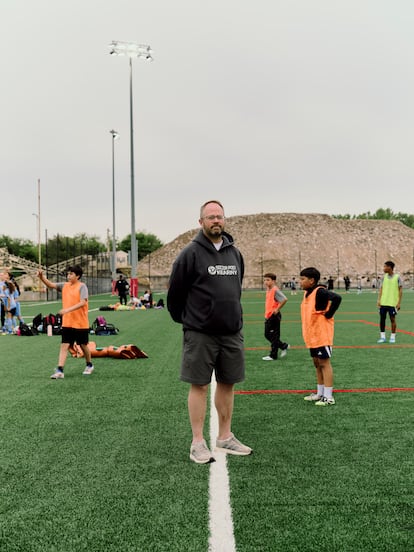
Michael Mara is more skeptical about his country’s chances: recent matches under Mauricio Pochettino left him with a bad feeling, he said at the Thistle training grounds, the youth club of Kearny. A boundless source of stories whom everybody knows and greets, he is its chief executive. “Everything here revolves around community,” Mara explained. “It’s less about competing than feeling you belong, whether you arrived yesterday or decades ago.”
Kearny’s story is “at the intersection of immigration, industry, and sport,” says Tom McCabe, co-writer and co-producer of the documentary Soccertown, which shows how English and Scottish factories in New Jersey had their own teams. He also describes the “three ages of soccer” in the United States. The first, a golden era, is told through the industrial cities where the game thrived and stretches to the 1930 World Cup. “There was a prosperous professional league that poached players from Scotland and England because they were paid more here to work during the week. That ended with the Great Depression when companies stopped spending on sport,” McCabe says.
The second age was that of “ethnic clubs”: German, English, Italian or Portuguese teams that kept the ball rolling. “The third arrives with Pelé and the rise of amateur youth soccer in the suburbs,” the historian adds. That’s when soccer found its place in the U.S. competitive landscape, where the dominant sports stagger their seasons so their leagues don’t overlap.
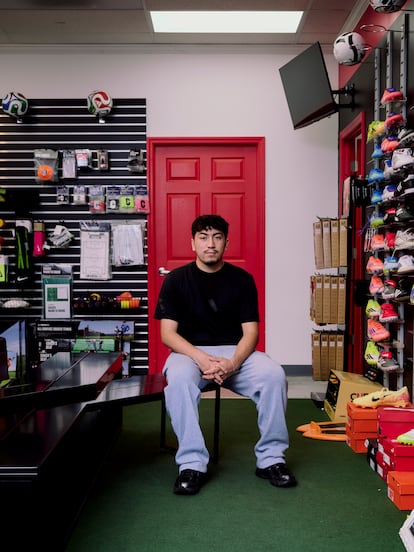
“Will we enter a fourth age with this summer’s World Cup? I’m not sure yet,” McCabe, who lives in London, says; when he returns home he often drops by the shop Mara opened three years ago in downtown Kearny.

The shop is dedicated exclusively to soccer. When we arrived it was rush hour: the World Cup album had been released that day and the flow of kids buying packets of stickers was constant. One of the clerks, Christian Escandón, whose promising career was cut short by a ligament tear, said the best-selling jersey is Ecuador’s, because of the growing community of Ecuadorians but also because Ecuador will play a friendly against Germany at the Red Bulls stadium in early June.
Glendon Cateau was there too; he works as a robotics engineer at Amazon’s huge Staten Island plant, although his “life,” he clarified, is soccer. Specifically, Real Madrid, as he proved by lifting his shirt to reveal a tattoo of the Spanish club’s crest.
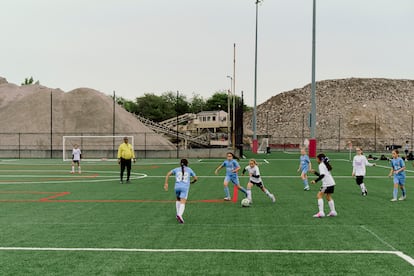
Cateau, from the island of Grenada, coaches the 12-year-olds and was due to train that night. Meanwhile, girls from Paisley, Kearny’s women’s team — named after the Scottish town and the paisley pattern that once supported the New Jersey town’s golden era as a textile production center — were on the adjacent pitch in front of a squad in shinier kits. “We like beating those newer clubs whose parents pay a fortune for their kids to play,” Mara said from the sideline.
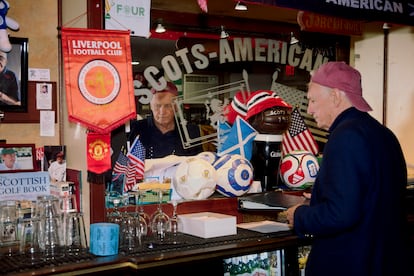
Adults played the third half in the Scots-American Club bar, a true temple with an astonishing collection of scarves, pennants, shirts, trophies, and other soccer memorabilia and a horseshoe pitch in the backyard. It’s a society that only started admitting women “about 10 minutes ago,” quipped Eddy Duffy, its manager, a genuinely funny septuagenarian Scot who wears his cap backwards like a rapper.
He arrived in Kearny 49 years ago with his wife, Alice, who was there that night too. With a thick accent she still retains, she said she has volunteered behind the bar for 25 years. She also said she supports Celtic and that Eddy supports Rangers, the two rival Glasgow clubs. “When we showed the derbies on TV, each fanbase took one corner of the bar,” she recalled. “As the beer bottles piled up in the middle, the space between them narrowed. In the end they’d be hugging.”
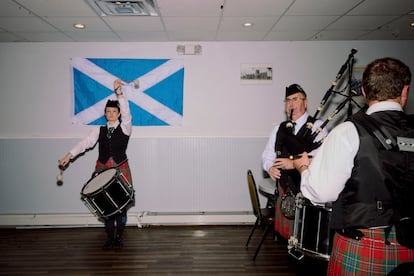
After a while part of the St. Columcille pipe band arrived; it has more than 100 members and rehearses upstairs. Dressed in kilts and matching ties, they had come straight from performing in a Memorial Day parade. Snare drummer Katie McGonigal, great-granddaughter of the founder and daughter of its current director, said that even if she had the money — “a lot of money” — she wouldn’t trade watching World Cup matches at the club for going to one of the 16 stadiums where a record 48 teams will play across three countries. Like the rest of the Scots’ regulars, she was almost more excited about a Scotland friendly against Bolivia at the Red Bulls stadium, for which the club will charter several buses.
Mid-conversation, a guy interrupted and said: “Has Katie already told you she was a very good player?”
“Everyone in this town seems to have been.”
“No, no, but she could have gone a long way.”
In the United States, “a long way” in women’s soccer is really a very long way. While the men’s team struggled through one World Cup cycle after another, the women have won four since 1991, though that didn’t stop their stars from protesting pay inequity. In 2022 they secured a $24 million settlement from the federation.
Aside from big names who come here to retire — like Messi or Luis Suárez — salaries for men are not yet comparable to Europe’s, although money has been flowing lately with genuine American enthusiasm through various competitions as clubs invest in top facilities and stadiums. For many domestic and South American players, the U.S. is a platform, a springboard for a move across the Atlantic.
The path is increasingly traveled the other way around too. Catalan Uri Rosell was a pioneer: he arrived here young, not at the end of his career, and it worked — he became the first Spaniard to win an MLS Cup title in 2013 with Sporting Kansas City. In 2024 he hung up his boots with the Los Angeles Galaxy and has opened a consultancy in the city to connect players with sponsors and brands in a promising market.
“MLS is no longer just a league of former greats. It’s increasingly investing in youth,” Rosell told this newspaper by phone. “Previously players arrived at 23 or 24 after college. Now there are 18- or 19-year-olds jumping up from MLS Next Pro.”
Created in 2022, MLS Next Pro is an unofficial second division for the main league. For the kids who trained on Kearny’s fields under the overcast sky the day EL PAÍS visited, it’s a route — no easy feat in a country of 350 million people — to professionalization. They can also end up in other leagues considered below MLS, though unrelated to it.
And that possibility is closer to becoming reality. The day before, Ramos had revealed at his school his plans with Meola, his former national teammate, to acquire a franchise to found a club in Kearny, absorb the city’s youth categories, build a stadium and make the team of his childhood “professional.”
The idea is to compete in the United Soccer League One (USL), which Ramos likens to “something like a fourth division.” If those plans go ahead, Thistle FC would face the New York Cosmos. Pelé’s old club has been resurrected this season (for the second time) by a man named Eric Stover, who has relocated it to Paterson, a New Jersey town with a brilliant industrial past and literary echo — it inspired poet William Carlos Williams to title his famous epic poem, a modernist masterpiece.
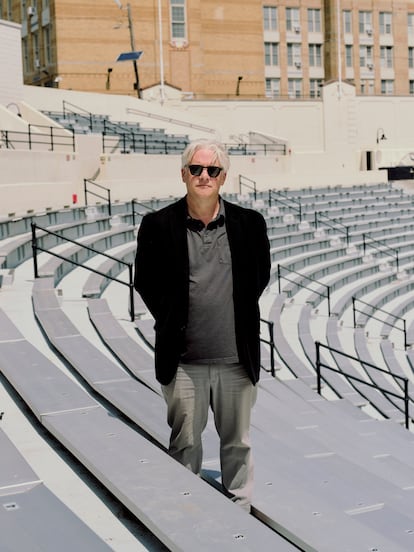
In better times Paterson was the Silk City, but for decades it has been ravaged by drugs and crime. “Part of the project is about revitalizing the community through soccer,” said Kilpatrick, the Cosmos historian, at Hinchliffe Stadium, an art-deco gem that, like so many fields in the country, is primarily a baseball ground — the true American pastime.
The city, Kilpatrick adds, was also where the first U.S. soccer club was founded in 1880, so there, as in Kearny, the past and present of soccer meet — terminology that, the historian clarifies near the end of this trip through its roots, is “despite appearances, the fault of the English.”
In case you were wondering, this is how it happened. When football and rugby were two sports called “association football” and “rugby football,” respectively, but not yet fully defined, Oxford students referred to one as soccer and the other as rugger. The first trace of its use on this side of the Atlantic dates to 1905 during a visit by the Pilgrims, who thrashed a local team. Over the years football won the semantic battle in England, but in the United States the opposite happened.
It’s now highly unlikely that will change. But who knows. Isn’t part of a World Cup’s magic that it creates a pause from daily problems in which you can dream the impossible?
Sign up for our weekly newsletter to get more English-language news coverage from EL PAÍS USA Edition

Why Vejer De La Frontera Has Become The Food Capital Of Spain’s Cadiz

Cars & Coffee Sotogrande At Trocadero.

FROM THE ARCHIVES: My Night Of Bedlam In Bilbao: Richarlison, Friendly Locals And A Slick Police Operation That Kept 80,000 English Fans From Harm
In The Final Stretch Of Colombia’s Presidential Campaign, Undecided Voters Are In High Demand

How To Get A Tourist Rental Licence In Andalusia (Spain) – Step-By-Step Guide 2025

Luis Rafael Sánchez: ‘Republicans Can’t Stand The Idea Of Puerto Rico Becoming A US State’


-
Abelardo de la Espriella2 weeks ago
In The Final Stretch Of Colombia’s Presidential Campaign, Undecided Voters Are In High Demand
-
 New Developments3 weeks ago
How To Get A Tourist Rental Licence In Andalusia (Spain) – Step-By-Step Guide 2025
-
 Bad Bunny2 weeks ago
Luis Rafael Sánchez: ‘Republicans Can’t Stand The Idea Of Puerto Rico Becoming A US State’
-
aemet3 weeks ago
Spain heatwave 2026: When the next extreme temperatures could hit and which areas may suffer most
-
Competiciones4 weeks ago
E
-
Costa Blanca North4 weeks ago
Benidorm unveils massive new SkyFest venue expecting 200,000 visitors this summer
-

 Uncategorized3 weeks ago
FBI investigation launched over Valtteri Bottas Cadillac theft
-
buffet4 weeks ago
Toyo Japanese, Asian favours in Fuengirola